
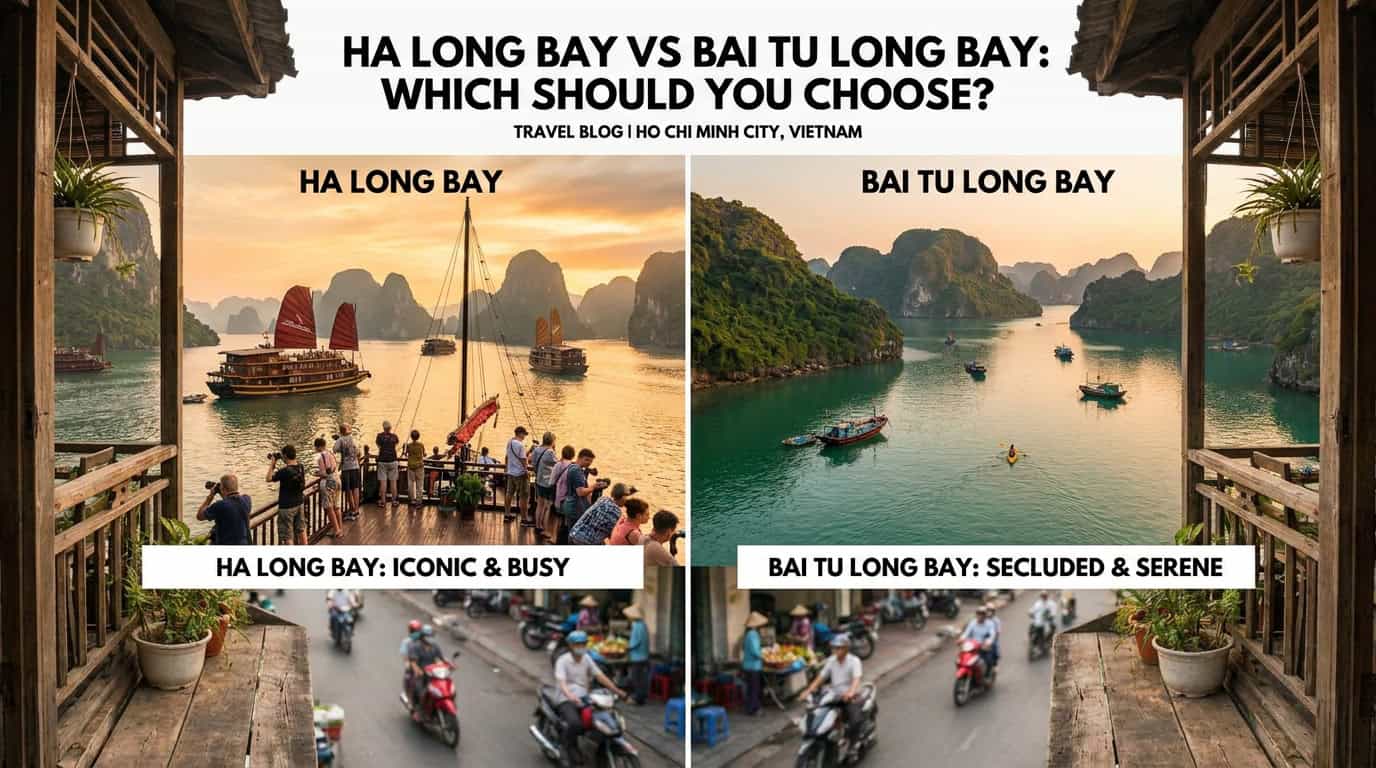
The choice between ha long bay vs bai tu long bay is one of the most common planning questions for travelers booking a northern Vietnam cruise — and the answer is genuinely different depending on your budget, schedule, and tolerance for crowds. Both bays rise from the same Gulf of Tonkin waters, share the same geology of ancient limestone karsts, and sit within the same Quảng Ninh province. But they deliver very different experiences on the water.
Ha Long Bay is world-famous, UNESCO-listed, and packed with 500+ cruise operators at every price point. Bai Tu Long Bay sits 50 km to the northeast, offers the same jaw-dropping scenery with a fraction of the foot traffic, and lets you anchor in near-total silence. This guide breaks down every key difference — location, cost, crowds, and access — so you can book the right cruise for your trip.

Key Takeaways
– Ha Long Bay draws over 9 million visitors per year; Bai Tu Long Bay sees a fraction of that traffic — making it significantly quieter.
– Ha Long Bay has held UNESCO World Heritage status since 1994. Bai Tu Long Bay is not UNESCO-listed but falls within a protected national park.
– Overnight cruises in Ha Long Bay start from roughly 1,500,000 VND (~$60) per person; Bai Tu Long Bay entry-level cruises start around 2,000,000 VND (~$80), with far fewer budget options.
– Ha Long Bay suits first-timers and budget travelers. Bai Tu Long Bay rewards travelers who want seclusion, cleaner reefs, and genuinely undeveloped beaches.
– Both bays share the same optimal travel window: October through April, avoiding typhoon months.
– You can pair either bay with a south-to-north itinerary starting from Ho Chi Minh City with a short flight into Hanoi.
Ha Long Bay vs Bai Tu Long Bay: Key Differences at a Glance
Before the detail, here’s the side-by-side picture most comparison guides don’t bother putting in one table.
| Feature | Ha Long Bay | Bai Tu Long Bay |
|---|---|---|
| Location | Quảng Ninh province, Gulf of Tonkin | Northeast of Ha Long Bay, Van Don district |
| Distance from Hanoi | ~165 km (3.5–4 hrs by road) | ~230 km (4.5–5.5 hrs by road) |
| UNESCO Status | World Heritage Site since 1994 | Not UNESCO-listed; national park since 2001 |
| Visitor Volume | 9+ million/year (2023 figures) | A small fraction — no separate official count |
| Licensed Cruise Operators | 400–500+ active boats | ~30–50 operators (capped) |
| 2D1N Cruise Price (budget) | From 1,500,000 VND (~$60)/person | From 2,000,000 VND (~$80)/person |
| 2D1N Cruise Price (mid-range) | 3,500,000–7,000,000 VND ($140–$280) | 5,000,000–9,000,000 VND ($200–$360) |
| 2D1N Cruise Price (luxury) | 10,000,000–25,000,000+ VND ($400–$1,000+) | Comparable or slightly higher |
| Crowd Level | High — especially Dec–Mar peak | Low to moderate year-round |
| Highlights | Sung Sot Cave, Ti Top Island, Titov Island | Quan Lan Island, Minh Chau Beach, Van Don |
| Best Time to Visit | Oct–Apr | Oct–Apr |
| Access Port | Tuan Chau / Bai Chay, Ha Long City | Cai Rong, Van Don district |
Ha Long Bay Overview — The World-Famous UNESCO Icon

Ha Long Bay is one of the most recognized natural landmarks in Southeast Asia, and its visitor numbers reflect that. According to the Vietnam National Administration of Tourism, the bay attracted over 9 million domestic and international visitors in 2023 as tourism recovered post-pandemic — and numbers have continued rising through 2025 and 2026.
The bay covers approximately 1,553 km² in Quảng Ninh province, scattered with 1,969 named islands and islets shaped over millions of years into the vertical limestone karsts that make Ha Long instantly recognizable. UNESCO first inscribed it as a World Heritage Site in 1994, recognizing its “outstanding aesthetic value,” and extended the protected boundary in 2000 to capture more of the geological heritage.
What you’ll actually see: The most-visited spots include Sung Sot Cave (Surprise Cave) — one of the largest grottoes in the bay, with a cathedral-like interior — and Ti Top Island, where a short steep climb rewards you with a sweeping panoramic view across the karst field. Kayaking through sea caves and hidden lagoons is a staple on almost every itinerary, budget or luxury.
The trade-off is crowds. On peak-season mornings near Bai Chay harbor, you’ll watch dozens of cruise ships depart within the same hour. Popular anchorage zones mean neighboring boats are visible — and audible — most evenings. Ha Long Bay still delivers if you choose the right boat and route. But the “deserted bay” experience you see in travel photographs requires deliberate operator selection.
Insider note: The “core zone” where roughly 80% of tour boats cluster covers only about 350 km² of the total 1,553 km² bay. Booking a cruise that routes toward the outer zones near Cát Bà Island or the eastern corridors dramatically cuts the crowd density — even on a standard Ha Long Bay ticket. Ask your operator specifically which anchorages they use.
For anyone comparing ha long bay vs bai tu long bay on a tighter budget, Ha Long Bay’s sheer volume of operators — from basic wooden junks to five-star floating hotels — means there’s genuine competition on price. Our Ha Long Bay cruise tips cover how to filter operators, read the red flags, and what to pack for an overnight cruise.

Bai Tu Long Bay Overview — The Quieter, Wilder Alternative
Bai Tu Long Bay stretches across roughly 2,200 km² (including national park terrestrial zones) immediately northeast of Ha Long Bay, sharing the same foundational geology of limestone karsts and emerald-green water. The critical difference: almost nobody goes there.
The bay falls within Bai Tu Long National Park, established in 2001 to protect both the marine ecosystem and the dense rainforest covering the inland islands. Because the national park authority caps the number of licensed operators, the anchorages are quiet, the coral reefs are in noticeably better condition, and the fishing villages on islands like Quan Lan and Minh Chau still feel genuinely lived-in rather than staged.
What makes it worth the extra cost and distance: Overnight cruises on Bai Tu Long Bay typically mean waking up to a sunrise with no other boats in sight — a common experience that becomes rare quickly if you stay on Ha Long Bay. Minh Chau Beach on Quan Lan Island is one of the finest undeveloped stretches of sand in northern Vietnam: white, clean, no vendors, no jet skis. The kayaking routes here pass through mangrove channels and sea caves that see perhaps a dozen visitors per week.
The downside is access and price. Reaching Bai Tu Long Bay means traveling to Cai Rong port in Van Don district, which adds roughly an hour to the journey from Hanoi. Cruise prices start higher, because operators run smaller boats with lower economies of scale and the limited access keeps supply tight.
What repeat visitors consistently say: Travelers who’ve done both bays report the same pattern — Ha Long Bay is more convenient and better value for money; Bai Tu Long Bay is more memorable. If you only have one chance to cruise in northern Vietnam and the budget allows it, Bai Tu Long’s silence and untouched scenery tend to be the version travelers are still talking about years later.
Ha Long Bay vs Bai Tu Long Bay: Crowds, Costs & Cruises Compared
The most practical way to frame the ha long bay vs bai tu long bay comparison is through three lenses: crowds, cost, and cruise quality.
Crowds
Ha Long Bay’s popularity means the central zone can feel more like a floating city than a natural wonder during peak months. The Quảng Ninh Tourism Authority has historically counted 400–500 active cruise boats in the bay at any one time during the December–March peak. Bai Tu Long Bay operates under national park permit limits; the number of boats allowed is strictly capped, keeping the experience calm regardless of season.
Cost in 2026
Here’s a realistic price breakdown per person for a 2-day/1-night cruise:
Budget travelers will find Ha Long Bay has far more options under 2,500,000 VND ($100) per person. Bai Tu Long Bay’s floor is higher — fewer operators means less price competition — but mid-range quality is often better for equivalent spend.
Cruise quality
Ha Long Bay’s 400–500 operators range from old wooden junks with questionable maintenance records to award-winning boutique vessels. Research matters here. Bai Tu Long Bay’s limited operator pool is a self-selecting filter: the boats that run here tend to be mid-tier or above, because travelers who seek it out are typically willing to pay more. For guidance on choosing a reliable operator for either bay, our Vietnam travel guide covers the major booking platforms and what red flags look like.
Combination itineraries exist: A small number of licensed operators run routes that begin in Ha Long Bay’s outer zone on day one and transit into Bai Tu Long Bay waters on day two. These combination routes are uncommon — ask specifically, because operators rarely advertise them — but they’re worth the premium if you find one.
Which Bay Is Right for You?
So which bay should you actually book? The ha long bay vs bai tu long bay decision comes down to a handful of factors you can score for yourself.
Choose Ha Long Bay if you:
– Are visiting Vietnam for the first time and want the iconic UNESCO experience
– Are traveling on a tighter budget — there are genuine quality options under 2,500,000 VND (~$100) per person
– Want maximum flexibility on departure dates, boat styles, and group sizes
– Are traveling with young children and feel safer knowing more support infrastructure is nearby
– Have only one night available — a single night in Bai Tu Long Bay barely justifies the longer journey
Choose Bai Tu Long Bay if you:
– Have already done Ha Long Bay (or have read enough about the crowds to want to skip it)
– Can allocate at least 5,000,000 VND (~$200) per person and two nights minimum
– Want to snorkel in cleaner water, walk on an undeveloped beach, or photograph the karsts without other boats in frame
– Are a repeat Vietnam visitor looking for the version of northern Vietnam that feels genuinely off the main tourist trail
– Value silence and wildlife over convenience
Doesn’t the prospect of waking up at anchor with nothing but karsts and birdsong in every direction sound like exactly what you came to Vietnam for? That’s Bai Tu Long Bay on most mornings.
Best Time to Visit Ha Long Bay and Bai Tu Long Bay
Both bays share the same Gulf of Tonkin climate pattern — the optimal window is identical for both. The Vietnam National Administration of Tourism identifies October through April as the best period for northern bay cruises.
Month-by-month breakdown:
- October–November: Warm days (25–28°C), calm seas, lighter crowds before the international holiday peak. Many experienced travelers call this the best overall window.
- December–February: Cool and occasionally misty (12–18°C). The atmospheric fog that rolls across the karsts in early morning is actually stunning for photography. Peak international visitor season — book Ha Long Bay cruises 4–6 weeks ahead.
- March–April: Warming again (20–25°C), seas still calm, drizzle possible but brief. Crowd levels start to ease after Tết. Widely considered the single best month combination for the ha long bay vs bai tu long bay corridor.
- May–June: Hot, humid, occasional afternoon showers. Still cruisable but seas become choppier from June onward.
- July–August: Typhoon season. Both bays issue temporary closures when storms approach. Not recommended without fully flexible travel insurance and zero schedule pressure.
- September: Tail end of typhoon risk. Weather improving week by week, very few tourists. A good value month if you have flexibility.
For Bai Tu Long Bay specifically, the shoulder periods of March–April and October–November offer the best combination of good weather and minimal boat traffic. On many mornings during these windows, you’ll share the entire bay with fewer than ten other vessels.
How to Get There from Hanoi (and from Ho Chi Minh City)
Hanoi to Ha Long Bay
Ha Long Bay is approximately 165 km from Hanoi’s Old Quarter — roughly 3.5–4 hours by road via the Hanoi–Haiphong–Quảng Ninh expressway network. Most cruise operators include hotel pickup from Hanoi’s Old Quarter or Hoan Kiem area in the package price, which makes this the easiest of the two bay journeys to manage.
A faster and more memorable option is the Hai Au Aviation seaplane service, which covers the Hanoi–Ha Long Bay route in about 45 minutes and provides aerial views of the karst field before you’ve even boarded your cruise. Seaplane fares start from roughly 3,500,000 VND (~$140) one-way. Read our full guide on getting from Hanoi to Ha Long Bay for complete bus schedules, transfer options, and arrival tips.
Hanoi to Bai Tu Long Bay
The most common approach is Hanoi → Ha Long City (3.5 hrs) → Cai Rong port, Van Don district (1 additional hour). Some operators now run direct private transfers from Hanoi straight to Cai Rong via the Van Don Expressway, cutting total journey time to around 4.5 hours.
Van Don also has a small regional airport (Van Don International Airport, VDO) with domestic connections from Ho Chi Minh City on Bamboo Airways — a useful option if you want to fly directly into the Bai Tu Long Bay gateway without transiting Hanoi at all. Check current schedules, as route availability changes seasonally.
Is the extra hour worth it? If you’re flying in from elsewhere in Vietnam, absolutely: the marginal time difference between the two bays disappears when you factor in the overall trip length.
From Ho Chi Minh City
Starting your Vietnam trip from the south? Fly into Nội Bài International Airport (Hanoi) on one of the multiple daily departures from Tân Sơn Nhất Airport in Ho Chi Minh City. Flight time is about 2 hours, and Vietnam Airlines, Vietjet, and Bamboo Airways all offer competitive fares — look for 800,000–1,500,000 VND (~$32–$60) one-way booked in advance.
Once in Hanoi, connect to whichever bay you’ve chosen using the road options above. If you’re planning a full south-to-north itinerary, our guide to things to do in Ho Chi Minh City covers how to structure the first few days in Saigon before heading north.
Frequently Asked Questions
Where is Hạ Long Bay?
Ha Long Bay is located in Quảng Ninh province in northeastern Vietnam, on the western shore of the Gulf of Tonkin. It lies approximately 165 km east of Hanoi and 50 km east of Hải Phòng. The bay spans roughly 1,553 km² and falls under the administrative jurisdiction of Ha Long City, the provincial capital of Quảng Ninh province.
Why Is It Called Bai Tu Long? (Tại sao gọi là Bái Tử Long?)
“Bái Tử Long” (Bai Tu Long) comes from a Vietnamese legend about a dragon mother — the same dragon deity central to Ha Long Bay’s origin story — who spat out jewels and jade as she flew over the sea to defend Vietnam. The jewels formed the karst islands. “Bái Tử Long” translates loosely as “worshipping the dragon’s children,” referring to the smaller islands said to be the offspring of the dragon that created Ha Long Bay.
What Does Ha Long Bay Mean? (Ha long bay nghĩa là gì?)
“Hạ Long” (Ha Long) translates from Vietnamese as “descending dragon” — hạ means “to descend” and long means “dragon.” Vietnamese legend holds that a great dragon descended from the heavens into the sea, its thrashing tail carving out the valleys and gulfs that became the limestone archipelago. UNESCO recognized this landscape for its outstanding geological and aesthetic value when it inscribed the bay as a World Heritage Site in 1994.
Where Is Bai Tu Long Bay? (Vịnh Bái Tử Long ở đâu?)
Bai Tu Long Bay lies directly northeast of Ha Long Bay within Quảng Ninh province in northeastern Vietnam. The bay is accessible via Cai Rong port in Van Don district, approximately 230 km from Hanoi by road (4.5–5.5 hours). It forms the core of Bai Tu Long National Park, which was established in 2001 to protect the bay’s marine ecosystems and the forested karst islands.
Plan Your Vietnam Stay: Central District 1, Ho Chi Minh City
Whether you’re heading north for Ha Long Bay, Bai Tu Long Bay, or building a full Vietnam itinerary from south to north, you’ll want a well-placed base in Ho Chi Minh City for the first leg — or the last.
Saigon Homestay offers comfortable, affordable accommodation in the heart of District 1, walking distance from Bến Thành Market, the main backpacker strip, and all major bus connections to Tân Sơn Nhất Airport. It’s the kind of central location that lets you hit the ground running in Saigon, sort your onward bookings over a solid breakfast, and catch an early flight north to Hanoi without a scramble.
Staying centrally in District 1 means you’re perfectly positioned to explore all the things to do in Ho Chi Minh City before the northern leg of your trip — from the War Remnants Museum and Củ Chi Tunnels to the best bánh mì on Lê Thị Riêng Street.
→ Book your District 1 homestay at saigonhomestay.com and start your Vietnam adventure with a comfortable, well-located base right in the middle of Saigon.
Sources:
– UNESCO World Heritage Centre — Ha Long Bay (List #672), retrieved 2026-06-09
– Vietnam National Administration of Tourism — Ha Long Bay destination page, retrieved 2026-06-09
– Quảng Ninh Department of Tourism, annual visitor statistics 2023–2024
– Vietnam Meteorological Hydrology Administration, climate data for Gulf of Tonkin region
Prices here are in Vietnamese dong. Our Vietnam currency and money exchange guide covers live rates, ATM fees and where to change money.
Related Guides
- Cat Ba Island vs Ha Long Bay: Where Should You Stay?
- Ha Long Bay Luxury Cruise: Best High-End Options (2026)
- Ha Long Bay 2-Day 1-Night Cruise: What to Expect
- Ha Long Bay Safety: Is It Worth the Risk?
- Ha Long Bay Beaches: Best Spots for Swimming & Sunsets
- Ha Long Bay Kayaking: Best Routes & Tours (2026)