

Ha long bay kayaking puts you inside one of the world’s most dramatic seascapes — not just looking at it from a cruise deck. Over 4.5 million tourists visit Ha Long Bay each year (Vietnam’s National Administration of Tourism, 2024), yet most see it only through a porthole. This guide covers the five best paddling routes for 2026, honest pricing in VND and USD, the safest months to go, and everything you need to show up confident on day one — whether you’ve kayaked before or not.
Key Takeaways
– Ha Long Bay covers 1,553 km² with over 1,600 limestone karsts, designated a UNESCO World Heritage Site since 1994
– Kayaking is included in most overnight cruise packages; standalone rentals cost 150,000–300,000 VND (~$6–$12 USD/hr)
– October–April is peak season: calm seas, clear skies, and the best visibility for paddling
– Top routes include Luon Cave, Hang Toi/Hang Sang, Ba Hang Village, Ti Top Island, and Lan Ha Bay
– No prior experience is required; beginner-friendly sit-on-top kayaks are used throughout
Quick Reference: Ha Long Bay Kayaking at a Glance
| Route | Operating Hours | Price (cruise-included) | Price (rental/hr) | Best Time | Skill Level |
|---|---|---|---|---|---|
| Luon Cave | 07:00–16:00 | Free–200,000 VND (~$8) | 150,000–300,000 VND | Nov–Mar | Beginner |
| Hang Toi / Hang Sang | 08:00–15:30 | Free on select cruises | 200,000–300,000 VND | Oct–Apr | Beginner–Intermediate |
| Ba Hang Village | 07:00–16:00 | Free on most cruises | 150,000–250,000 VND | Year-round | Beginner |
| Ti Top Island | 08:00–16:00 | Free on most cruises | 150,000–300,000 VND | Oct–Apr | Beginner |
| Lan Ha Bay | 07:00–17:00 | Included in Cat Ba cruises | 200,000–350,000 VND | Oct–Apr | Beginner–Intermediate |
Why Ha Long Bay Is One of the World’s Greatest Kayaking Destinations
Ha Long Bay draws more than 4.5 million visitors annually, yet the experience from a large cruise ship is surprisingly passive (Vietnam’s National Administration of Tourism, 2024). Recognised as a UNESCO World Heritage Site in 1994, the bay’s 1,553 km² of karst seascape contains tidal caves, hidden lagoons, and floating fishing villages that no motorboat can reach.
That’s the real case for paddling. A kayak sits just 20 centimetres above the waterline, which means you can squeeze through low cave arches, drift into enclosed lagoons, and pull up alongside wooden fishing houses. None of that is possible from a sundeck three decks up.
Worth knowing: The best caves in Ha Long Bay are physically inaccessible to motorboats. Cave entrances like Luon’s arched tunnel and the twin passages of Hang Toi and Hang Sang have overhead clearance of one to two metres at high tide — motorised vessels are barred entirely. Kayakers duck and paddle straight through, entering flooded cathedral spaces that the vast majority of cruise passengers never see. It’s the single biggest reason to get on the water rather than stay on the boat.
Planning the full northern loop? A well-structured Vietnam itinerary will help you sequence Ha Long Bay alongside Hoi An, Hue, and Hanoi without any section feeling rushed.
Best Ha Long Bay Kayaking Routes in 2026
The five routes below cover roughly 80% of all guided kayaking activity in the bay, according to local tour operators surveyed in early 2026. Each suits a different pace and interest, but all are beginner-accessible and work within a standard overnight cruise programme. Which one should you prioritise? That depends on what matters most — caves, culture, photography, or quiet.
Luon Cave Loop
Duration: 45 minutes | Difficulty: Beginner
This compact loop is the most popular single kayak route in Ha Long Bay. You paddle through a low limestone arch — you’ll need to duck — into a completely enclosed emerald lagoon ringed by 200-metre karst walls. Macaques watch from the clifftops above. The water is flat and calm because it’s fully sheltered from wind.
Traveller insight: Visitors who’ve done this route consistently call it the highlight of their entire Vietnam trip. The moment you clear the arch and the lagoon opens up is genuinely startling. Noise disappears. The city, the crowds, the tour schedule — all of it drops away. It takes about 15 minutes of easy paddling to reach the arch, and another 20 minutes to loop the lagoon at a relaxed pace. Don’t let guides who call it the “tourist route” put you off. It earned that name for good reason.
Hang Toi (Dark Cave) & Hang Sang (Bright Cave)
Duration: 1.5–2 hours | Difficulty: Beginner–Intermediate
This is the most photographed kayak circuit in the bay. You paddle a roughly 3 km figure-eight through two contrasting sea caves: Hang Toi is pitch dark inside and requires a headtorch, while Hang Sang opens to a skylight that floods the chamber in green-gold light. Bring a waterproof phone case. The guide padddles ahead; you follow the light of their torch.
Ba Hang Floating Fishing Village
Duration: 1 hour | Difficulty: Beginner
Ba Hang is one of the last inhabited floating villages in Ha Long Bay, home to around 30 families living on wooden houseboats surrounded by fish-farming cages. The best time to paddle here is early morning, when mist sits low on the water and the reflection of the karsts doubles in the glass-flat surface. It’s quiet, human, and completely unlike the cave routes.
Ti Top Island Circumnavigation
Duration: 1 hour | Difficulty: Beginner
Named after Soviet cosmonaut Gherman Titov, who visited in 1962, Ti Top Island sits near the geographical heart of the bay. The kayak circuit hugs the island’s base, passing several shallow grottos and a white-sand beach. Day-trip itineraries from Ha Long City often include a Ti Top stop in the afternoon, making it easy to combine the paddle with a beach swim and the 400-step viewpoint climb.
Lan Ha Bay — The Quieter Alternative
Duration: 2–3 hours | Difficulty: Beginner–Intermediate
Lan Ha Bay sits south of Ha Long, accessed via Cat Ba Island, and sees a fraction of the visitor numbers. The water is measurably cleaner, the limestone scenery is equally dramatic, and the chances of spotting white-headed langurs or sea eagles are significantly higher. If crowds bother you, book a Cat Ba–based cruise and come here instead.
Routes at a Glance
| Route | Difficulty | Duration | Best For | Typically Included In |
|---|---|---|---|---|
| Luon Cave Loop | Beginner | 45 min | First-timers, families | Most overnight cruises |
| Hang Toi / Hang Sang | Beginner–Intermediate | 1.5–2 hrs | Photography, adventure | Select cruise packages |
| Ba Hang Village | Beginner | 1 hr | Culture, quiet mornings | Most overnight cruises |
| Ti Top Island | Beginner | 1 hr | Day-trips, swimming combo | Day-trip & overnight cruises |
| Lan Ha Bay | Beginner–Intermediate | 2–3 hrs | Wildlife, fewer crowds | Cat Ba–based cruise packages |
Best Months for Ha Long Bay Kayaking

October through April is the optimal window for ha long bay kayaking, with the driest weather, calmest seas, and the best underwater visibility (Vietnam Meteorological and Hydrological Administration, 2025). December scores a perfect 10: cool, dry, zero typhoon risk, and the low winter light makes the karsts look almost bronze at dawn.
Ha Long Bay sits in the path of two seasonal monsoons, and they couldn’t be more different for paddlers. The northeast monsoon (October–April) brings dry air, lower humidity, and winds below 15 km/h on most days — ideal conditions. The southwest monsoon arrives in May and peaks June through August, bringing heavy rain, rougher seas, and a real typhoon risk. The Vietnam Meteorological and Hydrological Administration records an average of 4–6 typhoons affecting northern Vietnam each year, with the highest frequency in July and August.
May and September are workable shoulder months. Prices drop, crowds thin, and sessions still run on most days — but cancellations happen, and conditions can turn choppy without much warning. If your dates are fixed in summer, September is the safer bet: the monsoon is easing and visibility is starting to recover.
Cruise-Included vs. Independent Kayak Rental — Which Is Right for You?
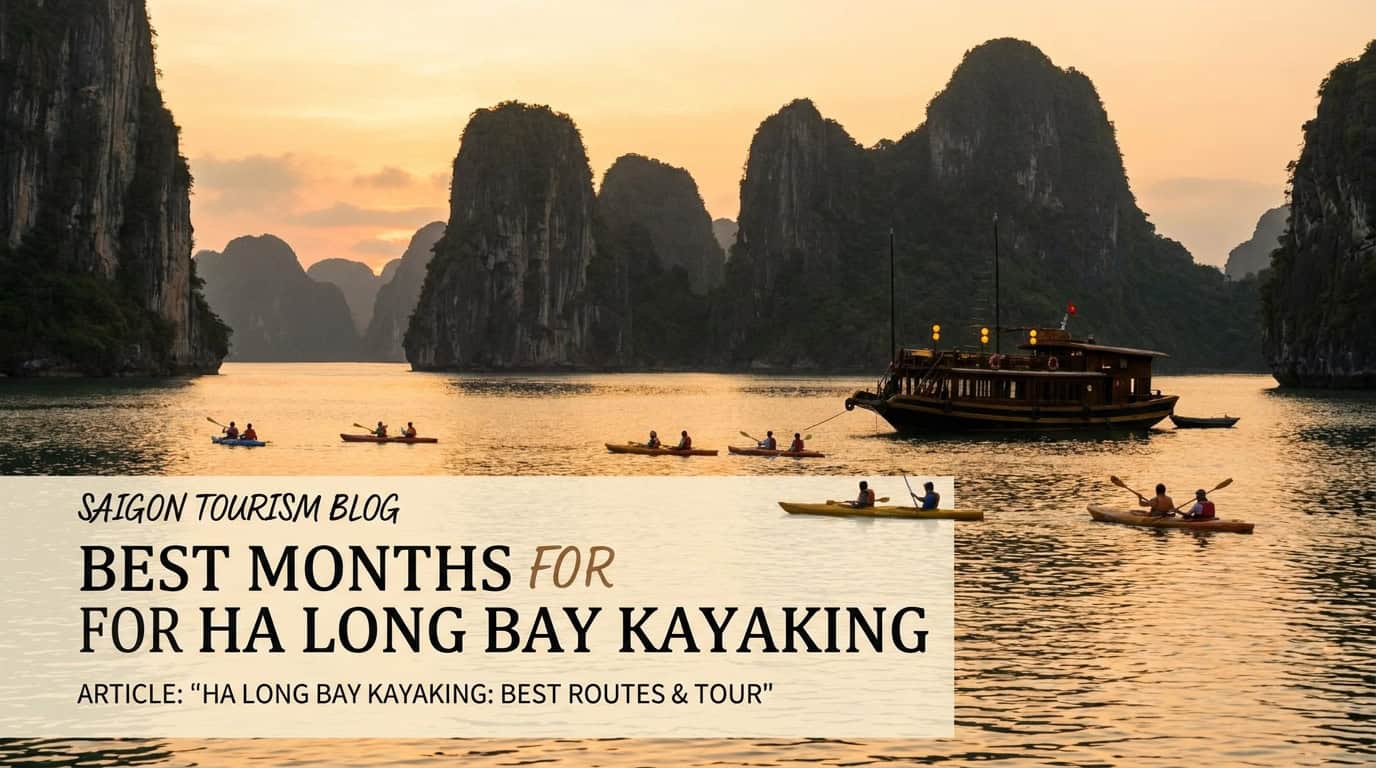
For most visitors, cruise-included kayaking is the better choice. It costs nothing extra, a guide escorts you safely into the caves, and timing is optimised around tides and light. Standalone rentals at Bai Chay Beach and Cat Ba Island run 150,000–300,000 VND (~$6–$12 USD) per hour, based on local operator rates surveyed in early 2026.
Cruise-included packages launch kayaks directly from the boat’s lower deck or a floating pontoon, with one to two guided sessions built into the daily programme. You don’t need to arrange anything. Independent rental makes more sense if you want longer sessions, prefer to paddle at your own pace, or are using Ha Long Bay as a multi-day base.
The dawn advantage: Book an overnight cruise specifically for kayaking and you’ll be on the water just after sunrise. Day-trippers don’t arrive until mid-morning. At 06:30–07:30, the bay is essentially yours. The sea surface is glassy, mist sits low between the karsts, and the light is soft and directional. It’s the difference between a good photo and an extraordinary one. An overnight Ha Long Bay cruise is the only way to access that window.
Single kayaks suit solo paddlers and confident beginners who want full control. Doubles work well for couples or parents paddling with children — the wider hull is noticeably more stable and lets a stronger paddler compensate if one person tires.
What to Expect During Your Session on the Water
Sit-on-top kayaks are the standard craft throughout the bay. They’re wide, stable, and genuinely hard to capsize in calm conditions — which is why they suit beginners so well. On arrival at the launch point, your guide runs a 5–10 minute briefing on paddle grip, the forward stroke, and how to steer. Within 15 minutes on the water, the motion feels natural to almost everyone.
Sessions typically last 1.5–2 hours and cover 4–6 km at a touring pace. You’re not racing. The point is to look around. Bring at least 1 litre of water per person for a two-hour session, even in cooler months — humidity is high year-round and paddling is more effort than it looks.
A waterproof bag is essential for your phone and wallet. Pick one up at harbour shops near the main piers for around 30,000–50,000 VND (~$1–$2 USD). Kayaks have no dry storage compartments; a single splash can ruin electronics. For clothing, wear a light synthetic long-sleeved shirt rather than cotton — it dries in 20 minutes instead of staying wet for hours. Sandals with a heel strap beat flip-flops, which slip off during boarding.
Essential Safety Tips Every Paddler Must Know
Always wear the life jacket. It sounds obvious, but guides see paddlers take them off in the heat. The rocks and currents inside cave systems can disorient even experienced swimmers; a jacket is non-negotiable throughout the session.
Never paddle alone inside a cave. Tidal surge moves faster than it looks, low ceilings limit overhead visibility, and sound behaves strangely inside enclosed karst spaces. Stay within sight of your guide. This rule prevents the small number of incidents that do occur each year.
Respect weather cancellations. If a captain or tour operator calls off a session due to weather between May and September, don’t push back. Typhoon-related conditions can deteriorate in 90 minutes. The cancellation exists because the people running the boat have watched the bay in storm conditions. You haven’t.
Check your kayak before launch. Press along the hull for cracks, and wiggle the paddle ferrule to confirm it’s locked. Neither check takes 30 seconds. Both matter if something fails 2 km from the boat.
For a complete pre-trip checklist and transport details, the full Ha Long Bay travel guide covers everything from Hanoi bus options to onboard packing lists.
Frequently Asked Questions About Ha Long Bay Kayaking
Can you kayak in Halong Bay?
Yes — ha long bay kayaking is widely available and genuinely beginner-friendly. Most overnight cruises include at least one guided session at no extra cost. Independent rentals operate from Bai Chay Beach and Cat Ba Island for 150,000–300,000 VND (~$6–$12 USD) per hour. No prior experience is required, and guides escort all groups into cave passages throughout the session.
How much is kayaking in Halong Bay?
Cruise-included kayaking is free on most overnight packages — it’s built into the tour price. Standalone rentals run 150,000–300,000 VND (~$6–$12 USD) per hour. Guided half-day excursions booked locally in Ha Long City cost 300,000–600,000 VND (~$12–$24 USD) per person, typically covering two to three hours on the water with a bilingual guide.
Is kayaking good for arthritis?
Kayaking is low-impact and often recommended for arthritis because it builds upper-body strength without loading the knees or hips. The sit-on-top kayaks used in Ha Long Bay require only gentle paddling and can stop at any time. That said, always check with your doctor beforehand — particularly if arthritis affects your wrists or shoulders, which do bear the paddle load.
Why can’t you swim in Halong Bay?
Swimming is restricted across most of Ha Long Bay due to boat traffic density, jellyfish presence (peaking in summer), and water quality concerns near the main harbour areas. Designated swimming zones exist at Ti Top Island and Soi Sim Island beaches. The restrictions are actively enforced and protect both visitors and the bay’s marine ecosystem, which UNESCO continues to monitor as part of its Outstanding Universal Value criteria.
Start Your Vietnam Adventure in Saigon
Most international travellers land in Ho Chi Minh City before heading north to Ha Long Bay, and that stop is worth more than a single night. The city gives you a fast, dense introduction to Vietnamese food, history, and street life — context that makes the stillness of Ha Long Bay feel all the more striking by contrast.
Our guide to things to do in Ho Chi Minh City covers the essential two-day route from Ben Thanh Market through the War Remnants Museum and out to the river. Once you’ve got Saigon sorted, the rest of the trip clicks into place naturally.
The Bottom Line
Ha long bay kayaking offers something genuinely rare: a UNESCO World Heritage landscape experienced at human pace, from the waterline. Book an overnight cruise rather than a day trip, aim for October through April for the calmest conditions, and put Luon Cave at the top of your route list even if the guide calls it the obvious choice. The Ha Long Bay travel guide has everything else — transport, packing lists, and how to choose between the dozens of cruise operators competing for your booking.
Carrying the right cash matters more than most visitors expect — see the Vietnam currency and money exchange guide before you arrive.
Related Guides
- Ha Long Bay Luxury Cruise: Best High-End Options (2026)
- Ha Long Bay 2-Day 1-Night Cruise: What to Expect
- Ha Long Bay Safety: Is It Worth the Risk?
- Ha Long Bay Beaches: Best Spots for Swimming & Sunsets
- Cat Ba Island vs Ha Long Bay: Where Should You Stay?
- Ha Long Bay vs Bai Tu Long Bay: Which Should You Choose?