
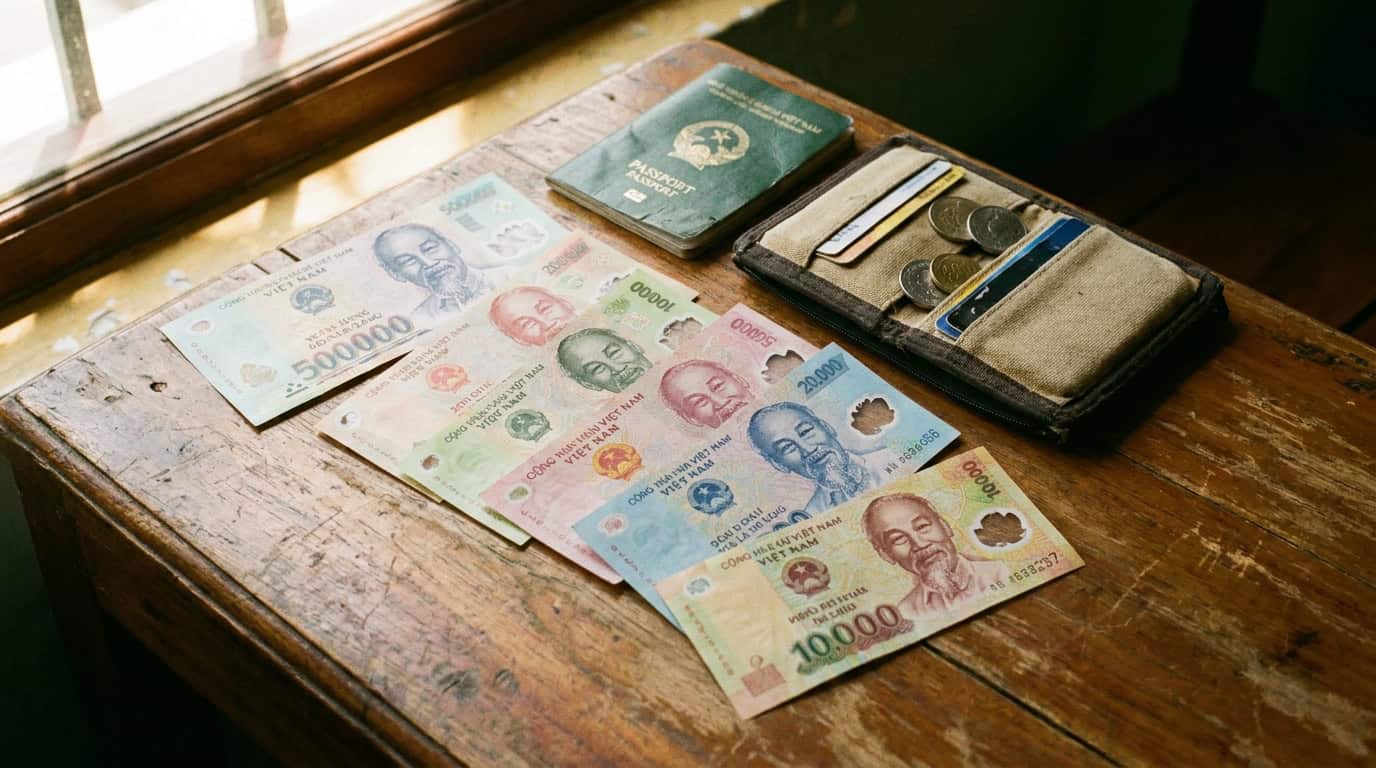
Vietnam currency exchange trips up more first-time visitors than almost anything else — not because it’s complicated, but because the rules changed significantly in early 2026, and a lot of older advice floating around is now wrong or even illegal to follow. This guide covers the Vietnamese dong, current exchange rates, every ATM option ranked by fee, the new 2026 regulations that affect where you can legally exchange money, and the most common scams to watch for. With 1 USD trading at roughly 26,300 to 26,400 VND in May 2026 (TradingEconomics, 2026), getting even a slightly better rate across a two-week trip saves real money.
Key Takeaways
– Rate context: 1 USD ≈ 26,300–26,400 VND in May 2026 (TradingEconomics, 2026).
– Best ATM: VPBank charges zero fees for foreign cards and allows up to 10,000,000 VND (~$390) per transaction.
– New 2026 rule: Licensed non-bank exchange offices can only BUY foreign currency from you — they cannot sell VND; unlicensed gold shops are illegal for exchange.
– Airport penalty: Airport exchange rates run 5–10% less favorable than city rates — exchange only enough for your first day or two.
Vietnam’s Currency: The Dong (VND) Explained
Vietnam’s official currency is the Vietnamese dong, abbreviated VND and symbolized as ₫. As of May 2026, the dong trades at approximately 26,300 to 26,400 per US dollar (TradingEconomics, 2026), making it one of the lowest per-unit values of any major travel currency. That means the numbers on price tags are always large, which is where most confusion starts.
The dong is a closed currency — you cannot buy it before you arrive, and you cannot reconvert large amounts after you leave except at international departure zones. There is no meaningful black market for VND. Every legitimate transaction happens through banks, licensed exchange counters, or ATMs. Anyone offering you a back-alley rate better than 27,000 per dollar is either scamming you outright or operating illegally under 2026 regulations.
Vietnam’s economy has grown at roughly 6–7% annually over the past decade (World Bank, 2025), and the dong has stayed relatively stable against major currencies. You won’t find dramatic swings week to week, but it’s worth checking the rate the day before your trip to calibrate your mental math.
In May 2026, 1 USD exchanged for approximately 26,300–26,400 Vietnamese dong at commercial banks and licensed exchange offices in Vietnam, according to rate data from TradingEconomics and Exchange-Rates.org. This represents a broadly stable period for the VND following modest appreciation in late 2025 (TradingEconomics, 2026).
Current USD to VND Exchange Rate (2026)
The benchmark rate to use is 1 USD = 26,300 VND. That’s the mid-market rate as of May 2026 (Exchange-Rates.org, 2026). Licensed exchange counters in the city typically offer 26,100 to 26,250, while banks run slightly lower. ATMs pull from your home bank’s interbank rate, then add their own markup, which is why the ATM rate varies by your card issuer.
A simple mental math shortcut: divide any VND price by 26 to get a rough USD figure. So 650,000 VND for a restaurant meal is about $25. A 2,000,000 VND hotel room is roughly $77. It’s faster than reaching for a calculator every time.
For live rates, check TradingEconomics or Google’s built-in currency converter before spending. The rates on those two sources update in near real-time and are consistently accurate.
The Vietnamese dong traded at 26,300–26,400 VND per USD in May 2026, according to commercial exchange rate data published by TradingEconomics and Exchange-Rates.org. Bank buying rates at major institutions such as Vietcombank and BIDV in the same period ran 26,050–26,200, reflecting the typical spread between interbank and retail rates (Exchange-Rates.org, 2026).
Vietnamese Dong Denominations — and How Not to Confuse Them
Vietnam issues dong in polymer banknotes ranging from 1,000 to 500,000 VND. The denominations currently in active circulation are: 1,000 (rare), 2,000, 5,000, 10,000, 20,000, 50,000, 100,000, 200,000, and 500,000 VND.
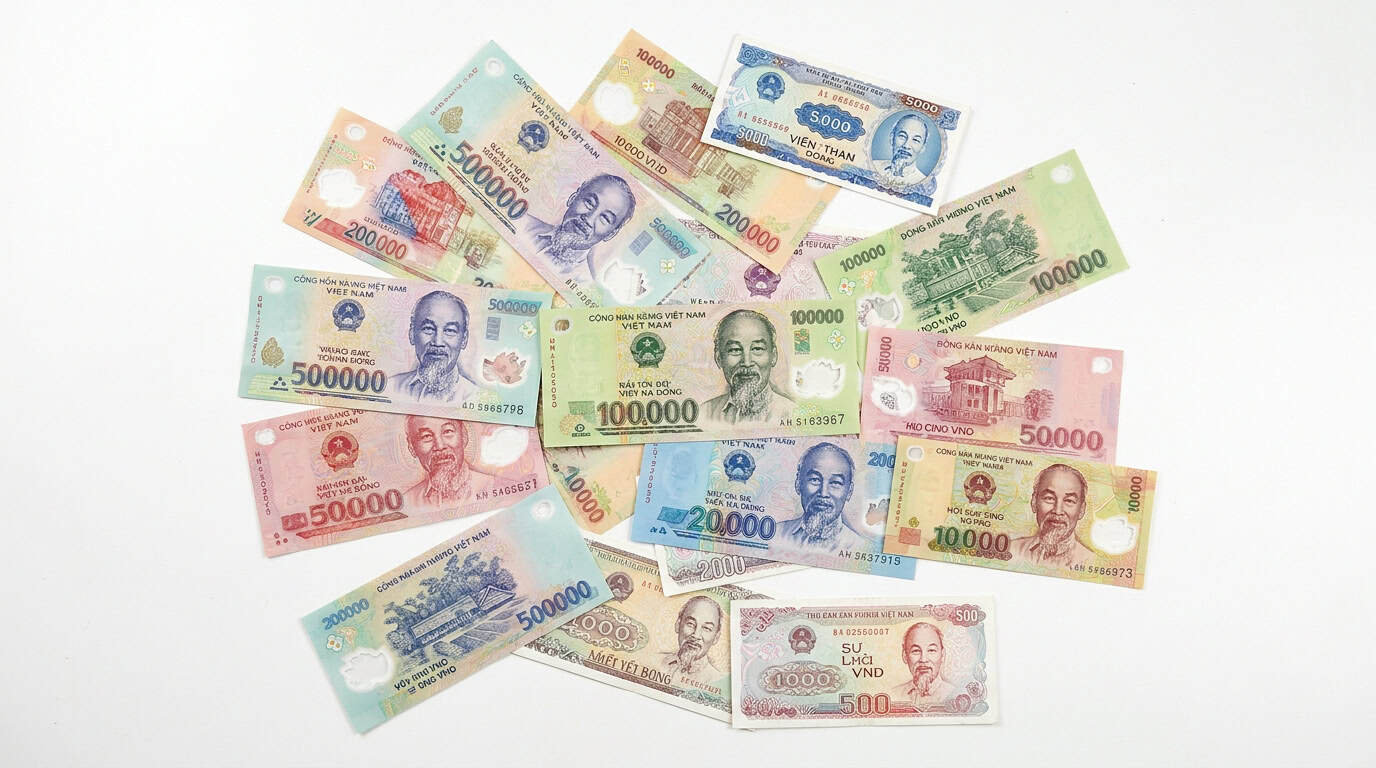
The single most dangerous confusable pair: the 500,000 VND note (blue-green) and the 20,000 VND note (also blue-green). Both are blue. The size difference is the tell. The 500,000 is noticeably larger than the 20,000. This is not an obscure edge case. It’s the most common honest mistake and the most common deliberate scam. Always count your change by denomination, not by color.
Here’s how to think about the common notes in practical terms:
- 500,000 VND (~$19): Largest note; use for hotels, larger purchases.
- 200,000 VND (~$7.50): Green; common from ATMs.
- 100,000 VND (~$3.80): Red-brown; workhorse note.
- 50,000 VND (~$1.90): Pink-purple; street food and motorbike taxis.
- 20,000 VND (~$0.75): Blue; small purchases, tipping.
- 10,000 VND (~$0.38): Red; coffee, basic tips.
ATMs typically dispense 200,000 and 500,000 VND notes. Break them early at a convenience store like Circle K or Vinmart, or when paying at restaurants, so you’re not handing a 500,000 note to a street vendor who genuinely can’t make change.
Where to Exchange Money in Vietnam: All Your Options Ranked
The best place for vietnam currency exchange is a licensed exchange counter in a major city, particularly near tourist districts in Ho Chi Minh City or Hanoi. Licensed counters consistently offer better rates than banks, and the 2026 regulatory overhaul eliminated most of the sketchy alternatives that used to compete with them. Here’s every option ranked by rate quality.
| Option | Rate Quality | Convenience | Recommended? |
|---|---|---|---|
| Licensed exchange counter (city) | Excellent | Moderate | Yes — best rates |
| Bank (Vietcombank, BIDV, ACB) | Good | High | Yes — reliable, slower |
| ATM (VPBank, ACB) | Good | Very High | Yes — best for card holders |
| Hotel front desk | Poor | Very High | Emergency only |
| Airport exchange counter | Poor | Very High | First day only, small amount |
| Unlicensed gold shops | Illegal | N/A | No — carries fines |
| Street changers / touts | Illegal / scam | N/A | Never |
Two notes on the table. First, “gold shops” used to be a popular tip in travel forums for getting slightly better rates. As of February 9, 2026, that is illegal under Decree 52/2024 — more detail in the regulations section below. Second, banks are safe and reliable but they process exchange transactions slowly. The queue and paperwork at a bank branch in District 1 can take 30 to 45 minutes.
Under Vietnam’s Decree 52/2024, which took effect February 9, 2026, licensed non-bank currency exchange organizations may only purchase foreign currencies from individuals and organizations — not sell Vietnamese dong. Gold shops and unauthorized dealers that exchange currency face fines of 10 to 100 million VND (~$400–$3,900) plus confiscation (Viet-Go, 2026).
Best Places to Exchange Money in Ho Chi Minh City (Saigon)
In Ho Chi Minh City, two exchange locations are consistently cited for the best USD-to-VND rates: Ha Tam Jewelry at 2 Nguyen An Ninh Street, District 1 (near Ben Thanh Market), and Kim Mai Gold Shop at 84C Cong Quynh Street, District 1. Both are licensed foreign currency buyers as of the new 2026 regulations, meaning they can legally purchase your USD and hand you VND (Laka.ai, 2025).
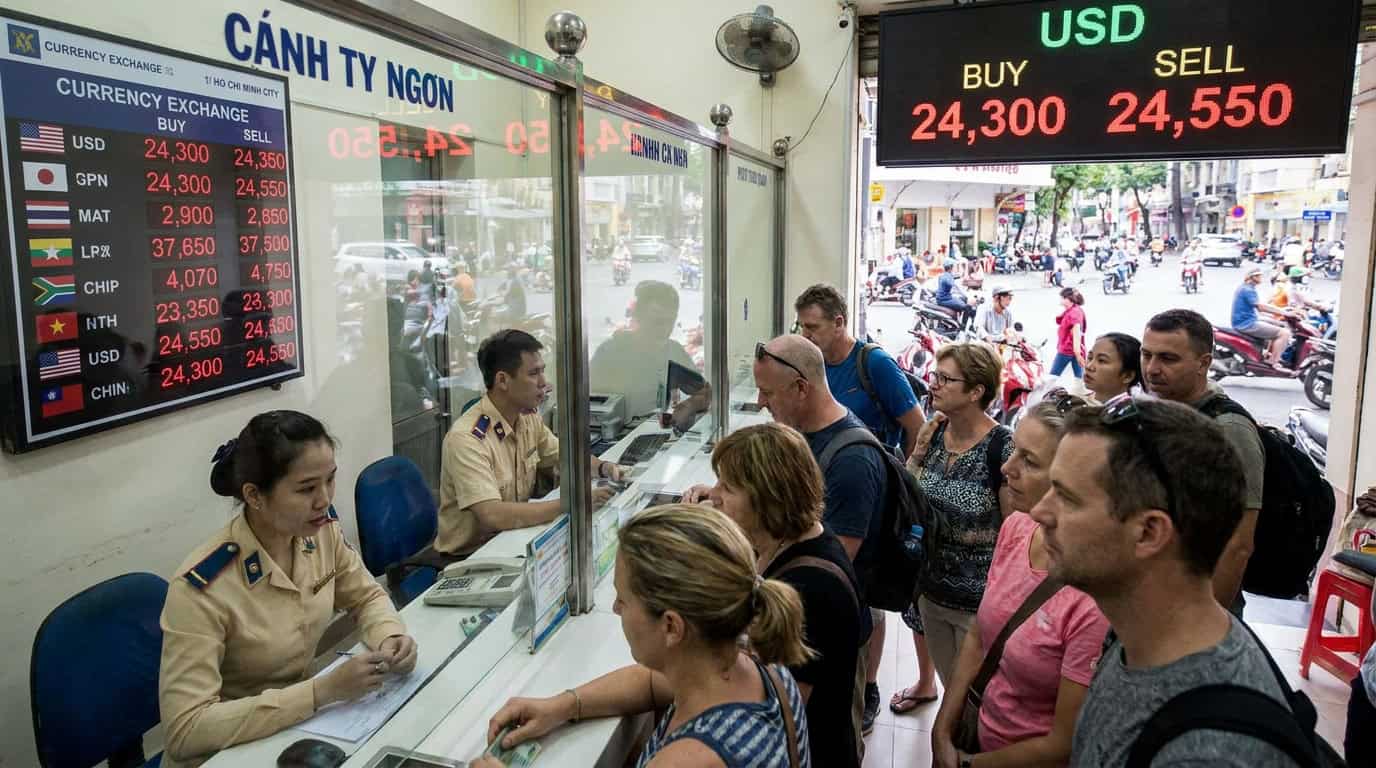
Ha Tam is the most frequently recommended among long-term expats. It operates out of a small shopfront but handles significant transaction volumes daily. Arrive early in the morning if you plan to exchange a larger amount — crowds build by late morning.
A few practical rules for getting the best rate at any licensed counter:
- Bring crisp, clean USD bills from recent print series. Notes with tears, heavy fold marks, or older series (pre-2013) may be rejected or accepted at a discounted rate.
- Don’t exchange everything in one go if you plan to be in Vietnam for more than a week. Exchange enough for 4–5 days, then exchange again mid-trip in case the rate moves slightly in your favor.
- Count the notes in front of the counter staff before you leave the window.
Rates at licensed counters in District 1 typically run 26,100 to 26,250 VND per USD, compared to 25,900 to 26,100 at bank branches. That 150–200 VND spread on $500 equals 75,000 to 100,000 VND — enough to cover two or three decent meals.
ATMs in Vietnam: Best Banks, Fees, and Withdrawal Limits
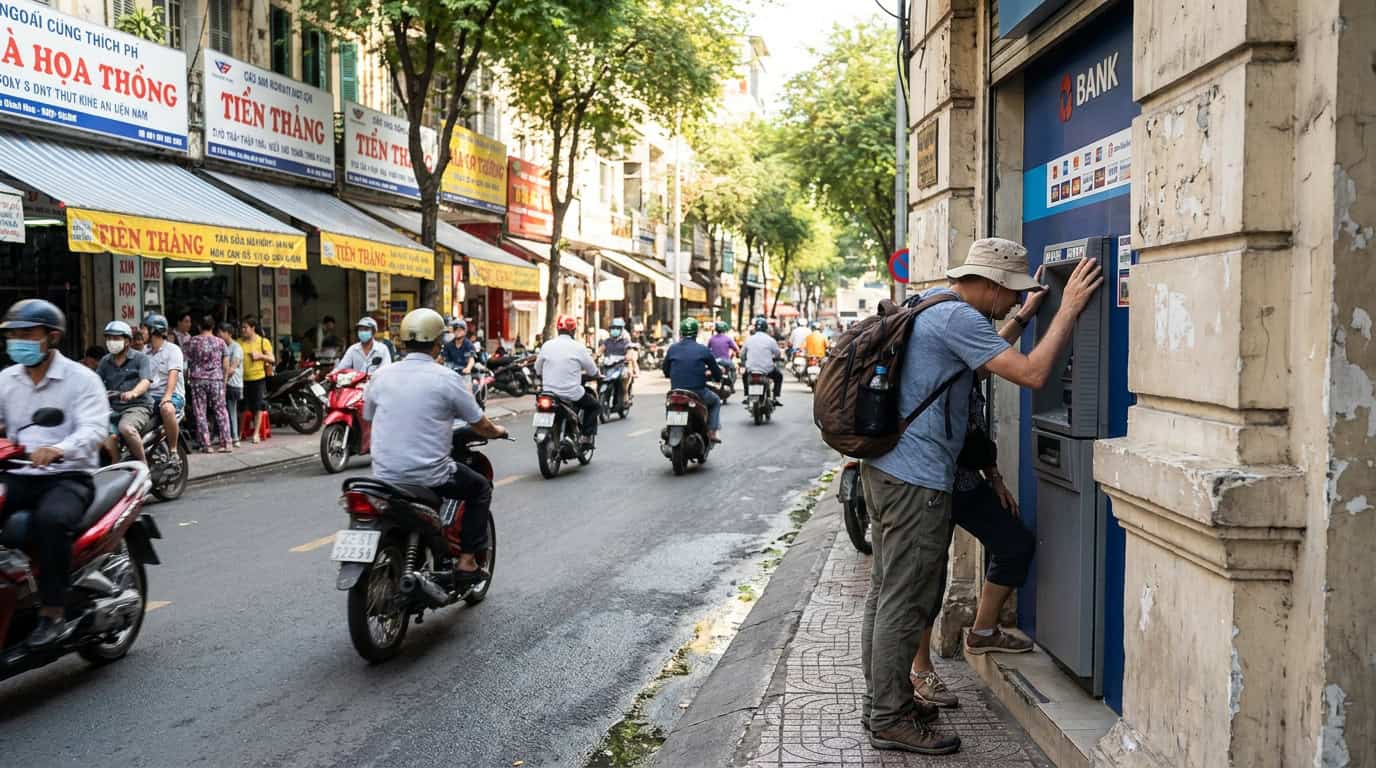
VPBank currently stands out as the best ATM option for foreign cardholders in Vietnam: it charges no fee for foreign card transactions and allows up to 10,000,000 VND (~$390 USD) per withdrawal (SmileJet, 2025). ACB is the second-best no-fee option, though its per-transaction limit is lower at around 3,000,000 VND (~$115). Both banks have wide ATM networks in Ho Chi Minh City and Hanoi.
| Bank | Fee for Foreign Cards | Max per Transaction | Notes |
|---|---|---|---|
| VPBank | None | 10,000,000 VND (~$390) | Best overall option |
| ACB | None | ~3,000,000 VND (~$115) | No fee but lower limit |
| Vietcombank | ~55,000 VND (~$2.10) | 5,000,000 VND (~$190) | Widespread network |
| BIDV | ~55,000 VND (~$2.10) | 5,000,000 VND (~$190) | Common in smaller cities |
| Agribank | ~55,000 VND (~$2.10) | 5,000,000 VND (~$190) | Rural coverage |
| Techcombank | 55,000–66,000 VND | 5,000,000 VND (~$190) | Avoid if VPBank nearby |
| TPBank | ~3.3% of amount | Varies | Changed from free June 2025 — avoid |
Your home bank also adds its own foreign transaction fee, typically 1.5–3% of the withdrawal amount. Add that to any ATM fee above and you can see why VPBank is the clear winner: even your home bank’s fee is unavoidable, so eliminating the Vietnam-side fee matters.
TPBank changed its fee structure in June 2025, shifting from zero fee to approximately 3.3% of the withdrawal amount (SmileJet, 2025). Any advice recommending TPBank as a free-withdrawal option is outdated. Avoid it.
How to Find VPBank and ACB ATMs
Google Maps is reliable for locating ATMs. Search “VPBank ATM” or “ACB ATM” with your current location. In District 1 of Ho Chi Minh City, both banks have multiple ATMs within the central tourist area. If a VPBank ATM is out of service or out of cash — which does happen on weekends and public holidays — ACB is your next-best option before falling back to Vietcombank.
VPBank ATMs in Vietnam impose no surcharge on foreign-issued debit or credit cards and permit withdrawals of up to 10,000,000 VND (~$390 USD) per transaction, making them the highest-value option for travelers who want to minimize fees. ACB ATMs are also fee-free for foreign cards but cap transactions at approximately 3,000,000 VND per withdrawal (SmileJet, 2025).
Using Credit and Debit Cards in Vietnam
Credit cards are accepted at hotels, mid-range and upscale restaurants, shopping malls, and larger tour operators. They are not accepted at street food stalls, wet markets, small local restaurants, most independent shops, or motorbike taxis. Cash is still the dominant payment method for daily life in Vietnam, and you’ll need it.
The standard credit card foreign transaction surcharge in Vietnam is 3%. American Express adds 4% and has limited acceptance even at card-friendly venues. Visa and Mastercard are the safest choices.
The DCC trap is worth understanding before you arrive. DCC stands for Dynamic Currency Conversion. When you pay by card at a restaurant or shop, the terminal sometimes prompts you to pay in your home currency (USD, AUD, EUR, etc.) rather than VND. Always choose VND. Choosing your home currency activates the merchant’s exchange rate, which runs 5–10% worse than your card issuer’s rate. There’s no benefit to paying in your home currency. The prompt is designed to generate revenue for the merchant’s payment processor, not to help you.
If you’re ever charged in your home currency without being asked, ask the staff to void the transaction and redo it in VND. Most will comply without argument.
Mobile Payments: MoMo, ZaloPay, and VietQR for Tourists
Vietnam’s QR payment ecosystem has expanded significantly for international visitors. As of April 2025, Circular 25/2025 eliminated transaction fees for QR payments under 500,000 VND, making small purchases cheaper for both merchants and customers (State Bank of Vietnam, 2025). This fee removal accelerated QR adoption at street-level vendors.
Visa cardholders can link international Visa cards to MoMo, VNPAY, and ZaloPay. The linking process takes about 5 minutes inside the app and works reliably for most international Visa cards issued in the US, EU, and Australia. Once linked, you can pay via QR code anywhere the app is accepted.
In practical terms, MoMo has the widest merchant network. ZaloPay has strong coverage in younger demographics and trendy coffee shops. VietQR is the interoperable standard that many banks and apps support, so you may encounter QR codes labeled “VietQR” that any of these apps can scan.
For a two-week tourist trip, mobile payments work as a supplement to cash, not a replacement. There are still plenty of vendors and local restaurants that don’t display a QR code. Carry cash for those.
Airport vs. City Exchange: How Much Worse Is the Airport Rate?
Airport exchange counters at Tan Son Nhat International Airport (SGN) typically offer rates 5–10% less favorable than licensed counters in the city (Viet-Go, 2026). On a $500 exchange, that gap equals $25–50 in lost value. It’s significant enough to matter.
The practical approach: exchange only what you need for your first one to two days at the airport. That’s roughly $60–100 for most travelers, enough to cover your Grab to the hotel, a meal, and incidentals. Exchange the rest in the city once you’ve located a VPBank ATM or a licensed counter in District 1.
Airport ATMs are available at Tan Son Nhat. The machines in the international arrivals hall include some bank brands, but availability varies. If you need cash immediately and there’s no VPBank ATM in sight, use whatever is available for a small withdrawal, then switch to VPBank once you’re in the city.
New 2026 Currency Exchange Laws: What Tourists Must Know
Vietnam’s Decree 52/2024 took effect on February 9, 2026, and it significantly changed the landscape for vietnam currency exchange. The core change: licensed non-bank exchange organizations (the counters you see in tourist areas) may now only purchase foreign currencies from individuals. They cannot sell VND to you. In practice, this means you hand over your USD and receive VND — which is the transaction tourists actually want, so the practical impact for most visitors is minimal (Viet-Go, 2026).
The bigger change: unlicensed gold shops are now explicitly prohibited from conducting currency exchange. For years, unlicensed gold shops in tourist areas competed on rates and were widely recommended by travel blogs. That recommendation is now outdated and following it puts you at legal risk. Fines for transacting at an unlicensed exchange point range from 10 to 100 million VND ($400–$3,900) and include confiscation of the exchanged funds.
Reconverting VND back to foreign currency before you leave is only possible in the international departure zone at major airports. You cannot do this in the city. Keep any leftover dong for a future trip or spend it before departure.
Vietnam’s Decree 52/2024, which entered force on February 9, 2026, restricts licensed non-bank exchange organizations to purchasing foreign currencies only — they may no longer sell Vietnamese dong. Gold shops are prohibited from conducting any currency exchange. Violations are punishable by fines of 10 to 100 million VND (~$400–$3,900) plus confiscation of exchanged funds (Viet-Go, 2026).
How Much Cash Should You Bring to Vietnam?
Vietnam is still primarily a cash economy for daily spending. Budget travelers spending on street food, local buses, and guesthouses typically need $30–60 per day. Mid-range travelers staying at 2–3 star hotels, eating at proper restaurants, and doing organized day tours spend $80–150 per day. Those figures are for Vietnam overall; Ho Chi Minh City runs slightly higher on accommodation than smaller cities.
For a 14-day trip:
- Budget traveler: $420–$840 total cash need.
- Mid-range traveler: $1,120–$2,100 total cash need.
You don’t need to arrive with all of that in your wallet. Bring $150–200 in USD to exchange at a city counter on day one, then withdraw from a VPBank ATM as needed throughout the trip. This approach gives you good rates on the initial exchange, zero-fee ATM withdrawals after that, and no risk of carrying large sums.
If you prefer carrying most of your budget in cash (rather than relying on ATMs), bring crisp USD bills in denominations of $50 and $100. Larger denomination bills get slightly better rates at licensed counters. Worn, marked, or pre-2013 series bills may be discounted or refused.
Declaring Cash at Vietnam Customs
Vietnam customs requires you to declare cash if you’re carrying more than $5,000 USD (or equivalent in other foreign currencies) or more than 15,000,000 VND when entering the country. There is no upper limit on how much you can bring — declaration is simply mandatory above those thresholds.
The declaration form is available at the customs desk on arrival. Fill it in accurately. Undeclared amounts above the threshold can be confiscated and result in fines. There’s no practical reason to smuggle cash into Vietnam; rates inside the country are better than anything you’ll find at home, and ATMs work reliably in all major cities.
On departure, you can take out whatever you brought in, provided you still have the customs declaration receipt if you declared on arrival. Leftover VND can only be reconverted to foreign currency at international departure zones at major airports.
Currency Exchange Scams — and How to Avoid Every One
The 500,000 vs. 20,000 confusion is the most common money problem tourists encounter. Both notes are blue-green. The 500,000 is physically larger. When receiving change, especially in busy night markets or from motorbike taxi drivers, count by denomination and by size. Don’t count by color alone.
The most common deliberate scam: a money changer counts out your VND correctly in front of you, then swaps the stack for a pre-counted short stack while appearing to organize or rubber-band it. The fix is simple. Count the notes yourself, in your own hands, before walking away. Don’t let anyone “helpfully” organize your money after you’ve counted it.
Worn USD bills deserve a separate mention. Exchangers at licensed counters may refuse or discount USD bills that are visibly worn, torn, written on, or from an older print series. This is not a scam. It’s a legitimate commercial practice. Bring clean, crisp bills from recent print runs to avoid this entirely.
Four scams to know:
- Short-stack swap: Counter staff counts notes correctly, then hands you a pre-sorted short stack. Always count in your own hands.
- Fake Grab at the airport: Someone inside the terminal shows you a phone claiming it’s your Grab booking. It isn’t. Book only from your own device.
- Unofficial exchanger: Someone approaches you on the street offering a better rate than any counter. The 2026 regulations make this illegal, and the rate is always a scam setup.
- DCC at card terminals: Terminal prompts you to pay in your home currency. Always choose VND. Choosing your home currency costs 5–10% extra with zero benefit to you.
Frequently Asked Questions
What is the best currency to bring to Vietnam?
US dollars are the best foreign currency to bring. Licensed exchange counters in Ho Chi Minh City and Hanoi offer strong USD-to-VND rates, and USD is accepted for exchange everywhere. Euros and British pounds are also widely exchanged at major counters, though the spread is slightly less favorable. Avoid exchanging Thai baht, Singapore dollars, or other regional currencies inside Vietnam, as very few counters handle them and rates are poor.
Can I use US dollars in Vietnam?
Technically, all retail transactions in Vietnam must be conducted in Vietnamese dong by law. In practice, some hotels, tour operators, and souvenir shops in heavily touristed areas quote prices in USD and accept payment in USD. However, change is given in VND at whatever rate the merchant sets — which is rarely favorable. It’s better to exchange your dollars and pay in VND everywhere for consistent, predictable pricing.
Are there ATMs in Vietnam that don’t charge fees?
Yes. VPBank and ACB both currently charge no fee for foreign-card withdrawals in Vietnam (SmileJet, 2025). VPBank allows the highest per-transaction limit at 10,000,000 VND (~$390). Your home bank may still charge its own foreign transaction fee (typically 1.5–3%), but eliminating the Vietnam-side fee at VPBank or ACB is the best achievable outcome. TPBank changed from fee-free to ~3.3% per transaction in June 2025 and should be avoided.
Is it safe to exchange money at gold shops in Vietnam?
No. As of February 9, 2026, gold shops are prohibited from conducting currency exchange under Decree 52/2024 (Viet-Go, 2026). Transacting at a gold shop for currency exchange exposes you to fines of 10 to 100 million VND and potential confiscation of your exchanged funds. Use only licensed exchange counters in tourist districts or bank ATMs. The gold-shop rate tip from older travel forums is now outdated and legally risky.
How much cash should I bring to Vietnam for 2 weeks?
For a two-week trip, budget travelers typically need $420–$840 total, while mid-range travelers spend $1,120–$2,100. You don’t need to arrive with the full amount in cash. Bring $150–200 USD in clean bills to exchange at a licensed city counter on day one, then withdraw from a VPBank ATM as needed. This minimizes the cash you’re carrying at any one time and takes advantage of zero-fee ATM withdrawals for the rest of the trip.
Sources
- SmileJet. (2025). ATMs in Vietnam: Which banks are best for foreign cards? https://smilejet.app/blog/atms-in-vietnam
- Viet-Go. (2026). Vietnam currency exchange: New regulations 2026. https://viet-go.com/en/articles/vietnam-currency-exchange-new-regulations-2026
- Laka.ai. (2025). Currency exchange in Ho Chi Minh City: How to get the best rates. https://blog.laka.ai/en/2025/04/24/currency-exchange-in-ho-chi-minh-city-to-get-the-best-rates/
- TradingEconomics. (2026). Vietnam currency. https://tradingeconomics.com/vietnam/currency
- Exchange-Rates.org. (2026). USD to VND exchange rate. https://www.exchange-rates.org
- World Bank. (2025). Vietnam — GDP growth. https://data.worldbank.org/country/VN
- State Bank of Vietnam. (2025). Circular 25/2025: QR payment regulations. https://www.sbv.gov.vn
Related Guides
- Getting Around Saigon: Grab, Metro, Bus & Waterbus Guide (2026)
- Vietnam Visa on Arrival vs E-Visa: Which Is Better?
- Rent Motorbike Vietnam: Everything You Need to Know (2026)
- Vietnam Public Holidays 2026: Complete Calendar
- Vietnam SIM Card Guide: Which to Buy & Where (2026)
- Tipping in Vietnam: How Much & When (2026 Guide)