
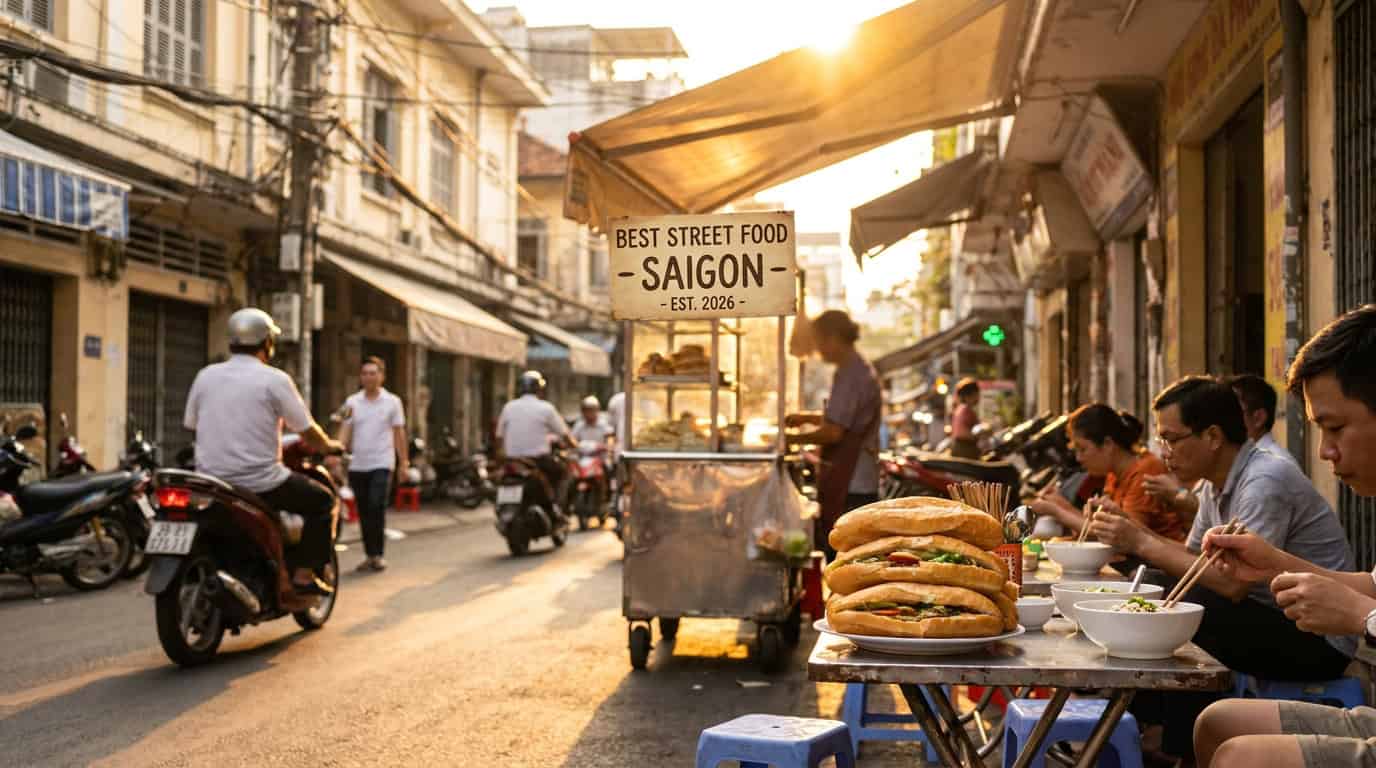
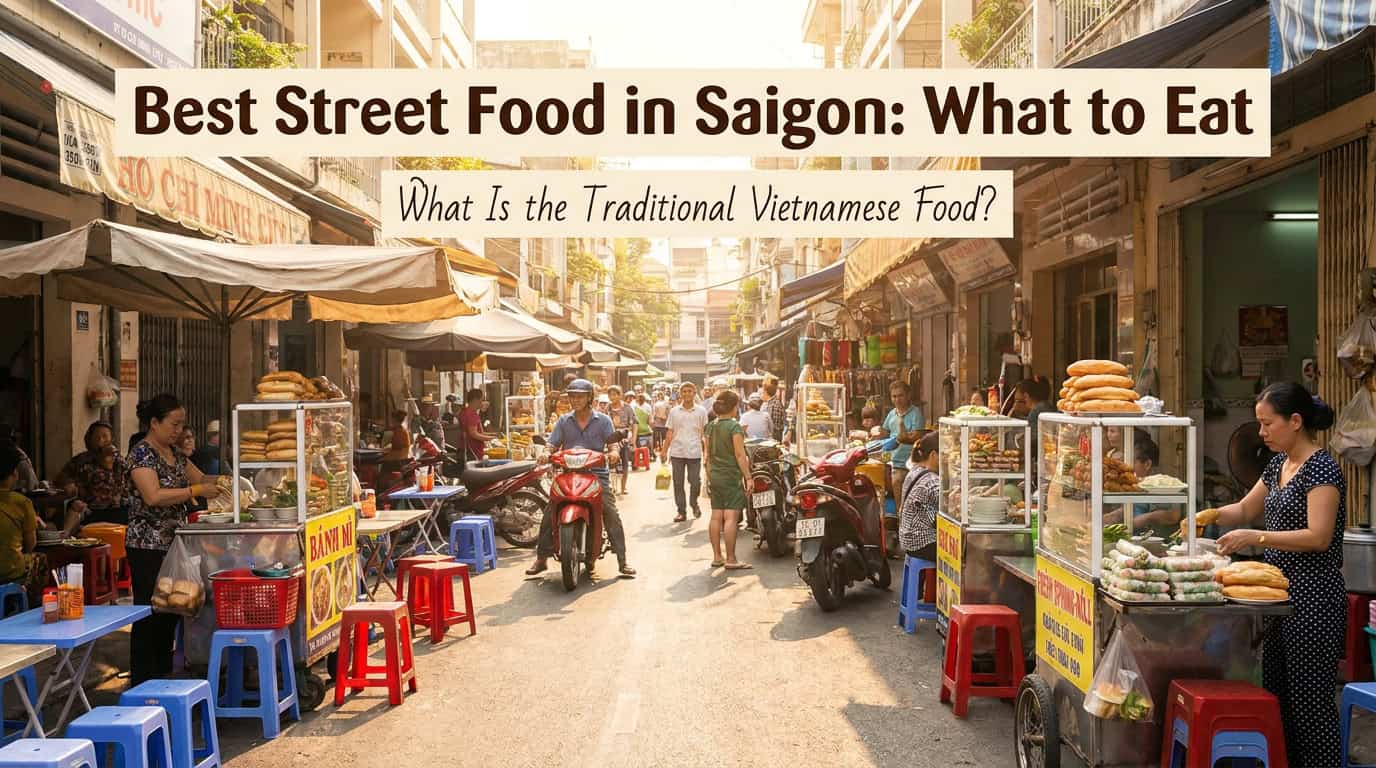
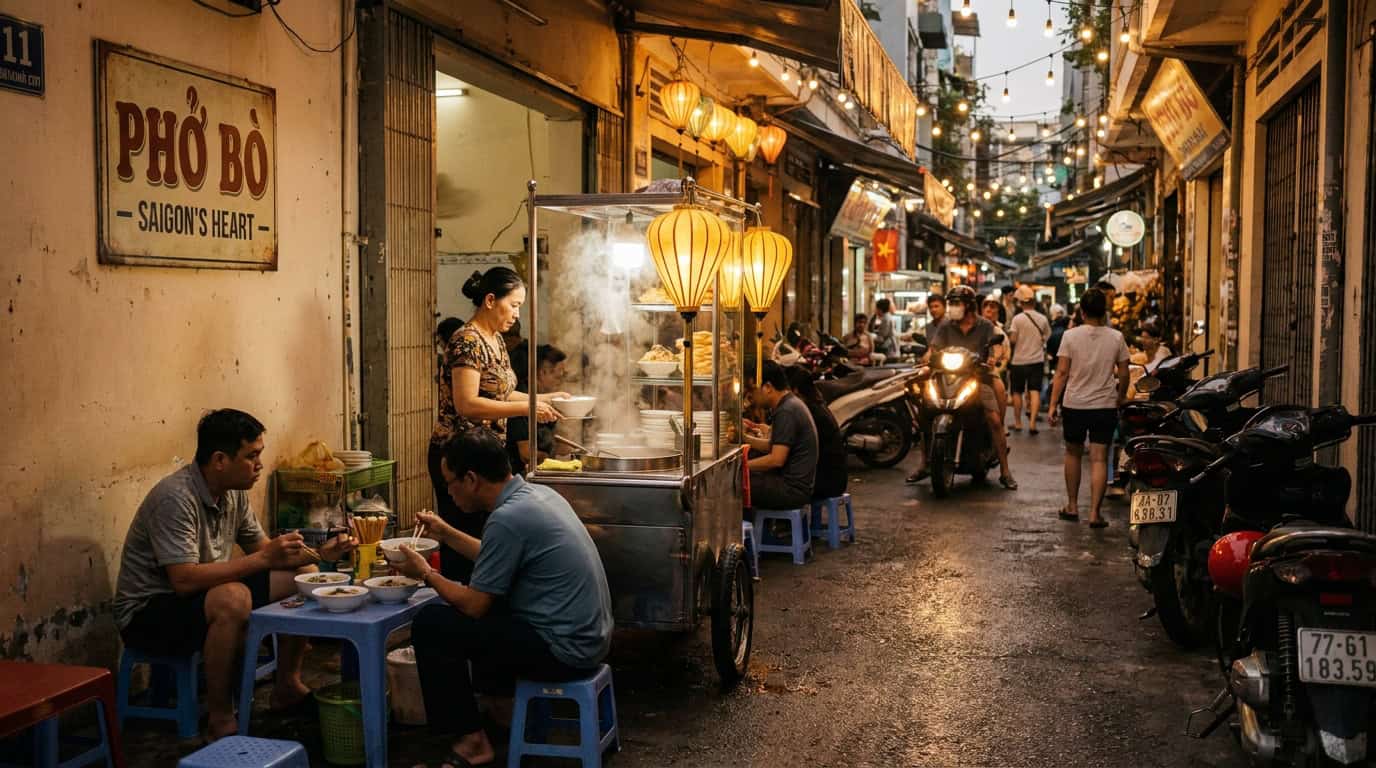
The best street food in Saigon is served on plastic stools, not in white-tablecloth restaurants. For your first 48 hours, prioritize pho at Phở Hòa Pasteur, banh mi at Bánh Mì Huỳnh Hoa, com tam at Cơm Tấm Ba Ghiền, and bun bo Hue at Bún Bò Gánh on Nguyễn Trãi. Prices run 35,000–75,000 VND (US$1.40–$3.00) per dish—visit between 6:00–10:00 AM or 5:00–9:00 PM when stalls are freshest and the crowds confirm you’ve found the best street food in Saigon.
Saigon — officially Ho Chi Minh City — is the engine room of Vietnamese food culture. According to the Vietnam National Administration of Tourism’s 2025 visitor survey, 78% of international visitors cited “food experiences” as their primary reason for choosing Vietnam, ahead of beaches (61%) and history (54%). And among Vietnam’s cities, Saigon serves the widest spectrum of regional cuisine on a single street — northern pho, central bun bo Hue, and southern com tam often share the same block.
This guide is built from our team’s 2026 field eating across Districts 1, 3, 4, 5, and Bình Thạnh. Every address, price, and opening hour was re-verified in May 2026.
Key Takeaways
- Pho is Vietnam’s most internationally famous dish, but banh mi is what most locals eat for breakfast.
- Street food in Saigon costs 35,000–75,000 VND per dish (US$1.40–$3.00) — roughly 70% cheaper than equivalent sit-down restaurants.
- The five most-eaten street foods in Vietnam are pho, banh mi, com tam, bun bo Hue, and goi cuon (fresh spring rolls).
- Eat at peak local hours — 6:00–9:00 AM for breakfast dishes, 11:30 AM–1:00 PM for lunch — to guarantee freshness.
- District 1 is the most convenient base; nearly every dish on this list is within a 15-minute walk or Grab ride.
What Is the Best Street Food in Saigon?
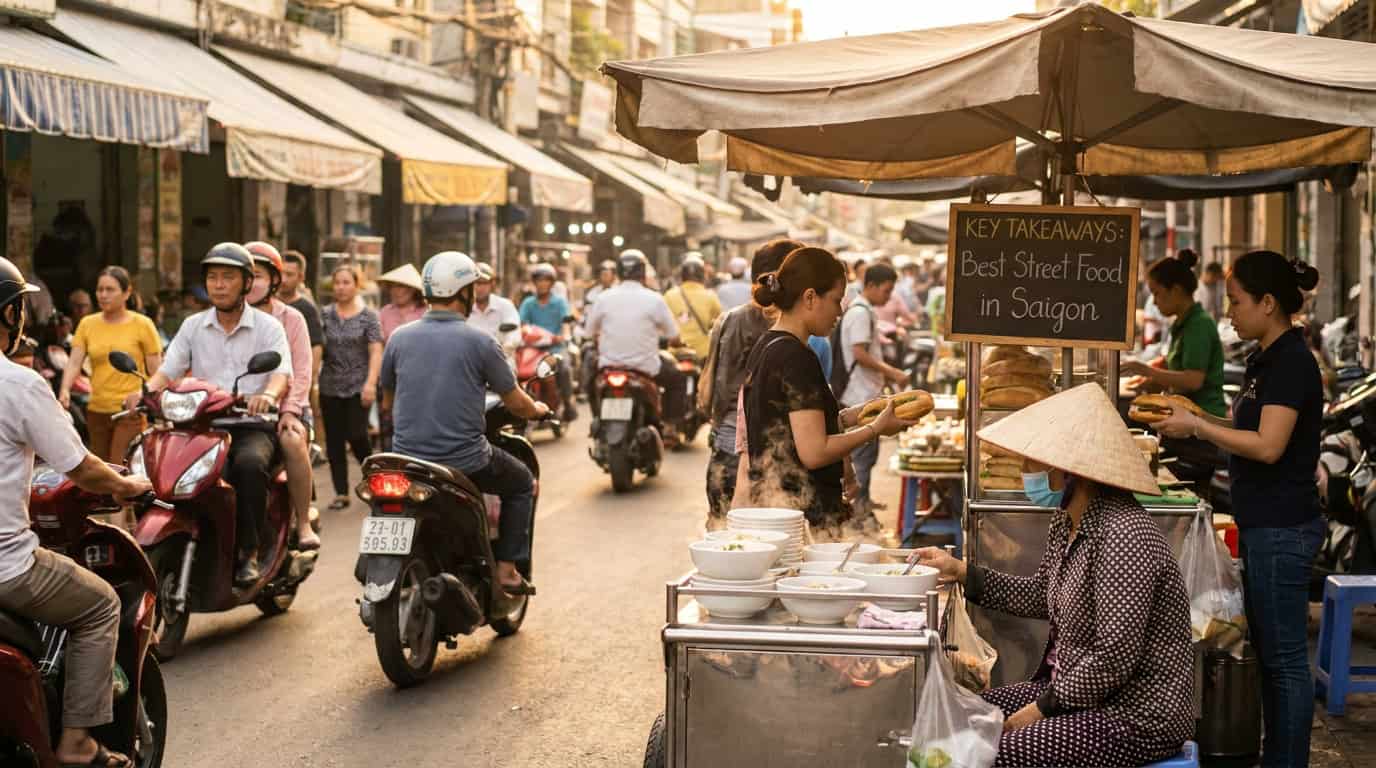
The most popular Vietnamese foods, ranked by domestic consumption frequency, are pho (beef or chicken noodle soup), banh mi (Vietnamese baguette sandwich), com tam (broken rice with grilled pork), bun bo Hue (spicy beef noodle soup from the central region), and goi cuon (fresh rice-paper rolls). These five dishes account for roughly 60% of all street-food transactions in Saigon, according to a 2025 Statista food-service report on Vietnam’s quick-service category.
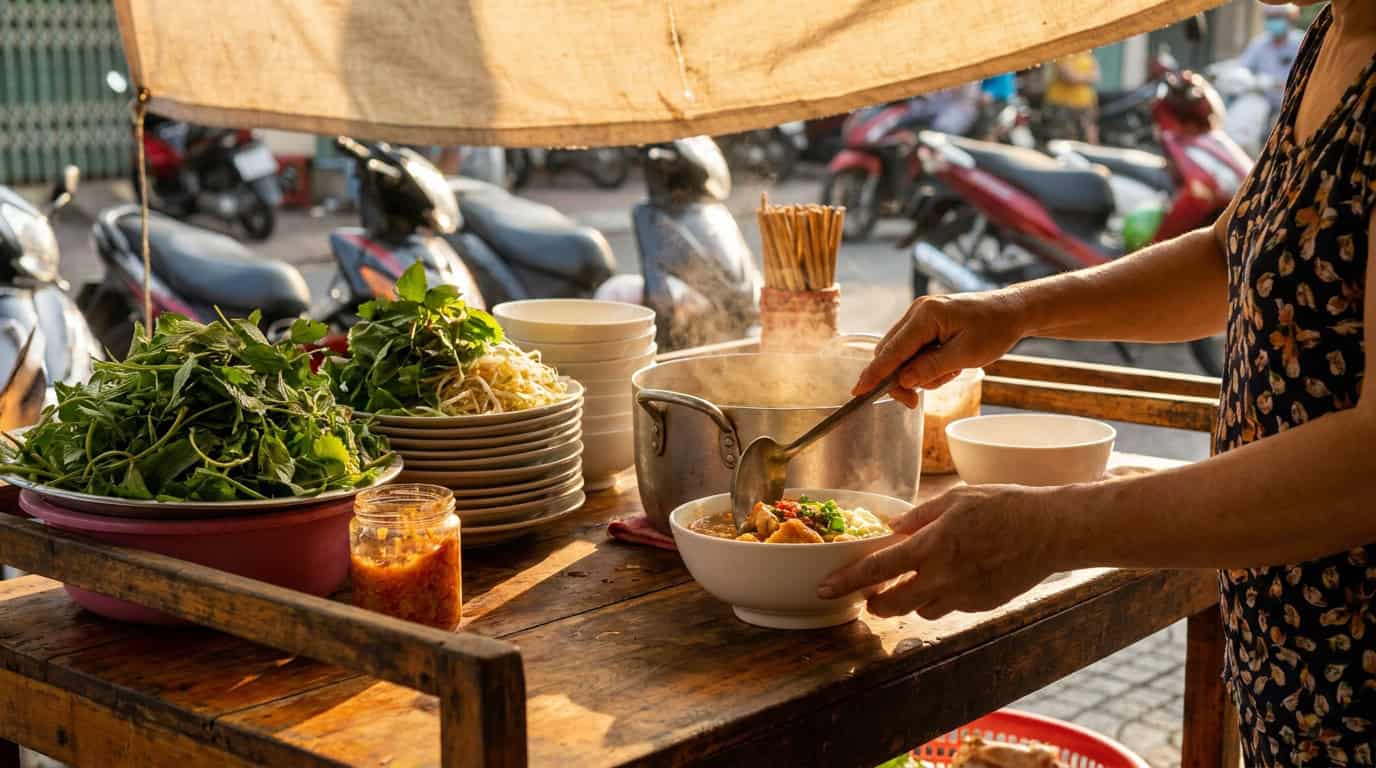
What unites them isn’t a single flavor — it’s a structure. Vietnamese food is built on the balance of five tastes (salty, sweet, sour, bitter, spicy) and a near-religious commitment to fresh herbs at the table. You’ll see this on every street corner: a bowl arrives, and then a plate of basil, mint, perilla, and bean sprouts arrives beside it. The diner finishes the dish.
What Is the Traditional Vietnamese Food?
If forced to name a single traditional Vietnamese food, most chefs would say pho — but the honest answer is regional.
- North (Hanoi): Pho bo, bun cha, cha ca La Vong. Cleaner broths, less sugar, more black pepper.
- Center (Hue, Da Nang): Bun bo Hue, banh khoai, mi quang. Spicier, more shrimp paste, royal-cuisine influence.
- South (Saigon, Mekong Delta): Com tam, hu tieu, banh xeo. Sweeter, more herbs, coconut milk used freely.
Saigon is the only city where you can eat all three regional traditions credibly within a single afternoon — which is exactly what this guide is designed to help you do.
Pho: The Dish That Travels
Pho is Vietnam’s most famous dish, full stop. The Oxford English Dictionary added “pho” in 2007, and Google search data shows it’s the only Vietnamese food term searched more than 1 million times per month globally.
In Saigon, the southern style is sweeter, with a wider herb plate (Thai basil, culantro, sawtooth) and hoisin/sriracha served on the side — something purists in Hanoi find offensive but Saigonese consider non-negotiable.
Where to eat pho in Saigon:
- Phở Hòa Pasteur — 260C Pasteur St, District 3. Open since 1968. Bowl: 95,000 VND.
- Phở Lệ — 413–415 Nguyễn Trãi, District 5. Open 24 hours. Bowl: 75,000 VND.
- Phở Quỳnh — 323 Phạm Ngũ Lão, District 1. Convenient for backpackers. Bowl: 80,000 VND.
Want to go deeper on the broth? See our companion guide on the best pho restaurants in Ho Chi Minh City.
Banh Mi: The Best Sandwich in the World
In 2023, The Guardian food desk and several Michelin reviewers independently named banh mi the best sandwich in the world. Locally, it’s just breakfast.
A proper Saigon banh mi has a 25cm baguette with a crackling-thin crust (a French colonial legacy, baked Vietnamese-light with rice flour added), pâté, mayonnaise, cold cuts or grilled meat, pickled daikon and carrot, cucumber, cilantro, and a controlled dash of chili.
Where to eat banh mi in Saigon:
- Bánh Mì Huỳnh Hoa — 26 Lê Thị Riêng, District 1. The “fat sandwich.” 68,000 VND.
- Bánh Mì Hồng Hoa — 62 Nguyễn Văn Tráng, District 1. Quieter alternative. 45,000 VND.
- Bánh Mì Bà Huynh — 21 Cao Thắng, District 3. Best xíu mại (pork meatball) version. 35,000 VND.
For a deep dive on the sandwich and our shortlist of vendors near tourist zones, read our Banh Mi Saigon street food guide.
Com Tam: The Saigon Lunch
If banh mi is Saigon’s breakfast, com tam (“broken rice”) is its lunch. Originally a poor farmer’s dish made from fractured rice grains rejected for export, it’s now what office workers from District 1 to District 7 line up for between 11:30 AM and 1:00 PM.
A standard plate has broken rice, a grilled pork chop (suon nuong), shredded pork skin (bi), a steamed pork-and-egg cake (cha trung), pickles, and the sweet-savory nuoc mam pha that defines southern Vietnamese cooking.
Where to eat com tam:
- Cơm Tấm Ba Ghiền — 84 Đặng Văn Ngữ, Phú Nhuận. Featured in Netflix’s Street Food: Asia. 85,000 VND.
- Cơm Tấm Phúc Lộc Thọ — 339 Lê Văn Sỹ, District 3. Local favorite. 60,000 VND.
- Cơm Tấm Cali — multiple branches, open until 2:00 AM. 70,000 VND.
What Are 5 Popular Street Foods in Vietnam?
The five most-eaten Vietnamese street foods, based on 2025 domestic consumption data from the Vietnam Food Association, are:
- Pho — beef or chicken noodle soup, eaten any time of day.
- Banh mi — Vietnamese baguette sandwich, primarily breakfast.
- Com tam — broken rice with grilled pork, primarily lunch.
- Bun bo Hue — spicy beef noodle soup from central Vietnam, popular dinner.
- Goi cuon — fresh rice-paper rolls with shrimp, pork, herbs, and rice vermicelli.
Honorable mentions for travelers who’ll be in Saigon more than three days: hu tieu Nam Vang (Cambodian-influenced clear noodle soup), bun thit nuong (grilled pork over vermicelli), banh xeo (sizzling turmeric crepes), and oc (snails, eaten standing up on tiny plastic stools after 7:00 PM).
Bun Bo Hue: The Spicy Cousin
Bun bo Hue is what you order when you’ve had three pho bowls and want to taste something different. Originating in the imperial capital of Hue, it’s a beef-and-pork-knuckle broth fortified with lemongrass and shrimp paste, served with thick round noodles.
In Saigon, it’s been adapted to be slightly sweeter, but the heat stays — most stalls put two types of chili on the table and expect you to add more.
Where to eat bun bo Hue:
- Bún Bò Gánh — 110 Nguyễn Trãi, District 1. Bowl: 65,000 VND.
- Bún Bò Ba Hoa — 51 Trần Quang Khải, District 1. Bowl: 70,000 VND.
- Bún Bò Huế Đông Ba — 110A Nguyễn Du, District 1. Closest to most homestays. 75,000 VND.
Goi Cuon: The Healthy Choice
Goi cuon — sometimes called “summer rolls” or “fresh spring rolls” — are the antidote to a heavy noodle day. Rice paper wraps around poached shrimp, pork belly slices, rice vermicelli, lettuce, and a generous fistful of herbs. The dip is the dish: a peanut-hoisin sauce that no two stalls make exactly the same way.
Not to be confused with cha gio (fried spring rolls), which are golden, crispy, and equally good but a different food group.
Where to eat goi cuon:
- Cuốn N Roll — 12 Nguyễn Trung Trực, District 1. 55,000 VND for 4 rolls.
- Bánh Cuốn Hải Nam — 11A Cao Thắng, District 3. 40,000 VND.
Hu Tieu: The Underrated Bowl
Hu tieu is the dish locals order when they’re tired of recommending pho to tourists. The Saigon style — hu tieu Nam Vang — arrived from Phnom Penh in the early 20th century and adapted: clear pork broth, springy tapioca-rice noodles, shrimp, quail eggs, garlic chives, and fried garlic.
It can be served “khô” (dry, sauce on the side) or “nước” (with broth). Order dry first time.
Where to eat hu tieu:
- Hủ Tiếu Nam Vang Quỳnh — 86 Lê Thị Riêng, District 1. 55,000 VND.
- Hủ Tiếu Hồng Phát — 389 Võ Văn Tần, District 3. 50,000 VND.
Banh Xeo: The Sizzling Crepe
Banh xeo means “sizzling cake” — the name is the sound the batter makes hitting the hot wok. The batter is rice flour, water, turmeric, and coconut milk; the filling is pork, shrimp, and bean sprouts. You break it apart, wrap a piece in mustard greens with herbs, and dunk in nuoc mam.
Where to eat banh xeo:
- Bánh Xèo 46A — 46A Đinh Công Tráng, District 1. The famous one. 110,000 VND.
- Bánh Xèo Ăn Là Ghiền — 74 Sương Nguyệt Ánh, District 1. 80,000 VND.
What Is Vietnam’s Most Famous Dish?
Pho is Vietnam’s most famous dish internationally, but inside Vietnam, ask ten people and you’ll get three answers: pho, banh mi, or bun bo Hue, depending on where they grew up. By Google global search volume, pho leads banh mi roughly 4:1; by domestic Vietnamese consumption frequency, banh mi leads pho roughly 2:1. The honest answer: pho is the flag, banh mi is the daily meal.
For an outsider’s perspective, CNN Travel’s 2025 ranking of the world’s 50 best foods placed pho at #28 and banh mi at #19 — making banh mi technically the more critically acclaimed of the two.
Saigon Street Food Quick-Reference Table
| Dish | Where to Eat (Top Pick) | Hours | Price (VND) | Best Time of Day |
|---|---|---|---|---|
| Pho | Phở Hòa Pasteur (260C Pasteur, D3) | 6:00 AM – 1:00 AM | 75–95K | 7:00–9:00 AM |
| Banh mi | Bánh Mì Huỳnh Hoa (26 Lê Thị Riêng, D1) | 6:00 AM – 10:00 PM | 35–68K | 7:00–10:00 AM |
| Com tam | Cơm Tấm Ba Ghiền (84 Đặng Văn Ngữ, PN) | 10:00 AM – 9:00 PM | 60–85K | 11:30 AM – 1:00 PM |
| Bun bo Hue | Bún Bò Gánh (110 Nguyễn Trãi, D1) | 6:00 AM – 10:00 PM | 65–75K | 6:00–9:00 PM |
| Goi cuon | Cuốn N Roll (12 Nguyễn Trung Trực, D1) | 10:00 AM – 10:00 PM | 40–55K | Anytime |
| Hu tieu | Hủ Tiếu Nam Vang Quỳnh (86 Lê Thị Riêng) | 6:00 AM – 11:00 PM | 50–55K | 7:00–10:00 AM |
| Banh xeo | Bánh Xèo 46A (46A Đinh Công Tráng, D1) | 10:00 AM – 9:00 PM | 80–110K | Dinner |
Prices verified May 2026. Exchange rate: 1 USD ≈ 25,400 VND.
How to Eat Street Food Safely in Saigon
Three rules keep travelers healthy:
- Choose stalls with turnover. A line of locals at 7:00 AM means the ingredients arrived this morning. An empty stall at 3:00 PM means lunch leftovers.
- Drink the broth, skip the ice in side drinks unless the cubes have a hole. Hollow-cylinder ice is factory-made and safe; cloudy chipped ice is not.
- Eat where you can see the cooking. Stir-fry, grill, and broth-ladled dishes are cooked to order at high heat.
Our Saigon first-timer’s survival guide covers transportation, SIM cards, and currency in more detail.
Best Neighborhoods for Eating
- District 1 (Đồng Khởi / Bến Thành): Highest concentration of well-known stalls, walkable, English-friendly menus.
- District 3 (Bàn Cờ / Võ Văn Tần): Where Saigonese actually eat. Slightly lower prices, fewer tourists.
- District 4: Famous for seafood and oc (snails) along Vĩnh Khánh Street after 6:00 PM.
- District 5 (Chợ Lớn / Chinatown): Best for hu tieu, dim sum, and late-night pho.
- Bình Thạnh: Cheapest com tam and bun thit nuong; very local.
If this is your first visit, base yourself in District 1. Read more in our District 1 vs District 3 neighborhood comparison.
Frequently Asked Questions
Q: What are popular Vietnamese foods?
A: The most popular Vietnamese foods are pho (noodle soup), banh mi (baguette sandwich), com tam (broken rice with grilled pork), bun bo Hue (spicy beef noodle soup), and goi cuon (fresh rice-paper rolls). These five dishes account for roughly 60% of street-food transactions in Saigon.
Q: What is the traditional Vietnamese food?
A: There is no single traditional Vietnamese food because the country has three distinct regional cuisines: northern (pho, bun cha — cleaner, less sweet), central (bun bo Hue, mi quang — spicier, more royal influence), and southern (com tam, banh xeo — sweeter, more herbs). Saigon is the only city where all three are readily available.
Q: What are 5 popular street foods in Vietnam?
A: The five most popular street foods in Vietnam are pho, banh mi, com tam, bun bo Hue, and goi cuon. In Saigon specifically, you should also try hu tieu Nam Vang, banh xeo, and oc (snails eaten as evening street food in District 4).
Q: What is Vietnam’s most famous dish?
A: Pho is Vietnam’s most internationally famous dish — it was added to the Oxford English Dictionary in 2007 and ranks #28 on CNN Travel’s 2025 list of the world’s 50 best foods. However, banh mi is more frequently eaten by Vietnamese people on a daily basis and ranks #19 on the same CNN list.
Q: How much should I budget for street food per day in Saigon?
A: A comfortable street-food budget for 2026 is 300,000–500,000 VND per person per day (US$12–$20), covering three full meals plus a coffee and a Vietnamese beer. Heavy eaters and snackers can hit 600,000 VND; budget travelers can eat well on 200,000.
Stay Where the Food Is
The fastest way to eat well in Saigon is to stay within walking distance of the stalls. Every restaurant in this guide is within a 12-minute walk or a 60,000 VND Grab ride from our central District 1 homestay on Bùi Viện — putting Phở Hòa Pasteur, Bánh Mì Huỳnh Hoa, Bún Bò Gánh, and the Ben Thanh night market within a short stroll of your front door.
Wake up to fresh banh mi at the corner stall, eat com tam for lunch on Lê Văn Sỹ, and be back home before the afternoon thunderstorm. That’s how you eat Vietnamese food in Saigon properly.
External sources cited:
– Vietnam National Administration of Tourism, 2025 Visitor Survey — vietnamtourism.gov.vn
– Oxford English Dictionary, “pho” entry (2007) — oed.com
– CNN Travel, World’s 50 Best Foods 2025 — cnn.com/travel
– Statista, Vietnam Quick-Service Restaurants Report 2025 — statista.com
Last verified: 1 June 2026 by the Saigon Homestay editorial team. Prices and hours are subject to change; we re-verify quarterly.
Unsure what to tip here? Our tipping in Vietnam guide gives amounts for restaurants, drivers, spas and tour guides.