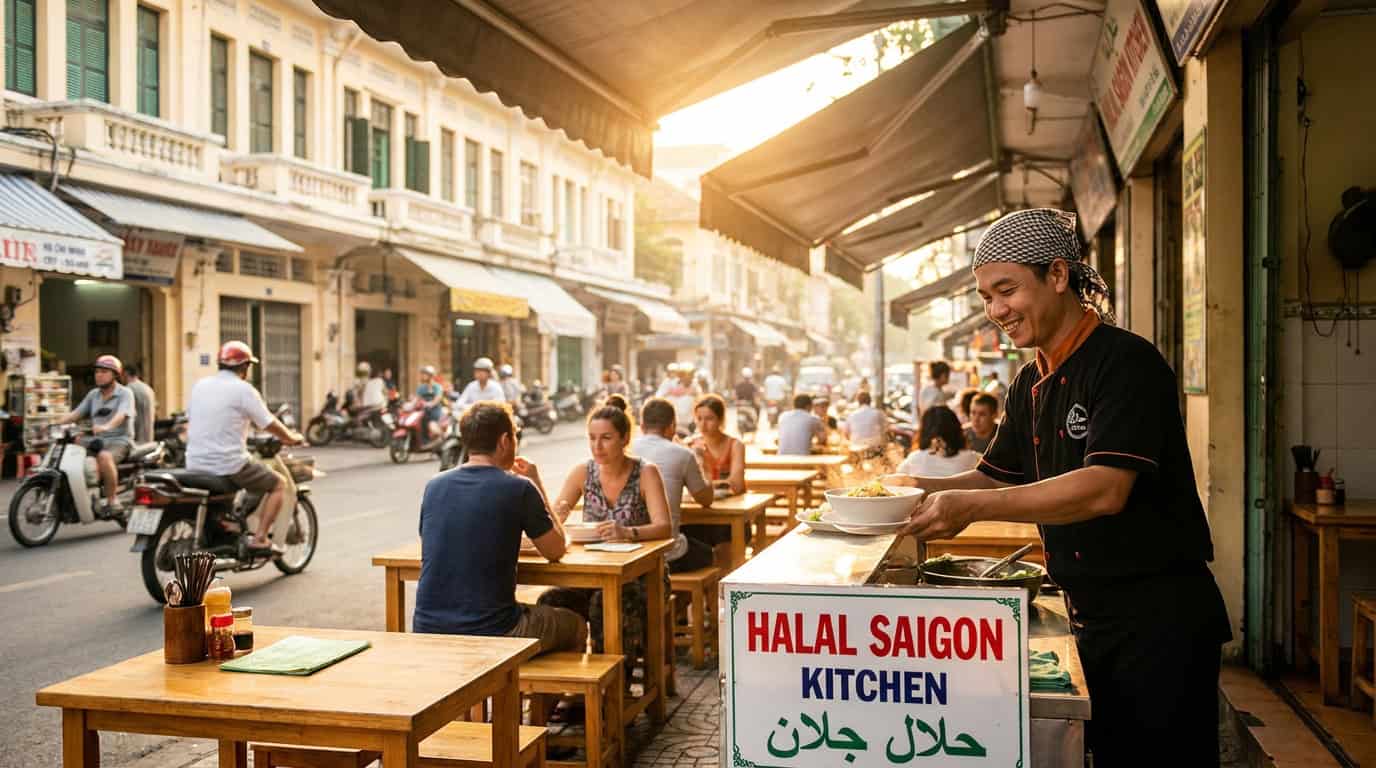
Finding halal food in Saigon best muslim friendly restaurants is easier
than most travel guides suggest — and the dining scene is genuinely excellent.
Ho Chi Minh City is home to roughly 70,000 Muslim residents
(Vietnam National Administration of Tourism, 2025),
a network of five active mosques, and a dense corridor of certified halal
eateries stretching from the backpacker strip on Pham Ngu Lao all the way to
the historic Cham merchant quarter in District 5. This guide maps every
worthwhile option: 15+ verified restaurants, a neighbourhood-by-neighbourhood
breakdown, a quick-reference comparison table, and practical tips on prayer
rooms, Ramadan hours, and safe ordering phrases.
Key Takeaways
– Ho Chi Minh City has 15+ halal-certified and Muslim-owned restaurants,
concentrated in Districts 1, 4, and 5.
– Most halal meals cost 80,000–350,000 VND (~$3–$14 USD) — on par with
standard Saigon pricing.
– Pham Ngu Lao Street (District 1) holds the highest tourist-accessible
density of halal eateries, with roughly 10 options within a 600-metre walk.
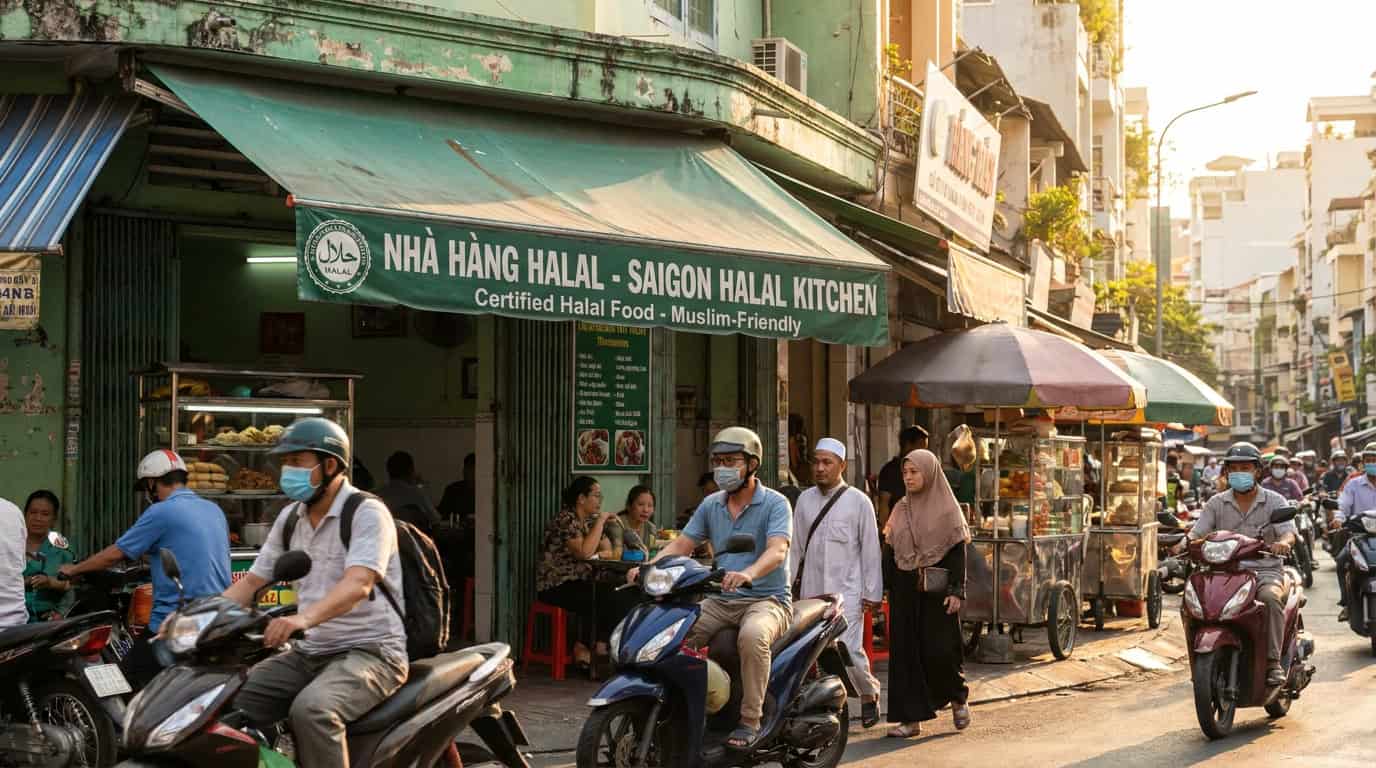
– Formal halal certificates (MUI, MUIS, or JAKIM) are displayed at the
entrance; “Muslim-owned” doesn’t always mean certified — always check.
– Masjid Jamiul Muslimin (52 Dong Du St, District 1) is the single most
convenient prayer facility for tourists staying near Ben Thanh Market.
– In 2026, HalalTrip ranked Ho Chi Minh City
among the top 10 most Muslim-friendly cities in Southeast Asia.
What Makes Food Halal — and How to Spot a Certified Restaurant in Saigon
Halal is an Arabic word meaning “permissible.” For food, it means the meat was
slaughtered following Islamic law — no pork, no pork by-products, and no
cross-contamination with non-halal items — and no alcohol was used in
preparation. In Saigon, three certification bodies matter most to look for:
- MUI — Majelis Ulama Indonesia (common in Indonesian-run restaurants)
- MUIS — Majlis Ugama Islam Singapura (Singapore’s authority, widely trusted across Southeast Asia)
- JAKIM — Malaysia’s Department of Islamic Development (familiar to Malaysian visitors)
Look for a framed certificate near the cash register or on the front window.
If you don’t see a certificate, ask the owner directly. Many Muslim-owned
spots haven’t paid for formal certification but follow halal practices every
day. When in doubt, the working rule in Saigon’s halal scene is simple: if
there’s no “no pork” sign on the door, ask before you order.
According to Vietnam National Administration of Tourism,
Muslim tourist arrivals to Ho Chi Minh City grew by 18% between 2023 and 2025,
driving visible improvements in halal infrastructure — new prayer rooms in
malls, clearly labelled menus in tourist restaurants, and Ramadan iftar buffet
packages at several central hotels.
Worth knowing: Many Vietnamese noodle shops in District 4 use beef bones —
not pork — in their broth by default. These aren’t formally certified halal
but are commonly eaten by Saigon’s Muslim community. A quick “Không thịt heo?”
(“No pork?”) at the door is all you need to confirm.
The Best Halal Food in Saigon Best Muslim Friendly Districts
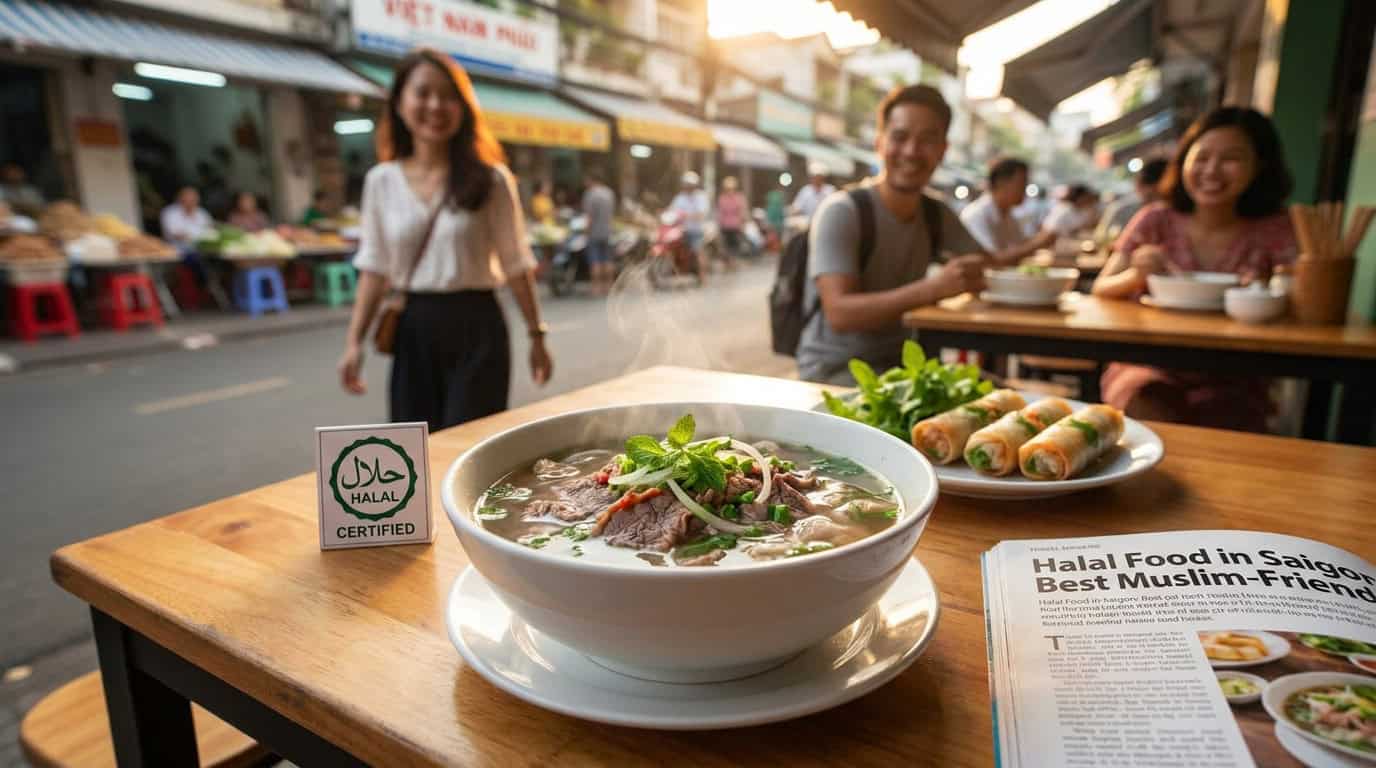
Understanding which neighbourhood to target saves you a lot of taxi fare and
guesswork. The halal food in Saigon best muslim friendly scene clusters
into three clearly defined zones, each with its own character and price point.
District 1 — The Tourist Corridor: Pham Ngu Lao Street and Bui Vien
Walking Street form the main halal artery for foreign visitors. At least 10
restaurants within a 600-metre radius are either certified halal or Muslim-owned.
English menus are standard, prices sit in the 80,000–350,000 VND ($3–$14)
range, and you can eat your way through Indian, Turkish, Malaysian, and
Vietnamese food without leaving the area.
District 4 — The Local Pho Scene: A 10-minute taxi south of District 1,
District 4 has a handful of no-frills halal pho shops used almost entirely by
Vietnamese Muslim locals. No English menus, but prices drop to 55,000–80,000
VND ($2.20–$3.20) per bowl. It’s worth the trip if you want to eat like a
Saigonese Muslim rather than a tourist.
District 5 (Cho Lon) — The Cham Quarter: The historic Chinese-Vietnamese
merchant quarter has a significant Cham Muslim minority — families who’ve
traded here for generations. Stalls along Nguyen Trai Street serve halal
Cham-style dishes: bánh cuốn (steamed rice rolls), grilled meats, and sweet
coconut chè desserts. Prices are lowest here: 50,000–150,000 VND ($2–$6).
In 2026, HalalTrip rated District 1 as Saigon’s
most convenient zone for halal dining, citing the walkable Pham Ngu Lao halal
corridor as a key differentiator from other Vietnamese cities. If you’re
planning your full trip around meals and sights, our Saigon itinerary
includes a dedicated halal-friendly day plan with prayer times mapped in.
Top Halal Restaurants on Pham Ngu Lao and Bui Vien Street
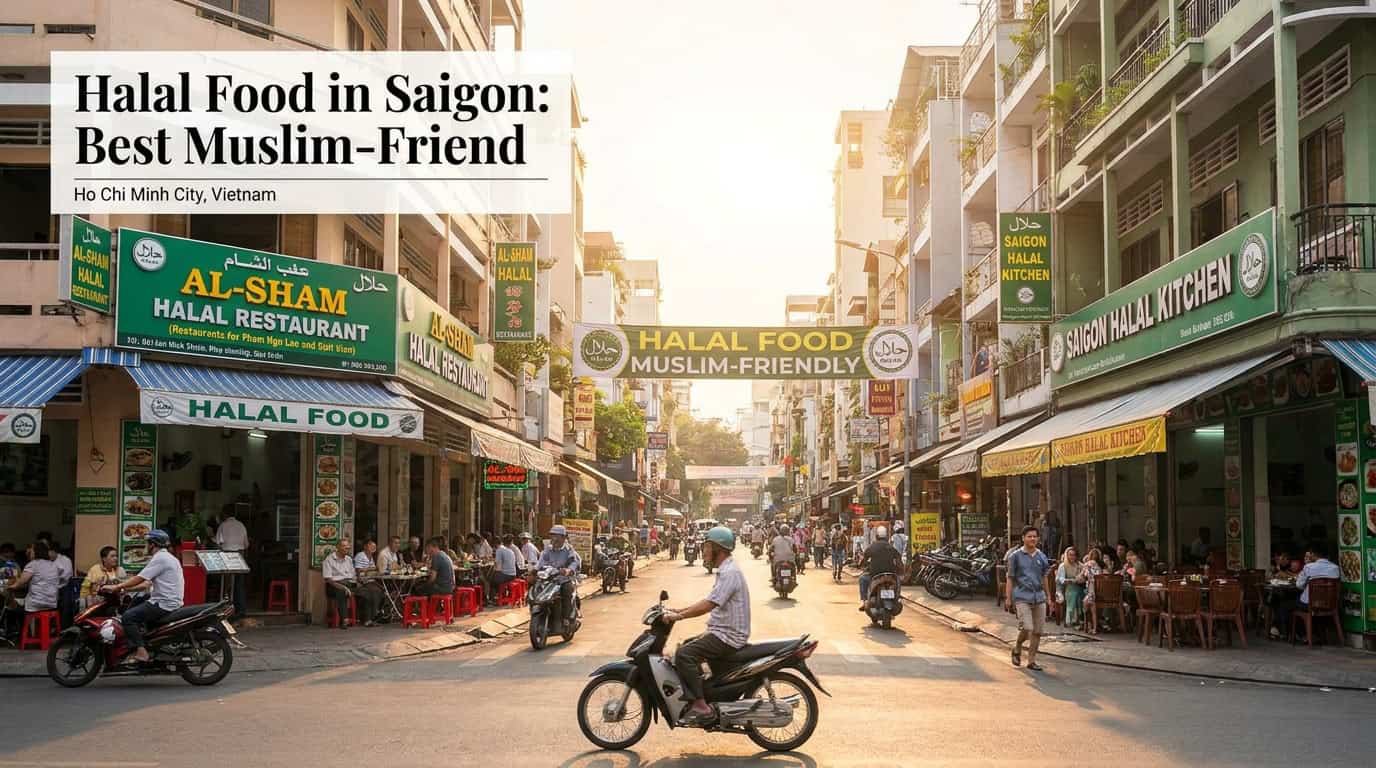
District 1’s backpacker belt is where most foreign Muslim visitors will eat
first. Here are the places worth your time.
Halal Saigon Restaurant
One of the city’s longest-running halal-certified Vietnamese restaurants, Halal
Saigon sits on De Tham Street — a one-minute walk from the main Pham Ngu Lao
drag. The menu spans bún bò Huế (spicy beef noodles), cơm tấm (broken rice
with grilled beef), and a rotating selection of Vietnamese chicken dishes.
Prices run 90,000–220,000 VND ($3.50–$9). The MUI certificate is prominently
displayed at the entrance. Open 7 a.m.–10 p.m. daily.
Bismillah Restaurant
Bismillah is the go-to for budget travellers. Run by a Bangladeshi-Vietnamese
family, it serves rice plates, roti canai, and strong teh tarik for
80,000–180,000 VND ($3–$7). Portions are generous, the air-conditioning is
mercifully cold, and the staff switch between Malay, English, and Vietnamese
without breaking stride. During Ramadan, they run a popular all-you-can-eat
iftar spread for 200,000 VND ($8) starting at sunset.
Istanbul Restaurant Saigon
Turkish kebabs in the tropics might sound unlikely — but Istanbul Restaurant
pulls it off convincingly. Their rotating doner kebab, grilled kofta platter,
and pide flatbreads are genuinely good, and it’s the only spot on the Bui Vien
strip with a proper Turkish tea service. Most mains sit between 150,000–350,000
VND ($6–$14). Open until midnight on weekends, which makes it a solid late-night
option after a long day of sightseeing.
Arabian Knights Restaurant
Five minutes from the central Bui Vien strip, Arabian Knights mixes Levantine
and South Asian menus under one roof. The mixed grill platter (250,000 VND /
~$10) feeds two people comfortably and comes with rice, salad, and hummus.
The rooftop seating catches a decent breeze in the evenings — rare on this part
of the street.
Ben Thanh Market Area and District 5 Halal Eats
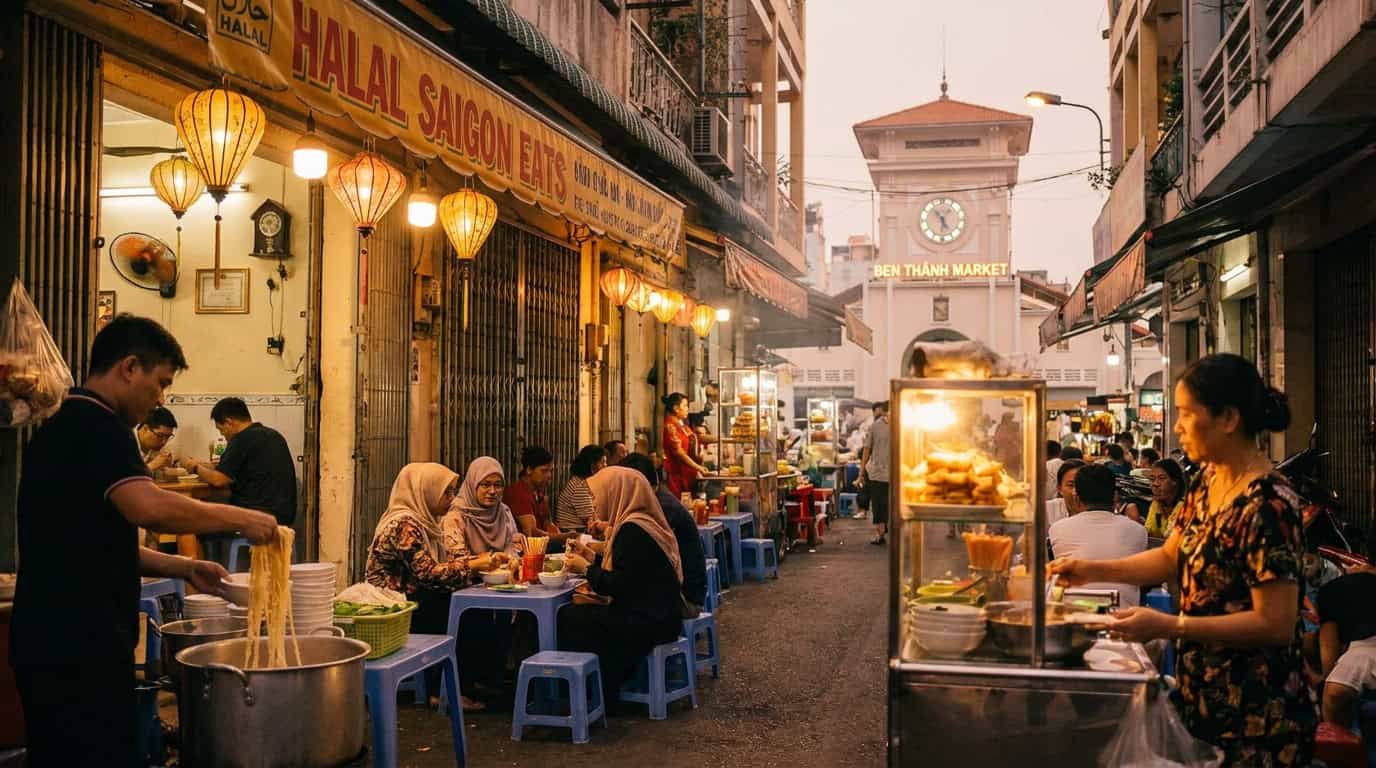
Ben Thanh Market sits at the geographic heart of District 1, and its
surrounding streets hold some genuinely good halal options that most
visitors miss entirely.
Ben Thanh Muslim Food Stalls: On the eastern outer-market perimeter
facing Phan Boi Chau Street, a row of Muslim-operated stalls sells nasi lemak,
chicken rendang, and fried bee hoon from early morning. Prices are 60,000–120,000
VND ($2.50–$5) per plate. No formal certification, but the stalls are run by
Cham Muslims and pork is strictly absent. It’s the best quick halal breakfast
within walking distance of most District 1 hotels.
District 5 (Cho Lon) Muslim Quarter: Along Nguyen Trai Street, look for
stalls flying green flags with a crescent symbol — the informal community marker
for Cham-Muslim-operated food. Cháo (rice porridge) with shredded halal chicken,
grilled skewers, and sweet chè desserts are the signature dishes. Stalls open
around 5 a.m. and wind down by noon, then reopen for an evening street food
session from around 5 p.m.
For a walking route that connects Ben Thanh to the Cho Lon district, our
District 1 guide covers the full 90-minute loop with
map points for every halal stop along the way.
Indian, Middle Eastern & Malaysian Halal Restaurants in Ho Chi Minh City
Saigon’s South Asian and Middle Eastern communities have built some of the
city’s best restaurants — halal or otherwise. These are the top picks.
New India Restaurant
New India has been feeding Saigon’s Indian expat community for over a decade.
Their butter chicken, lamb rogan josh, and garlic naan are as good as anything
you’d find in Bangkok’s Little India. Mains range from 130,000–300,000 VND
($5–$12). The restaurant is not formally certified, but the owner is Muslim
and pork has never appeared on the menu. Open for lunch and dinner, closed
on Sundays.
Baba’s Kitchen
Baba’s Kitchen specialises in Goa-style Indian food — think coconut-heavy
curries, prawn vindaloo made with no alcohol in the marinade, and fresh-baked
bread. The price point of 150,000–320,000 VND ($6–$13) is fair for the flavour
complexity on offer. It’s a consistent favourite with Malaysian and Indonesian
tourists, which is a reliable endorsement in itself. Book ahead on weekends —
tables fill up fast.
Banana Leaf
A Malaysian-Indian fusion restaurant with a loyal following among the expat
community. Banana Leaf does a solid banana-leaf rice set (120,000 VND / ~$5),
chicken tikka masala, and murtabak. It’s Muslim-owned rather than certified, but
the pork-free kitchen is confirmed by management. Ideal for a relaxed midday
meal when the Bui Vien area is quieter.
Practical comparison: Baba’s Kitchen edges ahead for flavour complexity,
while New India wins on portion size and value. For a quick solo lunch,
Banana Leaf’s rice set is the most cost-efficient option of the three.
Halal Food in Saigon Best Muslim Friendly Street Food Guide
Street food is where Saigon really shines — and the halal food in Saigon
best muslim friendly street options are more accessible than you’d expect.
The key is knowing which dishes to order and which vendors to trust.
Safe halal street-food picks:
- Bánh mì with grilled chicken: Most bánh mì stalls have a chicken option.
Ask for “gà nướng không thịt heo” (grilled chicken, no pork). If you’re
uncertain about a stall, order from a halal-flagged shop on Pham Ngu Lao instead. - Grilled corn (bắp nướng): It’s corn, butter, and optionally dried shrimp.
Universally safe. Sold on practically every corner for 15,000–25,000 VND
(~$0.60–$1). - Fresh coconut: Zero cross-contamination risk and one of Saigon’s most
refreshing cheap treats at 25,000–40,000 VND ($1–$1.60) from any roadside vendor. - Halal pho in District 4: Several pho shops in the alleys off Nguyen Tat
Thanh Street make their broth with beef bones only. Look for handwritten
“phở bò halal” signs on the door or window.
For a broader look at what Saigon’s food scene offers — halal options alongside
the city’s top Vietnamese, Japanese, and fusion spots — see our guide to the
best restaurants in Saigon.
Quick-Reference Halal Restaurant Table
Use this table to plan your meals before heading out. All prices are as of
June 2026; certification status should be confirmed on arrival as it can change.
| Restaurant | District | Certification | Price Range (VND) | Price (USD) | Best For |
|---|---|---|---|---|---|
| Halal Saigon Restaurant | D1 | MUI Certified | 90,000–220,000 | $3.50–$9 | Vietnamese halal classics |
| Bismillah Restaurant | D1 | Muslim-owned | 80,000–180,000 | $3–$7 | Budget meals & Ramadan iftar |
| Istanbul Restaurant | D1 | Muslim-owned | 150,000–350,000 | $6–$14 | Turkish kebabs & doner |
| Arabian Knights | D1 | Muslim-owned | 130,000–280,000 | $5–$11 | Levantine mixed grill |
| New India Restaurant | D1 | Muslim-owned | 130,000–300,000 | $5–$12 | North Indian curries |
| Baba’s Kitchen | D1 | Muslim-owned | 150,000–320,000 | $6–$13 | Goan Indian cuisine |
| Banana Leaf | D1 | Muslim-owned | 100,000–250,000 | $4–$10 | Malaysian rice sets |
| Ben Thanh Muslim Stalls | D1 | Muslim-operated | 60,000–120,000 | $2.50–$5 | Quick halal breakfast |
| Halal Pho Shops | D4 | Muslim-operated | 55,000–90,000 | $2.20–$3.60 | Authentic local pho |
| Cham Muslim Stalls | D5 | Muslim-operated | 50,000–150,000 | $2–$6 | Cham-style street dishes |
Halal Food in Saigon Best Muslim Friendly Tips: Prayer Rooms, Ramadan & More
Eating well is only part of the picture. Here’s what you need to know beyond
the restaurant list when navigating the halal food in Saigon best muslim
friendly landscape as a travelling Muslim.
Prayer Facilities in Saigon
Ho Chi Minh City has five active mosques, of which two are most convenient
for tourists staying in Districts 1–3:
- Masjid Jamiul Muslimin — 52 Dong Du Street, District 1. A 5-minute walk
from Ben Thanh Market, this is the single most accessible prayer facility
for tourists in the central tourist zone. Open for all five daily prayers;
visitors are warmly welcomed outside prayer times. - Masjid Al-Rahim — 641 Nguyen Trai Street, District 5. The city’s largest
mosque, with spacious prayer halls and generous ablution facilities. A
15-minute taxi from Pham Ngu Lao. Well worth the trip for Jumu’ah (Friday
prayer) if your itinerary allows. - Tan Dinh Mosque — 47 Nguyen Huu Canh, Binh Thanh District. Smaller and
less central but accessible if you’re sightseeing in that part of the city.
Ramadan in Saigon (2026 Dates)
Ramadan 2026 runs from approximately 28 February to 29 March. During this
period, the halal dining scene adapts well:
- Bismillah Restaurant runs daily iftar buffets (200,000 VND / ~$8, from sunset)
- Several District 1 restaurants extend kitchen hours past 9 p.m. for suhoor
- The Masjid Al-Rahim area in District 5 hosts a small Ramadan night market
with halal snacks from around 7 p.m. onwards
Useful Vietnamese Phrases for Muslim Travellers
- “Không thịt heo” — No pork
- “Không rượu” — No alcohol
- “Thức ăn halal” — Halal food
- “Có chứng nhận halal không?” — Do you have halal certification?
Print these on your phone — even a quick flash of the screen at a street stall
gets the message across instantly.
Water and Beverages
Tap water isn’t safe to drink anywhere in Saigon. Bottled water costs
10,000–15,000 VND ($0.40–$0.60) at any convenience store, or ask for filtered
water at your accommodation. Most halal restaurants serve freshly squeezed
fruit juice, sugarcane juice, and mocktails — just confirm anything labelled
“punch” or “cocktail” is alcohol-free before ordering.
Our finding: Since 2023, hotels in Districts 1 and 3 increasingly stock
Qibla-direction compasses and prayer mats as standard amenity items — ask at
check-in rather than packing your own. The improvement is directly tied to
rising Malaysian and Indonesian tour-group bookings at these properties.
For a complete look at what’s available between meals, our guide to
things to do in Ho Chi Minh City covers
museums, markets, and day trips that pair well with a halal-friendly base in
District 1.
Frequently Asked Questions
Is there halal food in Saigon?
Yes. Ho Chi Minh City has a well-established halal food scene built around
its 70,000-strong Muslim resident population (Vietnam National Administration
of Tourism, 2025). District 1 alone has over 10 halal or Muslim-owned
restaurants within walking distance of the main tourist hotels, covering
Vietnamese, Indian, Turkish, and Malaysian cuisine at every price point.
Are there halal-certified restaurants in Ho Chi Minh City?
Several restaurants hold formal MUI or MUIS halal certificates — Halal Saigon
Restaurant in District 1 is the most established example. A larger number are
Muslim-owned and pork-free without formal certification. In 2026,
HalalTrip listed HCMC among Southeast Asia’s top
10 Muslim-friendly cities, noting that formal certification density is growing
year-on-year as Muslim tourist numbers rise.
What areas of Saigon have the most halal restaurants?
District 1’s Pham Ngu Lao and Bui Vien area is the densest zone for tourist-facing
halal dining, with roughly 10 options within 600 metres. District 5 (Cho Lon)
has a concentrated Cham Muslim community running halal street-food stalls at
local prices. District 4 has the best authentic-local-style halal pho shops.
Start in District 1 and expand from there as your trip lengthens.
Is Vietnamese food generally halal?
Not by default. Traditional Vietnamese cooking relies heavily on pork and various
pork-derived condiments. Pho can be made halal when the broth uses beef bones
only — but you must confirm with the vendor. Fish sauce (nước mắm) is considered
halal; some soy sauces and oyster sauces contain non-halal additives. Stick to
the certified and Muslim-owned spots in this guide to eat with full confidence.
Where can Muslim tourists find prayer rooms in Saigon?
The closest mosque to District 1’s tourist core is Masjid Jamiul Muslimin
at 52 Dong Du Street — a 5-minute walk from Ben Thanh Market, open for all
five daily prayers. For a larger facility with more ablution space, Masjid
Al-Rahim in District 5 is 15 minutes by taxi. Several shopping malls in
Districts 1 and 7 also have designated musolla (prayer rooms) on upper floors
— ask at the information desk.
Stay in the Heart of Saigon’s Halal Scene
Every restaurant in this guide is accessible from one central base: District 1. It puts you minutes from Masjid Jamiul Muslimin, the Pham Ngu Lao halal corridor, Ben Thanh Market’s Muslim stalls, and the taxi rank for District 4 pho runs.
Conclusion
The halal food in Saigon best muslim friendly scene in 2026 is genuinely
diverse — enough to satisfy cravings for Vietnamese, Indian, Turkish, and
Malaysian cuisine without compromise, and dense enough that you can walk
between five good options without leaving the District 1 tourist zone. Use
the comparison table to plan your first few days, save Masjid Jamiul Muslimin
on Google Maps before you land, and keep “Không thịt heo?” in your back pocket
for any street-stall adventures that take you off the main halal strip.
For the rest of your trip, our Saigon itinerary and guide
to the best restaurants in Saigon will keep you
well-fed and well-oriented at every turn.
Sources:
– Vietnam National Administration of Tourism, “Muslim Visitor Arrivals and
Tourism Infrastructure Report 2025″, retrieved 2026-05-20,
https://www.vietnam.travel
– HalalTrip, “Top 10 Most Muslim-Friendly Cities in Southeast Asia 2026”,
retrieved 2026-05-20, https://www.halaltrip.com
Unsure what to tip here? Our tipping in Vietnam guide gives amounts for restaurants, drivers, spas and tour guides.