

Cat Ba Island is northern Vietnam’s most rewarding island escape — a rugged,
285 km² wilderness anchoring the Ha Long Bay – Cat Ba Archipelago UNESCO World
Heritage Site, where limestone karsts erupt
from jade-green water and critically endangered golden-headed langurs still leap
between cliff faces. Reachable from Hanoi in roughly four hours by bus and ferry,
it delivers every dramatic seascape Ha Long Bay promises — without the
cruise-ship crowds, the package-tour prices, or the feeling that you’re watching
Vietnam through a porthole.
Whether you’ve got two days or a full week, this guide gives you every practical
detail you need: how to arrive, what to do, where to sleep, what to eat, and
exactly when to come.
Key Takeaways
– Cat Ba Island is the largest island in the Ha Long Bay – Cat Ba Archipelago,
jointly inscribed as a UNESCO World Heritage Site in 2023, sheltering over
1,500 documented species of flora and fauna.
– Lan Ha Bay — on Cat Ba’s eastern side — shares the same karst geology as
Ha Long Bay but sees a fraction of the boat traffic, making it the superior
kayaking and overnight-cruise destination.
– Fewer than 80 Cat Ba langurs survive in the wild, making this golden-headed
primate one of the rarest mammals on earth; guided conservation boat tours
run daily from Cat Ba Town.
– Best travel windows: March–May (warm, clear, moderate crowds) and
September–November (post-monsoon, excellent visibility, lowest prices).
– Budget travelers manage comfortably on 700,000–1,000,000 VND (~$28–$40) per
day, covering a guesthouse, three meals, and a half-day boat tour.
| Detail | Information |
|---|---|
| Location | Hai Phong Province, northern Vietnam |
| Island size | 285 km² (110 sq mi) |
| Getting there | Bus + fast ferry from Hanoi (~4 hrs); ferry from Hai Phong (~1.5 hrs) |
| Best time | March–May; September–November |
| Recommended stay | 2–4 days |
| Daily budget | 700,000–2,000,000 VND (~$28–$80) |
| Currency | Vietnamese Dong (VND) |
| Nearest city | Hai Phong (~50 km by sea) |

Why Cat Ba Beats Ha Long Bay for Independent Travelers
Most travelers who end up on Cat Ba do so because a friend warned them that the
standard Ha Long Bay cruise felt like a floating hotel they never left. That
friend was right. Ha Long Bay’s tourism model runs almost entirely on packaged
overnight boats — you board, you cruise, you leave. Cat Ba flips that structure:
you base yourself on land and go deeper.
From Cat Ba Town you can hike a national-park trail at sunrise, spend the
afternoon kayaking through a sea cave in Lan Ha Bay, and eat grilled squid at a
harbor-side table for 90,000 VND ($3.60) — none of which is possible when you’re
tethered to a vessel.
Worth knowing: The island also rewards staying longer. Hospital Cave,
the Cat Ba Langur Conservation Project, and the summit hike at Kim Giao Peak
are each half-day experiences that need land access and time — the things that
make experienced Vietnam travelers consistently rate Cat Ba the better overall
destination.
How to Get to Cat Ba Island from Hanoi and Hai Phong

Getting to Cat Ba Island requires no flights — just a straightforward combination
of road and sea transport that most budget travelers complete for under 350,000
VND (~$14) per person.
From Hanoi (the most common route): Travel agencies and hostels throughout
the Old Quarter sell all-in bus-and-ferry combo tickets for 250,000–350,000 VND
(~$10–$14). The bus typically departs around 07:30–08:00, connects in Hai Phong,
and a fast hydrofoil from Got Pier (Gia Luan terminal) covers the final sea
crossing in roughly 45 minutes. Door-to-door: four to four-and-a-half hours.
From Hai Phong: Ferries depart from Binh terminal roughly every two hours
between 06:00 and 17:00. The slow car-and-passenger ferry takes about 90 minutes
and costs 120,000–150,000 VND (~$5–$6). A faster speedboat completes the
crossing in 45 minutes for around 230,000 VND (~$9).
From Ha Long City: A speedboat from Ha Long pier to Cat Ba runs about one
hour for roughly 280,000 VND (~$11). This route works well if you’re combining
Cat Ba Island with an Ha Long Bay overnight cruise.
Getting home: Return ferries toward Hai Phong and Hanoi last depart around
13:00–14:00. Buy your return ticket the morning you plan to leave — or the
evening before in peak season — to guarantee a seat.
| Route | Duration | Approx. Cost (VND) |
|---|---|---|
| Hanoi → Cat Ba (bus + ferry combo) | ~4 hours | 250,000–350,000 (~$10–$14) |
| Hai Phong → Cat Ba (slow ferry) | ~90 min | 120,000–150,000 (~$5–$6) |
| Hai Phong → Cat Ba (speedboat) | ~45 min | ~230,000 (~$9) |
| Ha Long City → Cat Ba (speedboat) | ~60 min | ~280,000 (~$11) |
Best Things to Do on Cat Ba Island

Cat Ba Island packs more activity variety into its modest footprint than almost
anywhere else in northern Vietnam. Here’s what belongs at the top of your list.
Kayak Through Lan Ha Bay
Lan Ha Bay is the piece of the picture that most Ha Long visitors never see.
Roughly 300 limestone islets rise on Cat Ba’s eastern side, riddled with hidden
lagoons, floating fishing villages, and sea caves you can paddle straight through.
Half-day kayaking tours from Cat Ba Town run 350,000–500,000 VND (~$14–$20) per
person including guide and equipment. For more independence, rent a kayak from
the harbor shacks for around 100,000 VND ($4) per hour.
Hike Cat Ba National Park
Cat Ba National Park covers 15,200 hectares of primary subtropical forest and
receives far fewer hikers than its ecological status deserves. The most popular
route is the 9 km Ngu Lam Trail to Kim Giao Peak — a three-hour return hike
with sweeping karst views from the summit. Park entrance costs 85,000 VND
(~$3.50); guides are compulsory for most trails and can be hired at the gate for
around 300,000 VND (~$12) for a half-day. Bring at least two liters of water.
Visit Hospital Cave (Hang Quân Y)
Hospital Cave is one of the most historically charged sites in northern Vietnam —
and one of the least covered on the standard tourist circuit. Built into a
limestone hill above Cat Ba Town in the 1960s, this three-level underground
complex served as a secret military hospital during the American War, capable of
treating 150 patients simultaneously while remaining invisible from the air.
Entrance costs 40,000 VND (~$1.60) and the self-guided tour takes 30–40 minutes.
Go before 09:30 to beat the tour groups.
Take a Cat Ba Langur Conservation Tour
The Cat Ba Langur Conservation Project runs
guided boat tours to observe the world’s most endangered primate in the wild.
Fewer than 80 of these golden-headed langurs survive, and they exist nowhere on
earth outside Cat Ba Island. Tours depart from Cat Ba Town around 06:30–07:00
and cost approximately 550,000 VND (~$22) per person. Sightings aren’t
guaranteed, but CBLCP guides have tracked specific family groups for two decades —
their success rate is high.
Deep-Water Solo Rock Climbing
Cat Ba has become one of Southeast Asia’s top deep-water soloing destinations,
largely unknown outside the climbing community. Limestone faces above Lan Ha Bay
offer grades from 5a to 8b+, with the sea directly below — you simply fall in
when you let go. Guided half-day sessions run 600,000–900,000 VND (~$24–$36)
including all equipment, and no prior experience is required for beginner routes.
Relax at the Cat Co Beaches
The three Cat Co beaches sit within a 20-minute walk of Cat Ba Town. Cat Co 1 is
the most developed, with sun loungers and beachside cafés. Cat Co 3 is the
quietest — a narrow strip of coarse sand wedged between limestone walls — reached
via a footpath from Cat Co 1. Entrance to the beach area costs 30,000 VND
(~$1.20). Arrive before 09:00 to have Cat Co 3 largely to yourself.

Where to Stay: Accommodation for Every Budget
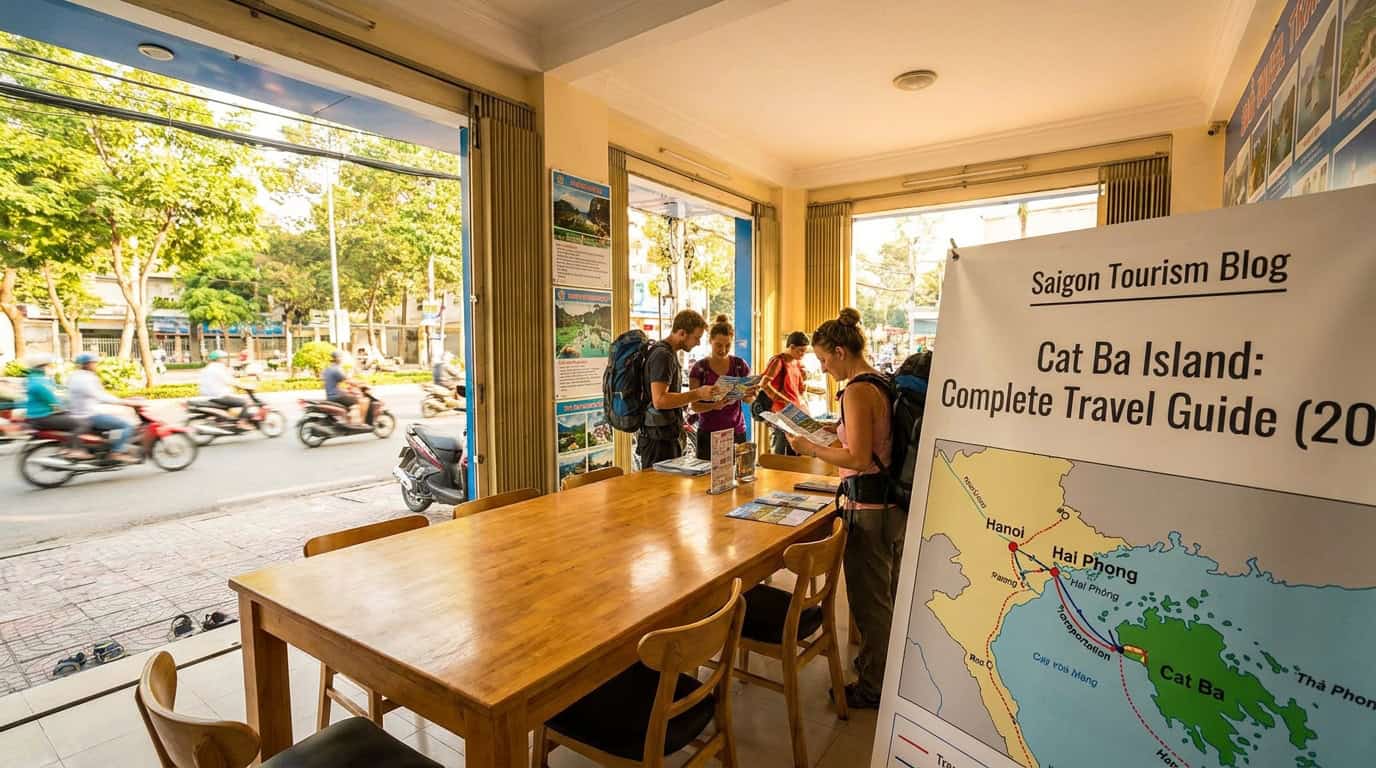
Cat Ba Town is the right base for most visitors. It’s walkable, well-connected
to boat tour operators, and puts every restaurant and landmark within easy reach.
Budget — 250,000–400,000 VND (~$10–$16/night): Guesthouses along Nui Ngoc
Street and 1 April Street are clean, air-conditioned, and include Wi-Fi. Don’t
pay more than 350,000 VND for a budget room — supply is high and there’s genuine
room to negotiate.
Mid-range — 700,000–1,500,000 VND (~$28–$60/night): Boutique hotels closer
to the harbor typically include breakfast, a sea-view balcony, and an in-house
tour booking desk. The breakfast alone usually justifies the premium over budget
guesthouses.
Splurge — 2,000,000–4,000,000 VND (~$80–$160/night): Eco-lodges and small
resort properties on the road toward Cat Ba National Park offer pools, private
balconies, and genuine quiet — worth considering if you’re staying three or more
nights.
Off the grid: A handful of fishing families in the village of Gia Luan (near
the northern ferry terminal) take paying guests for 300,000–500,000 VND
(~$12–$20) per night including dinner and breakfast. It’s not formally advertised
— ask guesthouses in Cat Ba Town to help arrange it.
Booking tip: Reserve at least two weeks ahead for April, May, September, and
October weekends. Good rooms in Cat Ba Town fill fast during those windows.
What to Eat: Seafood, Street Food, and Where to Go

Cat Ba’s food scene runs entirely on what arrived from the sea that morning. The
harbor stretch along 1 April Street is the best starting point: restaurants grill
whole squid (mực nướng) over charcoal for 80,000–120,000 VND (~$3.20–$4.80) and
serve steamed clams (ngao hấp sả) by weight at around 60,000 VND ($2.40) per 100
grams. Order directly from the live tanks — point at what you want, agree on the
weight, and they cook it in front of you.
Don’t miss these dishes:
- Bún cá — a thick, turmeric-tinged fish noodle soup native to the Hai Phong
region. Local plastic-chair spots one block inland from the harbor charge
40,000–60,000 VND (~$1.60–$2.40) per bowl. - Chả mực — fried squid cake, a regional specialty. Buy it fresh at the
morning market for 15,000 VND ($0.60) per piece; it tastes nothing like the
packaged souvenir version. - Lẩu hải sản (seafood hotpot) — a pot of prawns, squid, crab, and
vegetables for 250,000–400,000 VND (~$10–$16), best shared between two.
Order at dinner when the evening catch is freshest.
Green Mango Restaurant on 1 April Street is the most reliable mid-range
option, with English menus and mains around 120,000–200,000 VND (~$5–$8). For
the cheapest, most authentic meals, walk one block inland and join the fishing
community at the cơm bình dân (rice-plate) counters — a full lunch runs
50,000–70,000 VND (~$2–$2.80).
Best Time to Visit Cat Ba Island
March to May and September to November are the two optimal windows for visiting
Cat Ba Island, and experienced travelers almost universally choose one of these
over a summer trip.
Spring (March–May): Temperatures sit between 22–28°C, rain is infrequent,
visibility over the karsts is excellent, and accommodation prices run 20–30%
below the July–August peak. April and early May are the sweet spots — warm
enough to swim, clear enough for photography, and uncrowded enough to get a
kayak without booking three days ahead.
Autumn (September–November): The monsoon eases in September, the water stays
warm from summer heat, and the post-monsoon light over the limestone creates
genuinely beautiful conditions for photography. Prices drop sharply after the
August rush, and you can often walk into accommodation without a reservation in
October.
Avoid July and August if you can. These are peak Vietnamese domestic holiday
months — accommodation prices spike, boat tours sell out days in advance, and
Cat Ba Town gets crowded enough to strain its infrastructure.
January–February brings the coolest weather (15–18°C) and occasional mist,
which can be atmospheric for photography but doesn’t suit swimming or kayaking.
Chinese New Year (Tết, usually late January or early February) closes many
businesses for five to seven days.
and overall value. Source: saigonhomestay.com editorial.
Getting Around the Island
Cat Ba Town is entirely walkable — the harbor, Cat Co beaches, Hospital Cave, and
most restaurants sit within a 20-minute walk. Beyond town, three options cover
the island.
Motorbike rental is the most flexible choice. Shops along Nui Ngoc Street
rent semi-automatic 110cc bikes for 120,000–180,000 VND (~$5–$7) per day. The
road north to Cat Ba National Park and the fishing village of Gia Luan is
well-maintained and takes about 30 minutes each way.
Bicycle rental costs 50,000–80,000 VND (~$2–$3.20) per day and suits the
flat waterfront road. The loop from Cat Ba Town past Cat Co 1 and Cat Co 3 and
back is a pleasant 8 km ride, best done before the midday heat.
Xe ôm (motorbike taxis) cluster around the ferry terminal and the central
market. Agree on the price first — 30,000–70,000 VND (~$1.20–$2.80) covers most
in-town trips.
Boat access for Lan Ha Bay: All access is by sea. The pier opposite Ben Beo
harbor runs organized day trips from 350,000 VND (~$14) per person including
kayak hire. Private boat hire for groups of four to six runs 1,500,000–2,500,000
VND (~$60–$100) for a full day, negotiated at the pier.
Practical Tips Before You Go
Bring enough cash. Cat Ba has two ATMs near the town center (Agribank and
Vietcombank), but withdrawal limits are low and outages happen. Carry enough VND
from Hanoi or Hai Phong to cover your full stay.
Download offline maps. Mobile data works fine in Cat Ba Town with a Viettel
or Mobifone SIM, but drops out on hiking trails and inside the national park.
Download Maps.me or Google Maps offline before you leave — park trails are poorly
signed on the ground.
Book the return ferry early. Return boats fill quickly, particularly Sunday
afternoon departures. Buy your ticket the morning you plan to leave, or the
evening before during peak season.
Respect national park rules. No single-use plastics inside the park
boundaries, no feeding wildlife, and no leaving marked trails without an
authorized guide. Park rangers do check, and fines are enforced.
Sun protection is non-negotiable. Reflections off limestone and open water
amplify UV exposure dramatically — even on hazy days. Pack SPF 50+, a wide-brim
hat, and a rash guard for any kayaking session over an hour.
Frequently Asked Questions
Is it worth going to Cat Ba Island?
Cat Ba Island is absolutely worth visiting for independent travelers. It combines
UNESCO-protected karst scenery with genuine national park hiking, one of the
world’s rarest primates, and a seafood scene that rivals any Ha Long Bay cruise —
all for roughly 700,000–1,000,000 VND ($28–$40) per day. The four-hour journey
from Hanoi is straightforward, and two to four days gives you a rich, complete
experience.
What is better, Cat Ba or Halong Bay?
Cat Ba gives you more freedom, more activities, and better value. You’re based on
land, you can hike and kayak independently, and you have access to Lan Ha Bay,
which mirrors Ha Long Bay’s karst scenery with far fewer tourist boats. Ha Long
Bay suits travelers who specifically want the convenience of a packaged overnight
cruise. Most experienced Vietnam visitors rate Cat Ba the stronger all-round
experience.
What is the best month to visit Cat Ba Island?
April and October consistently score highest: temperatures are comfortable
(22–27°C), skies are clear, and crowds are manageable. The broader windows of
March–May and September–November are both excellent. Avoid July and August if
possible — these are peak Vietnamese domestic holiday months, when accommodation
prices spike and boat tours book out days in advance.
Is 4 days enough on Cat Ba Island?
Four days is actually an ideal length of time on Cat Ba Island. You can
comfortably fit a full-day Lan Ha Bay kayaking trip, a national park hike to Kim
Giao Peak, a Hospital Cave visit, a langur conservation tour, and still have an
afternoon free for the Cat Co beaches. Two full days covers the top essentials
without feeling rushed.
Start or End Your Vietnam Trip in Saigon
Cat Ba Island is one of the great northern additions to any Vietnam journey. When
you’re ready to head south — where the weather is reliable year-round, the food
scene is even louder, and District 1 keeps moving well past midnight — you’ll
want a home base that keeps everything within walking distance.
Saigon Homestay sits in the heart of District 1, Ho Chi Minh City —
three minutes on foot from Ben Thanh Market, five from the city’s best bánh mì
counters, and a short ride from every major landmark. Clean rooms, strong Wi-Fi,
and a team that actually knows the city.
Building your full Vietnam trip? Our Saigon itinerary guide
maps out three-to-seven-day plans for first-time visitors, and the things to do
in Ho Chi Minh City guide covers everything
from guided day tours to hidden local spots. Heading through central Vietnam first?
Our Hoi An travel guide and Hanoi travel
guide cover the rest of your route north to south.
Sources:
– UNESCO World Heritage Centre — Ha Long Bay – Cat Ba Archipelago, Viet Nam — retrieved 2026-06-09
– Cat Ba Langur Conservation Project — Population and Conservation Status — retrieved 2026-06-09
– Cat Ba National Park Authority, visitor fee schedule and trail data (verified on-site, 2025)
– General Statistics Office of Vietnam, Hai Phong Province Tourism Statistics Report, 2024
Carrying the right cash matters more than most visitors expect — see the Vietnam currency and money exchange guide before you arrive.
Related Guides
- Cat Ba Island vs Ha Long Bay: Where Should You Stay?
- Hoa Lu Ninh Binh: Ancient Capital Visitor Guide (2026)
- Mua Cave Ninh Binh: Hike, Views & Complete Guide
- Trang An Ninh Binh: Boat Tour Guide & Visitor Tips
- Ninh Binh Vietnam: Complete Travel Guide (2026)
- Ha Long Bay Luxury Cruise: Best High-End Options (2026)