
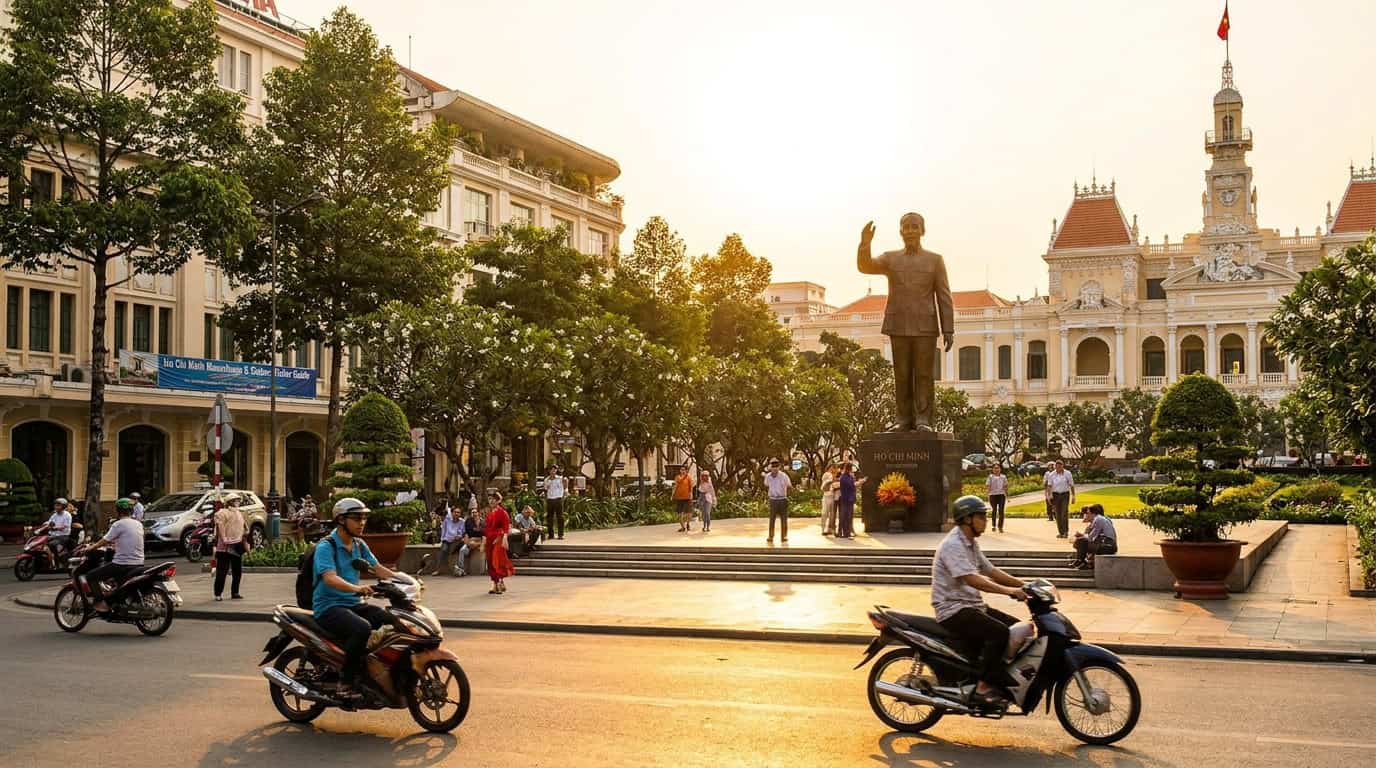
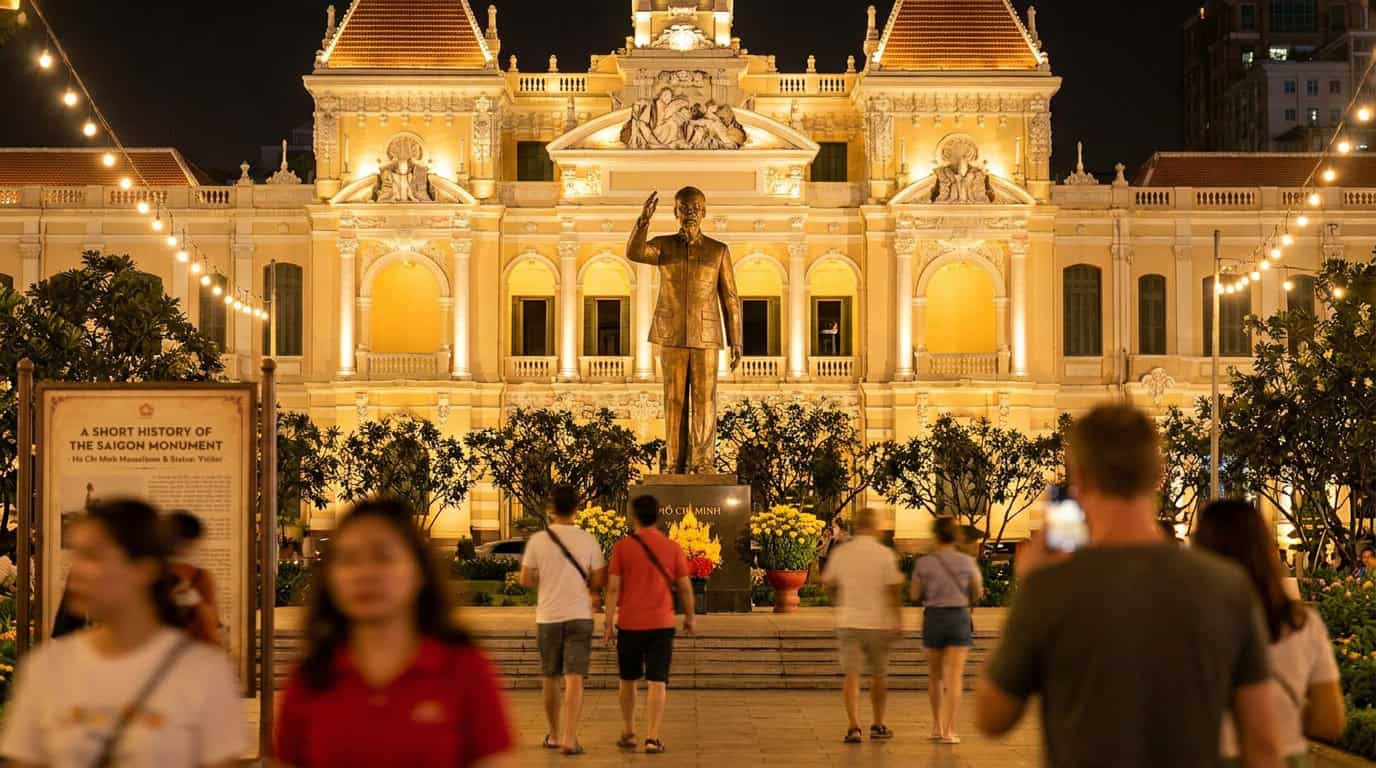
The Ho Chi Minh statue Saigon erected in front of City Hall is the most photographed monument in District 1, its seven-meter bronze figure overlooking the full length of Nguyen Hue Walking Street. Together with the Ho Chi Minh Mausoleum in Hanoi, it forms the most visited pair of historical landmarks in Vietnam. If you only have one afternoon in central Saigon, there is no better free anchor for your itinerary than the Ho Chi Minh statue Saigon locals and tourists flock to year-round.
This 2026 guide explains exactly what the Ho Chi Minh statue represents, what stands behind it, whether the Mausoleum in Hanoi is worth the long queue, and where “Uncle Ho’s” body actually rests today. You will also get opening hours, a dress code that will save you from being turned away at the gate, and walking directions from the homestays clustered around Ben Thanh Market.
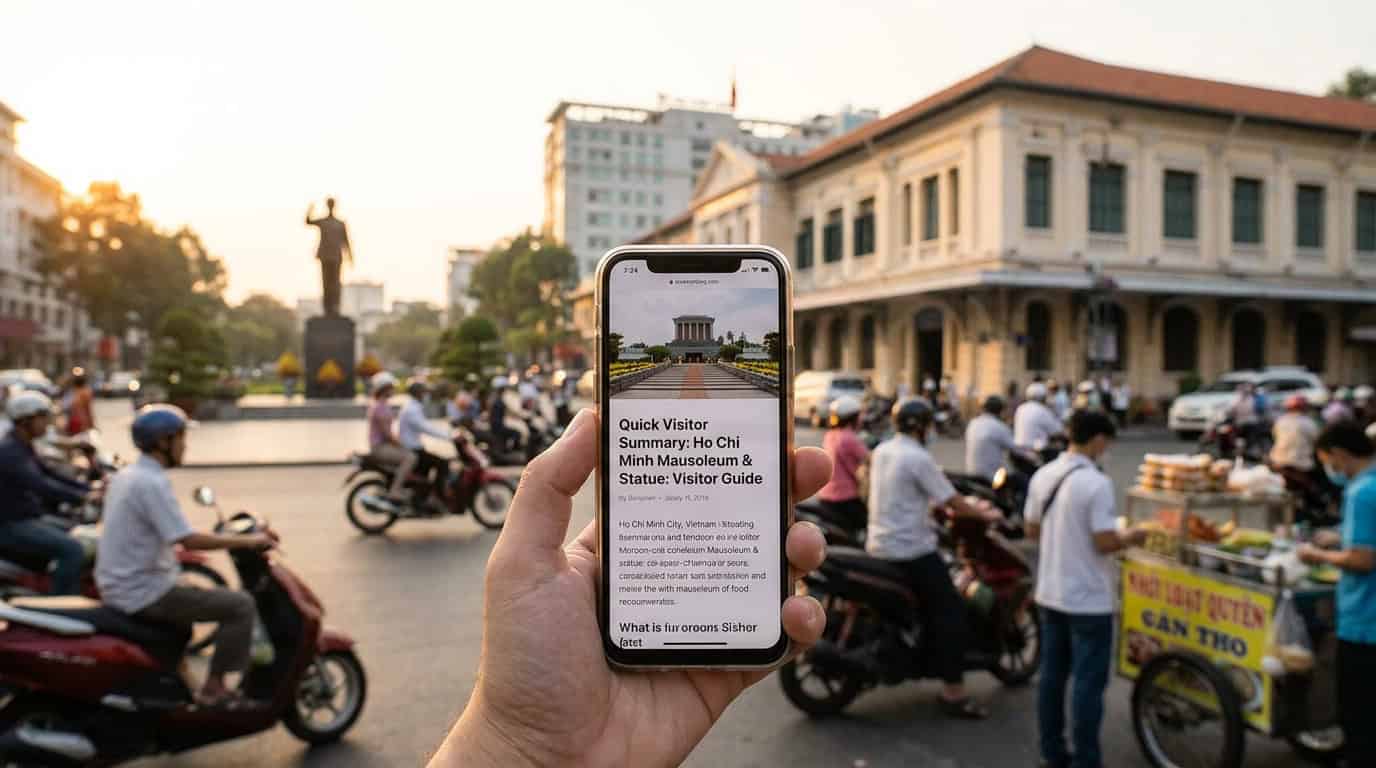
Quick Visitor Summary
Use this table to plan in 30 seconds. Both monuments are free, but the rules and timing are very different.
| Detail | Ho Chi Minh Statue (Saigon) | Ho Chi Minh Mausoleum (Hanoi) |
|---|---|---|
| Location | Nguyen Hue Walking Street, District 1 | 2 Hung Vuong, Ba Dinh Square, Hanoi |
| Opening hours | 24/7, outdoor plaza | Tue–Thu & Sat–Sun, 07:30–10:30 (Apr–Oct), 08:00–11:00 (Nov–Mar) |
| Closed days | Never | Mondays, Fridays, and Sept 4–Nov 4 (annual maintenance) |
| Entry price | Free | Free (passport required for foreigners) |
| Dress code | Casual is fine | Shoulders and knees covered; no shorts, tank tops, hats inside |
| Photography | Encouraged | Strictly forbidden inside the chamber |
| Best time | 18:00–21:00 for evening lighting | Arrive by 07:15 to beat the queue |
| Time needed | 15–30 minutes | 60–90 minutes total |
| Nearest landmark | Saigon City Hall (directly behind) | Presidential Palace, One Pillar Pagoda |
What Does the Ho Chi Minh Statue Saigon Represent?
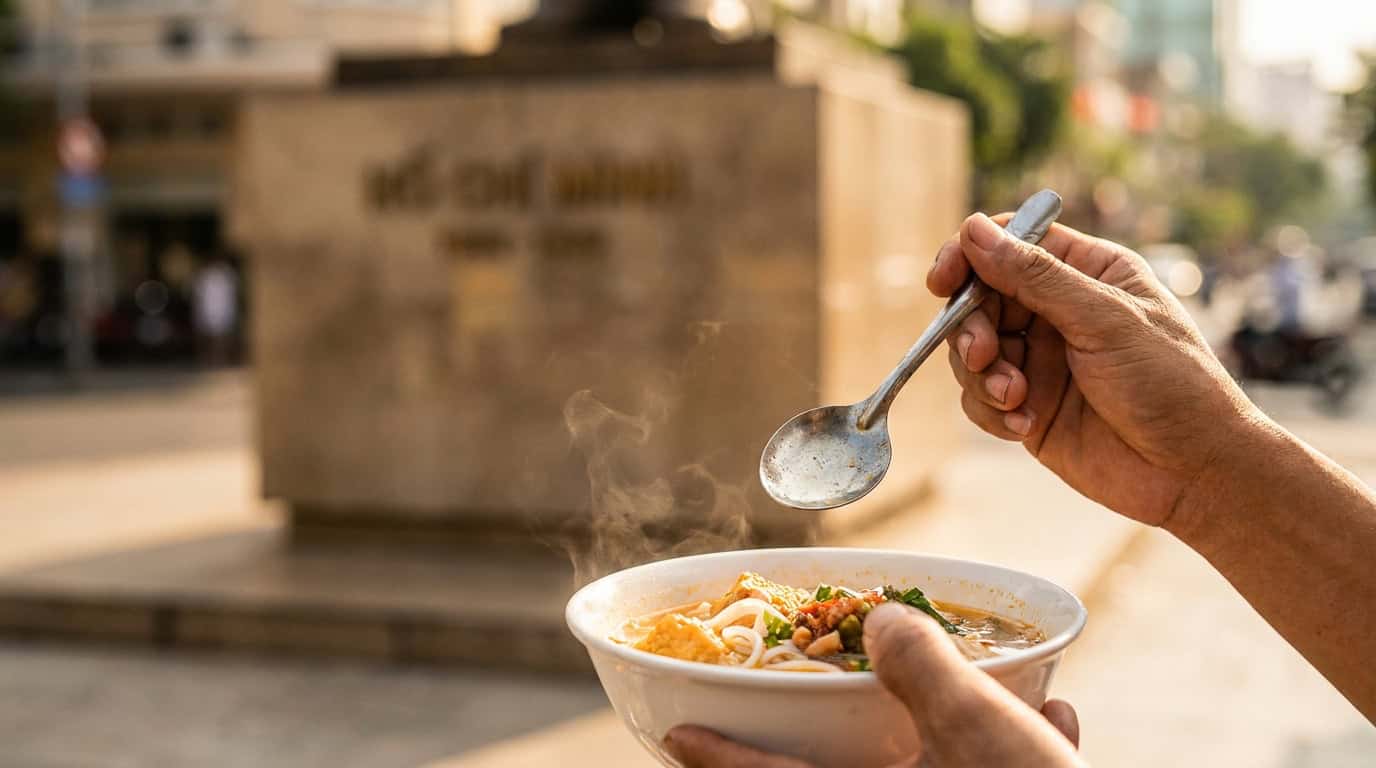
The Ho Chi Minh statue in Saigon represents Vietnam’s most enduring national symbol: the reunified country under a single founding figure. Unveiled on May 17, 2015 to mark the 125th anniversary of his birth, the seven-meter bronze figure shows Ho Chi Minh seated in a relaxed pose, one arm slightly raised in greeting. The Vietnam Tourism Administration describes it as deliberately warm and approachable, in contrast to the more austere standing pose preferred in northern monuments.
The statue replaced an older 1990 work that showed Ho Chi Minh holding a child. City planners decided that pose, while affectionate, made the figure look smaller than the colonial-era City Hall behind it. The 2015 redesign was specifically scaled to balance against the French Beaux-Arts facade, creating the visual conversation between colonial past and independent present that every guidebook now photographs.
For Vietnamese visitors, the monument carries three layered meanings:
- Unification — Saigon was renamed Ho Chi Minh City in 1976 after reunification, and the statue marks that political identity at the city’s symbolic center.
- Modesty — Ho Chi Minh is shown without military regalia, reflecting his lifelong preference for simple khaki clothing.
- Public access — Unlike statues sealed behind fences in many countries, this one sits at street level on a low pedestal so families can pose beside it.
If you want deeper context before visiting, our history of Saigon walking guide traces the same square from 1860s French colonization through the 2015 monument unveiling.
What Is the Building Behind the Statue of Ho Chi Minh?
The grand cream-and-yellow building directly behind the Ho Chi Minh statue is the Ho Chi Minh City People’s Committee Building, more commonly called Saigon City Hall. Built between 1902 and 1908 by French architect Femand Gardès, it was originally the Hôtel de Ville de Saïgon, the colonial city hall of French Cochinchina.
Architecturally it is a textbook example of French Third Republic civic design: a central clock tower, two symmetrical wings, allegorical sculptures of “the taming of wild beasts” above the main entrance, and decorative motifs blending French neoclassicism with subtle Indochinese flourishes. UNESCO has flagged it as one of Southeast Asia’s best-preserved colonial administrative buildings.
A few practical notes:
- The interior is closed to the public because it remains an active government office.
- The exterior is floodlit nightly from 18:00 to 23:00, which is when the photos circulating on Instagram are usually taken.
- Public tours are offered two weekends per year, typically around National Day (September 2) and Reunification Day (April 30). Tickets are free but require advance registration through the city tourism portal.
The plaza in front, Nguyen Hue Walking Street, was pedestrianized in 2015 — the same year the statue was unveiled — turning what used to be a six-lane road into a 670-meter promenade. For a full walking route from here to the Saigon Opera House and Notre Dame Cathedral, see our Nguyen Hue Walking Street guide.
A Short History of the Saigon Monument
The current statue is actually the third dedicated to Ho Chi Minh on this exact site:
- 1969 — A small commemorative bust was briefly installed by the Provisional Revolutionary Government in the months after Ho Chi Minh’s death.
- 1990 — A taller standing figure holding a child was inaugurated for the centenary of his birth. It became affectionately known as “Bac Ho with the child” and stood for 25 years.
- 2015 — The current seated bronze, designed by sculptor Lam Quang Noi, was unveiled. It weighs roughly seven tons and was cast in a foundry in Ha Tay province before being trucked south.
VnExpress notes in its survey of Ho Chi Minh monuments around the world that Vietnam now has more than 130 official statues of the leader, with replicas in Russia, France, India, Mexico, Cuba, and Chile. The Saigon version remains the most visited, partly because it is the only major one located in a fully pedestrianized commercial district.
Is It Worth Going Inside Ho Chi Minh Mausoleum?
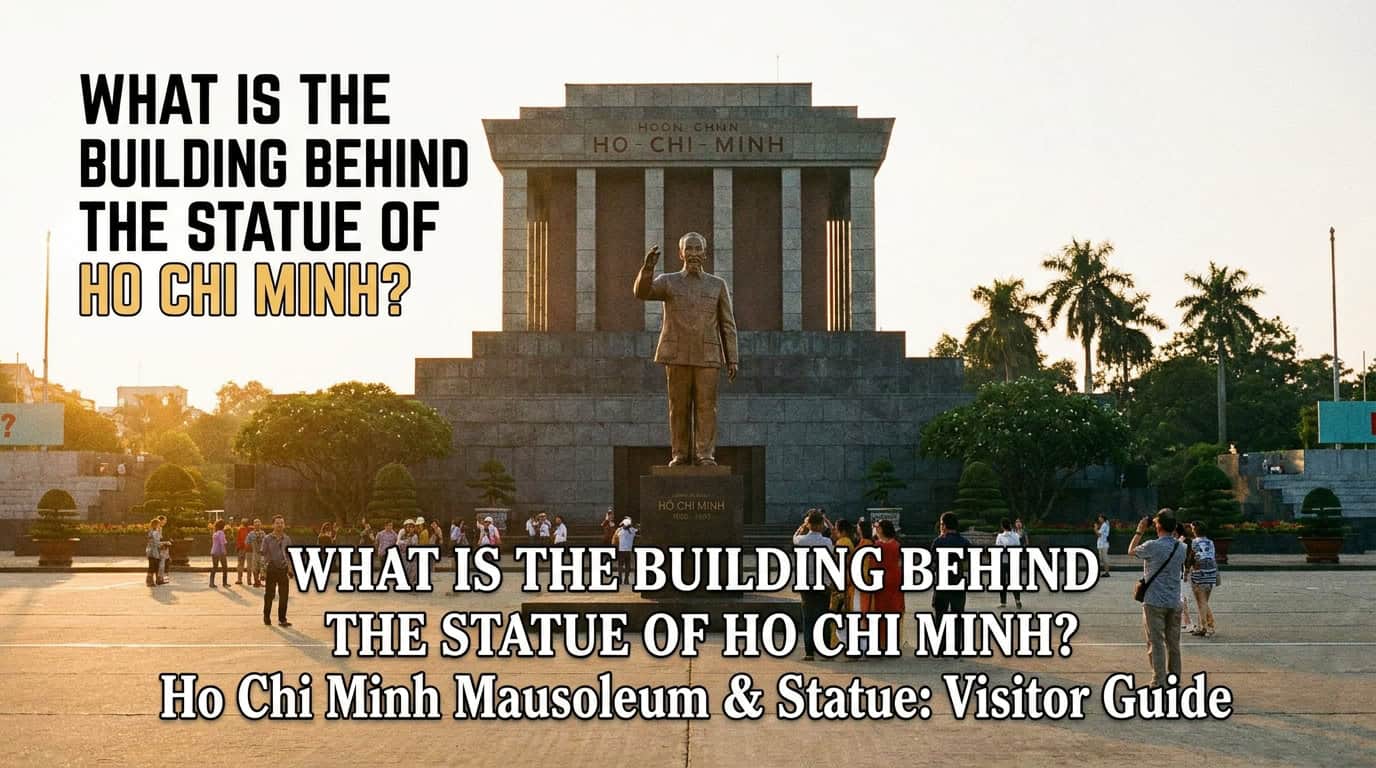
Yes — but only if you accept the rules and arrive prepared. The Ho Chi Minh Mausoleum in Hanoi is worth visiting because it is one of only four publicly viewable embalmed-leader mausoleums left in the world (alongside Lenin in Moscow, Mao in Beijing, and Kim Il-sung and Kim Jong-il in Pyongyang). For travelers interested in 20th-century political history, the experience is genuinely singular.
What makes it worthwhile:
- Free admission, which is rare for a top-five national monument anywhere in Asia.
- The changing of the guard at the entrance happens roughly every hour and is precisely choreographed.
- The viewing itself takes about 90 seconds as the line moves continuously past the glass sarcophagus. You will not have to linger if it feels uncomfortable.
- The surrounding complex is excellent — the Presidential Palace gardens, Ho Chi Minh’s stilt house, the One Pillar Pagoda, and the Ho Chi Minh Museum are all within a five-minute walk and can be combined into one morning.
What might make it not worth it for you:
- Queues regularly run 45 to 90 minutes in peak season (October–March).
- No bags, cameras, phones, or large items are allowed inside the chamber. You will check everything into a locker before entering, which adds 20 minutes either side.
- Strict dress code: covered shoulders and knees are mandatory. Shorts, miniskirts, and tank tops will get you turned away at the security check. Hats and sunglasses must come off before entering.
- Complete silence is required, hands out of pockets, no talking, no stopping to look. Guards will tap you on the shoulder if you slow down.
- The Mausoleum closes for two months every autumn (typically September 4 to November 4) when the body is sent to Russia for routine maintenance — confirm dates before booking flights.
If you only have time for one historical site in Hanoi, most travelers we host prefer the Hoa Lo Prison Museum or the Vietnam Museum of Ethnology for depth. But if you are already in Ba Dinh district for the wider Presidential Palace complex, the Mausoleum slots in naturally at the start of the morning.
Where Is Ho Chi Minh’s Corpse?
Ho Chi Minh’s embalmed body rests permanently in the Ho Chi Minh Mausoleum at 2 Hung Vuong Street, Ba Dinh Square, Hanoi. He died on September 2, 1969 — Vietnam’s National Day — at age 79.
The story of how his body ended up there contradicts his own wishes. Ho Chi Minh’s will, made public after the war, explicitly requested cremation and that his ashes be divided between three hills in northern, central, and southern Vietnam. The Politburo overruled this in 1969 because they considered a visible national figure essential for morale during the ongoing war with the United States. Soviet embalming specialists who had previously worked on Lenin’s body were flown in to begin preservation.
A few facts that surprise most visitors:
- Construction of the granite Mausoleum did not begin until 1973 and was not completed until 1975, six years after his death. During that period the body was hidden in a cave complex in the mountains north of Hanoi to protect it from American bombing raids.
- The body is sent to a Russian laboratory in Moscow for refurbishment approximately every two years. This is the reason for the annual September–November closure.
- According to reporting by Reuters and Vietnam News Agency, the Vietnamese government spends a confidential annual budget — estimated by independent analysts at several hundred thousand US dollars — on preservation, making it one of the more expensive embalming projects in continuous operation today.
- The Saigon Ho Chi Minh statue is sometimes mistakenly assumed by first-time visitors to be a tomb. It is not. It is purely a commemorative monument; no remains are interred anywhere in southern Vietnam.
How to Get to the Saigon Statue
The Ho Chi Minh statue sits at the northern end of Nguyen Hue Walking Street, where it meets Le Thanh Ton Street. It is one of the easiest landmarks in Vietnam to reach.
- From Ben Thanh Market: 700 meters north on Le Loi, then right on Nguyen Hue. About 9 minutes on foot.
- From the Saigon Opera House: 350 meters west along Le Loi. Five minutes.
- From Tan Son Nhat Airport: 7 km, 25–40 minutes by Grab depending on traffic. Expect 180,000–250,000 VND.
- By Metro Line 1: The Ben Thanh terminus opened in late 2024 and is now the fastest option from An Phu and Thao Dien. Exit at Ben Thanh and walk 9 minutes.
- By bus: Routes 03, 19, 36, and 152 stop within 300 meters.
Most of our guests staying in central District 1 simply walk — the statue is within 15 minutes of nearly every homestay between Ben Thanh and the Saigon River. For a curated route that hits five free landmarks in one loop, see our free things to do in District 1 guide.
Best Time to Visit the Saigon Statue
The Saigon Ho Chi Minh statue is technically open 24 hours a day, but four time windows give you very different experiences:
- 06:00–08:00 — Quiet, soft morning light, locals doing tai chi on the plaza. Best for photography without crowds.
- 11:30–14:00 — Avoid. The plaza has almost no shade and surface temperatures regularly exceed 38°C in dry season (December to April).
- 17:30–19:00 — Golden hour on the City Hall facade, growing crowds, food vendors appear along Nguyen Hue.
- 19:00–22:00 — Peak experience. City Hall is floodlit, water features along Nguyen Hue are running, and weekend nights bring street performers. This is when most professional photographs you see online are taken.
If your visit overlaps with a major holiday — Reunification Day (April 30), International Labor Day (May 1), National Day (September 2), or Tet (late January or early February) — expect the plaza to be decorated with hundreds of red banners and tens of thousands of visitors. Beautiful but crowded.
Photography Tips for the Statue
A few practical pointers from photographers we host regularly:
- Stand on the eastern side of Nguyen Hue, about 60 meters back, to get the statue and the full clock tower of City Hall in one frame without distortion.
- Use a 35mm or 50mm equivalent lens — wider angles bend the colonial architecture unnaturally.
- Drones are prohibited over the plaza without a special permit. Several travelers each year have their drones confiscated by the police at City Hall. Do not risk it.
- Tripods are tolerated at night but discouraged during weekend evenings when foot traffic peaks.
- The bronze surface picks up reflections of City Hall’s yellow facade after dark, which is the look most travel magazines try to capture.
Combining the Statue with Other District 1 Sights
The Ho Chi Minh statue is at the dead center of the densest concentration of historical sights in Vietnam. A reasonable half-day walking loop:
- Ho Chi Minh statue and City Hall (15 min)
- Nguyen Hue Walking Street — stroll south toward the river (20 min)
- Bitexco Financial Tower Saigon Skydeck — optional 49th-floor view (45 min)
- Saigon Opera House (15 min, exterior only unless you have evening tickets)
- Notre Dame Cathedral and Saigon Central Post Office (30 min)
- Independence Palace (60 min, paid entry)
- War Remnants Museum (90 min, paid entry)
Most guests finish this loop in 4–5 hours including coffee stops. Our one day in Saigon itinerary maps the exact route with time estimates between each stop.
Etiquette and Common Mistakes
A short list of things that get foreign visitors in trouble at both the Saigon Ho Chi Minh statue and the Hanoi Mausoleum:
- Do not climb on the pedestal of the Saigon statue for photos. Security will move you on quickly, and during national holidays there are uniformed guards on the plaza around the clock.
- Do not pose disrespectfully — peace signs and family poses are fine; mock-saluting, finger guns, or anything mocking will draw a sharp response.
- Remove hats and sunglasses when entering the Mausoleum chamber in Hanoi. Many tourists forget this and get turned around after queueing for an hour.
- Do not bring food, drink, or chewing gum into the Mausoleum complex. Water bottles are checked into the locker room.
- Photography of the embalmed body is a criminal offense under Vietnamese law. Phones must be in lockers, not pockets.
What It Costs to Visit (and What’s Nearby for a Drink)
| Item | Approximate cost (VND) | USD equivalent |
|---|---|---|
| Statue plaza entry | Free | Free |
| Bottle of water from a street vendor | 10,000 | $0.40 |
| Vietnamese iced coffee at a Nguyen Hue cafe | 45,000–80,000 | $1.80–$3.20 |
| Saigon Opera House evening show | 700,000–1,600,000 | $28–$64 |
| Bitexco Skydeck adult ticket | 240,000 | $9.60 |
| Independence Palace entry | 65,000 | $2.60 |
| War Remnants Museum entry | 40,000 | $1.60 |
For a post-photography coffee, The Workshop, Shin Coffee, and Cong Caphe are all within a five-minute walk of the statue and represent the three dominant cafe styles in Saigon (third-wave, single-origin Vietnamese, and retro-communist). Our best coffee shops near Nguyen Hue breakdown sorts them by atmosphere and price.
Frequently Asked Questions
What does the Ho Chi Minh statue represent?
The Saigon Ho Chi Minh statue represents Vietnam’s reunification under a single national figure. Unveiled in 2015, the seven-meter bronze depicts Ho Chi Minh seated and waving in a deliberately warm, approachable pose — contrasting with the more austere standing statues in northern Vietnam — to emphasize modesty, accessibility, and the symbolic identity of Ho Chi Minh City itself, which was renamed from Saigon in 1976.
What is the building behind the statue of Ho Chi Minh?
The building behind the statue is Saigon City Hall, officially the Ho Chi Minh City People’s Committee Building. Designed by French architect Femand Gardès and completed in 1908, it served as the colonial city hall of French Cochinchina and now houses the city government. The interior is closed to the public, but the floodlit exterior between 18:00 and 23:00 is one of the most photographed colonial facades in Southeast Asia.
Is it worth going inside Ho Chi Minh Mausoleum?
Yes, if you accept the rules — strict dress code, no photography, no bags, complete silence, and queues of up to 90 minutes in peak season. It is one of only four publicly viewable embalmed-leader mausoleums in the world, admission is free, and the surrounding Ba Dinh complex (Presidential Palace, stilt house, One Pillar Pagoda, Ho Chi Minh Museum) makes a full morning. Skip it if you cannot arrive before 08:00 or if you have already visited Lenin’s or Mao’s tombs and want something different.
Where is Ho Chi Minh’s corpse?
Ho Chi Minh’s embalmed body is in the Ho Chi Minh Mausoleum at 2 Hung Vuong Street, Ba Dinh Square, Hanoi. He died on September 2, 1969, and Soviet embalmers preserved his body despite his written wish to be cremated. It is publicly viewable Tuesday through Thursday and Saturday through Sunday mornings, and is sent to a Russian laboratory approximately every two years for preservation maintenance, which is why the Mausoleum closes annually from early September to early November.
Can I visit both the statue and the Mausoleum in one trip?
Yes — Vietnam Airlines, VietJet, and Bamboo Airways operate roughly 50 daily flights between Tan Son Nhat (SGN) and Noi Bai (HAN), with flight time of about 2 hours 10 minutes and one-way fares typically between 1,200,000 and 2,500,000 VND. The Reunification Express overnight train is the slower scenic alternative at 32–35 hours. Many of our guests use Saigon as a base, fly to Hanoi for two nights to see the Mausoleum, Hoa Lo Prison, and Ha Long Bay, then return south.
External Sources
- Vietnam Tourism Administration: President Ho Chi Minh statue unveiled in southern metropolis — official government record of the 2015 unveiling.
- VnExpress International: Ho Chi Minh monuments around the world — photo survey of more than 130 monuments globally.
- BBC News: Vietnam’s embalmed leader and the Soviet science behind him — background on the preservation process and Russian laboratory cycle.
Stay Five Minutes from the Statue
Every sight in this guide is within walking distance of our central District 1 homestays. Guests at Saigon Homestay’s Nguyen Hue and Ben Thanh properties are 5–12 minutes on foot from the Ho Chi Minh statue, City Hall, the Opera House, and Notre Dame Cathedral — meaning you can photograph the statue at sunrise, return for breakfast, and be back at the floodlit plaza by 19:00 without ever touching a taxi.
Browse available central District 1 homestays for your dates →
Have a question we did not answer here? Message our front desk team on WhatsApp — most replies arrive in under 10 minutes, 7:00 to 23:00 Indochina Time.
Staying in Saigon?
We host furnished apartments in District 1 — studios up to two-bedroom lofts, for stays from three nights to six months. See the apartments or check availability and book direct with us.
Work out transport before you go: getting around Saigon covers Grab, the metro, buses and the waterbus, with real prices.
Related Guides
- 30 Best Things To Do in Ho Chi Minh City (2026)
- Ho Chi Minh City Opera House: Shows, Tours & Visitor Info
- Best Spas & Massage in Saigon: Complete Guide
- Saigon Nightlife Guide: Bars, Clubs & What to Expect
- Saigon Rooftop Bars: Best Views in the City (2026)
- Best Day Trips from Saigon: Complete Guide (2026)