
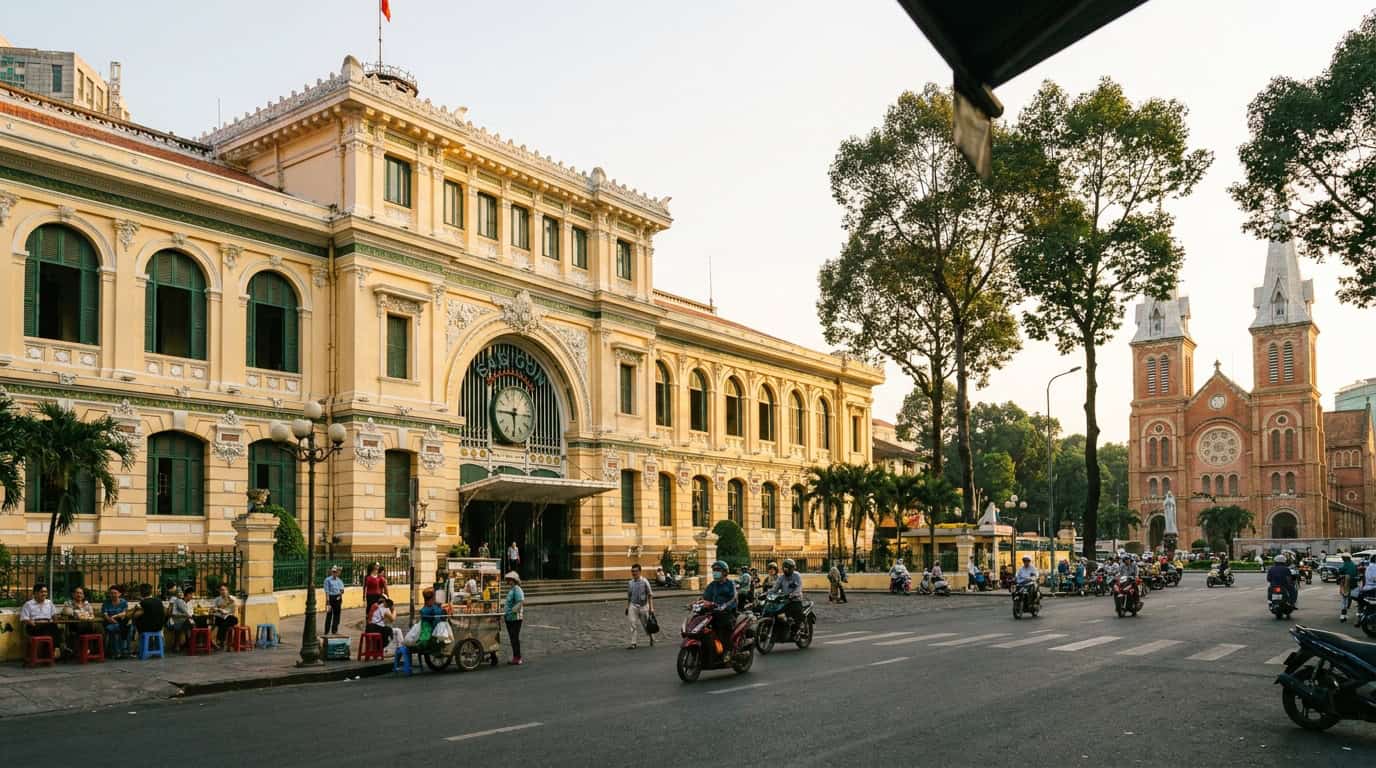
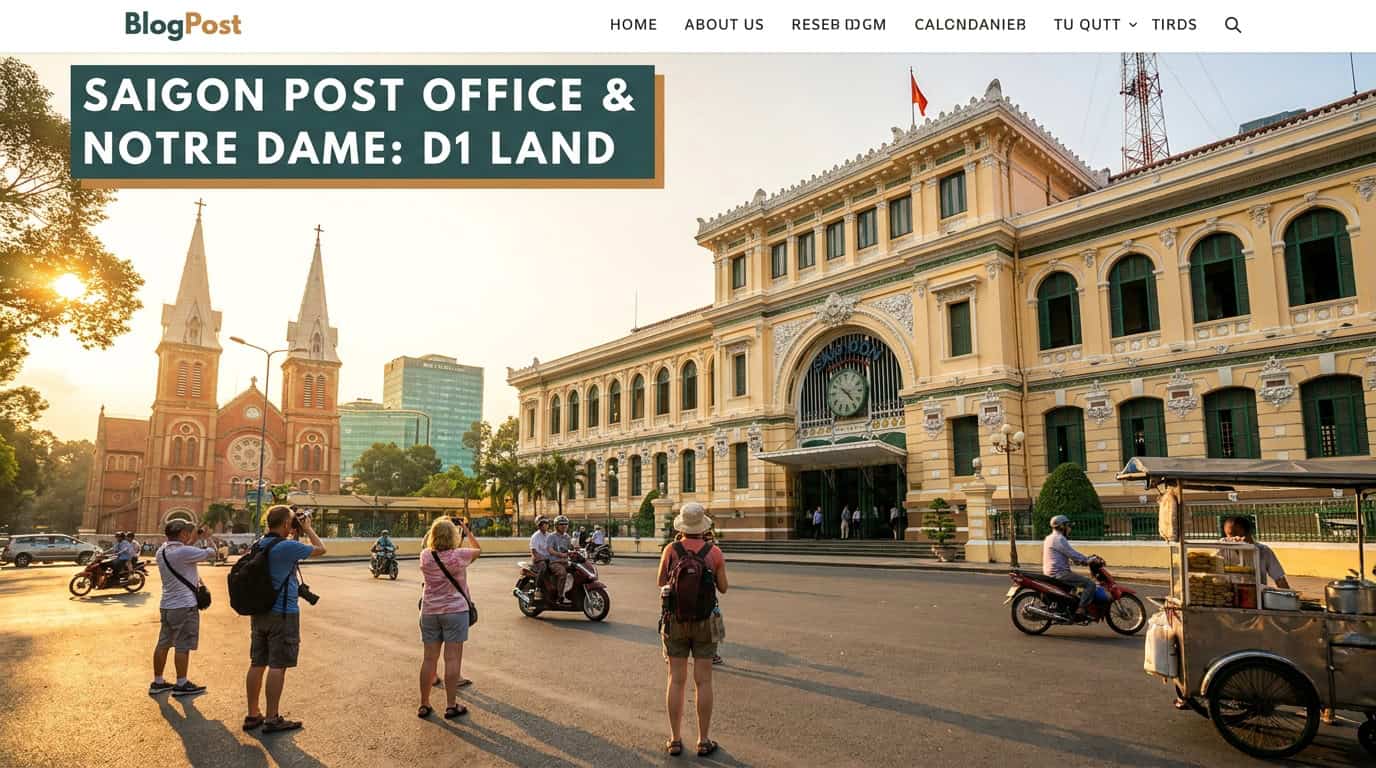
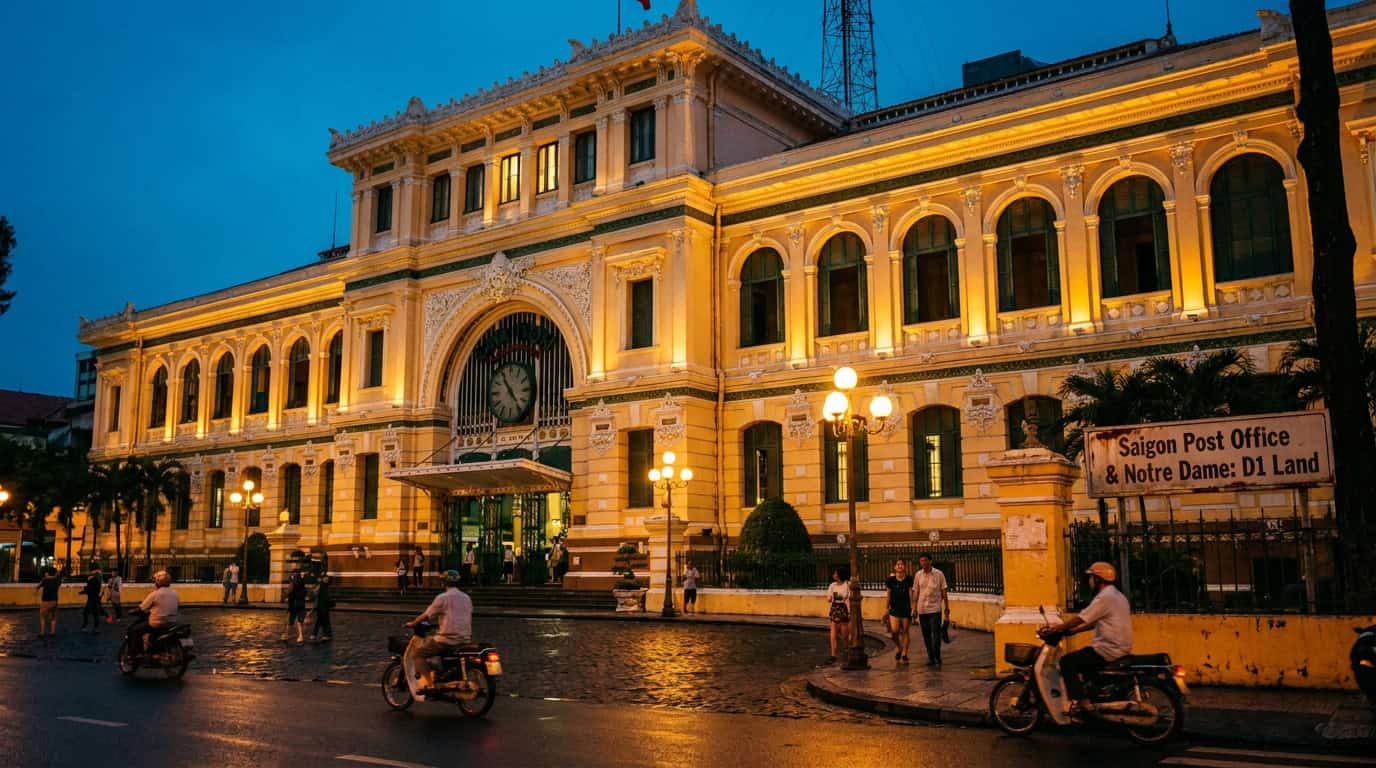
The Saigon Post Office is the most photographed colonial-era building in Ho Chi Minh City, and it sits directly across a small plaza from Notre Dame Cathedral — meaning you can tick off two of District 1’s most iconic landmarks in a single 90-minute walk. Both buildings are free to enter, both are still functioning (the post office still sells stamps; the cathedral still holds Mass), and both are a five-minute stroll from the upper end of Nguyen Hue walking street.
This guide covers everything you need to plan that visit in 2026: opening hours, the best time of day for photos, the history behind the famous Gustave Eiffel attribution myth, the ongoing Notre Dame restoration, and exactly how to combine the two stops with nearby cafés, bookshops, and rooftop bars. If you are staying in District 1, the Saigon Post Office should be on your first-morning list.
Quick-Reference Summary Table
| Detail | Saigon Central Post Office | Notre Dame Cathedral Basilica |
|---|---|---|
| Address | 2 Cong Xa Paris, Ben Nghe Ward, District 1 | 1 Cong Xa Paris, Ben Nghe Ward, District 1 |
| Opening Hours | Mon–Fri 7:00–19:00, Sat–Sun 8:00–18:00 | Exterior viewing 24/7; interior closed for restoration through late 2027 |
| Entry Price | Free | Free (when open) |
| Best Time to Visit | 7:30–9:00 AM (cool light, no crowds) | Golden hour, around 17:30 |
| Time Needed | 30–45 minutes | 15–20 minutes (exterior) |
| Nearest Metro | Ben Thanh Station (Line 1), 10-min walk | Same |
| Photography | Allowed; no flash inside | Exterior only during restoration |
| Accessibility | Step-free main entrance | Steps at front; side ramp available |
Why Is the Saigon Post Office Famous?
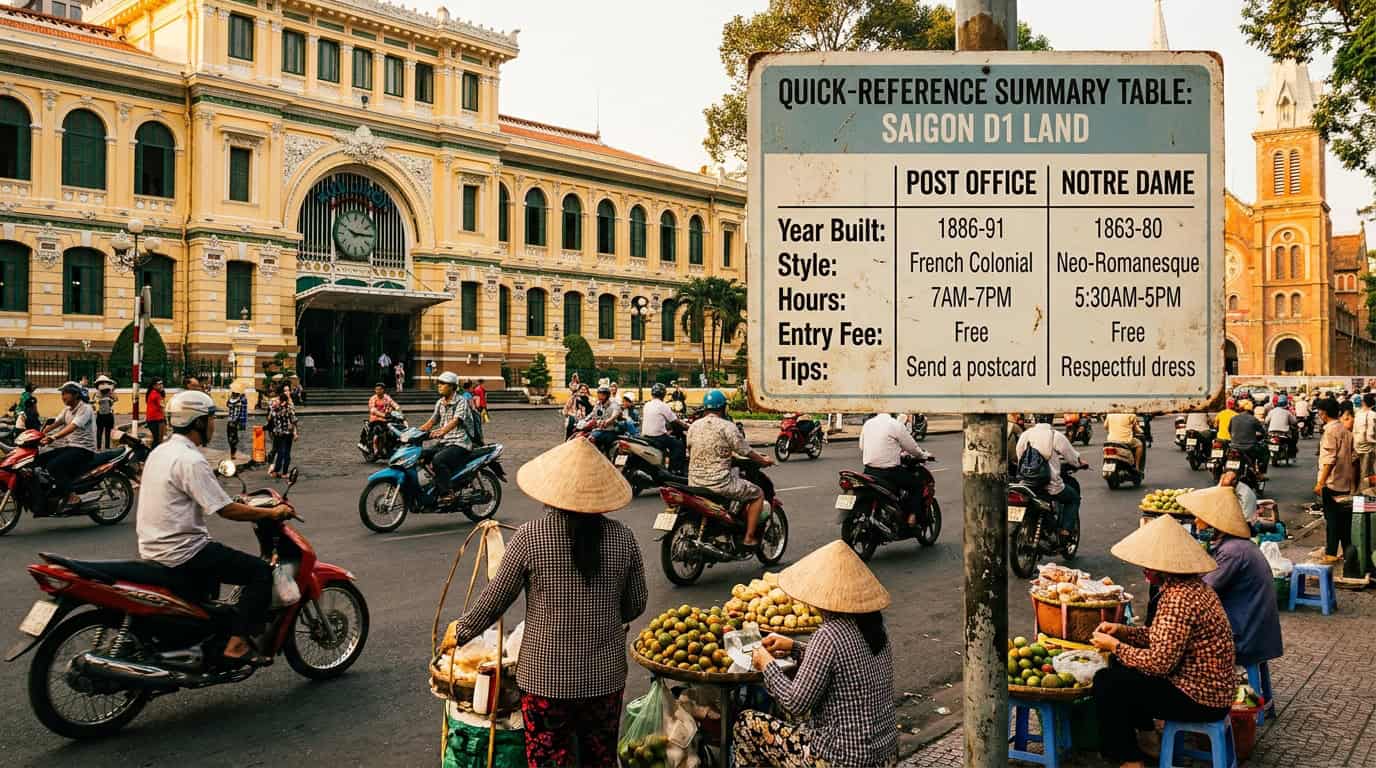
The Saigon Post Office is famous for three reasons: its 1891 French colonial architecture, its still-active postal service inside a museum-quality interior, and the persistent (but inaccurate) legend that Gustave Eiffel designed it. Built between 1886 and 1891 under the direction of architects Alfred Foulhoux and Henri Vildieu, the building blends Gothic, Renaissance, and French Second Empire styles into a single yellow-and-cream facade that has barely changed in 135 years.
Step inside and the wow moment hits immediately: a soaring arched vault, green wrought-iron lattice work, original wooden phone booths converted into ATM kiosks, and two enormous hand-painted maps from 1892 — one of southern Vietnam’s telegraph lines, the other of Saigon and its surroundings. A large portrait of Ho Chi Minh anchors the far wall, a 1975 addition that gives the colonial space its modern Vietnamese identity.
According to UNESCO’s Memory of the World documentation on French Indochina archives, the building is one of the best-preserved examples of late-19th-century colonial civic architecture in Southeast Asia. The Wikipedia entry on the Saigon Central Post Office correctly notes that the Eiffel attribution is a tourism myth — Eiffel’s firm worked on the nearby Long Bien Bridge in Hanoi, not this building.
Is the Saigon Post Office Worth Visiting?
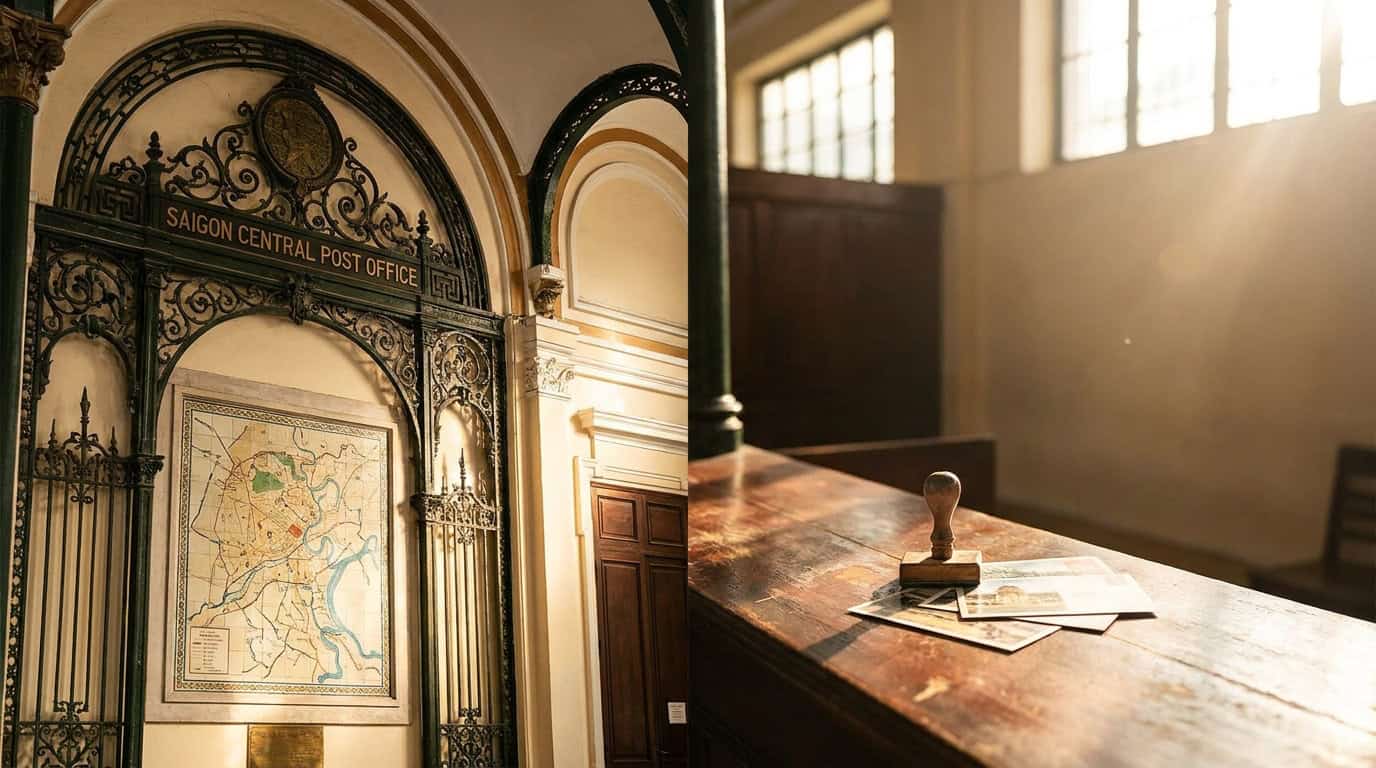
Yes — and unusually so for a free attraction. Most Ho Chi Minh City landmarks reward 10 minutes of attention; the Saigon Post Office comfortably fills 30 to 45 minutes if you actually look at the maps, write a postcard at one of the long wooden tables, and watch the resident letter-writer Mr. Duong Van Ngo’s legacy continue (he passed in 2023 after 76 years writing letters there; volunteers occasionally still offer the service).
Here is the honest case for visiting:
- Architectural payoff per minute is high. The interior is the photograph, and it costs nothing.
- It pairs perfectly with Notre Dame Cathedral, which is literally across the plaza. Two landmarks, one walk, zero entry fees.
- It is a working post office. You can buy stamps, mail a postcard home, or use the currency exchange counter — which is something you cannot do at the Reunification Palace or the War Remnants Museum.
- The souvenir stalls inside are better priced than Ben Thanh Market. Lacquerware, magnets, and Vietnamese coffee filters sell for 30–40% less than tourist-market prices.
The case against: it gets crowded between 10:00 AM and 4:00 PM as tour buses arrive. If you visit at opening time, you will share the hall with a handful of locals queueing for parcels and almost no other tourists.
A Brief History of the Saigon Central Post Office
Construction began in 1886, four years after France formally consolidated its rule over Cochinchina. The brief was ambitious: build a telegraph and postal hub that would connect Saigon to Paris, Hong Kong, and the rest of the French colonial network. The building opened in 1891 and immediately became the technological heart of the colony.
The two giant maps on the interior walls are the clearest record of that mission. The left-hand map, dated 1892 and titled Lignes télégraphiques du Sud Vietnam et Cambodge, shows every telegraph line radiating out from Saigon. The right-hand map, Saigon et ses environs 1892, depicts the city before most of its 20th-century expansion — a useful reference if you are also planning to visit the Reunification Palace and surrounding French Quarter.
During the American War (known internationally as the Vietnam War), the post office continued operating throughout. After 1975, the new government kept the building, the maps, and the original interior intact — a preservation decision that looks wiser every year. The Vietnam Airlines travel team’s feature on the Saigon Central Post Office describes the postwar preservation effort in more detail.
Is the Saigon Post Office Still a Functioning Post Office?
Yes. The Saigon Post Office is a fully operational branch of Vietnam Post. You can:
- Buy domestic and international stamps at the counters along the left wall
- Mail postcards, letters, and small parcels worldwide
- Use the on-site currency exchange (rates are competitive — usually within 0.5% of bank rates)
- Send international remittances via Western Union
- Buy SIM cards from Viettel and Vinaphone counters
- Use the public ATMs inside the converted phone booths
A postcard to Europe, North America, or Australia costs around 25,000–30,000 VND (about US$1.00–$1.20) including the stamp. This is the cheapest souvenir-with-purpose in District 1, and the postmark itself is a collector’s item because the postal cancellation still reads “Buu Dien Trung Tam Sai Gon” in the original 19th-century type style.
How Much Does It Cost to Visit the Saigon Post Office?
Entry is completely free — there is no ticket, no donation box, and no time limit on how long you can stay. This is unusual for a District 1 landmark of this stature and one of the reasons the building features in nearly every “free things to do in Ho Chi Minh City” list, including the well-regarded Ahoy Vietnam guide to the Saigon Central Post Office.
Optional costs you might incur once inside:
| Item | Typical Price (VND) | USD Equivalent |
|---|---|---|
| Postcard (blank) | 5,000–10,000 | $0.20–$0.40 |
| International stamp | 20,000–25,000 | $0.80–$1.00 |
| Vietnamese coffee filter (phin) | 80,000–150,000 | $3.20–$6.00 |
| Lacquerware magnet | 30,000–50,000 | $1.20–$2.00 |
| Áo dài silk scarf | 200,000–400,000 | $8.00–$16.00 |
Cash is preferred at the souvenir counters; the main postal counters accept Vietnamese debit cards and increasingly accept Visa and Mastercard.
Notre Dame Cathedral Basilica of Saigon: The Other Half of the Visit
Step out of the post office’s main door and you are looking directly at the red-brick twin spires of Notre Dame Cathedral Basilica of Saigon. Built between 1877 and 1880 — eleven years before the post office — the cathedral uses bricks shipped from Marseille that have famously never faded. The original stained glass came from Chartres, France, and the bells were cast in Bordeaux.
Important update for 2026 visitors: the cathedral has been under major restoration since 2017, with the interior closed to the public throughout. The current Archdiocese of Saigon timeline targets a late-2027 reopening, although the project has been extended multiple times. You can still walk around the exterior, photograph the spires, and visit the small statue of the Virgin Mary in the plaza — the same statue that locals believed shed tears in October 2005, an event that briefly drew international press coverage.
For the most current restoration updates, the Vinpearl guide to the Saigon Central Post Office and the Vietnam Discovery overview of the post office and cathedral area both maintain useful timelines.
How to Get to the Saigon Post Office
The post office sits at 2 Cong Xa Paris (“Paris Commune Square”), Ben Nghe Ward, District 1. Three practical ways to arrive:
By Metro Line 1 (opened December 2024). Get off at Ben Thanh Station and walk north on Pasteur Street for about 800 meters. The walk takes 10–12 minutes and passes the Bitexco Tower and several good coffee stops.
By Grab or taxi. A Grab car from anywhere in District 1 costs 30,000–60,000 VND. Show the driver the Vietnamese name: Bưu điện Trung tâm Sài Gòn. Most drivers will know it instantly.
On foot from Nguyen Hue walking street. The post office is 700 meters north of the Saigon Opera House — a 9-minute walk through tree-lined streets that are some of the most pleasant in District 1.
If you are staying at one of our recommended homestays near Ben Thanh Market, the walk is under 15 minutes.
Best Time of Day to Visit
| Time Slot | Crowd Level | Photography Conditions | Recommended For |
|---|---|---|---|
| 7:00–8:30 AM | Very low | Soft east light through arched windows | Photographers, solo travelers |
| 8:30–10:00 AM | Low | Even interior light | First-time visitors |
| 10:00 AM–12:00 PM | High | Crowded interior | Avoid if possible |
| 12:00–2:00 PM | Very high | Tour bus peak | Avoid |
| 2:00–4:00 PM | High | Harsh midday remnants | Avoid |
| 4:00–6:00 PM | Medium | Golden hour exterior | Cathedral exterior shots |
| 6:00–7:00 PM | Low | Façade lighting comes on | Night photography |
The single best window is 7:30 to 9:00 AM on a weekday morning. The east-facing main entrance catches the morning sun, the interior is genuinely quiet, and you can grab a Vietnamese drip coffee at one of the cafés on Han Thuyen Street next door before continuing your day.
What to Do Around the Saigon Post Office and Notre Dame
Both landmarks sit at the top of Cong Xa Paris square, which gives you immediate walking access to:
- Book Street (Duong Sach Nguyen Van Binh) — a 100-meter pedestrian lane running directly off the post office side, lined with independent Vietnamese bookshops, coffee carts, and one of the city’s best stationery stores
- The Cafe Apartment at 42 Nguyen Hue — 8 minutes’ walk south, with 9 floors of independent cafés in a converted 1960s residential block
- Saigon Opera House — 9 minutes’ walk south on Dong Khoi Street
- Independence Palace (Reunification Palace) — 12 minutes’ walk west, covered in our Reunification Palace visitor guide
- The Workshop coffee roastery — Saigon’s most respected third-wave café, 5 minutes east on Ngo Duc Ke
For a longer day, our one-day District 1 walking itinerary chains all of these stops with the post office and cathedral as the morning anchor.
Photography Tips for the Saigon Post Office Interior
- Stand at the entrance door and shoot the full vault. The symmetry of the arches and the 1892 map at the far end is the signature shot.
- Use the wooden tables as foreground. The original writing desks add depth and scale.
- Avoid flash. It washes out the green ironwork and the yellow walls.
- Wide angle helps. 16–24mm full-frame equivalent captures the full ceiling. Most modern phones in 0.5x ultra-wide mode work perfectly.
- The portrait of Ho Chi Minh at the far end is a culturally sensitive subject — photograph the building, not the portrait in isolation, and never pose with disrespectful gestures.
For the cathedral exterior, the best angle is from the steps of the post office itself, which compresses both buildings into a single frame.
What to Eat and Drink Nearby
You are in the upper end of District 1’s café and bistro belt. A few standouts within five minutes’ walk:
- Cong Caphe (corner of Pasteur and Le Thanh Ton) — the chain’s flagship branch, famous for coconut coffee
- Banh Mi Huynh Hoa — Saigon’s most-photographed banh mi, 12 minutes’ walk south
- L’Usine Le Loi — French-Vietnamese fusion brunch in a converted colonial space
- Propaganda Bistro — bold Vietnamese street food in an air-conditioned room, 6 minutes’ walk
If you are hunting for a proper lunch after sightseeing, our District 1 lunch guide for travelers maps the best spots within a 10-minute radius of the post office.
What to Avoid
A few honest warnings based on traveler reports:
- Cyclo rides starting from the cathedral. Drivers will quote 100,000 VND and try to charge 500,000 by the end. Use Grab.
- “Free” calligraphy or fortune-telling offers near the cathedral steps — they are not free.
- Buying lacquerware at the first cart you see. Walk through all the indoor stalls first; prices vary by up to 40%.
- Visiting between 11:00 AM and 2:00 PM unless you have no other option. The cruise ship and tour bus pulse hits hardest in this window.
Combining the Post Office and Cathedral with a Half-Day Plan
A realistic 4-hour itinerary that starts here:
- 7:30 AM — Coffee at Cong Caphe Pasteur (5 minutes)
- 8:00 AM — Saigon Post Office interior (45 minutes)
- 8:45 AM — Notre Dame Cathedral exterior and Book Street (30 minutes)
- 9:15 AM — Walk south to Reunification Palace (12 minutes)
- 9:30 AM — Reunification Palace visit (90 minutes)
- 11:00 AM — Banh mi or pho lunch on Pasteur Street (45 minutes)
- 11:45 AM — Return to homestay or continue to the War Remnants Museum
This is the same backbone we recommend in our first-time visitor’s 48-hour Saigon plan.
Frequently Asked Questions
Why is the Saigon Post Office famous?
The Saigon Post Office is famous for its 1891 French colonial architecture by Alfred Foulhoux and Henri Vildieu, its still-active postal counters inside a museum-quality interior, two enormous original 1892 hand-painted maps of southern Vietnam’s telegraph network, and the persistent (but inaccurate) legend that Gustave Eiffel designed it. It is also one of the few colonial-era civic buildings in Southeast Asia that has remained continuously in its original function for over 130 years.
Is Saigon Post Office worth visiting?
Yes. Entry is free, the interior delivers a genuine architectural wow moment in under five minutes, and it pairs naturally with Notre Dame Cathedral directly across the plaza. Plan 30–45 minutes for the post office, plus another 15–20 minutes for the cathedral exterior. Arrive between 7:30 and 9:00 AM to avoid tour groups.
Is the Saigon Post Office still a functioning post office?
Yes. It is a fully operational branch of Vietnam Post. You can buy stamps, mail postcards and parcels internationally, exchange currency, buy a local SIM card, and use the ATMs inside the converted original phone booths. A postcard to Europe, North America, or Australia costs roughly 25,000–30,000 VND including postage.
How much does it cost to go to the post office in Saigon?
Entry is completely free — there is no ticket, no donation requirement, and no time limit on your visit. Optional spending includes postcards (5,000–10,000 VND), international stamps (around 25,000 VND), and souvenirs from the interior stalls, which are 30–40% cheaper than equivalent items at Ben Thanh Market.
Can I visit Notre Dame Cathedral inside in 2026?
No — the interior has been closed for major restoration since 2017, with the current Archdiocese timeline targeting late 2027 for reopening. The exterior, the plaza, and the Virgin Mary statue remain accessible 24/7 and are still highly photogenic, especially at golden hour around 17:30.
Stay in the Heart of District 1
The Saigon Post Office and Notre Dame Cathedral are best experienced as a slow morning walk — and that only works if you are already staying nearby. Saigon Homestay’s District 1 properties are all within a 10-to-15-minute walk of both landmarks, putting you in coffee-and-croissant range before the first tour bus arrives.
If you want to wake up, walk five minutes to the post office at 7:30 AM, write a postcard home with morning light pouring through the arched windows, then be back at your homestay for a Vietnamese breakfast by 9:00 AM — book a central District 1 homestay with Saigon Homestay today. Our hosts will mark up a map for you, lend you an umbrella for the afternoon shower, and tell you which Book Street stall has the best lacquerware. That is the kind of detail no hotel concierge will catch.
Last updated: 29 May 2026. Hours, prices, and restoration timelines are verified at publication but subject to change — confirm with your homestay host on the day of your visit.
Staying in Saigon?
We host furnished apartments in District 1 — studios up to two-bedroom lofts, for stays from three nights to six months. See the apartments or check availability and book direct with us.
For fares and which option makes sense at which time of day, see getting around Saigon.