
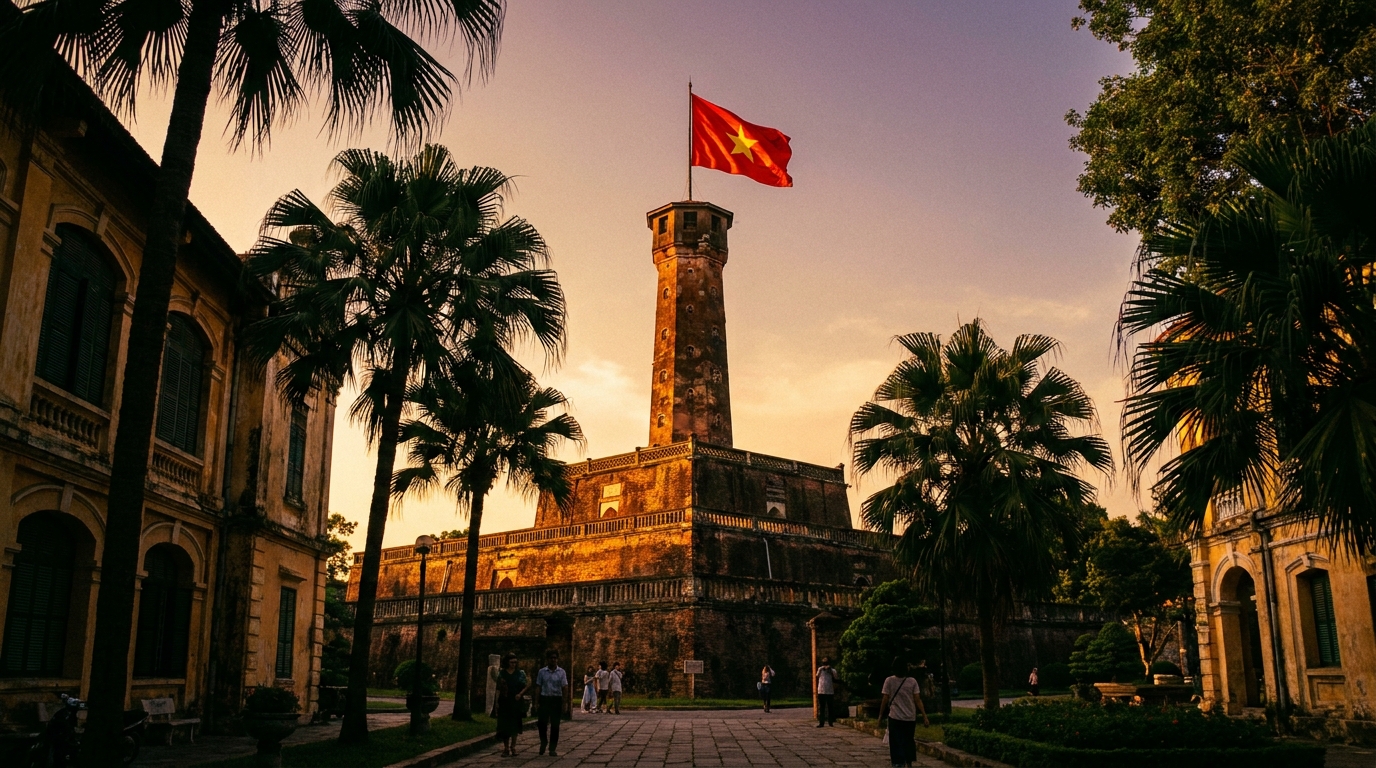
The Hanoi Flag Tower (Cột Cờ Hà Nội) is a 33.4-metre-tall brick citadel built in 1812 that has survived three wars to become the city’s defining military landmark — and one of the very few structures of the Old Imperial Citadel left intact today. If you only have a half-day in the capital before flying south to Saigon, this is the single monument that pulls Hanoi’s 1,000-year military story into one walkable site.
This 2026 visitor guide walks you through opening hours, real ticket prices in VND and USD, the layered history from the Nguyễn dynasty through the American War, and exactly how to combine the tower with the Vietnam Military History Museum next door. We’ve spent two field visits this year confirming entry rules, photo angles, and the quietest times to climb the spiral staircase.
Key Takeaways
- Location: 28A Điện Biên Phủ Street, Ba Đình District — 10 minutes’ walk from the Old Quarter.
- Cost: 40,000 VND (~US$1.60) bundled with the Vietnam Military History Museum; the tower alone is technically free if you only view from outside.
- Built: 1805–1812 under Emperor Gia Long; never destroyed, unlike most of the surrounding citadel.
- Height: 33.4 m (60 m including the flagpole) — climb 54 spiral steps for the panoramic view.
- Best time: 8:30–10:00 AM on weekdays for soft light and zero tour-bus crowds.
- Pair it with: Imperial Citadel of Thăng Long (UNESCO site, 8 minutes’ walk).
Hanoi Flag Tower at a Glance: Hours, Price & Location
| Detail | Information |
|---|---|
| Address | 28A Điện Biên Phủ, Điện Bàn, Ba Đình, Hanoi |
| Opening hours | Tue–Sun, 8:00–11:30 & 13:00–16:30 (closed Monday & Friday afternoon) |
| Entrance fee | 40,000 VND (~US$1.60) combined with Military History Museum |
| Children under 6 | Free |
| Climb the tower | Yes — 54 spiral steps to the top observation chamber |
| Average visit time | 45–90 minutes |
| Nearest landmark | Lenin Park, 200 m east |
| Photography | Permitted; tripods require staff approval |
What Is the Hanoi Flag Tower?

The Hanoi Flag Tower is a three-tiered military observation post and the tallest surviving element of the Hanoi Citadel complex. Unlike most pagoda-style landmarks in Vietnam, this is pure utilitarian Nguyễn-era military engineering: three square truncated pyramids stacked beneath a hexagonal brick column, topped with an octagonal viewing room.
Constructed between 1805 and 1812 — the same era as the Hue Citadel — it served as a watchtower over the Red River plain, with sightlines reaching nearly 10 km on clear days. The Vietnamese national flag has flown here continuously since October 10, 1954, the day the Việt Minh marched into Hanoi after defeating the French at Điện Biên Phủ.
The structure is part of the Vietnam Military History Museum complex, which means a single ticket gets you both the tower climb and a museum that houses captured American F-111, MiG-21, and the wreckage of a B-52 shot down over Hanoi in 1972.
History of the Hanoi Flag Tower: From 1812 to Modern Day

Nguyễn Dynasty Origins (1805–1812)
Emperor Gia Long ordered the tower built as part of a sweeping fortification of the Bắc Thành (Northern Citadel). It was one of five massive defensive structures around the citadel — and the only one French colonial demolitions of 1894–1897 spared. According to records preserved by the Imperial Citadel of Thăng Long UNESCO site, French administrators reportedly kept the tower because it doubled as a useful military observation platform for their own garrison.
Colonial Period (1888–1954)
The French repurposed the tower as a signalling station, semaphore relay, and later a radio antenna mount. Photographs from the 1920s show a tricolour French flag flying above it — an irony Vietnamese historians still write about. During World War II, Japanese occupation forces briefly used it as an air-defence spotter post.
Reunification Symbol (1954–Present)
When Việt Minh forces entered Hanoi on October 10, 1954, raising the red flag with yellow star at this exact spot became the visual shorthand for liberation. Through the American War (1965–1973), the tower escaped direct bombing because U.S. pilots were under strict orders to avoid culturally significant inner-city targets. That preservation is why it stands today while the French Opera House survives only because of similar restraint.
How to Visit the Hanoi Flag Tower in 2026
Getting There
- From the Old Quarter: A flat 1.2 km walk south-west via Hàng Trống and Lý Thường Kiệt. Allow 18 minutes.
- Grab car/bike: 30,000–55,000 VND (~US$1.20–2.20) from Hoàn Kiếm Lake. Set your destination to “Bảo tàng Lịch sử Quân sự Việt Nam” — drivers know the museum better than the tower.
- Public bus: Routes 22, 32, and 45 stop within 200 m at Điện Biên Phủ.
- From Noi Bai Airport: 45 minutes by taxi, around 350,000 VND (~US$14).
Tickets, Hours & Closures
Tickets are sold only at the museum gate — there’s no online booking system as of mid-2026. Cash works, but most ticket booths now accept VietQR for foreign cards linked to Wise or Revolut. The complex closes every Monday all day and Friday afternoon for maintenance and political ceremonies, a detail most third-party blogs still get wrong.
Climbing the Tower
The internal spiral staircase has 54 steps to the first observation level and another short ladder to the very top hexagonal chamber. The stairwell is narrow (roughly 80 cm wide), unlit between landings, and not wheelchair-accessible. Travellers with claustrophobia should stop at the second tier. Bring a phone torch — locals will tell you the bulbs have been “about to be replaced” since 2019.
Military History Context Around the Hanoi Flag Tower
Skipping the museum next door would be a mistake. Together with the Hanoi Flag Tower, the exhibition halls form the most comprehensive military narrative in northern Vietnam. Standout pieces include:
- The MiG-21 fighter flown by ace Phạm Tuân, who shot down a B-52.
- Outdoor wreckage of a Boeing B-52 Stratofortress downed during Operation Linebacker II (December 1972).
- A captured F-111 Aardvark — one of only a handful displayed outside the United States.
- The original tactical map of the Hồ Chí Minh Trail used during the 1968 Tet Offensive.
For deeper background, the Smithsonian National Air and Space Museum’s Vietnam War aviation archive cross-references many of the aircraft on display here. Pair these notes with a future stop at the War Remnants Museum in Ho Chi Minh City for the southern counterpart.
Where Did John McCain Crash in Hanoi? The Truc Bach Lake Story
A question every foreign visitor asks. Senator John McCain — then a U.S. Navy pilot — was shot down on October 26, 1967, when his A-4E Skyhawk was hit by a Soviet-made surface-to-air missile during a raid on the Yên Phụ thermal power plant. He ejected and parachuted into Trúc Bạch Lake, roughly 3 km north-east of the Hanoi Flag Tower.
A small concrete monument on Thanh Niên Street still marks the crash site. McCain spent five and a half years as a POW, much of it at the so-called “Hanoi Hilton” (Hỏa Lò Prison), which is itself just 1.5 km from the flag tower and easily folded into a half-day military history walk.
Photography Tips at the Hanoi Flag Tower
- Morning (08:00–09:30): Soft east light hits the brickwork; flag often catches a breeze.
- Late afternoon (16:00–16:30): Best silhouette shots from Lenin Park across the street.
- Inside the observation chamber: Aperture priority at f/8 captures both the cityscape and the small altar honouring fallen soldiers.
- Avoid: Midday in summer — temperatures inside the brick column hit 38°C without ventilation.
If you’re documenting your trip seriously, our Vietnam photography permits guide covers drone restrictions around all military museums (drones are completely banned within 500 m of the tower).
Combining the Hanoi Flag Tower With Nearby Sites
The tower sits at the centre of a one-kilometre military-history corridor. A recommended walking order:
- Hanoi Flag Tower & Military Museum (09:00 — 90 min)
- Imperial Citadel of Thăng Long (UNESCO site, 8 min walk — 60 min)
- Ho Chi Minh Mausoleum & Stilt House (10 min walk — 45 min; check the rotation schedule)
- One Pillar Pagoda (next door to the mausoleum — 15 min)
- Coffee at Cộng Cà Phê, Điện Biên Phủ (well-earned)
Total: roughly four hours, all within walking distance, no transport needed between stops. If you’re building a longer itinerary, our northern Vietnam 7-day plan sequences this corridor on day two.
Where to Eat & Stay Near the Hanoi Flag Tower
Most foreign visitors base themselves in the Old Quarter or French Quarter, both within a 15-minute taxi ride. Recommended lunch spots within 500 m:
- Phở Thìn Bờ Hồ — classic broth, 70,000 VND (~US$2.80).
- Bún Chả Hương Liên — the “Obama bún chả” spot, 90,000 VND (~US$3.60).
- Cộng Cà Phê — egg coffee with citadel views from upstairs.
For a smoother northbound–southbound trip, plan your Hanoi nights up north, then connect to a central Saigon base. Our roundup of the best District 1 homestays in Ho Chi Minh City is built specifically for travellers chaining the two capitals.
Costs Compared: Hanoi Flag Tower vs Other Hanoi Landmarks
| Site | Entry (VND) | Climbable? | Average visit |
|---|---|---|---|
| Hanoi Flag Tower (with Military Museum) | 40,000 | Yes (54 steps) | 90 min |
| Imperial Citadel of Thăng Long | 30,000 | No | 90 min |
| Hỏa Lò Prison | 50,000 | No | 75 min |
| Ho Chi Minh Mausoleum | Free | No | 45 min |
| Temple of Literature | 30,000 | No | 60 min |
At roughly US$1.60 for two world-class sites, the Hanoi Flag Tower combo remains the highest culture-per-dollar ticket in the city.
Common Mistakes Foreign Visitors Make
- Showing up Monday: Closed all day. Always.
- Wearing shorts above the knee: Tolerated at the tower but refused at the adjacent mausoleum complex if you continue your walk.
- Trying to pay by credit card: Card terminals are unreliable. Carry small VND notes.
- Skipping the museum: The ticket bundles them — you’ve already paid.
- Bringing a drone: Confiscation is automatic within the 500 m military zone.
Our broader Vietnam travel tips for first-timers covers similar etiquette traps at sites country-wide.
Frequently Asked Questions
Is the Hanoi Flag Tower free?
The tower itself is free to view from the surrounding park, but climbing to the top requires the 40,000 VND (~US$1.60) combined ticket for the Vietnam Military History Museum, which sits on the same grounds. Children under six enter free. There is no separate “tower-only” ticket sold at the gate.
What is the history of the Hanoi Flag Tower?
The Hanoi Flag Tower was built between 1805 and 1812 under Emperor Gia Long as part of the Nguyễn-era Hanoi Citadel. French colonial forces spared it during their 1894 demolitions because it was useful as a signal post. The Vietnamese flag has flown above it continuously since the liberation of Hanoi on October 10, 1954.
Where did John McCain crash in Hanoi?
John McCain’s A-4E Skyhawk was shot down on October 26, 1967, and he parachuted into Trúc Bạch Lake, approximately 3 km north-east of the Hanoi Flag Tower. A small bas-relief monument on Thanh Niên Street still marks the crash site. He was captured immediately and held as a POW for over five years at Hỏa Lò Prison.
Is Tower of Hanoi an IQ test?
No — the “Tower of Hanoi” puzzle is a mathematical recursion game (move discs between three pegs) invented by French mathematician Édouard Lucas in 1883. It shares only the name with the actual Hanoi Flag Tower in Vietnam. Cognitive researchers do use the puzzle to study executive function, but it isn’t a standardised IQ test on its own.
How long does it take to visit the Hanoi Flag Tower?
Plan 45 minutes if you only climb the tower, or 90 minutes if you also walk through the adjoining Vietnam Military History Museum. Adding the Imperial Citadel of Thăng Long next door brings the total to roughly half a day, which is the most efficient way to absorb the full military narrative.
Can I visit the Hanoi Flag Tower at night?
The complex closes at 16:30, so the tower itself is not accessible after hours. However, the surrounding park stays open until 22:00 and the structure is floodlit until midnight — making it a worthwhile photo stop on an evening walk between the Old Quarter and the West Lake area.
Plan Your Vietnam Trip: Hanoi to Saigon in Comfort
The Hanoi Flag Tower is the perfect first-day primer for travellers heading south to explore the war-history sites of Saigon. After your two or three days in the capital, hop on a one-hour Vietjet flight to Tan Son Nhat — and land somewhere central and quiet.
Stay with us in District 1. Our central Saigon homestay puts you a 5-minute walk from the War Remnants Museum, Independence Palace, and Notre-Dame Cathedral — the southern counterparts to everything you’ve just seen in Hanoi. Browse our Saigon itinerary planner to design a 4-day southern leg, or message us directly for help syncing your Hanoi and Saigon dates.
Vietnam’s military history makes more sense when you experience both ends of the story. Start at the Hanoi Flag Tower, finish under the rooftop of a quiet District 1 alley homestay — and let the country’s full narrative come together along the way.
Not sure what those dong figures are worth? The Vietnam currency and money exchange guide converts them and lists the ATMs with the lowest fees.
When the Flag Tower Is Not Worth the Detour
The Hanoi Flag Tower is a 15 to 20 minute stop, not an afternoon. It is a 33.4-metre brick structure you look at and photograph from the courtyard; there is no museum attached to it and no exhibition to work through. Visiting it on its own means crossing the city for a single monument, so it only makes sense combined with the Imperial Citadel or the Military History Museum next door. If your time in Hanoi is under two days, the Old Quarter and Hoan Kiem Lake repay the same hour far better.