
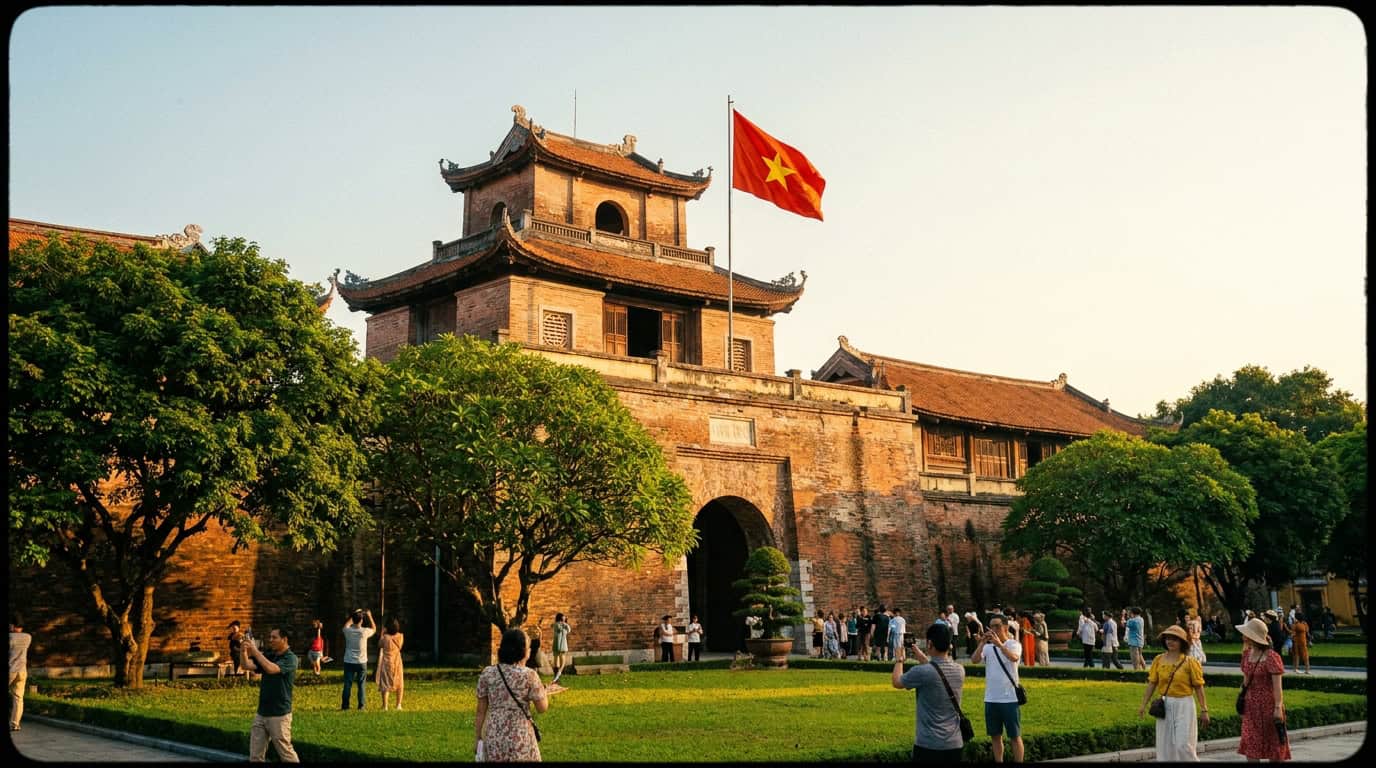
The Imperial Citadel of Thang Long Hanoi is a UNESCO World Heritage Site in the heart of Vietnam’s capital that preserves more than 1,300 years of continuous political history across 18.4 hectares of palaces, gates, archaeological pits and revolutionary-era bunkers. Sitting just 1.5 km west of Hoan Kiem Lake, the complex is one of the few places on Earth where you can stand on the same ground used by 52 emperors from the Ly, Tran, Le and Nguyen dynasties — and where North Vietnamese generals planned the final operations of the American War from a concrete bunker beneath the lawn.
This 2026 visitor guide explains exactly how to plan a trip: opening hours, the new ticket price, what to see in two hours versus a half-day, how to reach the site from District 1 of Saigon or from the Old Quarter of Hanoi, and the cultural context that turns a pleasant walk through brick gates into one of the most rewarding history experiences in Southeast Asia.
Key Takeaways
- Location: 19C Hoang Dieu Street, Ba Dinh District, Hanoi — 1.5 km from Hoan Kiem Lake.
- 2026 ticket price: 30,000 VND (~$1.20 USD) for adults; free for under-15s and over-60s with ID.
- Opening hours: Tuesday–Sunday, 08:00–17:00 (closed Mondays for conservation work).
- UNESCO inscription: 2010, on the 1,000th anniversary of Hanoi’s founding as Thang Long.
- Best time to visit: Early morning (08:00–10:00) October to April for cool, dry weather.
- Allow: 2–3 hours for a focused visit, 4 hours to include the D67 bunker and the archaeological site at 18 Hoang Dieu.
Quick-Reference Summary Table
| Detail | Information |
|---|---|
| Official name | Central Sector of the Imperial Citadel of Thang Long |
| UNESCO listing year | 2010 (Criteria ii, iii, vi) |
| Address | 19C Hoang Dieu Street, Dien Bien Ward, Ba Dinh District, Hanoi |
| Adult ticket | 30,000 VND (~$1.20 USD) |
| Student ticket | 15,000 VND (~$0.60 USD) with valid ID |
| Hours | Tue–Sun, 08:00–11:30 and 14:00–17:00 |
| Closed | Mondays |
| Best months | October, November, March, April |
| Recommended time | 2–4 hours |
| Photography | Permitted (no tripods inside buildings) |
| Dress code | Modest; shoulders and knees covered for shrine areas |
Why the Imperial Citadel of Thang Long Hanoi Matters
The imperial citadel of thang long hanoi is the only site in Vietnam to satisfy three separate UNESCO criteria in a single inscription, which is rare even by global standards. According to the UNESCO World Heritage Centre, the property demonstrates “an interchange of influences from China to the north and the ancient Kingdom of Champa to the south,” forming a unique cultural crossroads that continued without interruption from the 7th century until 1810, when the Nguyen dynasty moved the capital to Hue.
What makes the site extraordinary is the layering. Archaeologists have identified seven distinct construction periods stacked vertically beneath the surface: Dai La (7th–9th centuries), Dinh and Early Le (10th century), Ly (11th–12th), Tran (13th–14th), Le So (15th), Mac and Le Trung Hung (16th–18th), and finally Nguyen and modern (19th–20th). The 2002–2004 excavations at 18 Hoang Dieu Street recovered more than four million artefacts in a single dig — one of the largest single-site archaeological yields in Southeast Asian history.
For visitors more familiar with Saigon, the contrast is striking. While the south is defined by French colonial and 20th-century architecture (see our guide to historic sites in District 1 for comparison), Hanoi’s citadel reaches back to a Vietnam that predates European contact entirely.
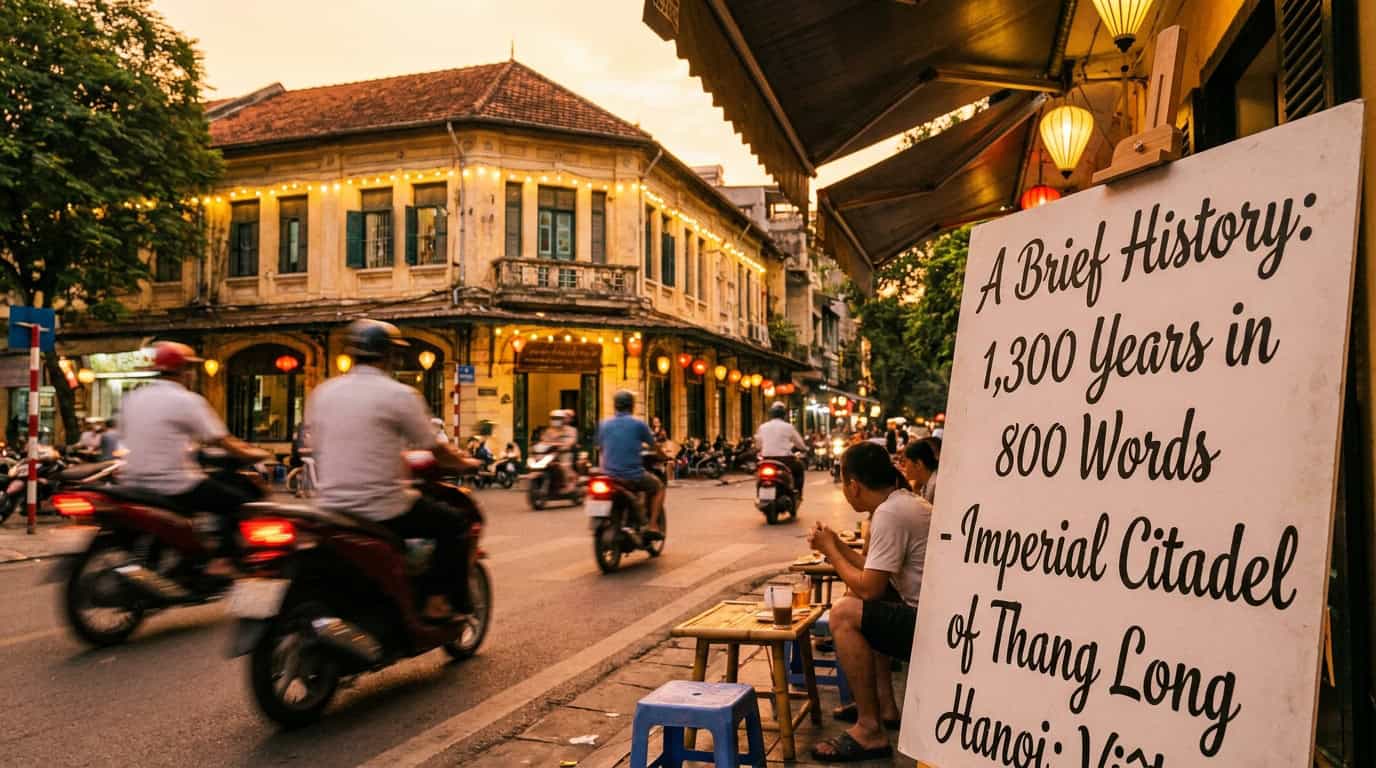
A Brief History: 1,300 Years in 800 Words
Foundation in 1010
In autumn 1010, Emperor Ly Thai To moved his court from Hoa Lu to a bend in the Red River and renamed the settlement Thang Long — “Ascending Dragon” — after seeing a golden dragon rise from the soil. The city he founded would remain the political center of Vietnam for the next 800 years.
The Ly and Tran Golden Age (1010–1400)
Under the Ly and Tran dynasties, the citadel grew into a three-walled fortress: an outer earth wall (La Thanh) enclosing the city, a middle brick wall (Hoang Thanh) around the imperial quarter, and an inner Forbidden City (Tu Cam Thanh) reserved for the emperor’s household. The Doan Mon south gate that visitors enter today dates from this period in form, though the surviving brickwork is largely Le-dynasty (15th-century) reconstruction.
Le Dynasty Expansion (1428–1788)
After expelling Ming Chinese occupation in 1428, Le Loi rebuilt the citadel on a grander scale. The famous Kinh Thien Palace — whose stone dragon balustrades remain the visual signature of the site — was constructed in 1467. Each balustrade weighs over three tonnes and is carved from a single block of green stone.
Nguyen Decline and French Occupation
When the Nguyen moved the capital to Hue in 1810, the Thang Long citadel was demoted to a provincial fortress. French colonial forces captured Hanoi in 1882 and demolished most of the imperial structures between 1894 and 1897 to build their military headquarters. Only Doan Mon, the Hau Lau (Princess Pavilion), the North Gate and Kinh Thien’s foundation platform survived.
Revolutionary Headquarters (1954–1975)
After 1954, the site became the General Headquarters of the People’s Army of Vietnam. The D67 building and bunker — built in 1967 at the height of US bombing — housed General Vo Nguyen Giap and the Politburo’s military commission. It was from this room, with its original maps still on the walls, that the 1975 Ho Chi Minh Campaign was directed.
For a deeper feel of how this same period shaped southern Vietnam, our article on the Reunification Palace and the end of the war makes a useful companion read.
How to Get to the Imperial Citadel of Thang Long Hanoi
From Hanoi Old Quarter
The entrance at 19C Hoang Dieu is a flat 1.8 km walk from Hoan Kiem Lake — about 25 minutes on foot through pleasant tree-lined streets. A Grab car costs 30,000–45,000 VND (~$1.20–1.80 USD). Cyclo from the Old Quarter is 80,000–120,000 VND (~$3.20–4.80 USD) after polite haggling.
From Noi Bai International Airport
The airport sits 27 km north. A metered taxi runs 350,000–400,000 VND (~$14–16 USD); Grab is typically 280,000–330,000 VND (~$11–13 USD). The Airport Bus 86 (45,000 VND / ~$1.80 USD) drops at the Opera House, from where the citadel is a 10-minute Grab ride.
From Ho Chi Minh City
Domestic flights (Vietnam Airlines, Vietjet, Bamboo Airways) run hourly from Tan Son Nhat to Noi Bai, with one-way fares from 1,200,000 VND (~$48 USD) when booked two weeks in advance. Many travelers combine a few nights in District 1 with a 3-day Hanoi extension. See the northern Vietnam itinerary for a sample route.
Parking and Public Transport
Public buses 22, 33, 45 and 50 stop within 300 metres. Motorbike parking inside the gate costs 5,000 VND (~$0.20 USD). There is no metro stop directly at the site as of June 2026, although Hanoi Metro Line 3 is under construction nearby.
Ticket Prices and Opening Hours in 2026
| Ticket Type | Price (VND) | USD Equivalent |
|---|---|---|
| Adult | 30,000 | ~$1.20 |
| Student (with ID) | 15,000 | ~$0.60 |
| Children under 15 | Free | — |
| Seniors over 60 (with ID) | Free | — |
| Vietnamese veterans | Free | — |
| Audio guide rental (EN/FR/JP/KR) | 50,000 | ~$2.00 |
Prices confirmed against the official Hoang Thanh Thang Long management board as of June 2026. Tickets are sold at the Hoang Dieu Street gate; cash and Vietnamese QR payment accepted, foreign cards not reliably supported, so carry small VND notes.
What to See: A Suggested 3-Hour Route
1. Doan Mon — The South Gate (15 min)
Start at Doan Mon, the five-arched ceremonial entry. The central arch was reserved exclusively for the emperor; mandarins used the side arches according to rank. Climb the staircase on the east side for a free elevated photograph of the courtyard and Kinh Thien platform behind.
2. Kinh Thien Palace Foundation (30 min)
Although the wooden palace itself was destroyed by the French in 1886, the stone platform and four 15th-century dragon balustrades remain. The dragons have five claws — a Chinese imperial symbol — but with subtly Vietnamese stylistic features, including the curved tail unique to Le-dynasty sculpture.
3. Hau Lau — The Princess Pavilion (20 min)
Behind Kinh Thien, this two-storey building housed concubines and princesses. French engineers rebuilt the upper floor in 1876 in a hybrid Sino-French style, which is itself now historic.
4. The North Gate (Cua Bac) (20 min)
The cannonball scars from the 1882 French naval bombardment are still visible above the eastern arch. Inside, a small shrine honours Nguyen Tri Phuong and Hoang Dieu, the two governors who committed suicide rather than surrender Hanoi.
5. D67 Building and Bunker (45 min)
The highlight for many international visitors. The above-ground meeting room preserves the original chairs of Le Duan, Le Duc Tho and Vo Nguyen Giap. Stairs lead 9 metres underground to the operations bunker with 1.5-metre-thick reinforced concrete walls.
6. 18 Hoang Dieu Archaeological Site (40 min)
Across the street, walkways span the open excavations where pillar bases from the Ly-dynasty Forbidden City lie exposed. A small museum displays ceramics from each historical layer.
Imperial Citadel of Thang Long Hanoi: Insider Tips for 2026
- Arrive at 08:00. Tour buses begin arriving from 09:30; the first 90 minutes are blissfully quiet.
- Buy the audio guide. At 50,000 VND it is the single best 2 USD you will spend in Hanoi — interpretation signage is sparse.
- Combine with the Vietnam Military History Museum (1.2 km south, opened late 2024) for a full day of north-Vietnamese historical context.
- Skip Mondays. Closed for conservation. Many visitors miss this and arrive at a locked gate.
- Bring water. There is one drink kiosk near Kinh Thien; bottles cost 25,000 VND vs. 10,000 VND outside.
- Photographers: Late afternoon (15:30–16:30) gives the warmest light on Doan Mon’s terracotta brick.
What to Eat Nearby
The lanes east of the citadel toward Hang Trong are full of Hanoi specialities. Try bun cha at Bun Cha Huong Lien (the “Obama bun cha” shop, 800 m east), pho at Pho Thin Bo Ho, or coffee at the Note Coffee on Luong Van Can. For a southern equivalent of this kind of food walk, see our guide to the best street food in District 1, Saigon.
Comparing Thang Long to Other Vietnamese Heritage Sites
If you have already visited Hue Imperial City (1802–1945) or Hoi An Ancient Town, Thang Long fills the older end of the chronological gap. According to Vietnam National Administration of Tourism, the three sites together cover Vietnamese imperial history from 1010 to 1945 — almost a complete millennium of political continuity.
Where Hue offers intact wooden palaces and Hoi An offers a preserved merchant town, Thang Long offers archaeological depth: the same physical ground used by every Vietnamese capital dynasty until the 19th century.
Best Time to Visit and Weather
Hanoi has four distinct seasons, unlike Saigon’s two. The optimal months for the citadel are:
- October–November: 22–28°C, low humidity, golden afternoon light.
- March–April: 20–25°C, occasional drizzle but spectacular cherry-blossom relatives in bloom.
- Avoid June–August: 33–38°C and humidity above 85% make the open courtyards punishing.
- Avoid late January–February: Tet closures and cold drizzle (12–16°C).
FAQ: Imperial Citadel of Thang Long Hanoi
How much does it cost to visit the Imperial Citadel of Thang Long Hanoi in 2026?
Adult admission is 30,000 VND (~$1.20 USD) and student tickets with valid ID are 15,000 VND (~$0.60 USD). Children under 15 and seniors over 60 enter free. An optional audio guide in English, French, Japanese or Korean costs 50,000 VND. Tickets are sold at the Hoang Dieu Street gate in cash or via Vietnamese QR payment.
How long should I spend at the Imperial Citadel of Thang Long Hanoi?
Plan for at least 2 hours to cover Doan Mon, Kinh Thien Palace foundation, Hau Lau, and the D67 bunker. Allow 3–4 hours to add the 18 Hoang Dieu archaeological site and the small on-site museum. History enthusiasts with audio guides often stay the full half-day, particularly in October-to-April weather when the courtyards are pleasant.
Is the Imperial Citadel of Thang Long Hanoi worth visiting?
Yes — it is one of only eight UNESCO World Heritage Sites in Vietnam and uniquely combines 1,300 years of imperial archaeology with intact 20th-century military bunkers used during the American War. For travellers interested in Vietnamese political history, no other single site offers comparable chronological depth, and the 30,000 VND ticket price is exceptional value.
Can I visit the citadel and Ho Chi Minh Mausoleum on the same day?
Yes. The mausoleum complex is 600 metres west of the citadel’s Hoang Dieu gate. Visit the mausoleum first (it closes at 11:00), then walk to the citadel for lunch nearby and an afternoon visit. The two together form Hanoi’s most efficient half-day historical itinerary.
What should I wear to the Imperial Citadel?
Comfortable walking shoes are essential — the site covers 18.4 hectares with mostly stone or gravel paths. Modest clothing covering shoulders and knees is required at the Kinh Thien shrine area. In summer, a hat and sunscreen are essential as the courtyards have little shade. In winter, a light jacket suits the 12–18°C range.
Are there guided tours available?
Yes. The site offers Vietnamese-language guided tours hourly from 09:00 (free with admission). English, French and Japanese tours can be pre-booked through the official site at hoangthanhthanglong.vn for 200,000–300,000 VND per group. Independent licensed guides also wait at the gate; expect 400,000–600,000 VND for a 2-hour private tour.
Where to Stay When Visiting Vietnam
If your Vietnam trip starts in the south, as most international itineraries do, base yourself centrally in Ho Chi Minh City before flying north for your Hanoi extension. District 1 puts you within walking distance of Ben Thanh Market, the Notre-Dame Basilica, and the Reunification Palace.
For a complete southern itinerary that pairs naturally with a 3-day Hanoi extension to the imperial citadel of thang long hanoi, browse our 3-day Saigon itinerary guide and our hand-picked list of the best things to do in Ho Chi Minh City.
Prices here are in Vietnamese dong. Our Vietnam currency and money exchange guide covers live rates, ATM fees and where to change money.
Related Guides
- Hanoi to Ha Long Bay: All Ways to Get There (2026)
- Vietnam Museum of Ethnology Hanoi: Is It Worth Visiting?
- Temple of Literature Hanoi: Complete Visitor Guide (2026)
- Ha Long Bay Luxury Cruise: Best High-End Options (2026)
- Ha Long Bay 2-Day 1-Night Cruise: What to Expect
- Ha Long Bay Safety: Is It Worth the Risk?