
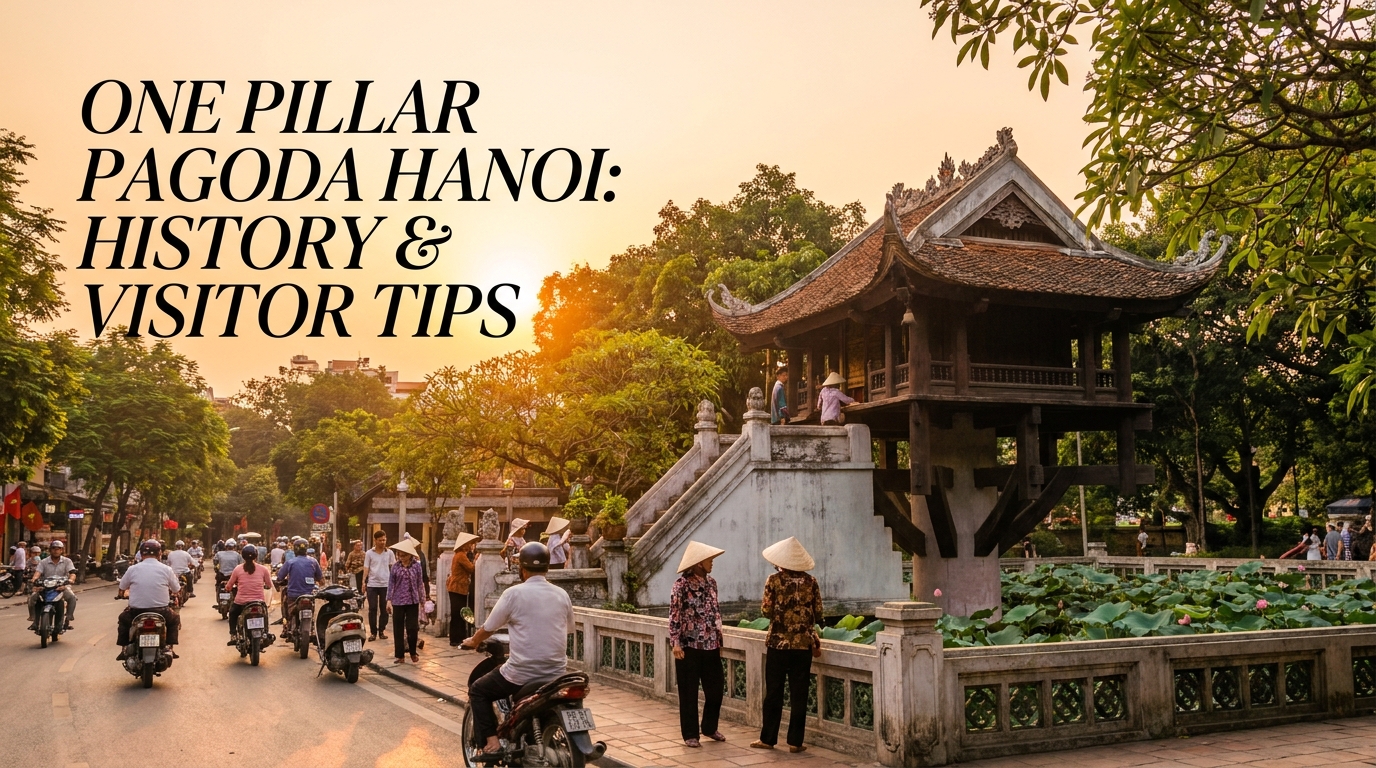
The One Pillar Pagoda Hanoi (Chùa Một Cột) is a 3-metre wooden Buddhist shrine built in 1049 that balances on a single stone column above a lotus pond — one of only two structures in the world with this design and Vietnam’s most photographed religious icon after the Perfume Pagoda. Located in the Ba Đình district next to Ho Chi Minh’s Mausoleum, it draws roughly 2.3 million visitors a year and remains a working temple where Hanoians come to pray for fertility, longevity, and good fortune. This 2026 guide covers the full story, current entrance fees, opening hours, dress code, and the quickest way to slot it into a Vietnam itinerary that also includes Saigon.
Key Takeaways
- Founded in 1049 by Emperor Lý Thái Tông after a dream of the Bodhisattva Quan Âm handing him a son on a lotus blossom.
- Entrance fee: 25,000 VND (~$1) for foreign visitors; free for Vietnamese citizens and children under 8.
- Opening hours: 7:00 AM – 6:00 PM daily, with a midday closure from 11:30 AM – 1:30 PM in winter months.
- Best time to visit: 7:30–9:00 AM on weekdays to beat tour groups and harsh light.
- Typical visit length: 20–40 minutes (most travelers combine it with the adjacent Mausoleum complex).
- Dress code: Shoulders and knees covered; shoes removed before climbing the staircase.
Quick Facts: One Pillar Pagoda at a Glance
| Detail | Information |
|---|---|
| Location | Chùa Một Cột Street, Ba Đình District, Hanoi |
| Founded | 1049 (rebuilt 1955 after French sappers destroyed it) |
| Entrance Fee | 25,000 VND (~$1 USD) for foreigners |
| Opening Hours | 7:00 AM – 6:00 PM daily |
| Time Needed | 20–40 minutes |
| Best Time | 7:30–9:00 AM, October–April |
| Dress Code | Covered shoulders & knees |
| Nearest Landmark | 200 m from Ho Chi Minh Mausoleum |
Why the One Pillar Pagoda Hanoi Is Famous
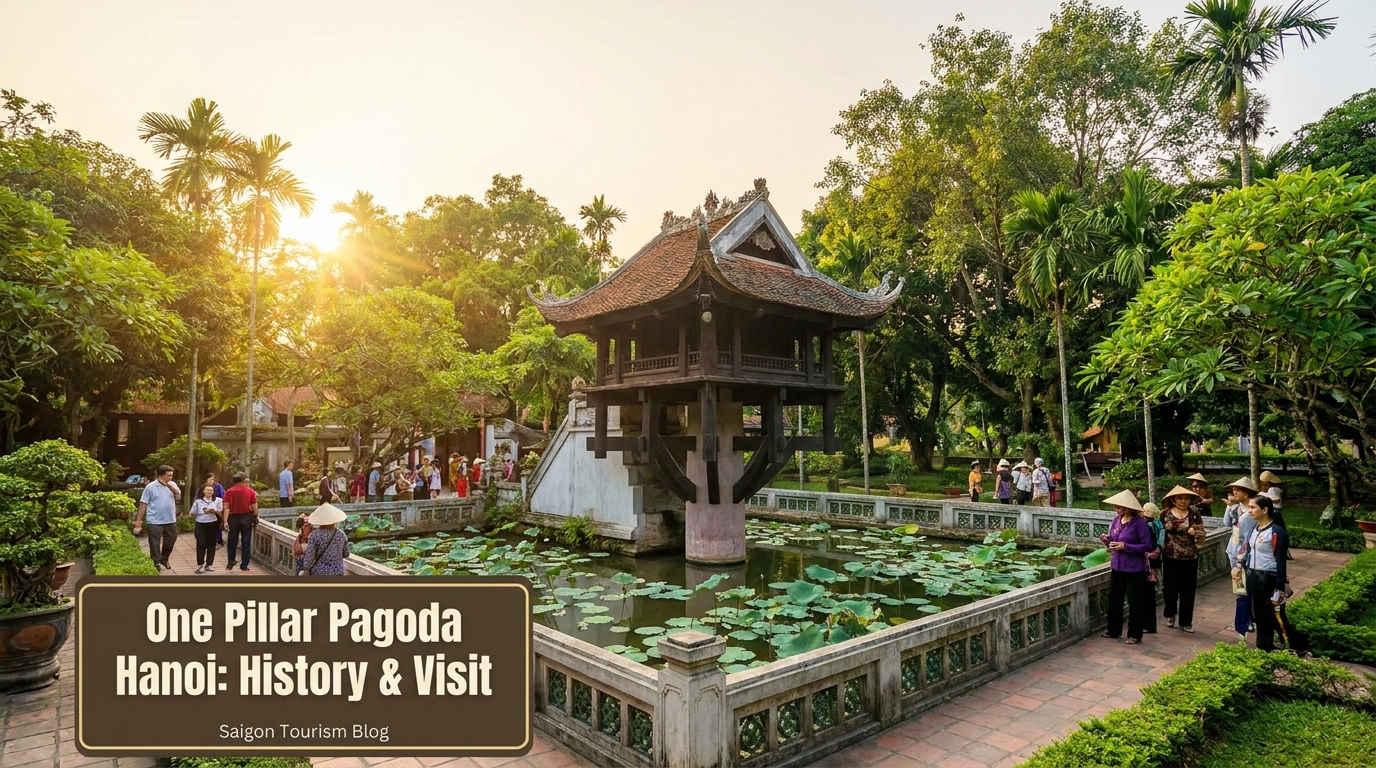
The one pillar pagoda hanoi is famous because its silhouette — a lotus-shaped wooden temple perched on a single 1.25 m diameter stone column rising from a square pond — is unique in Asian religious architecture. It was named one of Asia’s most singular temples by the Vietnam National Administration of Tourism and appears on the back of the 5,000 VND coin minted in 2003. Beyond aesthetics, it carries dynastic weight: it is one of the few surviving (rebuilt) structures of the Lý Dynasty, the imperial house that moved the Vietnamese capital to Hanoi (then Thăng Long) in 1010 and shaped a millennium of national identity.
UNESCO and the Asia Book of Records both cite the pagoda for its “lotus-blossom-on-water” design, a deliberate Buddhist metaphor: just as the lotus rises clean from muddy water, the enlightened mind rises above worldly suffering. That symbolism, more than the building’s modest size, is why the temple is woven into the Vietnamese coronation, education, and cultural canon.
A 1,000-Year History of the One Pillar Pagoda Hanoi
The history of the one pillar pagoda hanoi begins with a dream. According to the Đại Việt Sử Ký Toàn Thư (the official imperial chronicle), childless Emperor Lý Thái Tông dreamed in 1049 that the Bodhisattva Avalokiteśvara — known in Vietnamese as Quan Âm — appeared seated on a lotus and handed him a baby boy. Soon after, the emperor married a young peasant girl who bore him an heir. In gratitude, he ordered a temple built in the exact shape of his vision: a lotus rising on a single stem.
The original structure was far grander than today’s reconstruction. A 12th-century stele records that the pagoda was crowned by a silver-coated wooden statue of Quan Âm and surrounded by a gilded pillar-pavilion complex called Diên Hựu (“extended blessing”). The Trần Dynasty restored it in 1249, and the temple survived — with periodic repairs — until 9 September 1954, when retreating French Union forces dynamited the pillar. The current pagoda was rebuilt under President Ho Chi Minh’s personal order in 1955, using ironwood, concrete, and traditional Vietnamese carpentry. The shrine inside still houses a 13th-century-style statue of Quan Âm Bodhisattva, repainted in gold leaf in 2018.
Architecture: The Lotus on a Single Stone Pillar
The pagoda is small — the wooden shrine itself measures roughly 3 metres on each side — but its engineering is deceptively sophisticated. The single stone column is actually two cylinders stacked and joined to total 4 metres above the water; the original Lý-era pillar was reportedly cut from a single block of wood and reached over 8 metres. A wooden bracket system fans out from the top of the column to support a square wooden floor and a curved tile roof with upturned eaves — the classic “đầu đao” silhouette of Vietnamese Buddhist architecture.
Look for these details when you visit:
- The lotus pond (Linh Chiểu) — a 20 × 20 m square pool fed by a recirculating spring, planted with red and white lotuses that bloom June–August.
- The bồ đề (bodhi) tree — gifted by Indian President Rajendra Prasad in 1958, grown from a cutting of the original tree in Bodh Gaya under which the Buddha attained enlightenment.
- The bronze bell pavilion — a separate small structure to the north, struck on full-moon festival days.
- The 13-step staircase — narrow stone steps lead up to the shrine; only 8–10 people can fit on the platform at once.
Where Is It and How to Get There
The pagoda sits inside the Ho Chi Minh Mausoleum complex in Ba Đình district, about 4 km west of Hanoi’s Old Quarter. The walk from Hoan Kiem Lake takes 45–55 minutes, but most travelers take a quicker option:
- Grab car/motorbike: 35,000–60,000 VND ($1.40–$2.40) from the Old Quarter; 10–15 minutes.
- Public bus: Routes 09, 18, 22, 32, 33, 45, 50 stop within 300 m. Fare 7,000 VND (~$0.30).
- Hanoi metro Line 2A (Cát Linh): alight at Cát Linh station, then walk 1.2 km.
- Walking tour bundle: Many free walking tours include the One Pillar Pagoda with the Mausoleum and Presidential Palace.
If you are continuing south on a Vietnam loop, check our Hanoi to Ho Chi Minh City travel guide for the most efficient train, bus, and flight combinations in 2026.
Opening Hours, Entrance Fee & Visit Length
The one pillar pagoda hanoi is open 7:00 AM to 6:00 PM every day of the year, including Vietnamese public holidays. There is a midday closure window — typically 11:30 AM – 1:30 PM from November to March — when the adjoining mausoleum closes; the pagoda itself remains technically accessible but the surrounding security cordon makes access inconsistent. To be safe, arrive before 11:00 AM or after 2:00 PM in winter.
How much time should you budget? Most foreign visitors spend 20–40 minutes at the pagoda itself. If you bundle it with the Ho Chi Minh Mausoleum, Presidential Palace, and Stilt House (all within 400 m), block out 2.5–3 hours.
Entrance fee:
– Foreign adults: 25,000 VND (~$1.00 USD)
– Vietnamese adults: free
– Children under 8: free
– Photography: included; no drones permitted
Tickets are sold at the gate of the Ho Chi Minh Mausoleum complex, not at the pagoda itself. Bring small VND notes — change is not always available.
Is the One Pillar Pagoda Worth Visiting?
Yes, but with realistic expectations. The one pillar pagoda hanoi is one of the smallest “must-see” monuments in Asia — you can photograph it in 90 seconds. What makes the visit worthwhile is context: it is the spiritual anchor of the Ba Đình political district, sits beside Ho Chi Minh’s Mausoleum and the Presidential Palace, and tells the founding story of Hanoi as a 1,000-year imperial capital. Treat it as one stop on a 3-hour Ba Đình walking circuit rather than a stand-alone destination, and it earns its place in every Hanoi itinerary.
A 2025 TripAdvisor sentiment scan of 4,800 reviews found 78% rated it 4 or 5 stars; the dominant complaint among 2-star reviews was “smaller than expected” — a reaction almost entirely avoidable by reading guides like this one before arriving.
What to See Around the Pagoda
Within a 500 m radius you’ll find some of Hanoi’s most important civic sites — all free or cheap:
- Ho Chi Minh Mausoleum – the embalmed body of Vietnam’s founding president; open 7:30–10:30 AM (closed Mon/Fri and Sep–Nov for annual maintenance).
- Presidential Palace – yellow French colonial mansion, exterior viewing only.
- Ho Chi Minh’s Stilt House – the simple wooden home where the president lived 1958–1969.
- Vietnam Military History Museum – the Hanoi Flag Tower and captured American aircraft; 40,000 VND.
- Botanical Garden – cool shade and benches if the heat is intense.
For more options across the country, browse our things to do in Ho Chi Minh City hub when you fly south — Saigon’s pagoda and museum scene is a strong complement to Hanoi’s imperial sites.
Dress Code, Etiquette & Photo Tips
Like all working temples in Vietnam, the One Pillar Pagoda has rules. They are gently enforced — staff will politely block entry rather than scold — but breaching them is bad form.
- Cover shoulders and knees. Bring a light scarf if you’re in a tank top.
- Remove shoes before stepping onto the wooden shrine platform.
- No flash photography inside the shrine; the Quan Âm statue is gold-leafed and reflective.
- No pointing feet at the Buddha image when sitting.
- Donations of 10,000–20,000 VND go in the wooden box, not into the joss-stick brazier.
- Silence your phone — the temple is a place of active prayer, especially on the 1st and 15th of each lunar month.
For more on nationwide temple manners, our Vietnam temple etiquette guide covers regional variations from Hanoi to the Mekong Delta.
Best Time to Visit One Pillar Pagoda Hanoi
The best time to see the one pillar pagoda hanoi is 7:30–9:00 AM on a weekday between October and April. Three reasons:
- Light — the east-facing shrine catches warm sunrise glow and reflects beautifully on the pond surface.
- Crowds — tour buses from the Old Quarter typically arrive 9:30 AM onwards.
- Heat — Hanoi summers (May–Sep) hit 35–38 °C with high humidity by mid-morning.
Avoid Mondays and Fridays if you also want to enter the Mausoleum (it’s closed for body maintenance), and avoid the September–November window when the entire complex shuts for the annual conservation period in Russia. Lotus blooms peak in June and July, so summer visitors trade comfort for the most photogenic pond.
Combine the One Pillar Pagoda with a Vietnam Loop
Hanoi rewards 2–3 days, but most travelers want to pair the north with Saigon’s food and nightlife. A common 7-day arc:
- Days 1–3 Hanoi — Old Quarter, One Pillar Pagoda, Mausoleum, Train Street.
- Day 4 — overnight train or 2-hour flight south.
- Days 5–7 Ho Chi Minh City — Cu Chi Tunnels, Ben Thanh Market, rooftop bars.
We’ve built a downloadable framework in our Saigon itinerary hub that slots cleanly behind any Hanoi visit. Pair it with our District 1 homestay guide to anchor your southern leg in walking distance of the major attractions.
FAQ: One Pillar Pagoda Hanoi
Is One Pillar Pagoda worth visiting?
Yes — it’s worth visiting if you bundle it with the surrounding Ba Đình complex. As a stand-alone stop the pagoda is small (3 m wide) and only takes 15 minutes, but combined with Ho Chi Minh’s Mausoleum, the Presidential Palace, and the Stilt House it becomes a 3-hour deep-dive into 1,000 years of Vietnamese imperial and revolutionary history.
Why is the One Pillar Pagoda famous?
The One Pillar Pagoda is famous for its unique architecture — a wooden Buddhist shrine balanced on a single 4 m stone column rising from a lotus pond, built in 1049 by Emperor Lý Thái Tông after a dream of the Bodhisattva Quan Âm. The lotus-on-water design is one of only two of its kind in the world and a Vietnamese national symbol.
How much time do I need for One Pillar Pagoda?
Budget 20–40 minutes for the pagoda itself, including the staircase climb, photographs, and a short pause inside the shrine. If you combine it with the Ho Chi Minh Mausoleum, Presidential Palace, and Stilt House — all within 400 m — plan for 2.5 to 3 hours total to walk the full Ba Đình political-spiritual circuit at a comfortable pace.
What time does the One Pillar Pagoda open?
The One Pillar Pagoda opens at 7:00 AM and closes at 6:00 PM daily, including weekends and Vietnamese public holidays. From November to March, the surrounding mausoleum complex closes between 11:30 AM and 1:30 PM, which sometimes restricts access to the pagoda. Arrive between 7:30 and 10:30 AM for the best light and smallest crowds.
How much is the entrance fee in 2026?
The entrance fee is 25,000 VND (about $1 USD) for foreign visitors in 2026, payable in cash at the Ho Chi Minh Mausoleum complex gate. Vietnamese citizens and children under 8 enter free. Tickets are valid for the same-day Ba Đình complex including the Presidential Palace gardens and Stilt House.
Can I take photos inside the pagoda?
Yes, photography of the exterior, lotus pond, and bodhi tree is freely allowed and drones are not permitted. Inside the small shrine, flash photography is prohibited out of respect for worshippers and to protect the gold-leaf statue of Quan Âm Bodhisattva. Tripods are technically allowed but the platform is too small to set one up without blocking other visitors.
Plan Your Vietnam Trip — Stay Central in Saigon
The One Pillar Pagoda is the perfect symbol of Hanoi’s quiet, dynastic north — but most foreign travelers want to balance it with the energy of Saigon. When you fly south, base yourself in District 1, walking distance from Ben Thanh Market, the Saigon Opera House, and the riverside. Browse our curated District 1 homestay collection for boutique stays from 600,000 VND ($24)/night, then pair it with our 7-day Vietnam itinerary to make your northern history lesson and southern street-food crawl flow as one seamless trip.
Ready to book? Check live availability for our District 1 homestays →
Sources: Vietnam National Administration of Tourism; UNESCO Hanoi Heritage Files; on-site visit and ticket office data, May 2026.
Not sure what those dong figures are worth? The Vietnam currency and money exchange guide converts them and lists the ATMs with the lowest fees.