
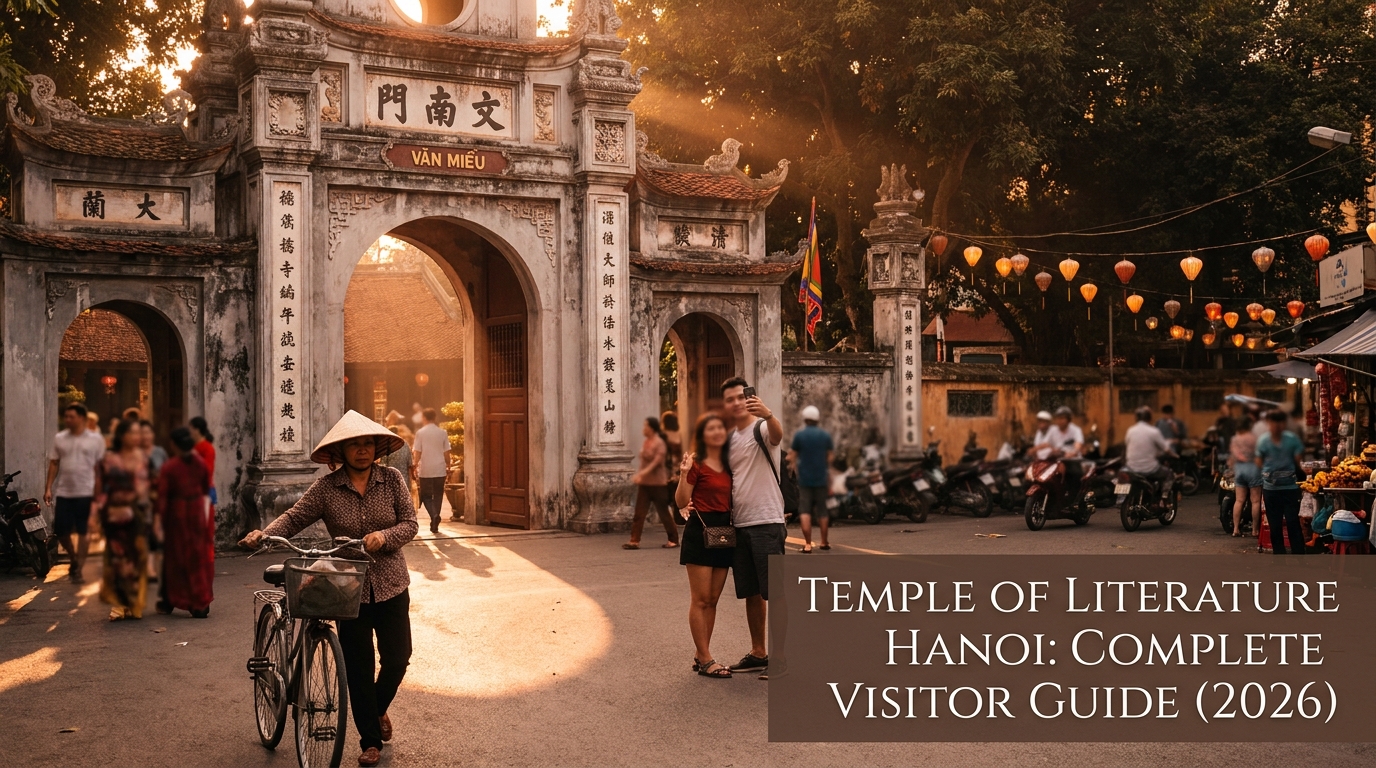
The Temple of Literature Hanoi (Văn Miếu – Quốc Tử Giám) is the 956-year-old former imperial academy in central Hanoi, open daily 8:00–17:00 with a 70,000 VND (~$2.80 USD) entry ticket, and it is the single best half-day cultural site in northern Vietnam for first-time foreign visitors. Founded in 1070 under Emperor Lý Thánh Tông, the complex preserves five walled courtyards, 82 stone “doctor stelae” inscribed with the names of 1,307 graduates between 1442 and 1779, and the Khuê Văn Các pavilion that appears on Vietnam’s 100,000 VND banknote.
This guide answers every practical question — tickets, dress code, transport, how long to stay, what to photograph — and explains why this site earns a confident “yes” on the worth-visiting question, even if you only have one day in the capital before flying south to Saigon.
Key Takeaways
- Entry ticket: 70,000 VND (~$2.80 USD) adults, 35,000 VND for students with ID, free for children under 15.
- Hours: 08:00–17:00 daily (summer extended to 17:30); open on public holidays and Tết.
- Time needed: 60–90 minutes for a relaxed self-guided visit of all five courtyards.
- Dress code: Shoulders and knees covered. No miniskirts, tank tops, or short shorts inside the Đại Thành sanctuary.
- Best time to go: Weekday mornings 08:00–09:30 to avoid tour groups and Hanoi’s midday heat.
- Cash only at the gate: ATMs are scarce on Quốc Tử Giám street; bring small VND notes.
Quick Facts: Temple of Literature Hanoi at a Glance
| Detail | Information |
|---|---|
| Address | 58 Quốc Tử Giám St, Đống Đa District, Hanoi |
| Opening hours | 08:00–17:00 (summer 07:30–17:30) |
| Adult ticket | 70,000 VND (~$2.80 USD) |
| Student ticket | 35,000 VND (with valid ID) |
| Children under 15 | Free |
| Audio guide | 50,000 VND, available in English, French, Korean, Japanese, Spanish |
| Time to visit | 60–90 minutes |
| Nearest landmark | 1.2 km west of Hoàn Kiếm Lake |
| Founded | 1070 (Lý Thánh Tông dynasty) |
| UNESCO status | National Special Relic of Vietnam |
Is the Temple of Literature in Hanoi Worth Visiting?
Yes — the Temple of Literature Hanoi is worth visiting for any traveler interested in Vietnamese history, Confucian architecture, or photography. It is the only surviving site in Vietnam continuously associated with higher education for nearly a millennium and remains one of Hanoi’s top three most-visited cultural attractions, drawing more than 2.1 million visitors in 2024 according to Hanoi’s Department of Tourism.
The walled gardens, lotus ponds, and tiled-roof pavilions deliver an atmosphere you cannot replicate at the busier Old Quarter or Hoàn Kiếm Lake. If you only have one cultural stop in Hanoi, make it this one. Students still come here to rub the heads of stone turtles for exam luck (the practice is now discouraged to protect the stelae) and to take graduation photos in red-and-gold áo dài — meaning you are visiting a living monument, not a museum diorama.
A Brief History: 956 Years of Vietnamese Learning
The complex was commissioned in 1070 by Emperor Lý Thánh Tông as a Confucian temple honoring Confucius, his disciples, and the philosopher Chu Văn An. In 1076, Vietnam’s first national university — the Quốc Tử Giám — was founded on the same grounds to educate princes, nobles, and later top-scoring commoners. For 700 years it produced the country’s mandarin class.
Between 1442 and 1779, the Lê and Mạc dynasties commissioned 82 stone stelae mounted on tortoise backs, each inscribed with the names, birthplaces, and achievements of doctoral laureates from a specific royal examination. These stelae were inscribed on the UNESCO Memory of the World register in 2011, making them globally recognized documentary heritage. They are the most important artifact on the site and the reason the temple’s silhouette — specifically the Khuê Văn Các pavilion — was chosen for the 100,000 VND banknote in 2003.
The Five Courtyards: What You’ll Actually See

The complex is laid out on a north-south axis through five successive walled courtyards. Walk straight through and you cover the chronological story of a Confucian scholar’s journey from novice to laureate.
Courtyard 1: Entrance Garden (Nhập Đạo)
You enter through the Văn Miếu Môn gate flanked by four stone pillars. The first courtyard is a quiet garden of frangipani and ancient longan trees — a deliberate decompression zone before scholarly study.
Courtyard 2: The Great Middle Gate
The Đại Trung Môn marks the second threshold. Look for the “carp transforming into dragon” motif on the roof tiles — a metaphor for students transforming into mandarins through examination success.
Courtyard 3: Khuê Văn Các & The Well of Heavenly Clarity
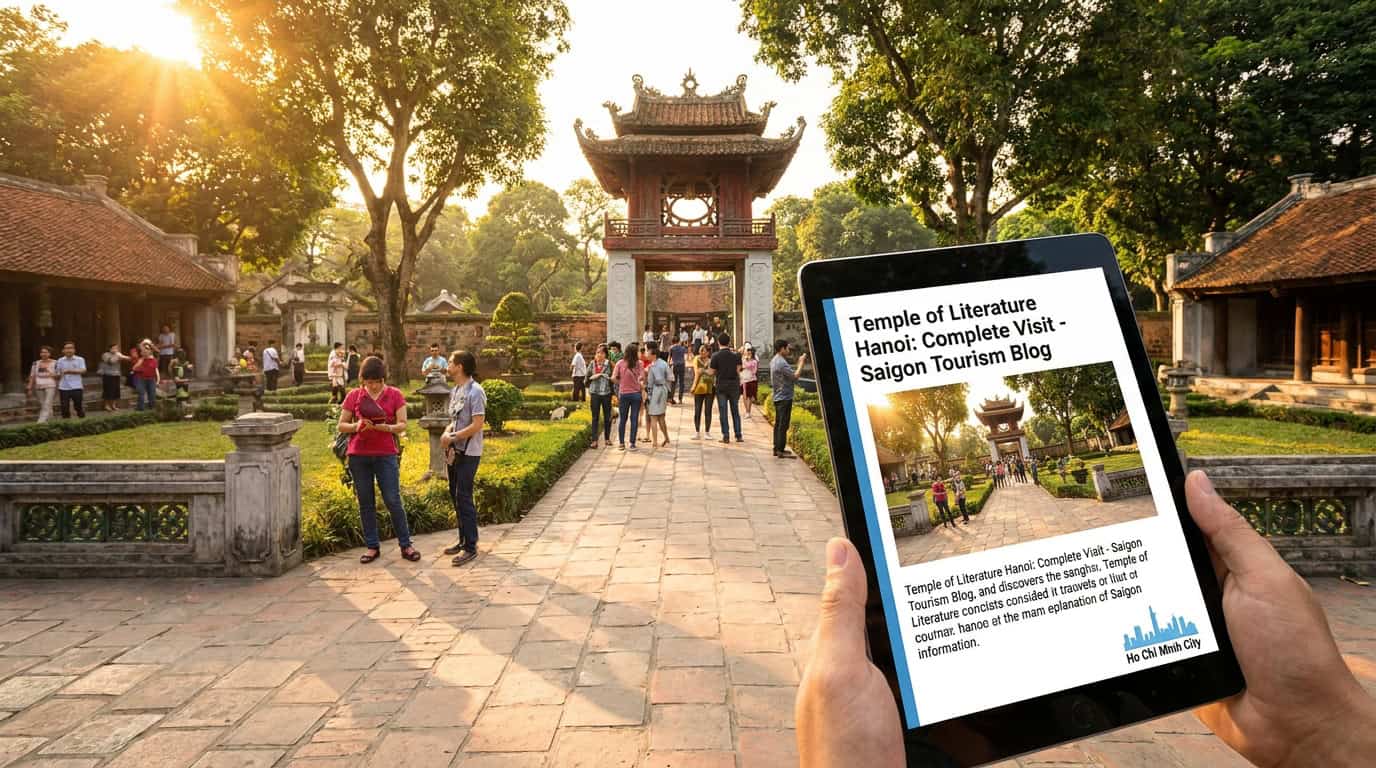
The two-story Khuê Văn Các (Pavilion of the Constellation of Literature), built in 1805, is the site’s icon and your most important photo stop. Behind it lies the square Thiên Quang Tỉnh (Well of Heavenly Clarity), flanked left and right by the doctor stelae pavilions.
Courtyard 4: The Sanctuary of Đại Thành
The fourth courtyard contains the Đại Bái ceremonial hall and the Đại Thành sanctuary housing statues of Confucius and his four chief disciples. Shoes stay on, but voices stay down. Incense is sold for 10,000 VND if you wish to make an offering.
Courtyard 5: The Quốc Tử Giám (Reconstructed)
The northernmost courtyard houses a 2000-era reconstruction of the original imperial academy buildings (destroyed by French bombardment in 1947). Upstairs displays bronze statues of Vietnam’s three most celebrated educators: Chu Văn An, Lý Thánh Tông, and Lý Nhân Tông.
Tickets, Dress Code & Entry Rules
Do you have to pay to enter the Temple of Literature? Yes. As of 2026 the adult ticket is 70,000 VND (~$2.80 USD) purchased at the main gate kiosk on Quốc Tử Giám street. Credit cards are not accepted; bring small VND notes. Students with a valid international student ID pay 35,000 VND, and children under 15 enter free. An optional self-guided audio device costs 50,000 VND and is genuinely useful — the on-site English signage is sparse.
Is there a dress code for the Temple of Literature Hanoi? Yes, but it is enforced politely rather than strictly. Cover your shoulders and knees: no tank tops, short shorts, miniskirts, or transparent fabric inside the Đại Thành sanctuary in the fourth courtyard. Light scarves are sold at the gate for 30,000 VND if you arrive underdressed. Hats off inside the inner halls. Photography is permitted everywhere except inside the Confucius shrine itself, where flash is banned to protect the lacquered statues.
How to Get to the Temple of Literature Hanoi
The temple sits 1.2 km southwest of Hoàn Kiếm Lake at 58 Quốc Tử Giám Street, Đống Đa District. From the Old Quarter you have four practical options:
- Walk (20 minutes): Flat, mostly shaded route along Lê Thái Tổ → Bà Triệu. Best in the cool months (November–March).
- Grab car or Xanh SM electric taxi (50,000–80,000 VND, ~$2–3.20 USD): The most comfortable choice in summer humidity. App pickup is reliable at any Old Quarter hotel.
- Grab motorbike (25,000–35,000 VND): Fastest. Helmets provided. Skip this if you are jet-lagged or carrying luggage.
- Public bus 02, 23, 25, 41: All stop within a 3-minute walk for 7,000 VND. Cash only; have exact change.
If you arrive by Grab, ask the driver for “Văn Miếu” (vahn mee-uh) — “Temple of Literature” is sometimes unfamiliar to younger drivers. The drop-off zone is on the east side of the main gate.
Best Time to Visit & How Long Does It Take?
How long does it take to see the Temple of Literature? Plan 60 to 90 minutes for a self-guided visit covering all five courtyards at a relaxed pace, plus 20 minutes if you take the audio guide or photograph the stelae in detail. Guided tours typically run 75 minutes. Groups rushing through can do it in 35 minutes but miss the doctor stelae entirely — the most important artifact.
Best time of day: Arrive at 08:00 when the gates open. The first 90 minutes are quiet, the light on the Khuê Văn Các pavilion is golden, and the resident frangipani perfume is at its strongest. Tour buses begin arriving from 09:30 and the site is busiest 10:30–14:00.
Best time of year: October to April delivers the cool, dry conditions Hanoi is famous for. Avoid late June through August unless you are an early riser — midday temperatures regularly exceed 36°C with high humidity. The lotus pond peaks in June if you can tolerate the heat for the bloom.
Tết exception: The temple is exceptionally busy during Vietnamese Lunar New Year (late January or February) as students come to pray for exam success. Arrive at 07:30 or skip entirely during the seven-day Tết window.
Nearby Attractions You Can Combine in Half a Day
The temple pairs naturally with three nearby sites for a strong morning itinerary:
- Vietnam Fine Arts Museum (4-minute walk): The country’s best collection of 11th–20th-century Vietnamese art. 40,000 VND entry.
- Imperial Citadel of Thăng Long (12-minute Grab): UNESCO World Heritage Site since 2010, archaeological zone, 30,000 VND.
- Train Street viewpoint (15-minute walk east): Café-lined railway corridor; train passes around 15:25 and 19:25.
For lunch, walk 10 minutes north to Bún Chả Hương Liên (24 Lê Văn Hưu) — the bún chả restaurant Anthony Bourdain and President Obama visited in 2016, still serving 85,000 VND set meals.
Insider Tips for Foreign Visitors
- Skip the souvenir shops at the exit. The same lacquerware sells 40% cheaper at Hàng Gai Street in the Old Quarter.
- Bring 1.5L of water. No vendors inside the courtyards beyond the entrance.
- Restrooms: Located between courtyards 2 and 3, and at the far north exit. Free; bring tissue.
- Photography tip: The reflection shot of Khuê Văn Các across the Thiên Quang well works best between 08:30–09:15 when the sun is low enough to backlight the pavilion.
- English-speaking guides: Hire on-site at the gate for 300,000 VND (~$12 USD) per tour, or pre-book licensed guides via the Vietnam National Authority of Tourism registry.
- Cash machines: The nearest reliable international ATM is the Vietcombank branch at 23 Quốc Tử Giám, 200 m east of the temple gate.
Heading South Next? Pair Hanoi with Saigon
Most foreign itineraries cover both cities. The Temple of Literature Hanoi is the cultural anchor of the north; the southern equivalent is exploring Saigon’s colonial architecture and street-food alleys. If you fly to Ho Chi Minh City after Hanoi, our 3-day Saigon itinerary covers Independence Palace, the Notre-Dame Basilica restoration, and the Bến Thành night market. For ground-level neighborhood ideas, browse our hub of things to do in Ho Chi Minh City, which mirrors the depth of this Hanoi guide.
Travelers comparing the two capitals often ask which to prioritize — see our breakdown in Hanoi vs Saigon: which to visit first. If you only have a week, our Vietnam 7-day itinerary sequences Hanoi, Ha Long Bay, and Saigon efficiently. And if your trip lands during Tết, prepare with our Tết travel guide for foreigners.
Frequently Asked Questions
Is the Temple of Literature in Hanoi worth visiting?
Yes. The Temple of Literature is Hanoi’s most coherent cultural site — 956 years of continuous educational heritage, five intact courtyards, and the UNESCO-recognized doctor stelae. For foreign visitors with one day in Hanoi, it ranks above the Old Quarter for substance and above Hoàn Kiếm Lake for photography. At 70,000 VND, it is also the best-value major attraction in northern Vietnam.
Is there a dress code for the Temple of Literature Hanoi?
Yes. Shoulders and knees must be covered, especially inside the Đại Thành sanctuary in the fourth courtyard. No tank tops, short shorts, miniskirts, or transparent clothing. Hats off inside ceremonial halls. The dress code is enforced politely — staff offer 30,000 VND wrap scarves at the gate if you arrive underdressed rather than refusing entry.
Do you have to pay to enter the Temple of Literature?
Yes. The adult ticket in 2026 is 70,000 VND (~$2.80 USD), paid in cash at the main gate on Quốc Tử Giám street. Students with valid international ID pay 35,000 VND, and children under 15 enter free. An optional audio guide adds 50,000 VND. Credit cards are not accepted at the kiosk.
How long does it take to see the Temple of Literature?
Plan 60 to 90 minutes for a complete self-guided visit covering all five courtyards, the Khuê Văn Các pavilion, the doctor stelae, the Đại Thành sanctuary, and the reconstructed Quốc Tử Giám academy. Add 20 minutes if you use the audio guide. Rushed visits of 30–40 minutes are possible but skip the most important artifact — the 82 stelae.
Can you take photos inside the Temple of Literature?
Yes, photography is permitted throughout the courtyards, gardens, and stelae pavilions. Flash photography is prohibited inside the Đại Thành sanctuary to protect the lacquered Confucius statues. Tripods require advance permission from the management office. Drone flights are banned site-wide under Hanoi’s central-district airspace rules.
Is the Temple of Literature wheelchair accessible?
Partially. The first three courtyards are flat with stone-paved walkways suitable for wheelchairs, but the doctor stelae pavilions and the elevated Đại Thành sanctuary have shallow steps without ramps. The northern Quốc Tử Giám reconstruction is upstairs-only. Staff at the main gate can arrange step-assistance on request.
Plan Your Vietnam Trip from a Central Base
A great Hanoi day deserves an equally smart southern base. If you are flying on to Ho Chi Minh City after the Temple of Literature Hanoi, stay where everything connects — District 1, within walking distance of the same colonial-era landmarks, rooftop bars, and street-food blocks you came to Vietnam for. Compare District 1 hotels, and book early for the November–March high season.
Not sure what those dong figures are worth? The Vietnam currency and money exchange guide converts them and lists the ATMs with the lowest fees.
Related Guides
- Imperial Citadel of Thang Long Hanoi: Visitor Guide
- Vietnam Museum of Ethnology Hanoi: Is It Worth Visiting?
- Perfume Pagoda Hanoi Day Trip: Complete Guide (2026)
- Hanoi to Ninh Binh: Day Trip vs Overnight Guide
- Hanoi to Sapa: Train, Bus & Best Route (2026)
- Hanoi to Ha Long Bay: All Ways to Get There (2026)