
When comparing vietnam visa on arrival vs e visa in 2026, the e-visa is the better choice for 99% of foreign travelers — it costs 580,000 VND (~$25 USD) for a single-entry permit, is approved within 3 working days, and is now available to citizens of all countries and territories worldwide. The visa on arrival (VOA) still exists but is restricted to air travelers in genuine emergencies, diplomatic cases, or those entering for funerals and urgent medical reasons. For a standard tourist or business trip to Ho Chi Minh City, Hanoi, or Da Nang, apply for the e-visa at evisa.gov.vn before you fly.
Key Takeaways
- The e-visa wins for almost every traveler in 2026 — it is cheaper, fully online, valid at all 49 international ports of entry (air, land, sea), and available for stays up to 90 days with single or multiple entries.
- Visa on arrival is no longer the default option — since January 2025, Vietnam’s Immigration Department restricts VOA to urgent cases backed by a sponsoring company’s approval letter.
- The official e-visa fee is 25 USD (single entry) or 50 USD (multiple entry) paid directly to the government portal — third-party agencies typically add 15–40 USD in service fees.
- Processing time is 3 working days for standard e-visa applications; urgent 2-hour and 1-day services exist only through licensed agencies with a real letter of approval.
- Indian, US, UK, Australian, and EU passport holders are not visa-exempt and need either an e-visa or VOA to enter Vietnam.
- Visa exemption applies to 25 nationalities (including UK, France, Germany, Italy, Spain, Japan, South Korea) for stays of 45 days, refreshed in 2025.
Vietnam Visa on Arrival vs E Visa: The 2026 Comparison Table
Before diving into the details, here is the side-by-side snapshot every traveler needs.
| Feature | E-Visa (2026) | Visa on Arrival (2026) |
|---|---|---|
| Official fee | 25 USD single / 50 USD multiple | 25 USD stamping + 6–50 USD agency letter |
| Processing time | 3 working days | Letter: 2 hours – 2 days; stamp at airport |
| Eligible nationalities | All countries and territories | All countries (with sponsor letter) |
| Maximum stay | Up to 90 days | Up to 90 days |
| Entries | Single or multiple | Single or multiple |
| Ports of entry | 49 ports: 13 airports, 16 land, 13 sea, 7 rail | Air only (8 international airports) |
| Where to apply | evisa.gov.vn (official) | Licensed travel agency |
| Documents needed | Passport scan + photo | Passport scan + photo + approval letter |
| Best for | All tourists, business travelers, expats | Last-minute urgent travel only |
| Risk level | Low — government portal | Medium — depends on agency |
The bottom line: for a routine 2026 trip, the vietnam visa on arrival vs e visa debate is essentially settled in favor of the e-visa.
What Changed in 2025 That Reshaped the Vietnam Visa on Arrival vs E Visa Debate
Two policy shifts moved nearly all foreign travelers toward the e-visa.
First, e-visa eligibility went global on 15 August 2023 under Resolution 127/NQ-CP, and the policy has remained in force through 2026. Before that, only 80 nationalities could apply online. Today, citizens of every country and territory can submit an e-visa application directly to the Vietnam Immigration Department.
Second, the maximum e-visa duration was extended to 90 days with multiple-entry options, replacing the former 30-day single-entry cap. This makes the e-visa competitive with traditional embassy visas for long-stay tourists, digital nomads, and repeat business travelers.
The result: VOA processing volumes have dropped significantly, and most licensed Vietnamese agencies now market VOA only as an emergency backup. If you are planning a typical trip and weighing vietnam visa on arrival vs e visa, the e-visa is what the government itself recommends.
How the Vietnam E-Visa Works in 2026
The e-visa is a fully digital permit issued by Vietnam’s Immigration Department. There is no paper sticker and no embassy visit.
Step-by-step e-visa application
- Go to the official portal: https://evisa.gov.vn/. Ignore lookalike sites that charge inflated fees.
- Upload a passport photo (4×6 cm, white background, no glasses) and a scan of your passport bio page. Your passport must be valid for at least 6 months from your entry date.
- Fill in arrival details — date, port of entry (e.g., Tan Son Nhat International Airport in Ho Chi Minh City), and accommodation address. Most travelers list their first hotel or homestay.
- Pay the fee online: 25 USD for single entry, 50 USD for multiple entry. Visa, Mastercard, JCB, and AmEx are accepted.
- Receive your e-visa within 3 working days by email (or download from the portal using your registration code).
- Print two copies and carry them with your passport. Vietnamese immigration officers will scan the QR code at the border.
Pros of the e-visa
- No middleman fees — pay the government directly.
- Valid at every international port of entry, including overland crossings from Cambodia, Laos, and China.
- Multiple-entry option lets you make Cambodia or Thailand side trips without reapplying.
- Predictable cost with no airport surprises.
Cons of the e-visa
- 3 working days is too slow for emergency travel.
- The portal occasionally rejects photos for tiny formatting issues — a frustrating but fixable problem.
- You cannot extend an e-visa from inside Vietnam easily; for longer stays, you exit and reapply.
How Visa on Arrival Still Works (And Who Should Use It)
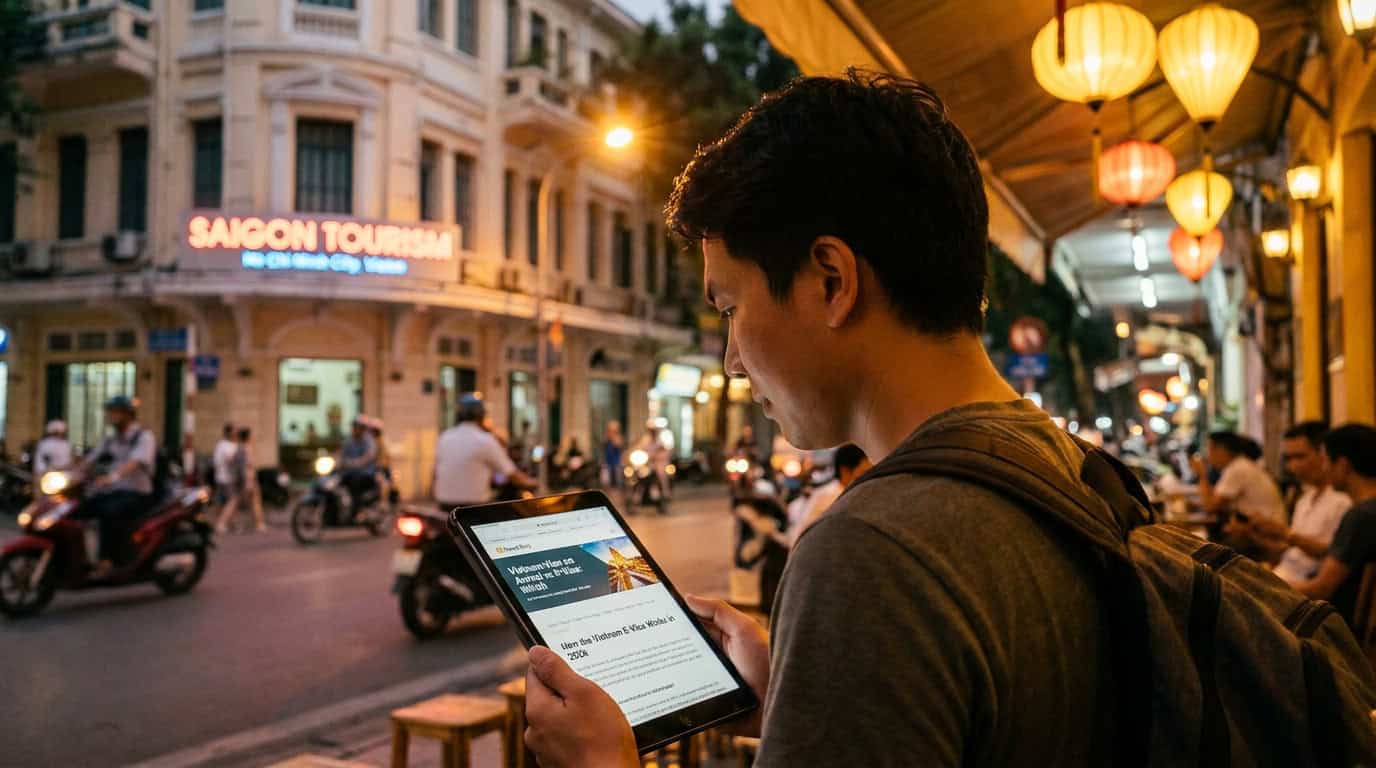
Despite the e-visa’s dominance, VOA has not disappeared. It works through a two-step process.
Step-by-step visa on arrival process
- Choose a licensed visa agency in Vietnam (you cannot apply for VOA directly with the government — a Vietnamese sponsor must submit your request).
- Submit your passport details and travel dates. The agency files an application with the Immigration Department.
- Receive an approval letter (công văn) by email — typically within 2 working days, or as fast as 2 hours for urgent service.
- Print the approval letter and bring it, plus your passport, two 4×6 photos, and the 25 USD stamping fee in cash, to the visa counter on arrival at one of 8 international airports (Tan Son Nhat, Noi Bai, Da Nang, Cam Ranh, Phu Quoc, Cat Bi, Phu Bai, Lien Khuong).
- Wait for your passport to be stamped — usually 20 to 60 minutes at busy airports.
When VOA still beats the e-visa
- You booked your flight less than 72 hours before departure and there is no time for standard e-visa processing.
- You only have an air arrival at one of the 8 supporting airports and need rush processing.
- You are entering for a funeral, medical emergency, or business meeting where the sponsoring Vietnamese entity already has VOA infrastructure.
For everyone else weighing vietnam visa on arrival vs e visa, the answer remains the e-visa.
Cost Breakdown: Vietnam Visa on Arrival vs E Visa in VND and USD
Money is usually the deciding factor. Here is the real 2026 math.
E-visa total cost
- Single entry: 580,000 VND (~25 USD) — government fee only.
- Multiple entry: 1,160,000 VND (~50 USD).
- No service fees if you apply at evisa.gov.vn.
Visa on arrival total cost
- Approval letter from agency: 150,000–1,200,000 VND (6–50 USD) depending on speed.
- Stamping fee at airport: 580,000 VND (25 USD single) or 1,160,000 VND (50 USD multiple) — must be paid in cash, ideally crisp US dollar bills.
- Urgent 2-hour processing: add 1,800,000–3,000,000 VND (75–125 USD).
A standard e-visa is around 15–40 USD cheaper than VOA once agency fees are added, and there is no awkward cash exchange at the airport counter.
Who Should Choose Visa Exemption Instead
Not every traveler needs to debate vietnam visa on arrival vs e visa. Vietnam offers visa exemption to 25 nationalities under policies refreshed in August 2023 and confirmed for 2026.
45-day visa-free stay applies to citizens of: United Kingdom, France, Germany, Italy, Spain, Russia, Japan, South Korea, Denmark, Sweden, Norway, Finland, and Belarus.
21-day or 30-day visa-free stays apply to most ASEAN passport holders (Thailand, Singapore, Malaysia, Indonesia, the Philippines, Laos, Cambodia, Myanmar, Brunei).
If your passport qualifies, skip both options and simply fly in. The official policy is published by the Vietnamese Government Portal. Indian, American, Australian, Canadian, and New Zealand passport holders are not on the exemption list and must use the e-visa.
Common Mistakes Travelers Make with Vietnam Visa on Arrival vs E Visa
After helping thousands of guests through arrival at our District 1 properties, we see the same errors repeatedly.
- Applying through a copycat website. Sites like “vietnam-evisa.org” or “e-visa-vietnam.com” are private agencies that charge 40–80 USD for a 25 USD government service. Always use evisa.gov.vn.
- Booking VOA for a land border crossing. VOA is air-only. If you are entering Vietnam from Cambodia via the Moc Bai border, you need a pre-arranged e-visa.
- Forgetting to print the approval letter before flying. Airlines have refused boarding to passengers without a printed letter.
- Bringing only USD bills with creases or pen marks. Airport counters routinely refuse damaged bills.
- Misspelling passport details on the e-visa form. Any error (even one missing middle name letter) requires reapplying and paying again.
How to Apply for the Vietnam E-Visa from Inside Vietnam (Extension Tips)
If you arrived on the visa exemption or a 30-day e-visa and want to stay longer, you generally cannot extend in-country. The practical workaround: do a visa run to Cambodia (Phnom Penh) or Bangkok, apply for a new 90-day multiple-entry e-visa while abroad, and re-enter. Plan 5–7 days for the round trip.
A simpler alternative for many travelers is to book a longer-stay homestay in central Saigon and time the visa run around a weekend trip. See our Saigon itinerary guide for ideas on what to do in the city between visa runs, and the best things to do in Ho Chi Minh City for a 90-day plan.
Vietnam Visa on Arrival vs E Visa for Specific Nationalities
Indian passport holders
Vietnam is not visa-free for Indians. You must apply for an e-visa (25 USD) or arrange VOA. Indian travelers report the e-visa works smoothly when applied 7–10 days before flying.
US passport holders
Americans need an e-visa or VOA — no exemption applies. The standard 90-day multiple-entry e-visa (50 USD) is the smart choice for most US travelers, especially those combining Vietnam with Cambodia or Thailand.
UK, French, German, Italian, Spanish passport holders
You are eligible for 45-day visa-free entry. No e-visa or VOA required if you are staying under 45 days. For longer stays, apply for the standard 90-day e-visa.
Australian, Canadian, New Zealand passport holders
Not visa-exempt. Use the e-visa.
Chinese passport holders
Mainland Chinese travelers should consult their nearest Vietnamese embassy as additional document requirements may apply.
Arriving in Saigon After Approval: What Happens Next
Once your e-visa is approved, the rest of the journey is straightforward. At Tan Son Nhat International Airport, walk to the regular immigration counter (not the VOA counter), present your printed e-visa and passport, and get stamped through in 5–15 minutes.
Once you clear customs, a taxi or Grab to District 1 takes 25–45 minutes depending on traffic and costs 180,000–280,000 VND (7–11 USD). For your first night in Vietnam, we recommend staying close to Ben Thanh Market or Nguyen Hue Walking Street.
Browse our best homestays in District 1 Saigon for stays under 1,200,000 VND (~50 USD) per night, or read our first-time Ho Chi Minh City guide for a stress-free arrival plan. If you’re balancing visa logistics with food adventures, our Saigon street food guide covers what to eat within 200 m of your homestay.
Vietnam Visa on Arrival vs E Visa: Frequently Asked Questions
Can I get a visa on arrival in Vietnam?
Yes, but only if you arrive by air at one of 8 international airports and hold a pre-arranged approval letter (công văn) from a licensed Vietnamese travel agency. As of 2026, visa on arrival is not the default option for most travelers — the e-visa is faster, cheaper, and accepted at all 49 ports of entry, including land borders.
Can I get a Vietnam visa in 2 hours?
Yes, through urgent visa on arrival service offered by licensed Vietnamese agencies for an extra 75–125 USD. The agency files an emergency approval letter request with the Immigration Department, you receive it in approximately 2 hours, then pay the 25 USD stamping fee at the airport. The standard e-visa cannot be rushed to 2 hours.
Is Vietnam still visa free for Indians?
No, Vietnam is not visa-free for Indian passport holders in 2026. Indians must apply for either a 90-day e-visa (25 USD single entry, 50 USD multiple entry) at evisa.gov.vn or arrange a visa on arrival through a licensed agency. Processing takes about 3 working days for the standard e-visa.
Can you do your Vietnam visa when you arrive?
Only with a pre-approved letter. You cannot simply land in Vietnam and apply for a visa from scratch at the airport — Vietnam does not offer true “on-the-spot” visas. Visa on arrival requires an approval letter arranged before you fly. Otherwise, apply for the e-visa online at evisa.gov.vn at least 3 working days before travel.
Which is cheaper, Vietnam visa on arrival vs e visa?
The e-visa is cheaper. The official e-visa costs 25 USD (single entry) paid directly to the government. Visa on arrival costs the same 25 USD stamping fee plus a 6–50 USD agency letter fee, making it 15–40 USD more expensive overall.
Is the e-visa accepted at land borders?
Yes. The Vietnam e-visa is valid at 49 ports of entry, including 16 land border crossings with Cambodia, Laos, and China, 13 international airports, 13 seaports, and 7 railway stations. Visa on arrival, by contrast, only works at 8 airports.
Final Verdict: Vietnam Visa on Arrival vs E Visa in 2026
For 99% of foreign travelers planning a 2026 trip to Vietnam, the e-visa is the right choice. It is cheaper, works at every port of entry, supports stays up to 90 days, and removes the cash-at-the-airport awkwardness of VOA. Reserve visa on arrival for genuine last-minute or emergency travel.
Plan Your Saigon Stay While Your E-Visa Processes
Apply for your e-visa today, then lock in a central Saigon homestay for arrival day. Our District 1 properties sit within a 10-minute walk of Ben Thanh Market, Bui Vien Walking Street, and the Saigon River, with English-speaking hosts who’ll meet you at the door at any hour. Browse availability at saigonhomestay.com and arrive in Vietnam without a single logistical worry.
Related Guides
- Getting Around Saigon: Grab, Metro, Bus & Waterbus Guide (2026)
- Rent Motorbike Vietnam: Everything You Need to Know (2026)
- Vietnam Public Holidays 2026: Complete Calendar
- Vietnam SIM Card Guide: Which to Buy & Where (2026)
- Tipping in Vietnam: How Much & When (2026 Guide)
- Vietnam Currency & Money Exchange Guide (2026)