
The three best Sapa trekking villages for foreign visitors in 2026 are Cat Cat (3km easy loop, 1–2 hours), Ta Van (10km moderate trek through Muong Hoa Valley, 4–6 hours), and Giang Ta Chai (12km harder trail with bamboo forests and a waterfall, 5–7 hours). Together they cover the full spectrum of difficulty, scenery, and ethnic-minority culture — H’Mong, Giay, and Red Dao — within a 15km radius of Sapa town in Vietnam’s Lao Cai Province.
If you only have one day, hike Ta Van. If you have three days, walk all three and sleep in a homestay along the Muong Hoa River. This guide walks you through every route, every cost in VND and USD, and every cultural rule you need to know before you arrive.
Key Takeaways
- 3 essential Sapa trekking villages: Cat Cat (easy, 3km), Ta Van (moderate, 10km), Giang Ta Chai (harder, 12km).
- Entrance fees in 2026: Cat Cat 150,000 VND (~$6 USD); Muong Hoa Valley ticket covering Ta Van and Giang Ta Chai 75,000 VND (~$3 USD).
- Best months: September–November (golden rice terraces) and March–May (green paddies, fewer crowds).
- Local guide cost: 600,000–1,200,000 VND per day (~$24–48 USD); hiring a H’Mong woman directly supports the community.
- Homestay rate: 250,000–500,000 VND per night (~$10–20 USD) including dinner and breakfast.
- Transport from Hanoi: 6-hour sleeper bus (350,000 VND / ~$14 USD) or overnight train + shuttle (~750,000 VND / ~$30 USD).
Why Sapa Trekking Villages Beat Every Other Northern Vietnam Hike
Vietnam’s Northwest has dozens of trekking spots — Ha Giang, Mu Cang Chai, Pu Luong — but the Sapa trekking villages remain the most accessible because the valleys cluster within 12km of a town with proper hotels, ATMs, and English-speaking guides. The UNESCO-tentative terraced landscapes of Muong Hoa Valley sit at altitudes between 1,000 and 1,600 metres, cool enough to hike year-round (12–22°C even in summer).
You’ll meet five recognised ethnic groups here — Black H’Mong, Red Dao, Giay, Tay, and Xa Pho — each with distinct textiles, language, and architecture. According to the Vietnam National Authority of Tourism, Sapa welcomed 3.5 million visitors in 2024, yet 80% never leave the town centre. Walking just 30 minutes downhill into the rice terraces leaves the crowds behind.
“I’ve hiked the Inca Trail and Annapurna. The Muong Hoa Valley walk to Ta Van gave me the same goosebumps for one-tenth the price.” — Reader feedback, March 2026.
Village 1: Cat Cat — The Easy Half-Day Sapa Trekking Villages Intro
Cat Cat is the closest village to Sapa town (2km from the church) and the gentlest of the three. It sits in a tight valley where the Tien Sa Waterfall drops 30m beside an old French hydroelectric plant built in 1925.
Route: A paved-then-stone loop that descends to the waterfall, crosses a wooden bridge, and climbs back via a stepped path lined with handicraft stalls.
Distance: 3km loop.
Time: 1–2 hours (add 1 hour for cultural shows at the village square).
Difficulty: Easy — but the return climb is 280 steep stone steps. Wear closed shoes.
What to See at Cat Cat
- Tien Sa Waterfall — best after May rains.
- A Linh wooden bridge — photo spot above the cascade.
- Indigo dyeing workshops — H’Mong women dip hemp in indigo vats for free demonstrations.
- 20-minute cultural performance — daily at 09:30 and 10:30, included in entry.
Practical Info — Cat Cat
| Detail | Info |
|---|---|
| Location | 2km southwest of Sapa centre |
| Hours | 05:00–22:00 daily |
| Entrance fee | 150,000 VND (~$6 USD) adults; 70,000 VND (~$3 USD) children |
| Best time | March–May, September–November |
| Electric shuttle | 50,000 VND one-way (~$2 USD) |
Go early — by 09:00 the village fills with tour buses. Sunrise at 05:30 in summer gives you 90 minutes of solo walking.
Village 2: Ta Van — The Iconic 10km Muong Hoa Valley Trek
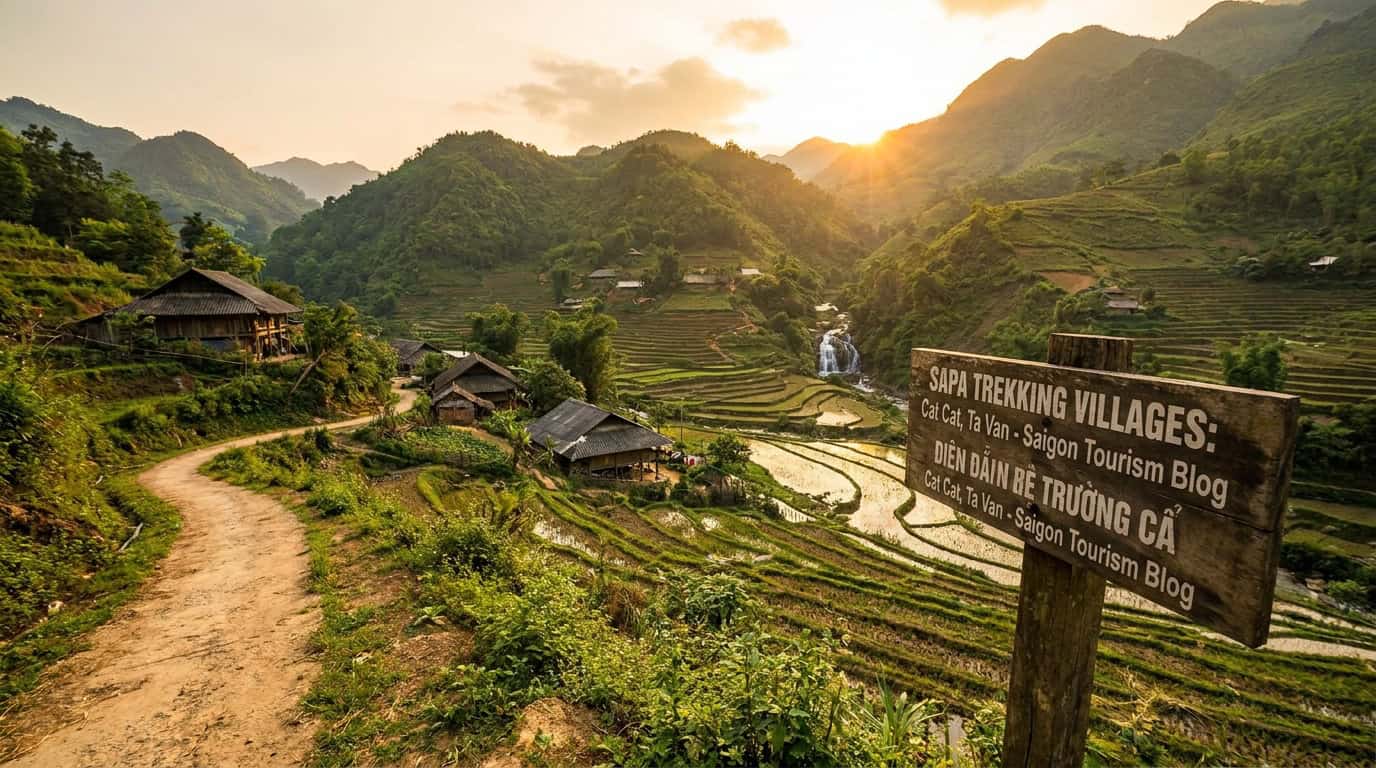
Ta Van is the village every photographer pictures when they imagine the Sapa trekking villages. The hike begins from Y Linh Ho or Lao Chai and rolls down the river valley past suspension bridges, water buffalo, and rice terraces that turn from emerald in May to molten gold in late September.
Route: Sapa town → Y Linh Ho → Lao Chai → Ta Van.
Distance: 10km point-to-point.
Time: 4–6 hours including lunch.
Difficulty: Moderate — muddy slopes when wet; trekking poles useful after rain.
Highlights Along the Trail
- Y Linh Ho: Black H’Mong hamlet at 1,200m; tiny school perched above the river.
- Lao Chai: Largest H’Mong settlement in the valley; 100+ stilt houses.
- Ta Van Bridge: 70m suspension bridge crossing the Muong Hoa River — set down your backpack and breathe.
- Giay village core: Two-storey wooden homes with carved doors; the Giay are skilled rice farmers and quieter than the H’Mong.
Ta Van Logistics
| Detail | Info |
|---|---|
| Trailhead | Y Linh Ho (5km south of Sapa) |
| Distance | 10km |
| Ticket | 75,000 VND Muong Hoa Valley pass (~$3 USD) |
| Recommended start | 08:30 |
| Homestay rate | 250,000–500,000 VND/night (~$10–20 USD) |
Most travellers sleep one night at a Ta Van homestay, eat a family dinner with rice wine, and trek back via a different ridge in the morning. Bring small VND notes — change is rare in the hills.
Village 3: Giang Ta Chai — The Quiet Red Dao Frontier

Giang Ta Chai sits 2km past Ta Van and ends most multi-day routes. It belongs to the Red Dao, whose women wear bright red headdresses embroidered with silver coins. You’ll cross a swaying bamboo bridge, descend into a forest of giant bamboo, and reach the Love Waterfall trail junction.
Route: Ta Van → Su Pan ridge → bamboo forest → Giang Ta Chai → optional finish at Ban Ho.
Distance: 12km from Ta Van (22km total from Sapa).
Time: 5–7 hours.
Difficulty: Hard — narrow ridges, slippery clay sections, and one river crossing.
What Makes Giang Ta Chai Special
- Bamboo Forest: 800m corridor of 15m-tall bamboo — cathedral-like.
- Red Dao herbal-bath homestays: 100,000 VND (~$4 USD) for a wooden tub bath of 18 medicinal herbs after the trek.
- Su Pan rice terraces: Less photographed than Ta Van, equally dramatic.
- Optional add-on: Continue 5km to Thanh Phu for a Tay village finish.
Hire a local Red Dao guide here — the trail forks four times and signage is minimal. Expect 700,000 VND (~$28 USD) for a full-day guide.
Comparison Table: Choosing Your Sapa Trekking Villages Route
| Village | Distance | Difficulty | Entry Fee | Best For |
|---|---|---|---|---|
| Cat Cat | 3km loop | Easy | 150,000 VND | Families, half-day visitors |
| Ta Van | 10km | Moderate | 75,000 VND | First-time trekkers, photographers |
| Giang Ta Chai | 12km | Hard | 75,000 VND | Experienced hikers, culture seekers |
| Lao Chai (combo) | 7km | Easy-moderate | 75,000 VND | Day-trippers without overnight |
How to Get to the Sapa Trekking Villages From Hanoi
You have three reliable options in 2026:
- Sleeper bus: 6 hours direct, 350,000–450,000 VND (~$14–18 USD). Departs Hanoi at 07:00, 14:00, and 22:00. Best operators: Sapa Express, Interbus Line.
- Train + shuttle: Overnight SP3 train Hanoi → Lao Cai (8 hours, 480,000 VND / ~$19 USD), then 35km minibus to Sapa (60,000 VND / ~$2.40 USD). Romantic, slower.
- Private car: 5 hours via the Noi Bai–Lao Cai expressway, 2,400,000 VND (~$96 USD) for up to 4 people.
The expressway, completed in 2014 and detailed by the Asian Development Bank, cut travel time from 10 hours to 5 and is the reason Sapa transformed from a remote outpost into Vietnam’s #2 mountain destination.
If you’re flying into Saigon first and want a smooth transit, read our guides on the best ways to travel from Ho Chi Minh City to Hanoi and pair them with a few days exploring our Saigon itinerary before heading north.
When to Trek: Month-by-Month Breakdown
- January–February: 8–14°C, mist, occasional snow on Fansipan. Quiet, atmospheric, no rice in the fields.
- March–May: 15–22°C, terraces flood and turn mirror-bright. Cherry and plum blossoms in March.
- June–August: 20–25°C, lush green, daily afternoon showers. Cheapest homestay rates.
- September–early November: Golden rice harvest — peak season, book 2 weeks ahead.
- November–December: Cool, dry, fields stubbled brown. Excellent for waterfalls and clear long-range views.
The Vietnam Meteorological and Hydrological Administration reports Sapa averages 2,800mm rainfall per year — pack a poncho between May and August.
What to Pack for Sapa Trekking Villages
- Waterproof hiking shoes with grip (mud is the #1 cause of trail injuries).
- Daypack 20–30L with rain cover.
- Layers: a fleece for evenings, light shell, quick-dry shirt.
- 1.5L water bottle — refill at homestays for 5,000 VND.
- Trekking poles (rentable in Sapa town for 50,000 VND/day).
- Headlamp for early starts and unlit village paths.
- Small denominations of VND (10k–50k notes) for snacks and tips.
- Phrasebook or Google Translate offline pack — H’Mong elders speak limited Vietnamese, let alone English.
Hiring a Local Guide — Why It Matters
Independent walking is legal and feasible on the Cat Cat loop, but for Ta Van and Giang Ta Chai a local guide is strongly recommended for three reasons:
- Trail finding: Side paths multiply after rainfall; GPS apps lose signal in narrow valleys.
- Cultural access: A H’Mong guide gets you invited into homes; without one you stay on the road.
- Direct community income: 60–80% of guide fees go to the family. Booking through the Sapa O’Chau social enterprise (sapaochau.org) or hiring directly at the Ta Van bridge ensures the money stays local.
Expect to pay 600,000 VND (~$24 USD) per day for a Ta Van guide and 1,000,000–1,200,000 VND (~$40–48 USD) for two-day overnight treks including homestay arrangement.
Homestay Etiquette: Sleeping in a Sapa Trekking Village
- Shoes off at the door, every time.
- Don’t touch the household altar or photograph it without permission.
- Accept the rice wine (or politely sip — refusing is rude).
- Tip the cook 50,000–100,000 VND if dinner blew you away.
- Bring a small gift for kids — pencils, picture books, not sweets.
- Mosquito nets are provided; use them April–October.
Dinner is communal: think hot pot, grilled pork belly, sticky rice in bamboo, and chayote leaves. Breakfast is usually pho or fried eggs with bread.
Combining Sapa With Other Vietnam Highlights
A typical northern loop runs Hanoi → Sapa → Ha Giang → Halong Bay. Most travellers spend 2–3 nights in Sapa, which is enough to walk all three villages with a rest day. For the southern side of your trip, see our deep-dive on the best things to do in Ho Chi Minh City and our breakdown of Saigon’s best street food neighbourhoods.
If you’re chasing waterfalls and caves after Sapa, our guide to Ninh Binh day trips from Hanoi covers the karst landscape just 2 hours south of the capital.
Costs: A Realistic 2-Day Sapa Trekking Villages Budget
| Item | VND | USD |
|---|---|---|
| Sleeper bus Hanoi–Sapa return | 800,000 | $32 |
| 2 nights mid-range hotel in Sapa | 1,400,000 | $56 |
| 1 night Ta Van homestay (dinner + breakfast) | 400,000 | $16 |
| Local H’Mong guide (1 day) | 700,000 | $28 |
| Cat Cat + Muong Hoa entrance | 225,000 | $9 |
| Meals, water, snacks | 500,000 | $20 |
| TOTAL per person | 4,025,000 | ~$161 |
That’s roughly half what a packaged tour costs and twice as memorable.
Frequently Asked Questions
How many days do I need for Sapa trekking villages?
Two full days is the sweet spot: one easy Cat Cat morning, one Ta Van overnight trek with a homestay. If you want Giang Ta Chai and the Red Dao bamboo forest, add a third day. Single-day visitors should pick Ta Van over Cat Cat for the real valley experience.
Is Sapa trekking safe for solo female travellers?
Yes. Sapa is among the safest trekking regions in Vietnam, with very low crime and a strong female-guide network. Most H’Mong and Red Dao guides are women who walk the same trails daily. Stick to recognised homestays in Ta Van and Lao Chai, share your route with your hotel, and carry a basic first-aid kit.
What’s the difference between Cat Cat and Ta Van?
Cat Cat is a 3km paved loop close to town with shops, a waterfall, and a cultural show — great for half-day visits but heavily touristed. Ta Van is a 10km rural trek through living rice terraces and four ethnic villages with far fewer crowds, an authentic homestay scene, and significantly better scenery.
Can I trek Sapa villages without a guide?
Cat Cat is fully signposted and safe alone. Lao Chai–Ta Van is doable solo in dry weather with a downloaded MAPS.ME track. Giang Ta Chai and any route after rain should be done with a local guide — trails fork, signage is sparse, and clay sections become dangerous when wet.
How cold does Sapa get in winter?
Sapa averages 8–14°C from December to February, with occasional dips below 0°C and snow on Fansipan summit roughly once every 2–3 years. Most homestays have wood stoves but limited insulation, so pack a warm sleeping layer and gloves if you trek in January.
Are ATMs available in the villages?
No. Withdraw cash at Agribank or Vietcombank ATMs in Sapa town (maximum 3,000,000 VND per transaction). Villages and homestays accept cash only, occasionally local QR-code apps. Bring enough VND for 2–3 days plus a buffer.
Final Tips Before You Lace Up
- Book Ta Van homestays 1–2 weeks ahead in peak season (Sept–Nov).
- Confirm your guide’s name and price the night before — write both in your phone.
- Buy your Muong Hoa Valley ticket at the Sapa tourism office, not from street touts.
- Save offline maps of the Y Linh Ho–Lao Chai–Ta Van path before you lose signal.
- Tip 10–15% if a homestay genuinely impresses you — it’s not customary, but it builds the local economy.
Plan the Rest of Your Vietnam Trip From a Central Saigon Base
Most travellers fly into Tan Son Nhat (Ho Chi Minh City) before connecting to Hanoi for Sapa. Make Saigon the bookends of your trip — chaotic, delicious, walkable — and let the cool mountain air of the Sapa trekking villages be the centrepiece in between.
When you land back in the south, stay with us. Saigon Homestay sits two blocks from Ben Thanh Market in District 1, with rooftop coffee, English-speaking hosts, and quick airport transfers. We help guests book Sapa trains, Ha Giang loops, and Mekong cruises every day. Browse our District 1 homestay rooms, check the Ben Thanh Market guide, and message us when you’re ready to plan — we’ll have the kettle on.
Last updated: 10 June 2026. Prices verified at the Sapa tourism office and confirmed with two operating homestays in Ta Van village.
Prices here are in Vietnamese dong. Our Vietnam currency and money exchange guide covers live rates, ATM fees and where to change money.