
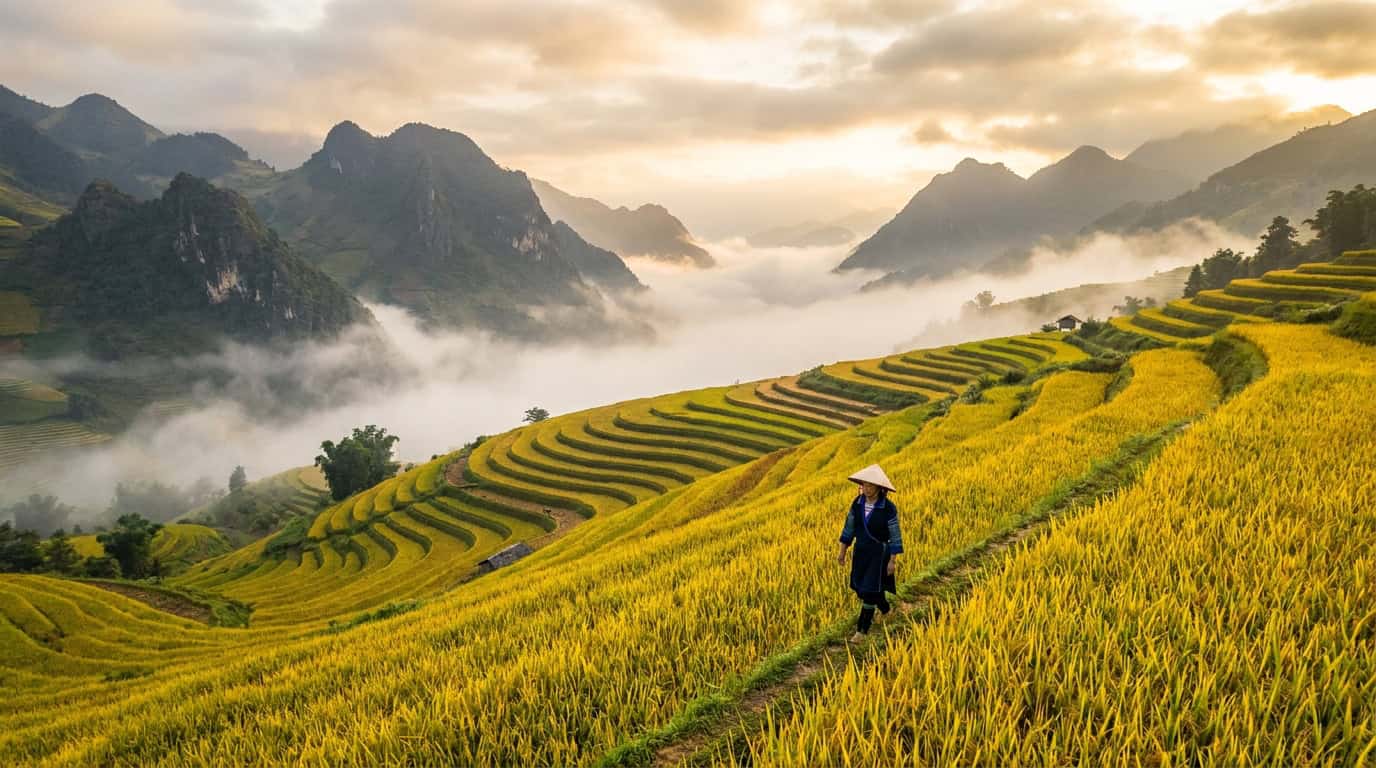
The Sapa rice terraces in Vietnam’s far northwest are a 200-year-old hand-carved landscape spilling down 2,000-meter mountainsides, and the very best two-week window to see them gold is September 15 to October 5, 2026. Carved by the Hmong, Dao, and Giay ethnic groups beginning in the early 1800s, these stair-step paddies cover roughly 1,000 hectares around Muong Hoa Valley alone, and UNESCO-affiliated researchers consider them one of Asia’s most significant living agricultural landscapes. This guide ranks the seven best viewpoints, gives you exact harvest and water-filling dates for 2026, real prices in VND and USD, and the trekking routes that local Hmong guides actually use.
Key Takeaways
- Peak golden harvest 2026: September 15 – October 5 (book lodging 6–8 weeks ahead)
- Best water-mirror season: May 10 – June 5 (newly flooded paddies reflect the sky)
- Top viewpoint overall: Y Linh Ho → Lao Chai → Ta Van trek (10 km, 4–5 hrs)
- Entry fee to terraced valleys: 80,000 VND (~3.20 USD) per person
- Avoid: July–August (heavy rain, leeches, landslide risk) and February (paddies are bare brown)
- Closest international airport: Hanoi (Noi Bai) — 5.5 hrs by overnight sleeper bus or limousine van
Why the Sapa Rice Terraces Are a Bucket-List Sight
Vietnam has three world-class terraced regions — Mu Cang Chai, Hoang Su Phi, and Sapa — but the Sapa rice terraces are the most accessible and visually dramatic for first-time visitors. They sit between 800 m and 1,800 m elevation, which means you can stand at a single viewpoint and see fifteen vertical layers of paddies disappearing into cloud. The Muong Hoa Valley terraces were officially designated a Vietnamese National Heritage Site in 2013 by the Ministry of Culture, Sports and Tourism, a status that protects them from large-scale resort development.
The terraces are not a museum piece. Around 38,000 Hmong and Dao farmers still flood, plant, and hand-harvest them on the exact same annual rhythm their ancestors used in the 1820s. When you walk through them, you are walking through an operational farm, not a theme park.
When to See the Sapa Rice Terraces in 2026 (Month-by-Month)
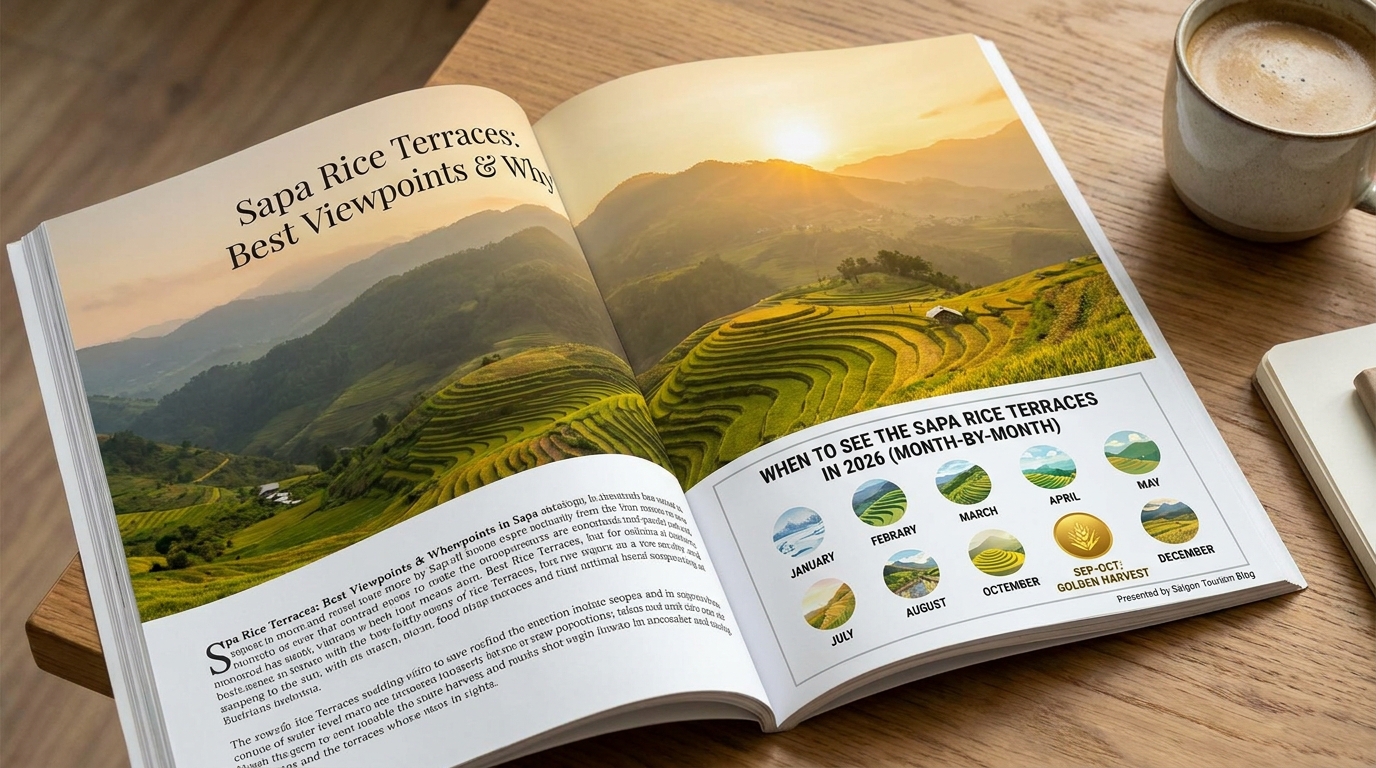
The single biggest mistake foreign visitors make is showing up in the wrong month. The terraces look radically different — sometimes brown, sometimes mirrored, sometimes green, sometimes gold — depending on the agricultural cycle.
| Period (2026) | What you’ll see | Crowd level | Verdict |
|---|---|---|---|
| Feb – early Apr | Brown, bare, dry stubble | Low | Skip |
| Apr 15 – May 9 | First plowing, muddy | Low | OK |
| May 10 – Jun 5 | Water-mirror season (flooded, reflective) | Medium | Excellent |
| Jun 10 – Aug 31 | Bright green seedlings, heavy rain | Low–Medium | Risky weather |
| Sep 15 – Oct 5 | Golden harvest | Very high | Peak — best of year |
| Oct 10 – Nov 5 | Post-harvest stubble, autumn light | Medium | Fair |
| Nov 10 – Jan 31 | Brown, cold, possible frost & snow | Low | Skip for terraces |
Why September 15 – October 5 is the absolute peak
The rice ripens to a uniform gold roughly 95–100 days after the June transplant. In 2026, the Lao Cai Department of Agriculture’s planting calendar puts the synchronized harvest in this exact two-and-a-half-week window. After October 5, farmers cut field by field, so the patchwork goes from “infinity gold” to “checkerboard of gold and brown” within days.
The 7 Best Sapa Rice Terraces Viewpoints (Ranked)
1. Muong Hoa Valley Panorama (Km 12 marker)
The unmarked layby at kilometer 12 on Muong Hoa Road is the single most photographed point in northern Vietnam. From here you see Lao Chai, Ta Van, and Ban Ho villages stacked across the valley. Arrive at 5:45 AM to catch mist filling the valley floor before the sun burns it off.
- Entry: 80,000 VND (~3.20 USD)
- Getting there: 20-minute taxi from Sapa town, 250,000 VND (~10 USD) round-trip with wait
2. Y Linh Ho → Lao Chai → Ta Van Trek
This 10-km, 4–5-hour walking route is the gold standard. You descend 600 m through Hmong farmland, cross the Muong Hoa River on a suspension bridge, and finish in Ta Van village. Local Hmong women guides charge 300,000–500,000 VND (~12–20 USD) per group and the route is not safely doable solo in rainy season.
3. Cat Cat Village Terraces
The closest terraces to Sapa town (2 km), reachable on foot. Less dramatic vertically but excellent for a half-day visit. Entry 150,000 VND (~6 USD).
4. Hang Da Pass Viewpoint
A roadside pull-off on the QL4D highway, 18 km east of Sapa toward Lao Cai. Free, never crowded, and offers a southern exposure that lights up beautifully at 4 PM in October.
5. Sapa Heaven Gate (Tram Ton Pass)
At 1,900 m on the road to Lai Chau, this is the highest accessible viewpoint. You see the western edge of the terraced valleys plus Fansipan (Vietnam’s tallest peak, 3,147 m). Best in clear winter mornings, not for terraces specifically but for context.
6. Sin Chai Hmong Village
A quieter alternative to Cat Cat with steeper terraces. 6 km from Sapa town, 50,000 VND entry (~2 USD).
7. Ban Ho – Thanh Phu Lower Valley
The lowest, warmest, and most southerly terraces of the Sapa cluster (elevation 400 m). Harvest here happens 10–14 days earlier than upper Muong Hoa, so it’s a useful backup if you arrive in early September.
How to Get to the Sapa Rice Terraces from Saigon

Most foreign visitors fly into Ho Chi Minh City (Saigon) first. Here’s the realistic routing for 2026:
- Saigon (SGN) → Hanoi (HAN) — 2 hours, ~1.5–2.5M VND (~60–100 USD) on Vietjet, Bamboo, or Vietnam Airlines
- Hanoi → Sapa town — 5.5 hours by limousine van (450,000 VND / ~18 USD), or 8 hours on an overnight sleeper bus (350,000 VND / ~14 USD), or 8 hours by overnight train to Lao Cai + 1-hour shuttle
- Sapa town → terraces — taxi, motorbike rental (150,000 VND/day / ~6 USD), or guided trek
If you’re basing yourself in Saigon for the Vietnam-wide leg of your trip, see our detailed Saigon to Sapa transport guide for current 2026 schedules and our things to do in Ho Chi Minh City hub for layover planning.
What to Pack for the Sapa Rice Terraces
Sapa sits 1,500 m above sea level. Even in October the morning temperature can drop to 12 °C while the lowland Saigon you flew from is at 32 °C. Pack:
- Waterproof hiking shoes with grip (paddy edges are slick clay)
- Light fleece + windproof shell
- Quick-dry trousers (not jeans)
- 1 liter of water per 2 hours of walking
- Cash in 50,000 VND and 100,000 VND notes — no ATMs in villages
- Small bills for tipping Hmong guides
Sapa Rice Terraces vs Mu Cang Chai vs Longji: Which to Choose
These are the three terrace regions every traveler asks about. Here is the honest comparison.
Is Mu Cang Chai worth visiting?
Yes — but only if you have already seen Sapa or want fewer tourists. Mu Cang Chai’s terraces in Yen Bai province are arguably more visually perfect (the La Pan Tan “raspberry hill” formation is iconic), but the region is 7 hours from Hanoi versus 5.5 to Sapa, has no train link, and far less English-speaking infrastructure. Best for second-time visitors to Vietnam.
Are Longji rice terraces worth it?
Longji (“Dragon’s Backbone”) in Guangxi, China, is visually similar to Sapa but requires a separate Chinese visa, is more commercialized, and the indigenous Zhuang/Yao villages charge multiple stacked entrance fees. If you are already in Vietnam, the Sapa rice terraces deliver 90% of the visual payoff with 30% of the logistical effort.
| Feature | Sapa (Vietnam) | Mu Cang Chai (Vietnam) | Longji (China) |
|---|---|---|---|
| Access from Hanoi | 5.5 hrs | 7 hrs | flight + 3 hrs |
| Visa needed (US/EU) | E-visa, easy | E-visa, easy | Full visa, harder |
| English signage | Good | Limited | Limited |
| Crowds in peak | High | Medium | Very high |
| Entry cost (USD) | ~3 | ~2 | ~15–20 |
For a longer overland route through northern Vietnam, our Vietnam north loop itinerary covers Sapa, Ha Giang, and Mu Cang Chai in a single 10-day trip.
Where Can I See Rice Terraces in Sapa? The 4 Core Valleys
To answer the most common “People Also Ask” question directly: the four valleys with terraced rice fields inside Sapa district are Muong Hoa, Ta Phin, Ta Van, and Ban Ho. Muong Hoa is the largest and most photographed, Ta Phin offers Red Dao villages with herbal baths, Ta Van is the homestay capital, and Ban Ho sits at lower elevation with earlier harvests. All four are within 25 km of Sapa town and can be visited on day trips.
According to data published by Vietnam Tourism’s official portal, Sapa attracts roughly 3.5 million visitors annually, with around 60% arriving specifically during the harvest months of September and October.
Responsible Trekking in the Sapa Rice Terraces
The Hmong and Dao communities welcome trekkers but the relationship is fragile. Some non-negotiable etiquette:
- Walk single file on the paddy bunds (ridges). A collapsed bund drains an entire field below it.
- Pay your Hmong guide directly, not through a Sapa-town tour office that may keep 60% of the fee.
- Buy textiles from women who made them — look for natural-indigo staining on their hands.
- Do not photograph children without asking the parent.
- Pack out all trash, including biodegradable items (orange peels take 6 months to decompose at altitude).
The UNESCO Asia-Pacific Cultural Heritage Programme recognizes the Muong Hoa Valley petroglyphs (carved between the 15th and 19th centuries) embedded inside the terraces themselves — never touch or walk on the carved boulders.
Where to Stay: Sapa Town vs Homestays in the Terraces
You have three lodging tiers for visiting the Sapa rice terraces:
- Sapa town hotels (4-star, 1.2–2.5M VND / ~48–100 USD) — convenient, hot showers, ATMs
- Boutique resorts on the edge of town (Topas Ecolodge, Pao’s Sapa) — 4–8M VND (~160–320 USD)
- Hmong/Dao homestays in Ta Van or Lao Chai (250,000–500,000 VND / ~10–20 USD including dinner) — the authentic choice
For most foreign visitors we recommend two nights in town plus one night in a Ta Van homestay. This gives you the panoramic-viewpoint dawn shots plus the inside-the-paddies sunset experience.
Returning Saigon-based travelers often pair the trip with a Mekong Delta extension — see our Saigon to Mekong Delta day trips guide for the southern half of the same itinerary.
Sample 4-Day Sapa Rice Terraces Itinerary (October 2026)
Day 1 (Hanoi → Sapa): Overnight limousine van departing Hanoi 22:00, arriving Sapa 04:30. Sunrise at Muong Hoa Km 12 viewpoint. Check into hotel, sleep midday.
Day 2 (Trek): Y Linh Ho → Lao Chai → Ta Van full-day trek with Hmong guide. Stay in Ta Van homestay.
Day 3 (Ta Phin loop): Motorbike to Ta Phin Red Dao village. Herbal bath, lunch. Return to Sapa town for Fansipan cable car (optional, 800,000 VND / ~32 USD).
Day 4 (Return): Sunrise at Hang Da Pass. Daytime limousine back to Hanoi, overnight flight to Saigon.
If you’re continuing south, our Saigon 3-day itinerary plugs straight into this routing.
Frequently Asked Questions
Where can I see rice terraces in Sapa?
The four main valleys are Muong Hoa, Ta Phin, Ta Van, and Ban Ho, all within 25 km of Sapa town. Muong Hoa is the largest and most photographed. The best single viewpoint is the Km 12 marker on Muong Hoa Road; the best trek is Y Linh Ho to Ta Van. Entry to terraced valleys costs 80,000 VND (~3.20 USD).
When to see rice fields in Sapa?
Two windows in 2026: water-mirror season from May 10 to June 5 (flooded paddies reflect the sky), and golden harvest from September 15 to October 5 (uniform gold across the valley). Avoid July–August (heavy rain, leeches), February–March (bare brown stubble), and December–January (cold, possible frost).
Is Mu Cang Chai worth visiting?
Yes for second-time Vietnam visitors who want fewer crowds and have at least 5 spare days. Mu Cang Chai’s La Pan Tan “raspberry hill” formation is more visually striking than anything in Sapa, but the region takes 7 hours from Hanoi, has no train link, and minimal English-speaking infrastructure. First-time visitors should choose Sapa.
Are Longji rice terraces worth it?
Only if you are already in southern China or want to combine Vietnam and Guilin. Longji requires a full Chinese visa (not a simple e-visa), stacks multiple entrance fees totaling around 20 USD, and is significantly more commercialized than Sapa. The Sapa rice terraces deliver 90% of the visual payoff with about a third of the logistical effort.
How many days do I need for the Sapa rice terraces?
A minimum of 3 days and 2 nights, ideally 4 days. One day is lost to overnight transport from Hanoi, one to the panoramic viewpoints, and one to the Muong Hoa Valley trek. Adding a fourth day allows for Ta Phin village, the Fansipan cable car, or a Ban Ho lowland visit.
Can I visit Sapa from Saigon in a long weekend?
Tight but possible: fly Saigon–Hanoi Friday evening, overnight bus to Sapa, full Saturday and Sunday in the terraces, overnight bus back Sunday, fly Hanoi–Saigon Monday morning. You’ll be exhausted but will see the main viewpoints. Most travelers find a 5-day mini-trip more sustainable.
Plan Your Vietnam Trip from a Central Saigon Base
Before or after Sapa, almost every foreign visitor passes through Saigon. Staying in District 1 puts you 5 minutes from Ben Thanh Market and 8 minutes from the Reunification Palace, with easy connections for an overnight bus or flight to Sapa.
Carrying the right cash matters more than most visitors expect — see the Vietnam currency and money exchange guide before you arrive.