
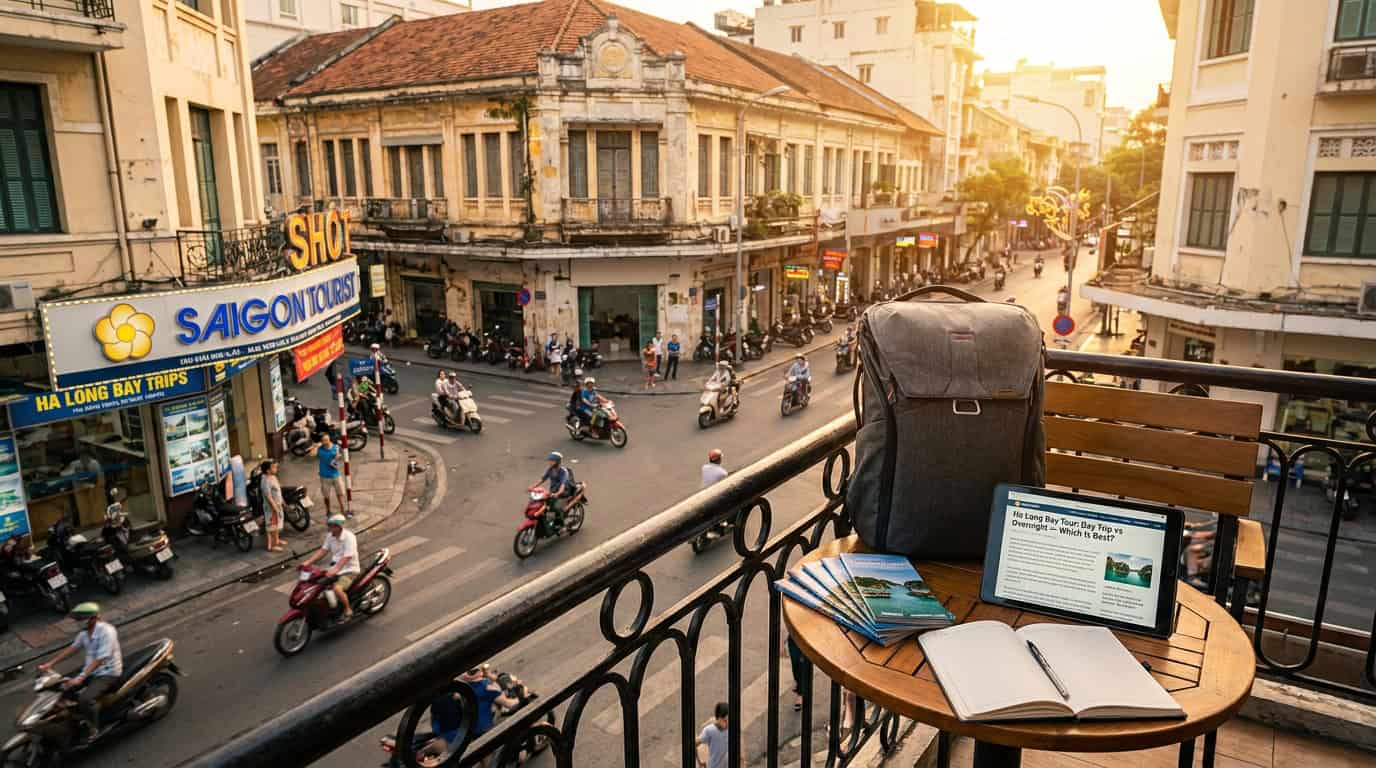
A ha long bay tour is one of the most-anticipated experiences in all of Southeast Asia —
and the first decision every visitor must make is whether to do it as a day trip or an overnight
cruise. Ha Long Bay spans 1,553 square kilometres of the Gulf of Tonkin, holding 1,969 limestone
islands and islets that have earned UNESCO World Heritage status since 1994
(UNESCO World Heritage Centre, 2000). It consistently
ranks as Vietnam’s single most visited natural destination. But visiting is one thing. How you
visit shapes everything.
This guide compares both formats directly — hour by hour, cost by cost — so you can make the
right call before you book.
Key Takeaways
– Day trips start from 850,000 VND (~$33 USD) per person; overnight cruises (2D1N) start
from 2,200,000 VND (~$85 USD).
– Ha Long Bay is ~170 km from Hanoi — roughly 3–3.5 hours each way, meaning day-trippers
spend more time in the van than on the water.
– Only overnight guests catch sunrise over the karsts, kayak into hidden lagoons, and explore
caves without the midday crowd.
– The best time to visit is October to April: clear skies, calm seas, comfortable
temperatures on deck.
– For most international travellers with two free days, the overnight cruise delivers far
greater value — the math strongly favours it.
What Makes Ha Long Bay Vietnam’s Most Iconic Destination?
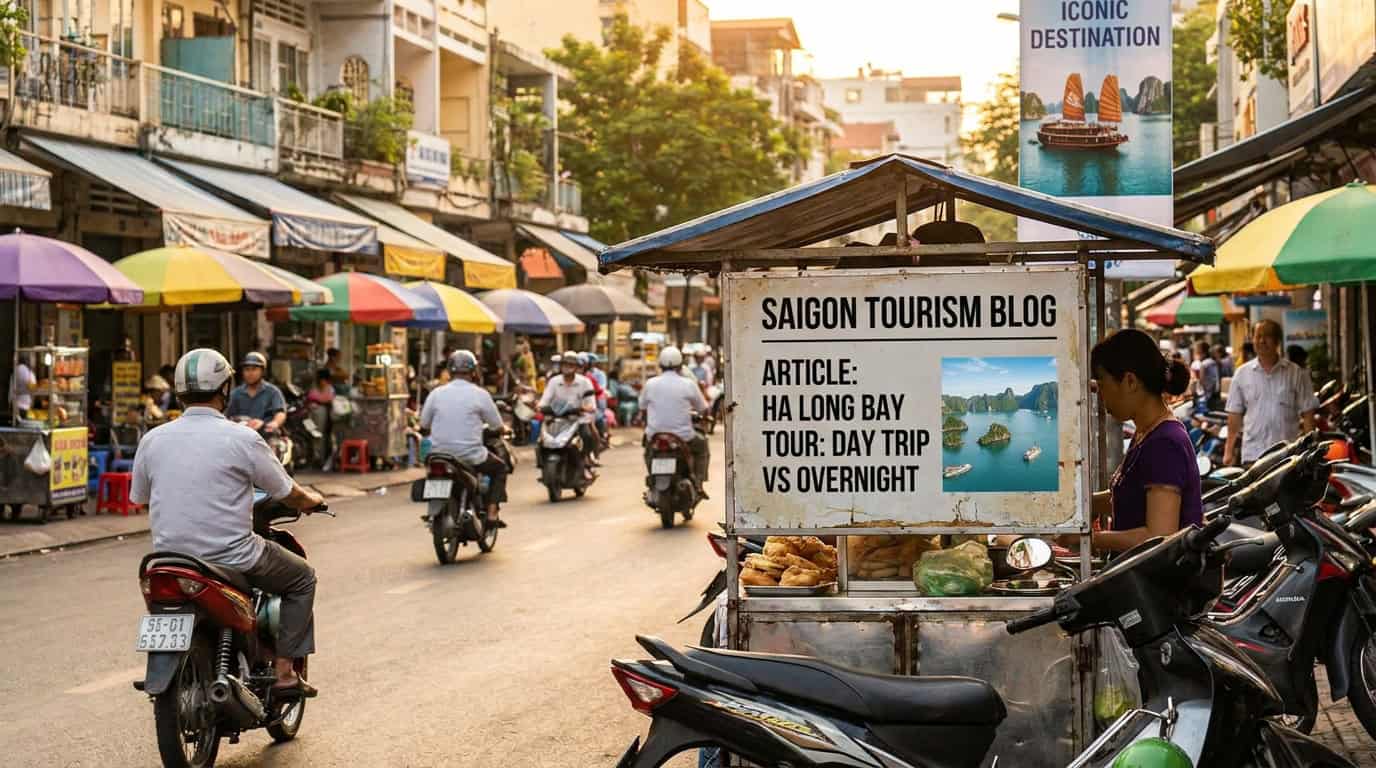
Ha Long Bay sits in Quang Ninh Province in northeastern Vietnam, about 170 km east of Hanoi.
The bay receives millions of visitors every year, making it the country’s most visited natural
attraction by a wide margin (Vietnam Tourism,
2025). The name translates roughly as “Descending Dragon Bay” — a reference to a Vietnamese
legend in which a family of dragons spat gemstones into the sea, creating the thousands of
islands that rise from the water today.
The geology is less romantic but no less impressive. Those limestone karsts formed over 500
million years through a process called karstification: tectonic shifts pushed ancient seabed
upward, ocean water slowly dissolved the soluble rock, and successive ice ages left jagged towers
marooned above the waterline. The result is a seascape unlike anywhere else on earth — and one
that photographs simply cannot prepare you for.
Inside the larger karsts, stalactite caves hold chambers the size of sports stadiums. On the
water, traditional wooden junk boats weave between the islands while fishermen haul nets from
floating villages that have survived on the bay for generations. Whether you choose a day trip or
an overnight stay, you’ll see some of this. The question is how deeply.
Ha Long Bay Tour Options: Day Trip vs Overnight at a Glance

Before going deep on either format, here’s the full side-by-side comparison.
| Feature | Day Trip | Overnight Cruise (2D1N) |
|---|---|---|
| Duration | ~11–12 hrs door-to-door | ~26–30 hrs door-to-door |
| Time on the water | ~4–5 hours | ~18–22 hours |
| Cost per person | From 850,000 VND (~$33) | Budget: 2,200,000 (~$85) · Mid: 4,500,000 (~$175) · Luxury: 9,000,000 (~$350) |
| Overnight on board | No | Yes |
| Sunrise on the bay | No | Yes |
| Kayaking | Rarely | Almost always included |
| Cave visits | 1 cave | 1–2 caves |
| Meals | Lunch only | Breakfast + lunch + dinner |
| Group size | Often 20–60 passengers | 8–20 on quality boats |
| Advance booking | 1–2 days | 2–4 weeks in peak season |
| Best for | Tight schedules, low budgets | First-timers wanting the full experience |
The Ha Long Bay Day Trip: What to Expect
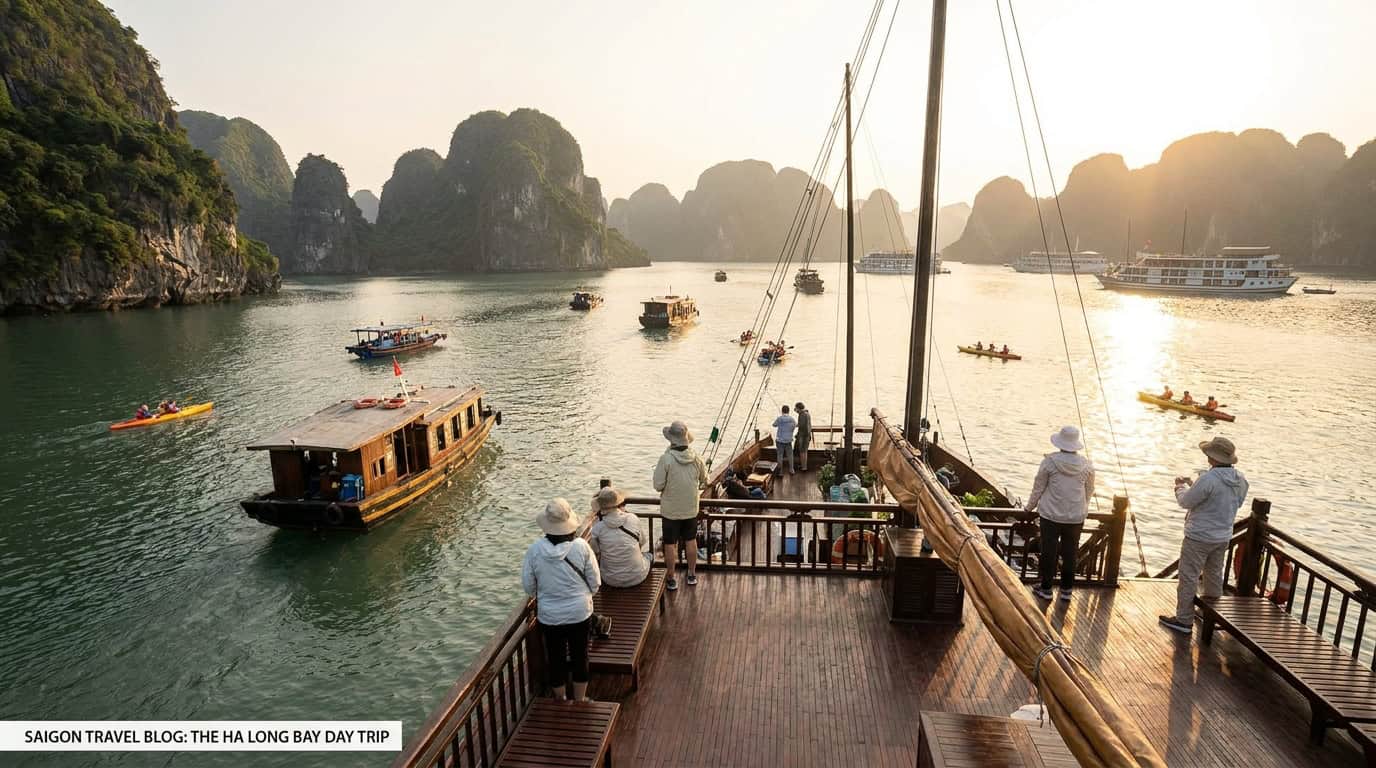
A ha long bay tour day trip departs Hanoi between 07:30 and 08:00 and returns between
19:30 and 21:00. The road transfer alone takes 3–3.5 hours each way, leaving you roughly four
to five hours of actual time on the water. Budget day trips start from 850,000 VND (~$33 USD)
per person. Quality mid-range options run 1,200,000–1,800,000 VND ($47–$70 USD) and include a
better boat, an English-speaking guide, and a proper seafood lunch.
What a standard day trip includes:
- Round-trip transfer from your Hanoi hotel
- 4–5 hours cruising on a shared boat
- One cave visit (typically Sung Sot Cave or Thien Cung Cave)
- Seafood lunch on board — rice, grilled fish, vegetable dishes
- English-speaking guide and life jackets
Day trip: Pros
- Lowest cost entry point — ideal if your budget is tight or your schedule won’t stretch
- Zero overnight packing — no bag of clothes, toiletries, or planning logistics
- Works for families with toddlers who may not sleep in a small, rocking cabin
- Fits a one-day gap in a dense Vietnam itinerary without rearranging flights
Day trip: Cons
- You spend more time in the van than on the bay. A 3.5-hour transfer each way to spend
4–5 hours on the water is a punishing ratio — and that 4–5 hours includes lunch and a cave
visit. - No sunrise. Mist lifting off 1,969 limestone peaks at 5:30 AM is one of Vietnam’s most
photographed moments. Day-trippers miss it entirely. - Severely limited activities. Most budget day boats don’t carry kayaks, and the itinerary
has no space for evening squid fishing or cooking classes. - Crowded boats. Budget day trips often share large ferries with 40–60 passengers, and the
bay is measurably busier during midday hours.
If you have only one free day in Hanoi and Ha Long Bay is the non-negotiable item on your list,
the day trip works. But it’s worth knowing exactly what you’re trading away.
The Overnight Ha Long Bay Tour: A Completely Different Experience
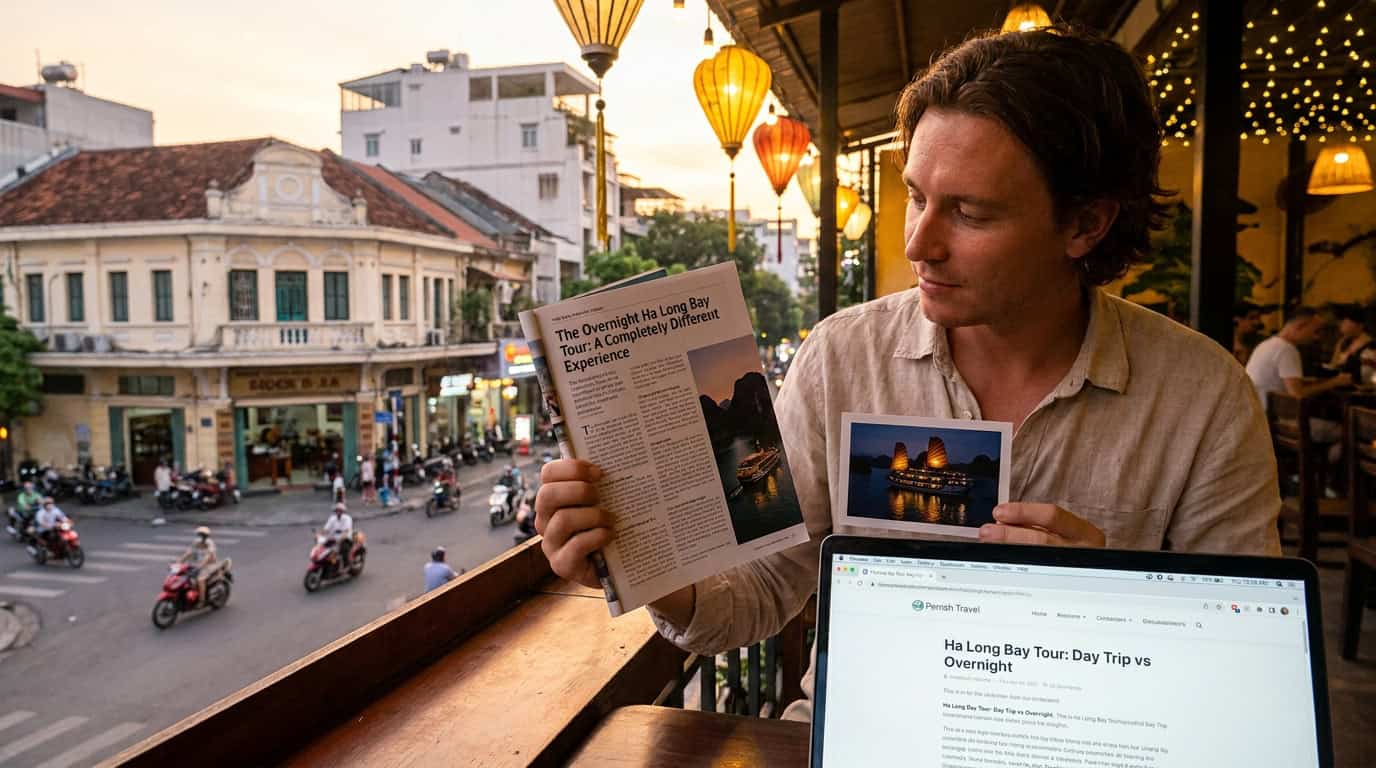
The overnight ha long bay tour changes the tempo entirely. Boats leave at roughly the same
time as day trips, but once you’re on the water, there’s no race back to the harbour. Your junk
anchors in a quiet lagoon after dark, away from the day-boat crowds, and the bay takes on a
completely different character as the sun drops.
2026 overnight cruise price tiers:
| Tier | Cost per person (2D1N) | What you get |
|---|---|---|
| Budget | From 2,200,000 VND (~$85) | Basic or shared cabin, fan/AC, simple meals |
| Mid-range | From 4,500,000 VND (~$175) | Private en-suite cabin, AC, kayaking, cooking class, 2 caves |
| Luxury | From 9,000,000 VND (~$350) | Suite, private balcony, spa, wine dinner |
include transfers, all meals, and core activities.
What a standard mid-range overnight cruise includes:
- Round-trip transfer from your Hanoi hotel
- Private en-suite cabin with air conditioning
- All meals: dinner (night one), breakfast and lunch (day two)
- Two cave visits, including quieter off-the-beaten-path options
- Guided kayaking through hidden lagoons
- Squid fishing from the deck (seasonal, October–March)
- Sunrise watch from the sun deck at ~5:30 AM
- Morning tai chi session
- Cooking demonstration — spring rolls, Vietnamese dipping sauces
Overnight cruise: Pros
- Sunrise over the karsts is among the most moving experiences in all of Vietnam. Nothing
in travel writing adequately prepares you for mist lifting off 1,969 limestone peaks at dawn. - Access to quieter, remote areas. Quality overnight boats anchor well away from the
day-trip zones. You’ll hear the water lapping against the hull, not a generator. - Kayaking into sea caves. Paddling through a narrow cave mouth into a sunlit, enclosed
lagoon is impossible on a day trip — it requires arriving in the late afternoon when tides align. - Better value per activity. When you total up meals, activities, accommodation, and
transfers, the cost per experience on a mid-range cruise drops well below the headline number. - The food is genuinely good. Overnight boats invest in dinner — fresh seafood, Vietnamese
specialties, and open bar on many mid-range operators.
Overnight cruise: Cons
- Higher upfront cost. Even the cheapest overnight cruise costs more than a day trip.
- Motion sickness is a real consideration. The bay is sheltered, but October–February can
bring swells, and budget boats have little stabilisation. - Requires advance planning. Reputable mid-range and luxury boats fill up 3–4 weeks ahead
in peak season (July–August, and around Vietnamese New Year).
Day Trip vs Overnight — Which Ha Long Bay Tour Is Right for You?
Choosing the right ha long bay tour format comes down to three honest questions: How much
time do you have? How tight is your budget? And will you regret missing the sunrise?
Choose a day trip if:
– You have only one free day in Hanoi with no flexibility to extend
– Your total Vietnam travel budget is under $40 USD per day
– You’re travelling with children under five who may struggle sleeping in a small moving cabin
– You’re prone to severe motion sickness and the forecast shows rough weather
Choose an overnight cruise if:
– You can spare two days — even arriving in Hanoi a day earlier than planned is worth it
– You’re a photographer, a couple, or someone who travels for the feeling of a place, not just
the sight of it
– You want kayaking, cave exploration, and the experience of watching a floating village wake up
at dawn
– You’d rather do Vietnam once properly than tick boxes at pace
The honest verdict: For the vast majority of international visitors, the overnight cruise is
the right call. The 170 km transfer from Hanoi is simply too long, and the bay too vast, for a
day trip to deliver real value. If cost is the constraint, a budget 2D1N cruise at 2,200,000 VND
(~$85 USD) still offers a dramatically richer experience than any day trip.
If you’re structuring a full Vietnam itinerary from south to north, our
complete Saigon travel itinerary covers how to plan your days so Ha Long
Bay fits without sacrificing time in the south.
How to Get to Ha Long Bay from Hanoi
Ha Long Bay is approximately 170 km northeast of Hanoi, following the expressway via Hai
Phong. Road transfers take 2.5 to 3.5 hours depending on traffic and your hotel pickup location.
Most reputable operators include round-trip transfer in the package price.
Your transfer options:
| Option | Journey time | Cost | Best for |
|---|---|---|---|
| Shared minivan (tour-included) | 3–3.5 hrs | Included in most tours | Individuals, couples |
| Private car | 2.5–3 hrs | 2,500,000–3,500,000 VND (~$97–$135) for the vehicle | Groups of 4+ |
| Seaplane (Hai Au Aviation) | ~45 min | From ~3,200,000 VND (~$124) one-way | Splurge-worthy; flies over the karsts |
| Public bus to Ha Long | 3.5–4.5 hrs | ~200,000 VND (~$8) | Budget travellers; not recommended for first-timers |
A practical note for travellers coming from Ho Chi Minh City: the standard route is a 2-hour
domestic flight to Noi Bai Airport (Hanoi), then onward to Ha Long the same or next morning.
For help planning your southern Vietnam days before heading north, see our guide to
things to do in Ho Chi Minh City — it covers the best
one-, two-, and three-day itineraries from a District 1 base.
For navigating Hanoi itself before or after the bay trip, our
Hanoi Old Quarter travel guide has everything you need.
Most Ha Long Bay operators offer free hotel pickups from the Old Quarter area.
Best Time to Visit Ha Long Bay
Ha Long Bay has two distinct seasons that affect visibility, sea conditions, crowd levels, and
the viability of outdoor activities.
October to April — Recommended (dry season)
Clear skies, calm seas, and temperatures from 17°C in January up to 28°C in April. Visibility
is excellent, and the karsts photograph at their best against blue sky. November and February–March
are the sweet spots: stable weather, lower crowds than the July–August peak, and comfortable
temperatures on deck. Book overnight cruises 3–4 weeks ahead during this window.
May to September — Proceed with caution (wet season)
Warmer water (up to 30°C) and longer daylight hours, but Vietnam’s typhoon season runs
July–September, bringing real disruption risk. Rain is frequent, visibility drops sharply, and
some operators temporarily suspend cruises during typhoon warnings. If you’re visiting in summer,
choose an operator with a clear bad-weather rebooking or refund policy.
Best single month: November — post-typhoon stability, pre-Chinese New Year crowds, clear
skies, and dry decks.
Top Tips for Booking Your Ha Long Bay Tour
When booking your ha long bay tour, these rules consistently separate good experiences from
bad ones:
- Book directly with the cruise operator rather than through street-level travel agents
in Hanoi’s Old Quarter. Prices are typically identical, but direct booking eliminates the risk
of a last-minute boat substitution. - Read TripAdvisor reviews from the last 90 days. Boat quality in Vietnam changes fast —
ownership changes, standards slip. A 200-review average from 2023 tells you nothing about
2026. - Ask about boat capacity before paying. Reputable operators cap their boats at 8–20
passengers. Anything over 30 feels like a ferry crossing. - Get inclusions confirmed in writing. Some budget operators charge separately for kayaking,
cave entrance fees, and even bottled water. - Always choose a private cabin. Shared dorms on a rocking boat, after a long travel day,
are a false economy at any price point. - Verify your travel insurance covers maritime activities. Standard backpacker policies
routinely exclude sea activities and nautical incidents. - Consider a 3D2N extension. The third day takes you deeper into Bai Tu Long Bay, where
the scenery matches Ha Long’s and the crowd count drops to near zero.
For a complete pre-departure checklist covering visas, transport, and packing for Vietnam, our
Vietnam travel tips and packing guide has you covered.
What to Pack for Ha Long Bay
Pack light. Cabin storage on junk boats is limited — a 30–40L daypack or soft duffel is the
maximum you’ll want on board. Leave your rolling suitcase in your Hanoi hotel’s storage room
(most operators and hotels offer this free of charge).
Essentials:
– Sunscreen SPF50+ — reflected glare off the water is intense; reapply every two hours
– Seasickness tablets or acupressure wristbands — take tablets 30 minutes before boarding
– Light rain jacket or packable poncho — brief showers happen even in dry season
– Sandals or reef shoes for kayaking, wet cave walks, and boat decks
– Small dry bag or heavy-duty Ziploc bags for your phone, camera, and passport
Optional but genuinely useful:
– Polarised sunglasses — the glare on the water is severe throughout the day
– Mosquito repellent — essential at dusk near mangrove areas and floating villages
– Reusable water bottle — some budget operators charge for bottled water
– A wide-angle lens or phone clip-on lens — the bay is too grand for standard phone zoom
Frequently Asked Questions
How much does a Halong Bay tour cost?
A ha long bay tour day trip starts from 850,000 VND (~$33 USD) per person, including
transfers, lunch, and one cave visit. Overnight 2D1N cruises range from 2,200,000 VND (~$85)
for budget options up to 9,000,000 VND (~$350) for luxury, with mid-range at 4,500,000 VND
(~$175) representing the best value for most international travellers in 2026.
What is the best month to go to Halong Bay?
October to April is the recommended window, with November and March standing out as the
ideal months — stable post-typhoon weather, fewer crowds than the July–August peak, clear
skies, and 20–25°C temperatures. Avoid the typhoon season (July–September), when storms can
disrupt or cancel cruises entirely, particularly day trips that offer limited rebooking flexibility.
Can Halong Bay be a day trip from Hanoi?
Yes — Ha Long Bay is roughly 170 km from Hanoi (3–3.5 hours by road transfer), and day
trips are widely available from 850,000 VND (~$33 USD). The trade-off is real: you spend more
time in the transfer van than on the water. Most experienced Vietnam travellers strongly
recommend at least a 2D1N overnight cruise to make the journey genuinely worthwhile.
How long is the Halong Bay tour?
Day trips run 11–12 hours door-to-door from Hanoi, with 4–5 hours of actual time on the
water. Overnight 2D1N cruises last 26–30 hours, giving you a full afternoon, evening, and
morning on the bay. For deeper exploration, 3D2N packages start from 6,500,000 VND (~$250) at
mid-range and cover quieter areas including Bai Tu Long Bay and Lan Ha Bay.
Plan Your Vietnam Trip from Ho Chi Minh City
Ha Long Bay fits most naturally into a north-south Vietnam itinerary. Travellers who fly into
Ho Chi Minh City, spend four to seven days exploring the south, then fly up to Hanoi and head
to the bay within 24 hours — consistently report Ha Long as the emotional highlight of the
entire trip.
That itinerary works best when you have a reliable, well-located base in Saigon. Saigon
Homestay places you in the heart of District 1, minutes from Ben Thanh Market, Bui Vien
Walking Street, and the fastest connections to Tan Son Nhat Airport. Our guests regularly use
us as the launchpad for their full Vietnam journey — south to north, ending at the bay.
Ready to lock in your Ha Long Bay dates? Start with a few nights in District 1, settle into
Vietnam at its most vibrant, and head north with the logistics already sorted.
Check availability at our District 1 homestay and book
direct for the best rate — no booking platform fees, free airport pickup on stays of 3+ nights.
Sources:
– UNESCO World Heritage Centre — Ha Long Bay (List #672),
retrieved June 2026
– Vietnam National Administration of Tourism — Ha Long Bay,
retrieved June 2026
Unsure what to tip here? Our tipping in Vietnam guide gives amounts for restaurants, drivers, spas and tour guides.
Related Guides
- Ha Long Bay Luxury Cruise: Best High-End Options (2026)
- Ha Long Bay 2-Day 1-Night Cruise: What to Expect
- Ha Long Bay Safety: Is It Worth the Risk?
- Ha Long Bay Beaches: Best Spots for Swimming & Sunsets
- Ha Long Bay Kayaking: Best Routes & Tours (2026)
- Cat Ba Island vs Ha Long Bay: Where Should You Stay?