
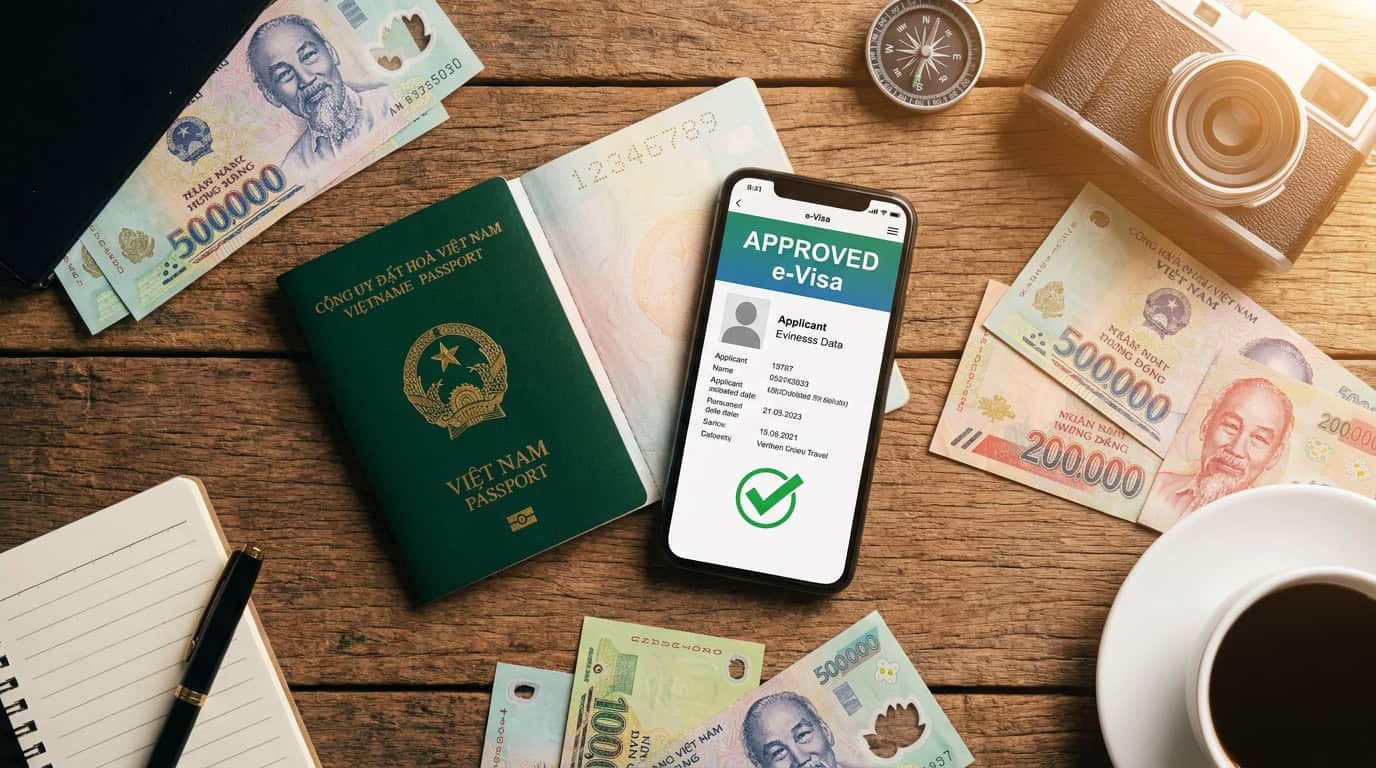
Vietnam hit 21.2 million international arrivals in 2025, an all-time high and a 20.4% jump over the previous year (VnExpress, 2025). Government officials credited the 2023 vietnam evisa reforms directly — opening eligibility to every nationality worldwide and extending validity from 90 days. If you are planning a trip and still uncertain how the process works, this guide covers every step, every fee, and every pitfall for 2026.
Key Takeaways
– Cost: $25 USD for single entry, $50 USD for multiple entry — paid on the official portal evisa.gov.vn only.
– Validity: Up to 90 days, single or multiple entry, available to all nationalities since August 15, 2023.
– Processing: Standard 3 working days (weekends and public holidays excluded); plan for 3-5 working days in practice.
– New in 2026: A mandatory Digital Arrival Card must be submitted within 72 hours before landing at Tan Son Nhat (HCMC) via prearrival.immigration.gov.vn.
What Is the Vietnam E-Visa? (And Why Almost Everyone Should Use It)
The Vietnam e-visa is an official electronic visa issued by Vietnam’s Ministry of Public Security, available entirely online without visiting an embassy or consulate. Since the August 15, 2023 reform, it is valid for up to 90 days per entry — single or multiple — and is accepted at all 83 of Vietnam’s international border checkpoints including airports, land crossings, and seaports (evisa.gov.vn, 2026).
Before 2023, Vietnam’s e-visa had a 30-day cap with single-entry only, and coverage was limited to roughly 80 nationalities. That made it awkward for long-stay travelers and frequently sent people toward visa on arrival (VOA) arrangements. The 2023 overhaul removed both restrictions in one go.
The result: for the vast majority of travelers, the e-visa is now the simplest, cheapest, and most reliable option available. You apply from your laptop or phone, pay $25, and get a PDF approval document within a few business days. No agents. No embassy queues. No stamping fee on arrival.
There is one strong caveat worth understanding from the start: the official application portal is evisa.gov.vn and nothing else. Lookalike websites charge $50 to $100 or more for the exact same service. More on that in the mistakes section.
Citation Capsule: Vietnam’s e-visa reform of August 15, 2023 extended maximum validity to 90 days (single or multiple entry) and opened eligibility to all nationalities worldwide. The visa is accepted at all 83 international border checkpoints. Source: evisa.gov.vn, 2026.
Who Is Eligible — and Who Might Not Need One at All?
Every nationality worldwide is eligible for the Vietnam e-visa as of August 15, 2023 — there are no excluded countries in the official framework (evisa.gov.vn, 2026). That said, some nationalities do not need a visa at all for short stays, which changes the calculation.
Vietnam currently grants 45-day visa-free entry (no e-visa required) to citizens of the following countries, under a policy effective August 15, 2025 through August 14, 2028 (VietnamPlus, 2025):
Visa-free 45 days (current policy):
Germany, France, Italy, Spain, United Kingdom, Russia, Japan, South Korea, Denmark, Sweden, Norway, Finland, Belarus, Belgium, Bulgaria, Croatia, Czech Republic, Hungary, Luxembourg, Netherlands, Poland, Romania, Slovakia, Slovenia, and Switzerland.
If your nationality is on that list and your trip is 45 days or under, you can board your flight and present your passport at immigration. No prior application needed. If you plan to stay longer than 45 days, you will need to apply for the e-visa before departure.
For everyone else, the e-visa is the right starting point. Citizens of ASEAN member states (Thailand, Malaysia, Singapore, Indonesia, Philippines, Cambodia, Laos, Myanmar, Brunei) generally have separate bilateral visa-free or visa-on-arrival arrangements — check the Vietnamese embassy website for your specific country if you are from one of these nations.
Vietnam E-Visa vs. Visa on Arrival: Which Should You Choose?
The e-visa is better for almost every traveler in 2026. Visa on Arrival (VOA) requires a pre-approved letter from a third-party agent, a stamping fee paid in cash on arrival, and is only valid at airports — not land borders or seaports. The e-visa costs the same or less, works everywhere, and involves no middlemen (evisa.gov.vn, 2026).
| Feature | E-Visa | Visa on Arrival |
|---|---|---|
| Cost | $25 single / $50 multiple | ~$25 agent fee + $25-$50 stamping fee on arrival |
| Entry types | Air, land, seaport (all 83 checkpoints) | Air only (international airports) |
| Where to apply | evisa.gov.vn (official, online) | Third-party agent for approval letter |
| Processing | 3 working days standard | Agent varies; 1-3 business days for letter |
| Valid for | Up to 90 days | Up to 90 days |
| Ease | Simple — no agent, no cash on arrival | More complex — agent required, cash needed at desk |
The only scenario where VOA might make practical sense is if you have an emergency same-day flight and cannot wait even 3 days for e-visa processing. In every other case, the e-visa wins on simplicity, transparency, and accepted entry points.
Citation Capsule: Vietnam’s e-visa is accepted at all 83 international border checkpoints including airports, land crossings, and seaports. Visa on Arrival is only valid at air entry points and requires a pre-approved letter from a third-party agent plus a cash stamping fee at the counter. Source: evisa.gov.vn, 2026.
Requirements: What You Need Before You Apply
The Vietnam e-visa application has straightforward requirements, but getting the details wrong on any of them is the top cause of rejection. Check each item against your actual passport before opening the portal.
Passport requirements:
– Valid for at least 6 months from your intended entry date into Vietnam
– At least one blank visa page
– Must be a regular (tourist/ordinary) passport — official and diplomatic passports follow a different process
Photo requirements:
– Portrait photo of your face, taken against a white or plain light background
– Clearly shows your full face, without glasses, hats, or head coverings (unless for religious reasons)
– Recent photo (taken within the last 6 months is advisable)
– File format: JPEG or PNG; file size under 2 MB
Passport bio page scan:
– Clear scan or photo of the bio data page (the page with your photo, name, passport number)
– Must show all four corners of the page
– Text must be legible — blurry scans are a rejection trigger
Other information you will need:
– Intended entry date and exit date (within the 90-day maximum)
– Entry checkpoint (the airport, land border, or seaport where you plan to enter)
– Accommodation address in Vietnam (hotel name and address is sufficient)
– Email address (your visa approval will be sent here)
– Valid debit or credit card (Visa, Mastercard, JCB accepted) for the $25 or $50 fee
Double-check that the name on your application exactly matches the name on your passport’s machine-readable zone (MRZ) — the two lines of characters at the bottom of the bio page. Name mismatches are the single most common rejection reason.
How to Apply for a Vietnam E-Visa Step by Step (Official Portal Only)
Applying for a Vietnam e-visa takes about 15 to 20 minutes when you have all documents ready. Use only the official portal at evisa.gov.vn — the government does not authorize any other website to collect applications or fees (evisa.gov.vn, 2026).

Step 1 — Go to evisa.gov.vn
Open evisa.gov.vn directly. Bookmark it. Do not search “vietnam evisa apply” and click the first ad result — many lookalike sites appear in paid placements. The official URL ends in .gov.vn.
Step 2 — Select “Grant E-Visa”
On the homepage, choose “Grant E-Visa for Foreigners.” You will land on the application form. Read the guidance notes before typing anything.
Step 3 — Enter your personal details
Fill in your full name exactly as it appears on your passport’s MRZ. Enter your nationality, date of birth, passport number, and passport expiry date. Any mismatch with your passport — even an extra space or abbreviation — can trigger a rejection.
Step 4 — Choose entry and exit details
Select your intended entry date, exit date, and entry checkpoint. You can enter through one checkpoint and exit through a different one — the e-visa is not tied to a specific entry or exit point, as long as both are on the 83-checkpoint list.
Step 5 — Upload your photo and passport scan
Upload your face photo and the scan of your passport bio page. Both must meet the quality requirements listed in the previous section. Blurry, cropped, or low-contrast uploads are frequently rejected by the automated system before a human reviewer even sees them.
Step 6 — Review and submit
Read through the entire form before submitting. Check name spelling, passport number, and dates again. Once submitted, the application reference number is displayed — save or screenshot it immediately.
Step 7 — Pay the fee
Pay $25 USD for single entry or $50 USD for multiple entry by card. The portal uses an encrypted payment gateway. No additional service fee is charged on the official site.
Step 8 — Wait and monitor
Standard processing is 3 working days, excluding weekends and Vietnamese public holidays. You will receive an email notification when the decision is made. You can also check status using your application reference number on the portal.
Vietnam E-Visa Cost in 2026: Single vs. Multiple Entry
The official Vietnam e-visa fee is $25 USD for single entry and $50 USD for multiple entry (evisa.gov.vn, 2026). These are government-set fees with no hidden charges or service fees on the official portal — what you see at checkout is what you pay.
Single entry ($25): Allows one entry into Vietnam. Once you leave the country, the visa is no longer valid even if the 90-day period has not expired. Best for travelers making a straightforward single-country visit.
Multiple entry ($50): Allows unlimited entries and exits within the 90-day validity window. Useful for travelers who plan to visit neighboring countries (Cambodia, Laos, Thailand) and return to Vietnam, or who are unsure of their exact itinerary.
The $25 price difference is worth paying if there is any chance you will leave and re-enter. Upgrading after the fact requires a new application and another 3-day wait.
Third-party “visa service” websites typically charge $50 to $100 or more for single entry — double to quadruple the official rate — for the exact same outcome. They add no value to the process. The only legitimate use case for a third-party agent is Visa on Arrival, which requires an approval letter that the government does not issue directly online.
Processing Time: How Long Does It Take?
Vietnam e-visa applications are officially processed within 3 working days, but in practice, most approvals arrive within 3 to 5 working days once weekends and public holidays are factored in (evisa.gov.vn, 2026). “Working days” in Vietnam means Monday through Friday, excluding national holidays.
Apply at least 7 calendar days before your intended travel date to stay comfortable. If you apply on a Thursday, the 3-working-day count starts Friday — add Saturday and Sunday and your earliest realistic approval is the following Wednesday or Thursday.
There is no legitimate expedited or rush processing option on the official portal. Any website offering “24-hour” or “same-day” processing for a premium is a third-party service, not the government. Some of these sites do submit applications on your behalf and monitor status, but they charge significantly more and introduce an unnecessary intermediary.
Rejection does happen, and it adds time. If your application is rejected for a fixable reason (photo quality, name mismatch), you must submit a new application and pay the fee again. That is another 3-working-day cycle. Get it right the first time.
How to Check Your Application Status and Download Your E-Visa
Application status is checked directly on evisa.gov.vn using the reference number you received at submission. No account or login is required — enter the reference number and your date of birth to pull up the current status (evisa.gov.vn, 2026).
Status states you may see:
– Processing — your application is under review. No action needed.
– Approved — the visa has been issued. Proceed to download.
– Rejected — the application was denied. Check the stated reason, correct the issue, and reapply.
When status changes to Approved, download the e-visa document as a PDF. Print a physical copy to carry when you travel. Many immigration officers at land borders and seaports prefer to see a printed copy. At airports, showing the PDF on your phone screen is generally accepted, but a printout removes any ambiguity.
The e-visa PDF contains your name, photo, nationality, visa type, validity dates, entry checkpoint, and a QR code. Immigration officers scan the QR code to verify the document is genuine. Do not alter the PDF in any way.
Store a digital copy in cloud storage (Google Drive, iCloud, email) as a backup in case you lose the printout.
New in 2026: Mandatory Digital Arrival Card for HCMC (Tan Son Nhat)
Starting April 15, 2026, all international travelers arriving at Tan Son Nhat International Airport (HCMC) must complete a mandatory Digital Arrival Card before landing (Mainly Miles, 2026). This is a new requirement separate from your visa.
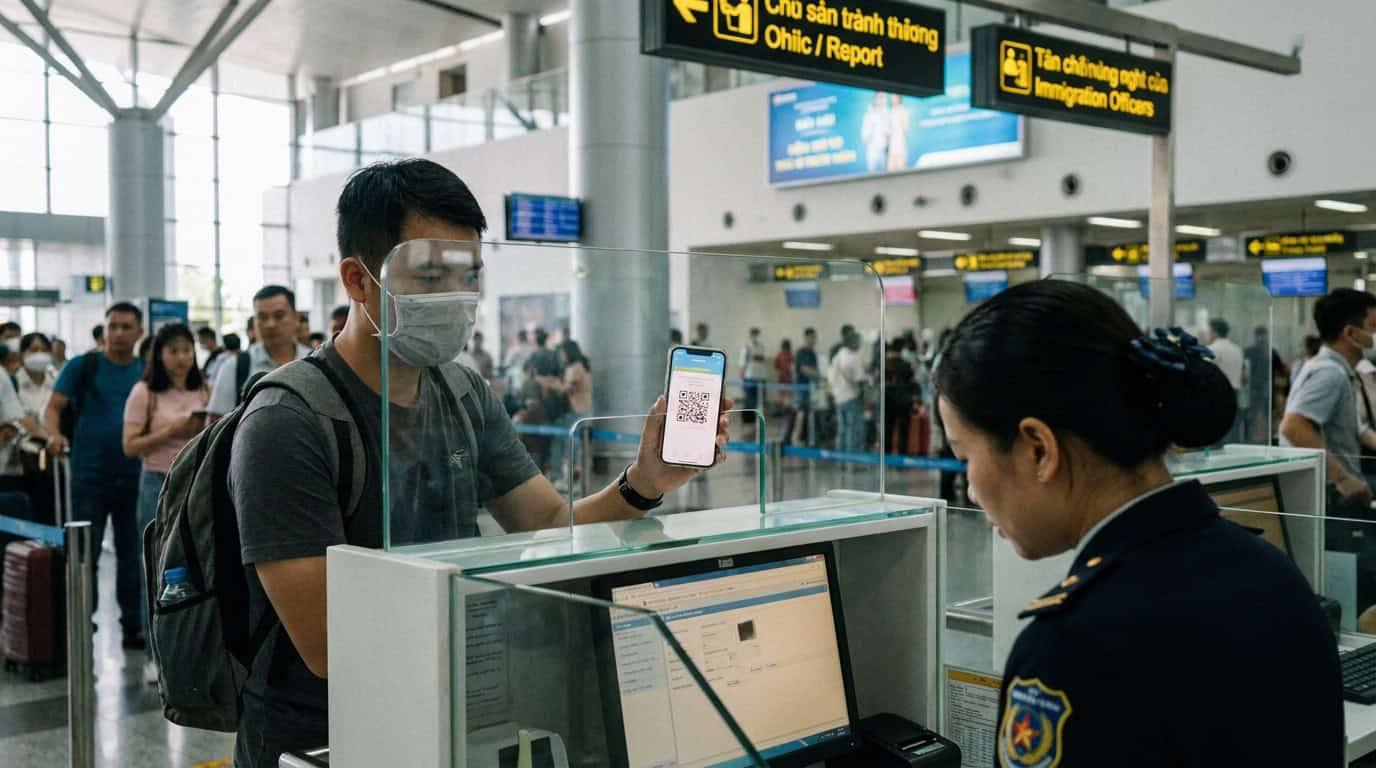
Key details:
– Where to complete it: prearrival.immigration.gov.vn (official portal)
– When to complete it: Within 72 hours before your scheduled arrival at Tan Son Nhat
– What it generates: A QR code you present at immigration
– What it replaces: The paper arrival card previously filled out on the plane
The Digital Arrival Card does not replace your visa. You still need your e-visa (or passport for visa-free nationalities) as the entry document. The arrival card is a separate declaration of personal details, travel itinerary, and health/customs information — now collected digitally instead of on paper.
How to complete it:
1. Visit prearrival.immigration.gov.vn within 72 hours of your arrival time
2. Enter your personal details, passport information, flight number, and Vietnam accommodation address
3. Submit and save the QR code — screenshot or download it
4. Present the QR code at the immigration counter alongside your passport and e-visa
This requirement currently applies to Tan Son Nhat (HCMC). Check aviation news sources close to your travel date for any expansion to Noi Bai (Hanoi) or Da Nang International Airport, as the policy may be rolled out nationally.
Missing the digital arrival card does not necessarily prevent entry, but it can cause significant delays at the immigration counter. Complete it during the 72-hour window.
Citation Capsule: From April 15, 2026, international travelers arriving at Tan Son Nhat Airport (Ho Chi Minh City) must complete a mandatory Digital Arrival Card at prearrival.immigration.gov.vn within 72 hours before landing. The card generates a QR code for immigration — it does not replace the visa requirement. Source: Mainly Miles, 2026.
Ports of Entry That Accept the Vietnam E-Visa
The Vietnam e-visa is accepted at all 83 international border checkpoints in the country (evisa.gov.vn, 2026). This is one of the most significant advantages over Visa on Arrival, which is limited to air entry only.
Major international airports:
– Tan Son Nhat International Airport (HCMC / Ho Chi Minh City) — SGN
– Noi Bai International Airport (Hanoi) — HAN
– Da Nang International Airport — DAD
– Cam Ranh International Airport (Nha Trang) — CXR
– Phu Quoc International Airport — PQC
– Cat Bi International Airport (Hai Phong) — HPH
– Long Thanh International Airport (Dong Nai) — added in 2026
Major land border crossings:
– Moc Bai (Tay Ninh province) — Cambodia border, most-used land crossing for Ho Chi Minh City
– Lao Cai (Lao Cai province) — China border, gateway to Sapa
– Huu Nghi (Lang Son province) — China border
– Lao Bao (Quang Tri province) — Laos border
– Nam Can / Tinh Bien (An Giang province) — Cambodia border
Seaports:
– Ho Chi Minh City Port (Ben Nghe)
– Da Nang Port
– Tien Sa Port
– Chan May Port (Hue/Da Nang area, popular cruise port)
When you fill in your e-visa application, you choose an intended entry checkpoint. This is not binding — you can enter through a different checkpoint as long as it is on the approved list. The field is used for immigration planning purposes, not to restrict you to a single gate.
Common Mistakes That Get Applications Rejected
Most Vietnam e-visa rejections are avoidable. The errors below account for the large majority of failed applications, based on the patterns described in immigration guidance and traveler reports.
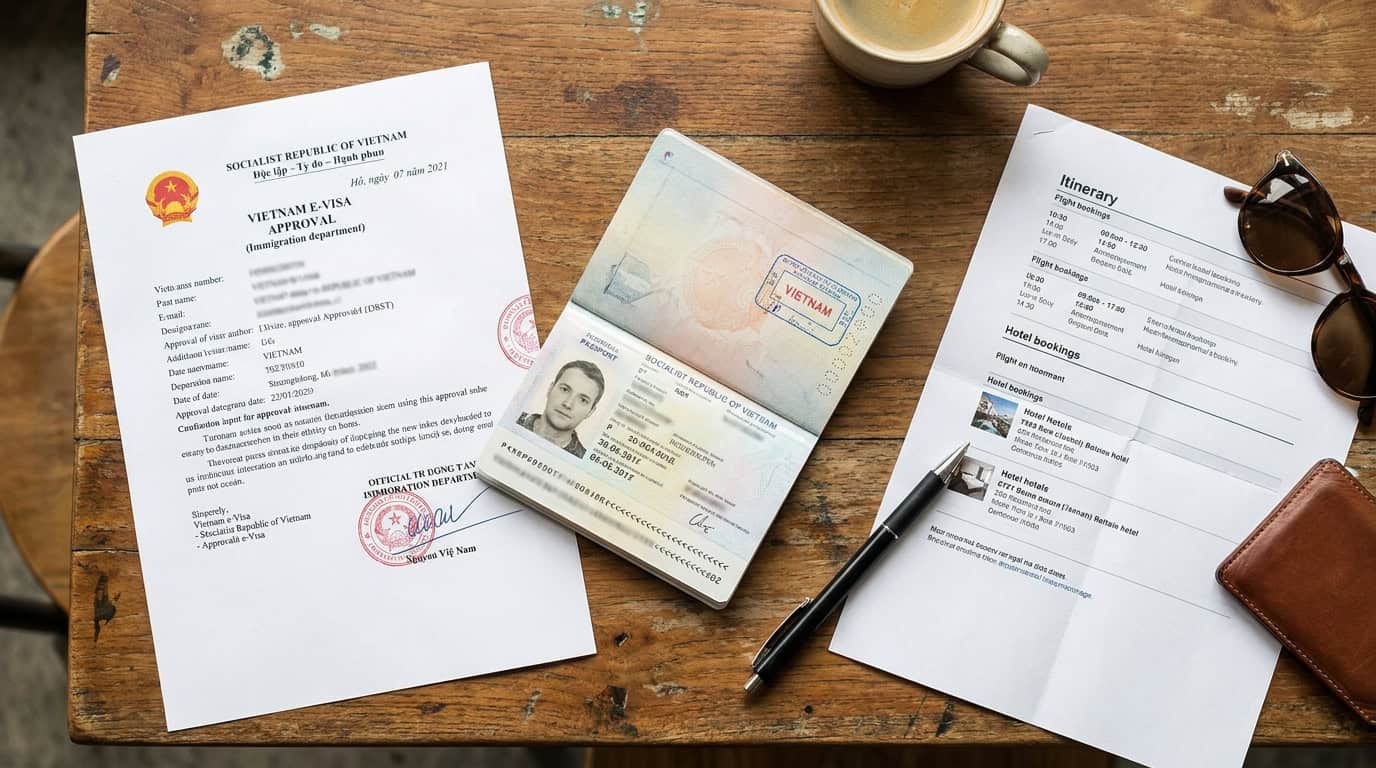
1. Name mismatch vs. passport MRZ
Your name must match exactly what appears in the machine-readable zone at the bottom of your bio page — including hyphenation, order of names, and spacing. If your passport shows “VAN NGUYEN THI” in the MRZ, that is how it must appear on your application.
2. Photo quality failure
The automated review system checks contrast, background color, face visibility, and file size. Photos taken in poor lighting, with shadows across the face, or against a patterned background are frequently rejected. Use a plain white or light-gray background and natural light facing your face.
3. Applying while already inside Vietnam
This is the primary rejection trigger listed in official guidance. You cannot apply for an e-visa while you are currently in Vietnam on a valid visa or visa-free entry. The system flags the application and rejects it. Apply before you travel, never after you have already arrived.
4. Expired or near-expiry passport
Your passport must be valid for at least 6 months from your intended entry date. A passport expiring in 5 months and 29 days fails the check.
5. Using a non-official website
Third-party sites sometimes submit inaccurate information, use old form versions, or delay submission. You then wait 3-5 days for a rejection you would have avoided by applying directly. Always use evisa.gov.vn.
6. Wrong passport type selected
If you hold an official or diplomatic passport and select “ordinary passport” (or vice versa), the application will be rejected. Match the type exactly as stated in your passport.
Can You Extend or Renew a Vietnam E-Visa?
Extending a Vietnam e-visa is possible but not guaranteed. Travelers can apply once for a 90-day extension at a local Immigration Department office (Phong Quan Ly Xuat Nhap Canh) during their stay (evisa.gov.vn, 2026). Approval is at the discretion of immigration authorities, and processing takes additional time.
The practical path for most long-stay travelers is a “visa run” — leaving Vietnam and re-entering on a new e-visa (if holding a single-entry visa) or simply re-entering (if holding a multiple-entry visa). Neighboring Cambodia, Laos, and Thailand are common destinations for short turnaround trips.
If you need to stay in Vietnam for more than 90 days continuously, a different visa category — such as a business visa (DN), investor visa, or temporary residence card — may be more appropriate. These are applied for through Vietnamese embassies or consulates in your home country, not the e-visa portal.
Renewal (applying for a new e-visa):
You can apply for a fresh e-visa from outside Vietnam at any time. There is no official restriction on how many times you can hold consecutive e-visas, but immigration officers have discretion to question travelers who appear to be living in Vietnam on rolling tourist visas. A clear exit plan and proof of accommodation helps.
One thing not to do: apply for a new e-visa while you are still inside Vietnam. As noted earlier, the system rejects applications submitted from within the country.
Vietnam E-Visa for Specific Nationalities (US, UK, Australia, India, EU)
The e-visa process is the same for all nationalities. What differs is whether you need it at all and which travel document category you fall into.
United States citizens
US passport holders are not on Vietnam’s visa-free list and require a visa for any stay. The e-visa ($25 single, $50 multiple, up to 90 days) is the most practical route. Apply at evisa.gov.vn at least 7 days before travel.
United Kingdom citizens
UK citizens received a 45-day visa waiver effective August 15, 2025, valid through August 14, 2028 (VietnamPlus, 2025). For stays up to 45 days, no visa is needed — arrive with your UK passport. For stays over 45 days, apply for the e-visa before departure.
Australian citizens
Australian passport holders are not currently on the visa-free list and need the e-visa for any length of stay. Apply at evisa.gov.vn.
Indian citizens
Indian passport holders require the e-visa. All nationalities are eligible since August 2023, so Indian citizens can apply online at evisa.gov.vn without needing embassy involvement.
EU citizens
EU member state citizens have varied access. Citizens of Germany, France, Italy, Spain, Belgium, Bulgaria, Croatia, Czech Republic, Hungary, Luxembourg, Netherlands, Poland, Romania, Slovakia, and Slovenia currently enjoy 45-day visa-free entry (VietnamPlus, 2025). EU citizens not on this list (such as Austria, Greece, Ireland, Portugal) need the e-visa. Check the current list close to your travel date, as bilateral agreements can change.
Swiss and Norwegian citizens
Switzerland and Norway are not EU members but are currently on Vietnam’s 45-day visa-free list, effective through August 14, 2028.
Citation Capsule: Vietnam’s 45-day visa waiver policy, effective August 15, 2025 through August 14, 2028, covers citizens of 25 countries including Germany, France, Italy, Spain, the UK, Russia, Japan, South Korea, and selected EU nations. Citizens of other countries can apply for the 90-day e-visa at evisa.gov.vn for $25 (single entry). Source: VietnamPlus, 2025.
Frequently Asked Questions
Do US citizens need a visa for Vietnam?
Yes, US citizens need a visa for Vietnam. The United States is not included in Vietnam’s current visa-free list, which covers citizens of about two dozen countries under Vietnam’s 2025 visa-waiver policies. US passport holders should apply for the e-visa at evisa.gov.vn before traveling. The cost is $25 USD for single entry (up to 90 days) or $50 USD for multiple entry. Processing takes 3 working days in standard cases, so apply at least 7 days before your departure date.
What is the official website to apply for a Vietnam e-visa?
The only official website for Vietnam e-visa applications is evisa.gov.vn, operated by Vietnam’s Ministry of Public Security. No other website is authorized by the Vietnamese government to accept applications or collect fees. Lookalike websites with similar domain names charge $50 to $100 or more for the same $25 service. Always verify you are on the .gov.vn domain before entering any personal or payment information.
Can I apply for a Vietnam e-visa at the last minute?
Standard processing is 3 working days, which in practice means 3 to 5 calendar days once weekends and Vietnamese public holidays are factored in. There is no official rush or expedited processing option on the government portal. Applying the day before travel is not realistic. For last-minute situations, Visa on Arrival at air entry points remains an option if you can secure an approval letter from an agent, but this adds complexity and cost. Apply at least 7 days before your intended entry date to give yourself a comfortable buffer.
What is the new digital arrival card for Vietnam?
The Digital Arrival Card is a mandatory pre-arrival declaration form introduced at Tan Son Nhat International Airport (Ho Chi Minh City) from April 15, 2026 (Mainly Miles, 2026). It is completed online at prearrival.immigration.gov.vn within 72 hours before your scheduled arrival and generates a QR code for presentation at immigration. The card collects personal details, flight information, and accommodation data digitally, replacing the paper arrival form previously filled out on the plane. It does not replace your visa — both the arrival card QR code and your e-visa (or passport for visa-free travelers) are required at the immigration counter.
Can I enter Vietnam by land or sea with an e-visa?
Yes. The Vietnam e-visa is accepted at all 83 of Vietnam’s international border checkpoints, including land border crossings and seaports (evisa.gov.vn, 2026). This is a key advantage over Visa on Arrival, which is only valid at airports. Common land entry points include Moc Bai (Cambodia border, convenient for travelers arriving from Phnom Penh or Siem Reap), Lao Cai (China border), and Lao Bao (Laos border). When completing your e-visa application, you select an intended entry point, but this field is not binding — you can enter through any approved checkpoint.
Conclusion
The Vietnam e-visa process in 2026 is genuinely straightforward. Apply at evisa.gov.vn, pay $25 (single entry) or $50 (multiple entry), upload a clean photo and passport scan, and wait 3 to 5 working days for approval. The 90-day validity and all-nationality eligibility make it the right tool for the large majority of international visitors.
Three things are worth remembering before you finalize your plans. First, check whether your nationality qualifies for the current 45-day visa-free waiver — it could save you $25 and the application step entirely. Second, if you are landing at Tan Son Nhat in HCMC, complete the Digital Arrival Card at prearrival.immigration.gov.vn within 72 hours of arrival — it is now mandatory. Third, apply only through evisa.gov.vn and avoid any site that asks you to pay more than $25 for single entry.
With your visa confirmed and arrival card ready, the planning work shifts to what to do once you land. Ho Chi Minh City rewards travelers who explore beyond the tourist circuit, and the city’s neighborhoods, food scene, and day-trip options give even a 90-day stay plenty of material to work with.
Sources
- evisa.gov.vn — Official Vietnam E-Visa Portal
- VietnamPlus — Vietnam grants 45-day visa waivers to citizens from 12 countries (2025)
- Mainly Miles — Vietnam introduces mandatory digital arrival card at Ho Chi Minh City (2026)
- VnExpress — Vietnam wraps up 2025 with 21.2 million foreign arrivals, an all-time high
Related Guides
- Getting Around Saigon: Grab, Metro, Bus & Waterbus Guide (2026)
- Vietnam Visa on Arrival vs E-Visa: Which Is Better?
- Rent Motorbike Vietnam: Everything You Need to Know (2026)
- Vietnam Public Holidays 2026: Complete Calendar
- Vietnam SIM Card Guide: Which to Buy & Where (2026)
- Tipping in Vietnam: How Much & When (2026 Guide)