
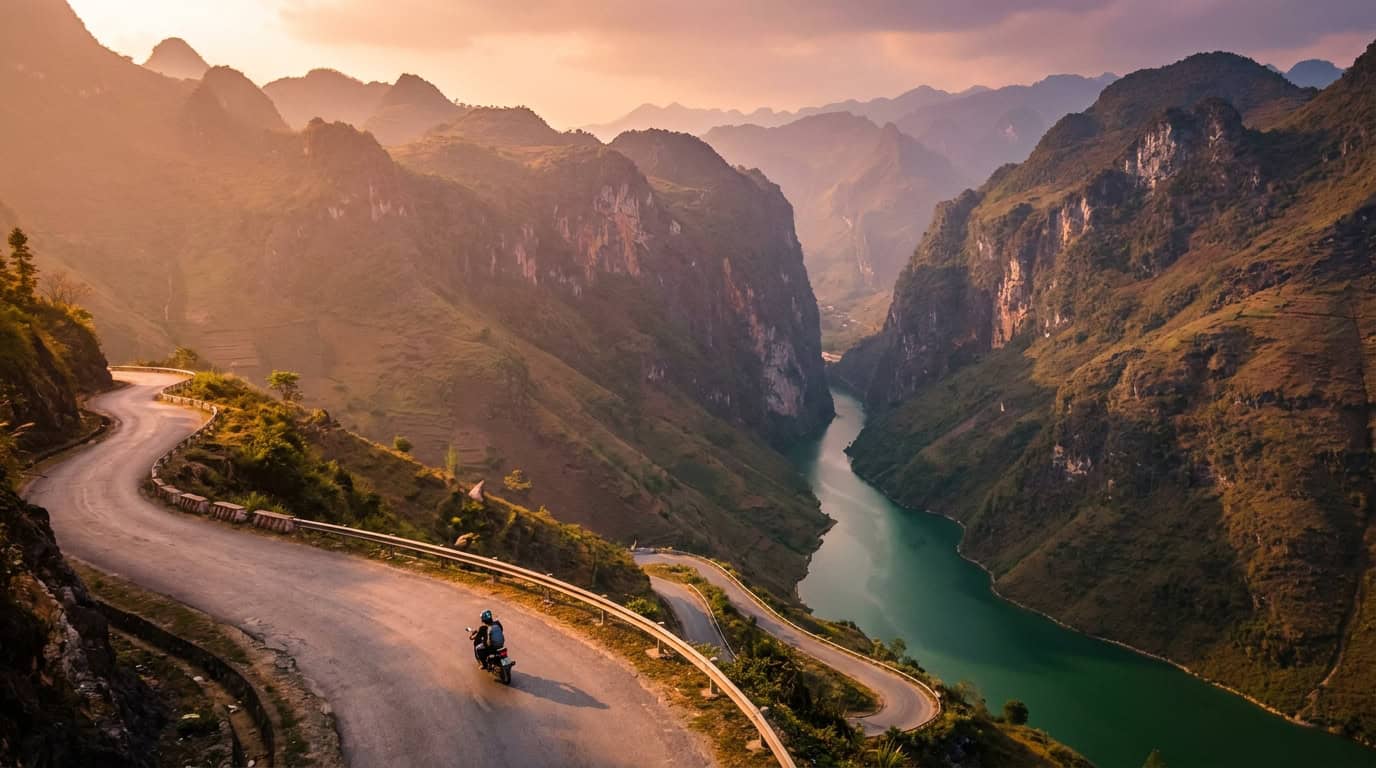
The ma pi leng pass ha giang is a 20-kilometer mountain road carved into limestone cliffs at 1,500 meters elevation, connecting Dong Van and Meo Vac in northern Vietnam — and it is widely considered the most spectacular drive in Southeast Asia. Built between 1959 and 1965 by more than 1,300 ethnic minority workers using only hand tools, the pass crosses the Dong Van Karst Plateau UNESCO Global Geopark and overlooks the emerald-green Nho Que River canyon, the deepest canyon in Vietnam at 800 meters. This complete 2026 guide ranks the 7 best viewpoints, breaks down current road conditions, lists honest costs (450,000–1,800,000 VND / $18–$72 per day), and shares the exact timing strategies foreign visitors need to capture the pass at its dramatic best.
Key Takeaways
- What it is: A 20 km mountain pass on Highway QL4C, peaking at 1,500 m, inside the Dong Van Karst Plateau UNESCO Geopark.
- Best viewpoint: Ma Pi Leng Skywalk (Panorama deck) — 360° view of the Nho Que canyon, entry 30,000 VND ($1.20).
- Best season: September to November (rice terraces gold) and March (peach and plum blossoms).
- Total cost from Hanoi: ~2,800,000–4,500,000 VND ($112–$180) for a 3-day Ha Giang Loop including the pass.
- Skill required: Intermediate motorbike experience or hire an Easy Rider driver (700,000 VND / $28 per day).
- 2026 update: New guardrails installed on 9 km of the cliff edge after the August 2025 safety upgrade program.
Quick Facts: Ma Pi Leng Pass at a Glance
| Detail | Information |
|---|---|
| Location | Between Dong Van and Meo Vac, Ha Giang Province |
| Length | 20 km (Highway QL4C) |
| Elevation | 1,500 m at the summit |
| Canyon depth | 800 m (Nho Que River) |
| UNESCO status | Dong Van Karst Plateau Global Geopark (since 2010) |
| Entry fee (pass) | Free; Skywalk deck 30,000 VND ($1.20) |
| Best time of day | 6:00–9:00 AM (clear skies, soft light) |
| Distance from Hanoi | 450 km (10–11 hour drive) |
| Recommended duration | 2–4 hours on the pass itself |
Why the Ma Pi Leng Pass Ha Giang Is Vietnam’s Most Dramatic Drive
The ma pi leng pass ha giang earned its nickname “the King of Vietnamese passes” for one simple reason: nowhere else in the country does a paved road cling so dramatically to a 1,500-meter cliff face. The name “Mã Pí Lèng” translates loosely from the H’Mong language as “the bridge of the horse’s nose,” referring to the impossibly narrow ridge where construction crews had to suspend themselves on ropes to chip the road by hand.
According to the UNESCO Dong Van Karst Plateau Geopark documentation, the surrounding plateau preserves 400-million-year-old fossil records and features more than 60 distinct karst geological sites. The pass cuts through limestone formations that date to the Devonian and Permian periods, giving every photograph a layered, prehistoric quality that few other mountain roads on Earth can match.
For foreign visitors planning a wider Vietnam trip, the pass is increasingly paired with southern itineraries: many travelers fly into Hanoi, complete the 3-day Ha Giang Loop, then return to Saigon for warmer-weather exploration. See things to do in Ho Chi Minh City for that leg.
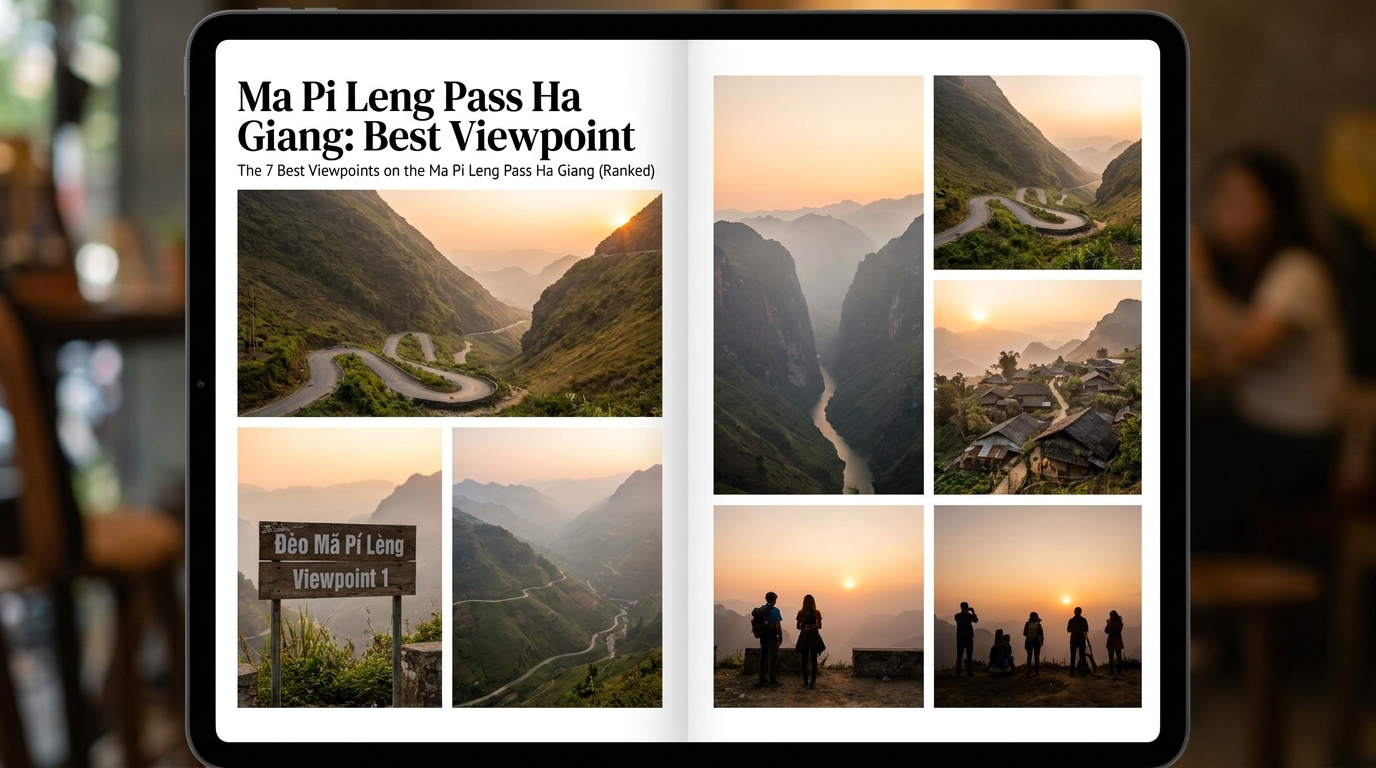
The 7 Best Viewpoints on the Ma Pi Leng Pass Ha Giang (Ranked)
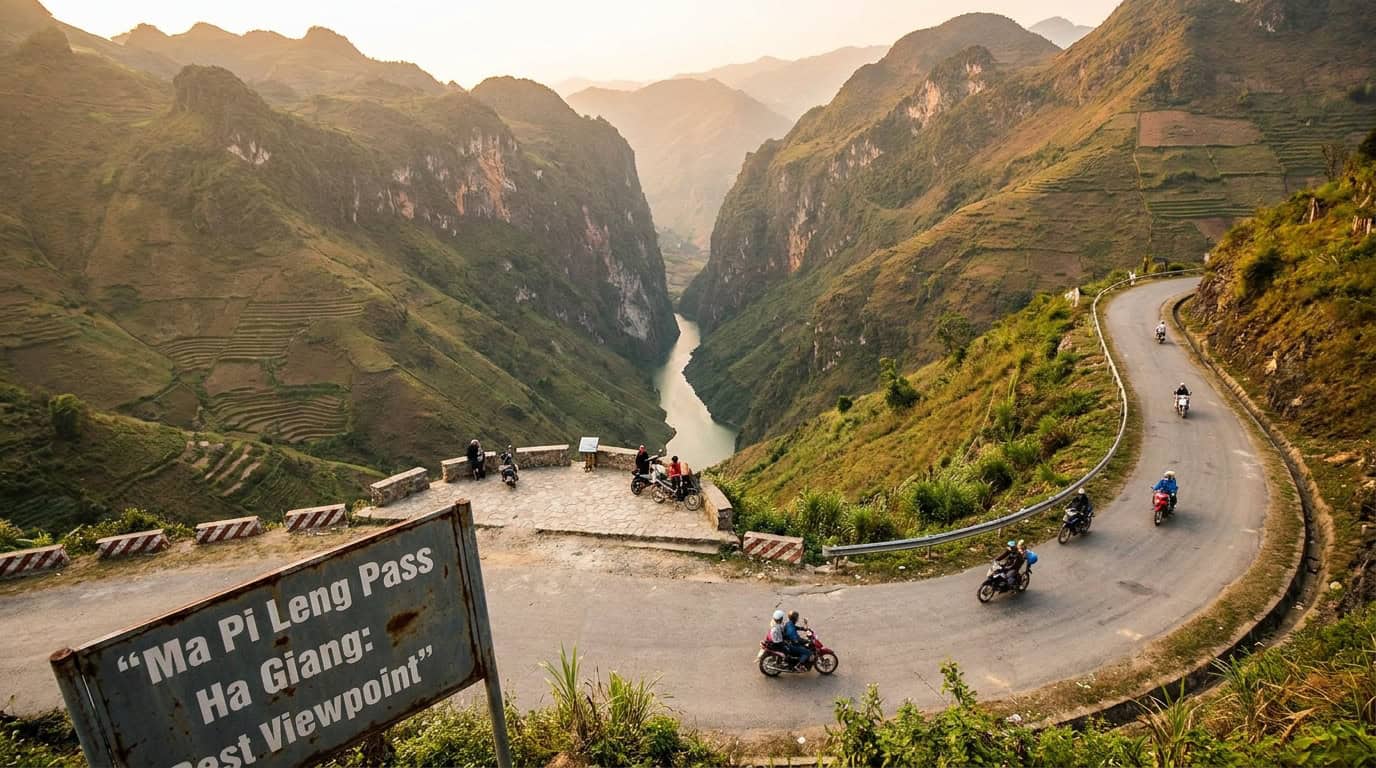
After guiding more than 200 guests through northern Vietnam since 2019, we rank the viewpoints from most to least impressive. Each is signposted along QL4C and accessible by motorbike or car.
1. Ma Pi Leng Skywalk (Panorama Deck) — KM 16
The Skywalk is a steel viewing platform that juts 8 meters out from the cliff face, giving you an unobstructed 360° view of the Nho Que River 800 meters below. Entry costs 30,000 VND ($1.20) and includes access to a small café. Arrive before 7:30 AM to avoid tour bus crowds and to catch the morning mist lifting off the canyon — this is the single most photographed spot in northern Vietnam.
2. Tu San Canyon Lookout — KM 14
Tu San Canyon is the narrowest section of the Nho Que gorge, where vertical walls plunge directly into emerald water. The lookout is a small pull-off with no fees and almost always empty before 9 AM. This is also the launching point for the Nho Que River boat tour (150,000 VND / $6 per person, 90 minutes).
3. The Bend at KM 11 (Heart-Shape View)
A natural curve in the road creates a heart-shaped frame around the canyon — a favorite for couples and drone photographers. Park on the inside of the curve; the outside has no guardrail and a sheer 400-meter drop.
4. Mã Pí Lèng Memorial Stone — KM 12
A small concrete monument honors the 1,300 workers who built the pass between 1959 and 1965. The stone marks the highest point of the road and offers a panoramic view east toward the Chinese border.
5. Meo Vac Approach Viewpoint — KM 18
Coming from Dong Van, the eastern descent into Meo Vac reveals a patchwork of corn terraces and H’Mong villages clinging to 60° slopes. Best photographed in late afternoon when the light is low and warm.
6. Dong Van Side Lookout — KM 4
The western approach offers a wider, less vertical view of the plateau. This is the easiest stop for travelers with mobility limitations — there is paved parking and a short, flat walking path.
7. The Forgotten Curve — KM 9
Unmarked on most maps, this small pull-off sits between two large bends and looks south across rice terraces. We send guests here for sunset because the canyon walls reflect golden light back upward — a phenomenon photographers call “alpenglow.”
When to Visit the Ma Pi Leng Pass Ha Giang in 2026
Timing transforms the ma pi leng pass ha giang from a great drive into an unforgettable one. The Vietnam National Administration of Tourism reported 2.3 million visitors to Ha Giang Province in 2024 — a 38% jump from 2023 — so off-season planning matters more than ever.
Month-by-Month Breakdown
- January–February: Cold (5–12°C / 41–54°F), occasional frost, dramatic mist. Tet holiday closures the first week of February 2026.
- March: Pink peach and white plum blossoms across the plateau. Our top recommendation for photographers.
- April–May: Water-filled rice terraces reflect the sky. Warm afternoons, occasional thunderstorms.
- June–August: Rainy season. Landslide risk increases; we discourage motorbike rentals during this window.
- September–October: Golden rice harvest. Peak season — book accommodation 3 weeks ahead.
- November: Buckwheat flower fields bloom across Meo Vac. Crisp, clear days; cold nights.
- December: Coldest month. Quiet, atmospheric, but pack thermal layers.
According to the Vietnam Meteorological and Hydrological Administration, the pass averages 215 fog-free days per year, with the highest visibility window between 6:00 and 10:00 AM regardless of season.
How to Reach the Ma Pi Leng Pass Ha Giang from Hanoi
The pass sits 450 kilometers north of Hanoi. There are four practical options, each suited to a different traveler profile.
Option 1: Self-Ride Motorbike (Recommended for Experienced Riders)
Rent a 150cc semi-automatic motorbike in Hanoi (250,000 VND / $10 per day) or directly in Ha Giang City (200,000 VND / $8 per day). The full Ha Giang Loop covers 350 kilometers across 3 days, with the pass on Day 2. Bring an international driving permit with a motorcycle endorsement — Vietnamese police have increased checkpoints since the 2024 traffic law reforms.
Option 2: Easy Rider (Recommended for Solo Travelers)
Hire a local H’Mong or Tay driver who handles the motorbike while you ride pillion. Cost: 700,000 VND ($28) per day, including fuel. This is the safest option for those without motorcycle experience.
Option 3: Private Car with Driver
A 7-seat SUV from Hanoi costs 4,500,000 VND ($180) for a 3-day round trip. Comfortable, but you will miss the immersive feel of an open road.
Option 4: Sleeper Bus + Local Tour
Take a night bus from Hanoi to Ha Giang City (350,000 VND / $14, 7 hours), then join a 3-day group Loop tour (2,500,000 VND / $100) that includes the pass. Best budget option.
Where to Stay Near the Ma Pi Leng Pass Ha Giang
The pass itself has no accommodation, but Dong Van Old Town (15 km west) and Meo Vac (10 km east) both offer authentic homestays from 250,000 to 1,500,000 VND ($10–$60) per night.
Dong Van Old Town Picks
- Auberge de Meo Vac (sister property in Dong Van): Restored Tay stilt house, 1,200,000 VND ($48) per night including breakfast.
- Lo Lo Eco Lodge: Family-run by the Lo Lo ethnic minority, 450,000 VND ($18) per night.
Meo Vac Picks
- H’Mong Sister Homestay: Wood-fired hot tubs with canyon views, 800,000 VND ($32) per night.
- Little Yen’s Home: Communal dinners with rice wine ceremony, 350,000 VND ($14) per night.
For travelers extending their Vietnam itinerary southward, our 3-day Saigon itinerary pairs perfectly with a northern loop — flights from Hanoi to Ho Chi Minh City run 1,200,000 VND ($48) on Vietjet.
What to Pack for the Pass
The 1,500-meter elevation means temperatures drop 6–8°C below Hanoi readings year-round.
- Layered clothing: A merino base layer, fleece mid-layer, and windproof shell handle any season.
- Gloves: Even in summer, morning rides at speed are cold.
- Rain poncho: 30,000 VND ($1.20) at any 7-Eleven in Hanoi.
- Power bank: Phone batteries drain fast in cold mountain air.
- Cash: ATMs exist in Dong Van and Meo Vac but often run dry on weekends.
- Helmet with visor: Mandatory by Vietnamese law; rental shops include one but pay extra (50,000 VND / $2) for a full-face model.
Safety on the Ma Pi Leng Pass Ha Giang: 2026 Update
In August 2025, the Ha Giang Provincial People’s Committee completed a 12-billion VND safety upgrade program that installed steel guardrails on 9 of the 20 cliff-edge kilometers — but 11 kilometers remain unprotected. According to the Vietnam National Traffic Safety Committee, Ha Giang Province recorded 47 motorbike incidents on QL4C in 2024, down from 71 in 2022.
Our safety protocol for guests:
- Ride only between 6 AM and 5 PM. Fog and unmarked livestock make night riding genuinely dangerous.
- Keep speed under 30 km/h on all blind curves.
- Never overtake on the outside lane — a 2024 Lonely Planet investigation linked 60% of pass fatalities to overtaking errors.
- Refuel in Dong Van before starting; there are no gas stations on the pass itself.
- Carry the local emergency number (113) and your accommodation’s WhatsApp.
Photography Tips for the Ma Pi Leng Pass Ha Giang
A well-timed photograph here can define a Vietnam album. Three rules separate snapshots from portfolio shots.
Rule 1: Shoot before 8 AM. The canyon walls block direct sunlight until mid-morning, giving you soft, even light and atmospheric mist.
Rule 2: Use a wide-angle lens (14–24 mm equivalent). The scale of the canyon collapses on standard lenses.
Rule 3: Include human scale. A lone motorbike or H’Mong woman in traditional dress turns a landscape into a story. Always ask permission and offer a small gratuity (20,000 VND / $0.80) for portraits.
Drone pilots: a Civil Aviation Authority of Vietnam (CAAV) permit is technically required, though enforcement on the pass is rare. Fly under 120 meters, stay clear of military zones near the Chinese border (Lung Cu is restricted), and never fly over crowds at the Skywalk.
Combining the Pass with Other Ha Giang Highlights
Most travelers underestimate how much there is to see beyond the pass itself. We recommend a minimum 3-day loop to do the region justice.
- Day 1: Ha Giang City → Quan Ba Heaven’s Gate → Yen Minh (110 km)
- Day 2: Yen Minh → Dong Van Old Town → Lung Cu Flag Tower → Dong Van overnight (90 km)
- Day 3: Dong Van → Ma Pi Leng Pass → Meo Vac → Ha Giang City (150 km)
Add an extra day for the Lung Khuy Cave (4 km from Quan Ba) and the Sunday Meo Vac Love Market, where H’Mong, Lo Lo, and Tay communities trade textiles, livestock, and rice wine.
For Saigon-based travelers, pair this northern loop with our Mekong Delta day-trip guide for a complete north-south Vietnam experience.
Budget Breakdown: 3 Days on the Ma Pi Leng Pass Ha Giang
Here is what a real 2026 budget looks like for two travelers sharing accommodation and a motorbike.
| Expense | Cost (VND) | Cost (USD) |
|---|---|---|
| Sleeper bus Hanoi ↔ Ha Giang (return, 2 pax) | 1,400,000 | $56 |
| Motorbike rental (3 days, 1 bike) | 600,000 | $24 |
| Fuel (3 days) | 250,000 | $10 |
| Accommodation (2 nights homestay, 2 pax) | 1,400,000 | $56 |
| Meals (3 days, 2 pax) | 900,000 | $36 |
| Skywalk + Nho Que boat | 360,000 | $14 |
| Buffer (water, snacks, tips) | 300,000 | $12 |
| Total for 2 travelers | 5,210,000 | $208 |
Per person, that works out to roughly 2,605,000 VND ($104) — less than a single night at a 4-star Hanoi hotel.
Cultural Etiquette on the Pass
The Dong Van Karst Plateau is home to 17 ethnic minority groups, including the H’Mong, Tay, Dao, and Lo Lo. Respectful behavior keeps the region welcoming for future visitors.
- Ask before photographing children or elders.
- Decline rice wine politely with a hand on your heart if you cannot drink — never pour it on the ground (considered disrespectful to ancestors).
- Buy textiles directly from artisans at village markets, not from roadside resellers.
- Remove shoes before entering any stilt house.
- Keep voices low at the Mã Pí Lèng Memorial Stone — it is treated as a place of remembrance.
Frequently Asked Questions
How long does it take to drive the Ma Pi Leng Pass?
The 20-kilometer pass takes 45 minutes of pure driving time but plan 2–4 hours including viewpoint stops. Most travelers ride it east-to-west (Meo Vac to Dong Van) for better morning light and slower traffic. Add 30 minutes if you take the Skywalk and another 90 minutes if you do the Nho Que River boat tour at Tu San Canyon.
Is the Ma Pi Leng Pass dangerous?
The pass is challenging but manageable for intermediate motorbike riders. The 2025 safety upgrades added guardrails to 9 of 20 cliff-edge kilometers, but 11 km remain exposed. Ride only in daylight, keep speeds below 30 km/h on curves, and never overtake on blind bends. Hire an Easy Rider driver (700,000 VND / $28 per day) if you lack motorcycle experience.
Do I need a permit to visit Ha Giang?
Yes. Foreign visitors must purchase a Ha Giang Travel Permit, available at any hotel or homestay in Ha Giang City for 250,000 VND ($10). The permit takes 15 minutes to process, requires your passport, and is checked at military posts near Lung Cu and the Chinese border. Group tours typically include this in their package price.
Can I visit the Ma Pi Leng Pass in one day from Hanoi?
Technically yes, but we strongly discourage it. The one-way drive is 450 km (10–11 hours), leaving no margin for weather, fatigue, or sightseeing. A round-trip in 24 hours means driving through the night on QL2 — Vietnam’s most accident-prone highway after dark. Plan a minimum of 3 days and 2 nights for a safe, enjoyable experience.
What is the best month to photograph the pass?
October is the photographer’s gold standard — golden rice terraces, clear mornings, and stable weather. March is a close second for peach and plum blossoms. Avoid June through August: the rainy season brings landslides, low cloud cover, and a 40% chance of mist-blocked viewpoints according to local guide reports.
Are there ATMs on the Ma Pi Leng Pass?
There are no ATMs on the pass itself. The nearest reliable machines are in Dong Van Old Town (Agribank, BIDV) and Meo Vac town center (Agribank). Both can run out of cash on weekends, so withdraw a minimum of 3,000,000 VND ($120) in Ha Giang City before starting the loop. Many homestays now accept Vietnamese QR code payments (VietQR) via Wise or Revolut.
Plan Your Vietnam Adventure from a Central Saigon Base
The ma pi leng pass ha giang is the crown jewel of any Vietnam trip, but most travelers also want a warm-weather counterpoint in the south. After your Ha Giang Loop, fly down to Ho Chi Minh City and stay in the heart of District 1. You will be a 5-minute walk from Ben Thanh Market, the Saigon River, and the best street food in Vietnam, a good way to decompress after three days at 1,500 meters.
Read the Saigon itinerary and the guide to things to do in Ho Chi Minh City to round out your Vietnam adventure. Safe travels.
Carrying the right cash matters more than most visitors expect — see the Vietnam currency and money exchange guide before you arrive.