
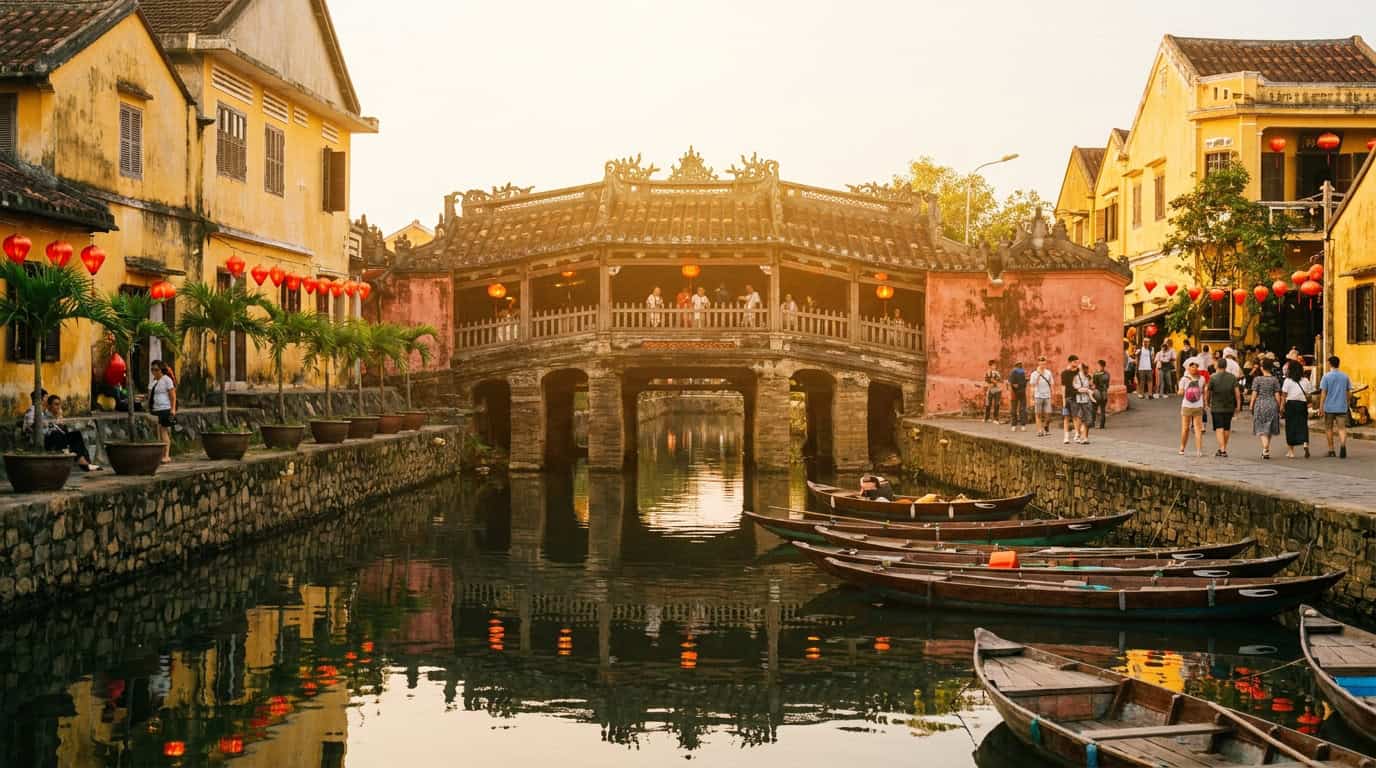
The Japanese Covered Bridge Hoi An is a 430-year-old wooden pagoda bridge in Vietnam’s UNESCO-listed Ancient Town, built in the late 1590s by Japanese merchants to connect their quarter with the Chinese district across a small canal feeding the Thu Bon River. It is the single most photographed monument in central Vietnam, appears on the back of the 20,000 VND banknote, and following a US$1.07 million restoration completed in August 2024, the bridge reopened to visitors in beautifully preserved condition just in time for your 2026 trip.
This guide gives you everything a foreign traveler actually needs: the real history behind the structure, the current ticket rules (yes, you sometimes pay, but there’s a workaround), the best hours to photograph it without crowds, and how to combine the visit with the rest of Hoi An’s Old Town in a single afternoon.
Key Takeaways
- Location: Western end of Tran Phu Street, crossing into Nguyen Thi Minh Khai Street, Hoi An Ancient Town, Quang Nam Province.
- Cost: Walking across the bridge is free; entering the small temple inside requires a 120,000 VND (~US$4.80) Ancient Town ticket that covers 22 other heritage sites.
- Best time to visit: 6:00-7:30 AM for empty photos, or 6:30-8:30 PM for lantern-lit shots.
- Time needed: 15-30 minutes for the bridge itself; 3-4 hours combined with the surrounding Ancient Town.
- Restoration: Reopened August 2024 after a 19-month, US$1.07M heritage restoration.
- Cultural status: UNESCO World Heritage component since 1999; national symbol on the 20,000 VND note.
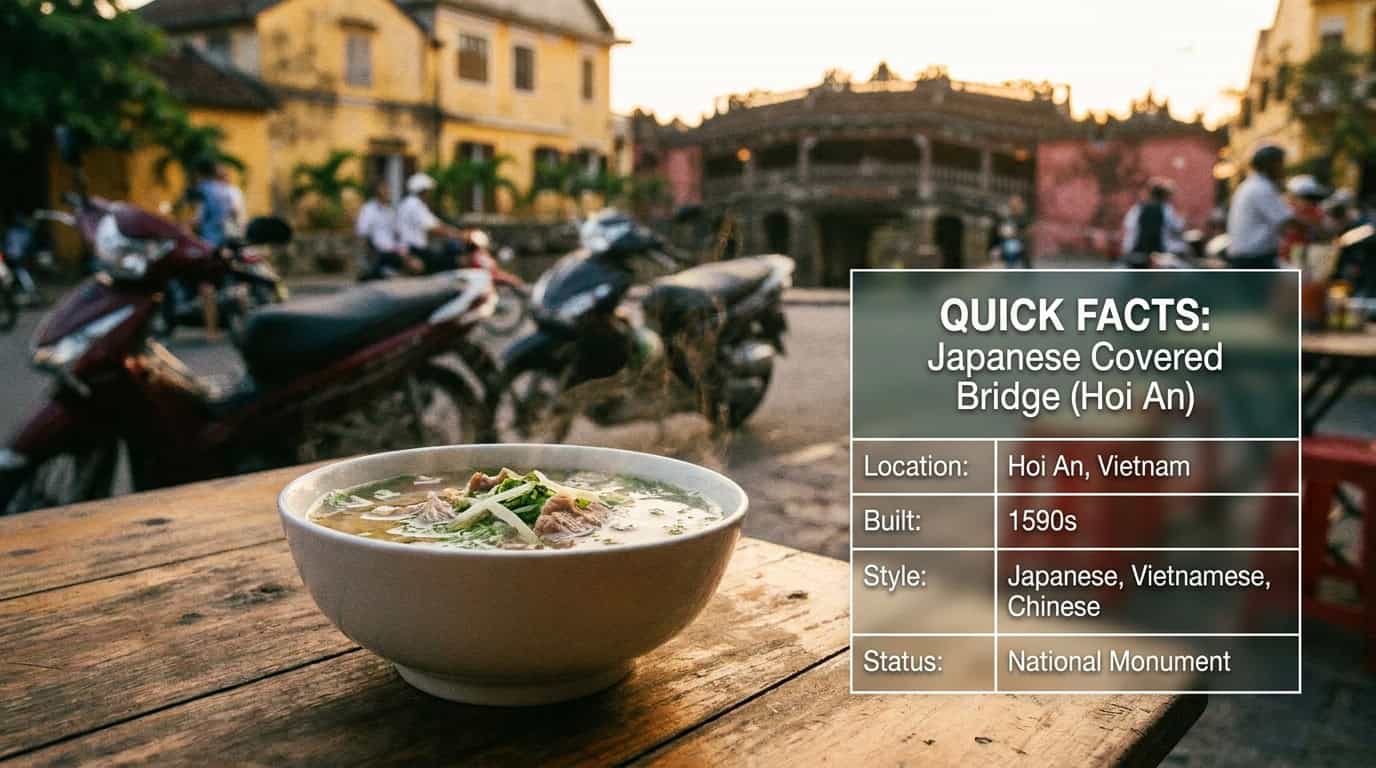
Quick Facts Table
| Detail | Information |
|---|---|
| Vietnamese name | Chùa Cầu (Pagoda Bridge) |
| Built | Late 1590s (completed circa 1593-1595) |
| Length | 18 meters (59 ft) |
| Architectural style | Japanese with later Vietnamese & Chinese influence |
| Ticket price | 120,000 VND (US$4.80) for Ancient Town combo |
| Walking across | Free (since August 2024 reopening) |
| Opening hours | 24/7 access to walk across; temple inside 8:00 AM-9:00 PM |
| Nearest airport | Da Nang International Airport (DAD), 30 km |
| UNESCO status | Listed 1999 as part of Hoi An Ancient Town |
The Story Behind the Japanese Covered Bridge Hoi An
The story behind the japanese covered bridge hoi an begins in the late 16th century, when Hoi An (then called Faifo) was one of Southeast Asia’s busiest international ports. Japanese, Chinese, Dutch, and Portuguese merchants lived in segregated quarters along the Thu Bon River, trading silk, ceramics, spices, and silver. According to records preserved by the UNESCO World Heritage Centre, the bridge was constructed by the Japanese trading community sometime between 1593 and 1595 to link their neighborhood with the Chinese quarter across a narrow stream.
A Bridge Built to Tame a Mythical Monster
Local legend explains why the bridge has such an unusual covered roof and shrine in the middle. Vietnamese folklore tells of a monstrous sea serpent called Namazu in Japanese mythology (or Cù in Vietnamese), whose head lay in India, body in Vietnam, and tail in Japan. When the creature stirred, it caused earthquakes in Japan and floods in Hoi An. The bridge was supposedly built across the monster’s spine like a sword, pinning it in place and protecting all three nations.
To honor this protective function, the bridge guards a small Taoist temple dedicated to Tran Vo Bac De, the northern deity who controls weather and natural disasters. The temple doors face north, the direction associated with the god, rather than aligning with the bridge axis.
Why It Has Stone Animals at Each End
Look closely at the four entrances and you’ll find two pairs of carved stone animals: dogs at the western end and monkeys at the eastern end. Two popular interpretations exist. The first suggests construction began in the year of the monkey and ended in the year of the dog (a span of three Lunar cycles). The second, recorded by Banyan Tree’s cultural archive on the bridge, posits the animals are guardian deities common to Japanese Shinto shrines, transplanted to Hoi An by the original builders.
Is the Japanese Covered Bridge Hoi An Free? Ticket Rules Explained
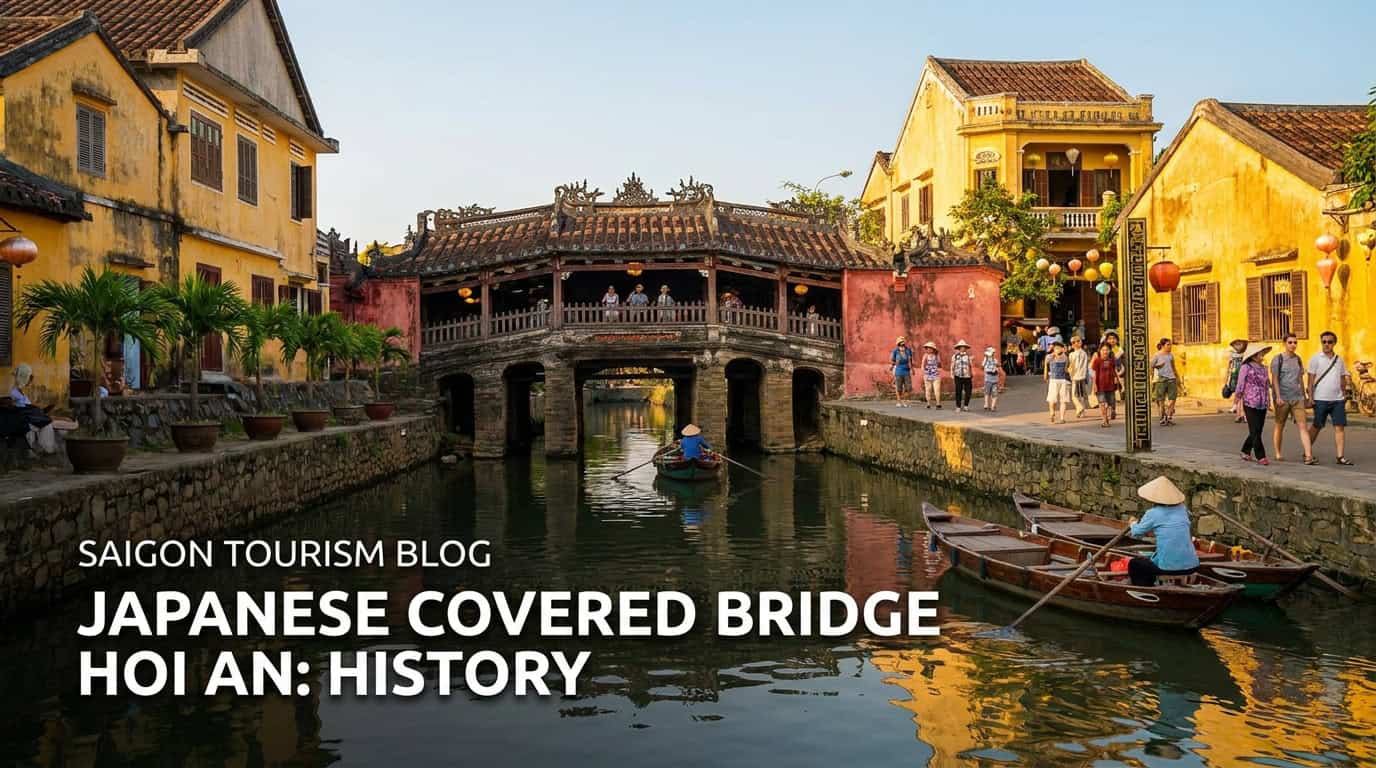
Visiting the japanese covered bridge hoi an has been free of charge to walk across since the restoration reopening on August 3, 2024. However, the rule is nuanced enough that most blogs get it wrong, so here is the current situation as of June 2026:
- Walking across the bridge: Free, 24/7, no ticket required.
- Entering the small temple chamber in the middle of the bridge: Requires the Hoi An Ancient Town combination ticket.
- Standing on the bridge to photograph the canal: Free.
The Ancient Town ticket costs 120,000 VND (about US$4.80) for foreign visitors and 80,000 VND for Vietnamese nationals. One ticket admits you to 5 of 22 heritage sites scattered through the old quarter, plus the temple inside the bridge. Tickets are sold at small wooden booths on every street leading into the Ancient Town. They do not expire on the same day in practice, though officially they’re valid for 24 hours.
Insider tip: If you only want the bridge photograph, do not buy a ticket. If you plan to see Phuc Kien Assembly Hall, Tan Ky Old House, or the Quan Cong Temple, the 120,000 VND ticket pays for itself within 30 minutes.
What Is the Famous Bridge in Hoi An Vietnam?
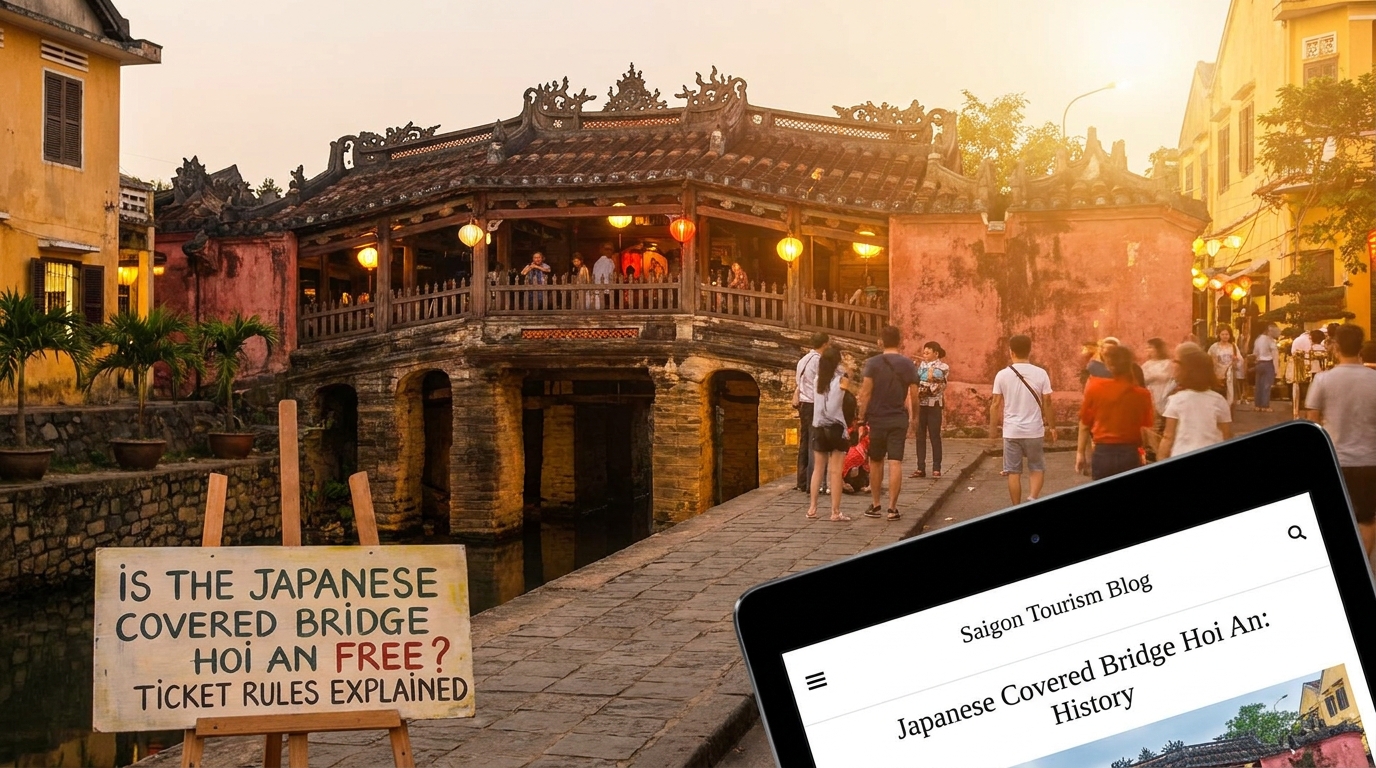
The famous bridge in Hoi An, Vietnam, is the Japanese Covered Bridge (Chùa Cầu in Vietnamese), and it is the only known surviving covered bridge in the world with a Buddhist/Taoist temple integrated into its midsection. The structure has been the official emblem of Hoi An city for decades and was selected by the State Bank of Vietnam to appear on the back of the 20,000 VND polymer banknote issued in 2006. If you have any Vietnamese cash in your wallet right now, pull out a 20,000 VND note and you’ll see exactly the view you’ll soon be photographing.
The bridge is sometimes confused by foreign visitors with two other famous Vietnamese bridges:
- The Dragon Bridge (Cầu Rồng) in Da Nang, which is a modern 666-meter steel structure shaped like a dragon.
- The Golden Bridge (Cầu Vàng) at Ba Na Hills, with the giant stone hands holding up the walkway.
Both are in Da Nang Province, about 30-45 minutes north of Hoi An, and make excellent day-trip combinations from any central District 1 homestay base if you’re starting in Saigon and flying up.
Does the Dragon Bridge in Da Nang Breathe Fire?
Yes, the Dragon Bridge in Da Nang really does breathe fire and shoot water. The 666-meter dragon-shaped bridge across the Han River performs a free fire-and-water show every Saturday and Sunday night at 9:00 PM sharp, lasting roughly 7-10 minutes. The dragon’s head releases real flames first, followed by jets of water at the crowd below — bring a light raincoat if you stand on the eastern bank within the first 50 meters. The show is free, performed by the city of Da Nang, and easily combinable with a Hoi An stay since the cities are connected by a 45-minute taxi ride (~450,000 VND / US$18). Read our complete Da Nang to Hoi An transport guide for details on Grab, private cars, and shuttle buses.
The 2024 Restoration: Why the Bridge Looks New
When the japanese covered bridge hoi an closed for restoration in December 2022, conservators discovered the wooden support pillars had rotted 60% through and the tiled roof was sinking by approximately 2 cm per year. The Quang Nam provincial government committed 20.2 billion VND (around US$1.07 million in 2024 dollars) to a full structural restoration led by the Hoi An Centre for Cultural Heritage Management and Preservation, with technical advice from Japan’s Japan International Cooperation Agency (JICA), which has supported Hoi An conservation since the 1990s.
The work involved:
- Replacing 60% of the load-bearing wooden columns with hardwood matched to the original 16th-century timber species.
- Re-laying the entire tile roof using traditional yin-yang clay tiles fired in Quang Nam.
- Stabilizing the canal-side stone abutments against rising flood levels.
- Restoring the Chinese-character calligraphy plaques and the temple’s original lacquer altars.
The bridge reopened on August 3, 2024, and the bright new paint on the wooden facade was a controversial talking point on Vietnamese social media for weeks. By the time you visit in 2026, the colors will have weathered slightly, taking on the moody patina visitors expect.
Best Time to Visit the Japanese Covered Bridge Hoi An
Hoi An Ancient Town receives roughly 5.3 million visitors per year (Quang Nam Tourism statistics, 2024), and the vast majority funnel past the bridge between 10:00 AM and 4:00 PM. To photograph the japanese covered bridge hoi an without crowds, plan your visit at one of these windows:
| Time slot | Crowd level | Best for |
|---|---|---|
| 5:30-7:00 AM | Empty | Misty river photos, locals doing tai chi |
| 7:00-9:00 AM | Light | Sunlit wooden details, breakfast in cafés |
| 11:00 AM-3:00 PM | Peak crowds | Avoid if possible |
| 5:00-6:30 PM | Building | Sunset golden hour on the canal |
| 6:30-8:30 PM | Busy but magical | Lantern-lit reflections (the iconic shot) |
| After 9:30 PM | Light | Long-exposure night photography |
Best Months of the Year
The dry season runs February through August, with the most reliable weather in March-May (25-30°C, low humidity, occasional clouds). Avoid October and November entirely if you can — central Vietnam’s flood season regularly puts the bridge’s lower beams underwater. The 2020 floods reached 1.6 meters above street level in the Ancient Town.
For more on seasonal planning, see our guide to the best time to visit Vietnam by region.
How to Get to the Japanese Covered Bridge Hoi An
The bridge sits on the western edge of Hoi An’s pedestrianized Ancient Town. From the three main arrival points:
- From Da Nang Airport (DAD): 30 km, 35-45 minutes by Grab car (~400,000 VND / US$16) or fixed-price private taxi (~600,000 VND / US$24).
- From Da Nang city center: 30 km, 40 minutes by Grab (~350,000 VND / US$14).
- From your Hoi An hotel: Most accommodations are within a 2 km walk or 15,000 VND (US$0.60) cyclo ride.
Cars and motorbikes are not allowed inside the Ancient Town between 9:00 AM-11:00 AM and 3:00 PM-9:30 PM, so you’ll be walking the last few hundred meters regardless. Bicycles are permitted and free to rent at most homestays.
If you’re combining Hoi An with a Saigon-based trip, see our Saigon itinerary for how to structure a multi-city Vietnam route that includes the bridge.
What to See Inside the Bridge
Most visitors walk across in under a minute. Slow down — there are five details that reward attention:
- The Tran Vo Bac De altar — the small Taoist shrine in the northern alcove, dedicated to the weather god. Notice the offerings of fruit and incense left by Vietnamese visitors.
- The wooden ceiling beams — look up. The geometric joinery is pure Japanese carpentry, executed without nails.
- The carved stone dogs and monkeys at each entrance — guardian animals discussed above.
- The Chinese calligraphy plaques — three plaques over the temple door read “Lai Vien Kieu” (Bridge for Visitors from Afar), the name bestowed by Lord Nguyen Phuc Chu in 1719.
- The view downstream from the bridge railing — the iconic photograph of yellow shophouses reflected in the canal, especially after 7 PM when the lanterns light up.
What to Eat Near the Japanese Covered Bridge Hoi An
The streets immediately surrounding the bridge are home to Hoi An’s three signature dishes, all best eaten within 300 meters of the bridge:
- Cao Lau — thick wheat noodles in a smoky broth, traditionally made only with water from the Ba Le well. Try Cao Lau Thanh on Thai Phien Street.
- White Rose dumplings (Bánh Bao Bánh Vạc) — translucent shrimp dumplings, made by a single family in Hoi An. Try Bong Hong Trang restaurant, two blocks east.
- Banh Mi Phuong — Anthony Bourdain’s famous sandwich shop, 400 meters from the bridge.
For a deeper food deep-dive, our Vietnamese street food guide covers the regional specialties from north to south.
Photography Tips: How to Get the Iconic Shot
The classic postcard view of the japanese covered bridge hoi an is taken from the southern bank of the canal, looking northwest, with the bridge framed by overhanging lanterns. Here’s how to nail it:
- Lens: 24-35mm wide angle on full frame, or the 1x lens on a phone.
- Time: Exactly 30 minutes after sunset (called the blue hour), when ambient sky light balances the lanterns.
- Position: Stand on the small wooden footbridge directly south of the Japanese Bridge, not on the bridge itself.
- Settings (camera): ISO 400, f/4, 1/15s with image stabilization; bring a small tripod if you have one.
- Settings (phone): Switch to Night Mode and brace against the railing.
Tripods are technically allowed but increasingly discouraged after 7 PM due to crowd density. A small tabletop tripod (Gorillapod-style) is fine.
Where to Stay Near the Japanese Covered Bridge Hoi An
Hoi An has hundreds of homestays within 1 km of the bridge, ranging from US$15-150 per night. The most atmospheric stays are restored merchant houses in the An Hoi peninsula, directly across the river. If you’re connecting through Ho Chi Minh City first, our recommendation is to base 2 nights in a District 1 homestay for the city, then fly Vietjet or Bamboo Airways to Da Nang for 2-3 nights in Hoi An.
Common Mistakes Foreign Visitors Make
After hosting hundreds of guests heading to Hoi An, these are the mistakes we see repeated:
- Paying for the bridge entry assuming it’s required. Walking across is free. Only the temple needs a ticket.
- Visiting at midday. The light is harsh, the crowds are at peak, and the heat is brutal.
- Skipping the surrounding Ancient Town. The bridge is 18 meters long. The Ancient Town deserves at least a half-day.
- Wearing thin-soled shoes. The 16th-century cobblestones will punish your feet by hour three.
- Bringing large drones. Drone use over Hoi An Ancient Town requires a permit from the Quang Nam People’s Committee.
Frequently Asked Questions
What is the story behind the Japanese Bridge in Hoi An?
Japanese merchants built the bridge in the late 1590s to connect their trading quarter with the Chinese district across a small canal in the port town of Faifo. Folklore says the bridge was constructed across the spine of a mythical sea monster called Namazu, whose head was in India and tail in Japan, to prevent earthquakes and floods. A small Taoist temple inside honors the weather god Tran Vo Bac De.
Is Japanese Covered Bridge free?
Yes, walking across the Japanese Covered Bridge has been free since the August 2024 restoration reopening. You only pay if you enter the small Taoist temple chamber inside, which requires the 120,000 VND (US$4.80) Hoi An Ancient Town combination ticket. That ticket also admits you to 4 other heritage sites of your choice from 22 total options, making it excellent value if you plan to explore the Old Town.
What is the famous bridge in Hoi An Vietnam?
The famous bridge in Hoi An is the Japanese Covered Bridge, locally called Chùa Cầu (Pagoda Bridge), built around 1593-1595 by Japanese merchants. It is the only surviving covered bridge in the world with an integrated Taoist temple, and it appears on Vietnam’s 20,000 VND banknote. The 18-meter wooden structure is the official symbol of Hoi An city and a UNESCO World Heritage site component since 1999.
Does the Dragon Bridge in Da Nang breathe fire?
Yes, the Dragon Bridge in Da Nang breathes real fire and shoots water every Saturday and Sunday night at 9:00 PM. The free show lasts 7-10 minutes: the 666-meter steel dragon first releases flames from its head, then sprays jets of water at spectators below. Stand on the eastern bank of the Han River for the best view, and bring a light raincoat if you’re within 50 meters of the dragon’s head.
How long do I need at the Japanese Covered Bridge?
Plan 15-30 minutes for the bridge itself, including a slow walk across, photos from both banks, and a brief look inside the temple. Combined with the surrounding Ancient Town, allocate 3-4 hours minimum to see the major heritage houses, eat one signature dish, and enjoy the lantern-lit atmosphere after sunset. A full day allows a more relaxed pace with shopping and café stops.
Can I visit the Japanese Covered Bridge at night?
Yes, the bridge is accessible 24 hours a day for walking across, and the most magical visiting time is actually 6:30-8:30 PM when the surrounding lanterns are lit and the canal reflects the warm yellow glow. The Ancient Town pedestrianizes from 5:00 PM-9:30 PM nightly. The small temple inside the bridge closes at 9:00 PM, but the structure itself remains beautifully lit until midnight.
Plan Your Hoi An Trip from a Central Saigon Base
Most international travelers fly into Ho Chi Minh City and continue north to Hoi An on a domestic flight. Spending your first 2-3 nights in central District 1 lets you adjust to the time zone, sample southern Vietnamese cuisine, and arrive in Hoi An refreshed and ready to walk for hours. Compare District 1 hotels, all within walking distance of Ben Thanh Market, the Notre-Dame Cathedral, and the airport shuttle. Your perfect 10-day Vietnam itinerary starts with the right base.