
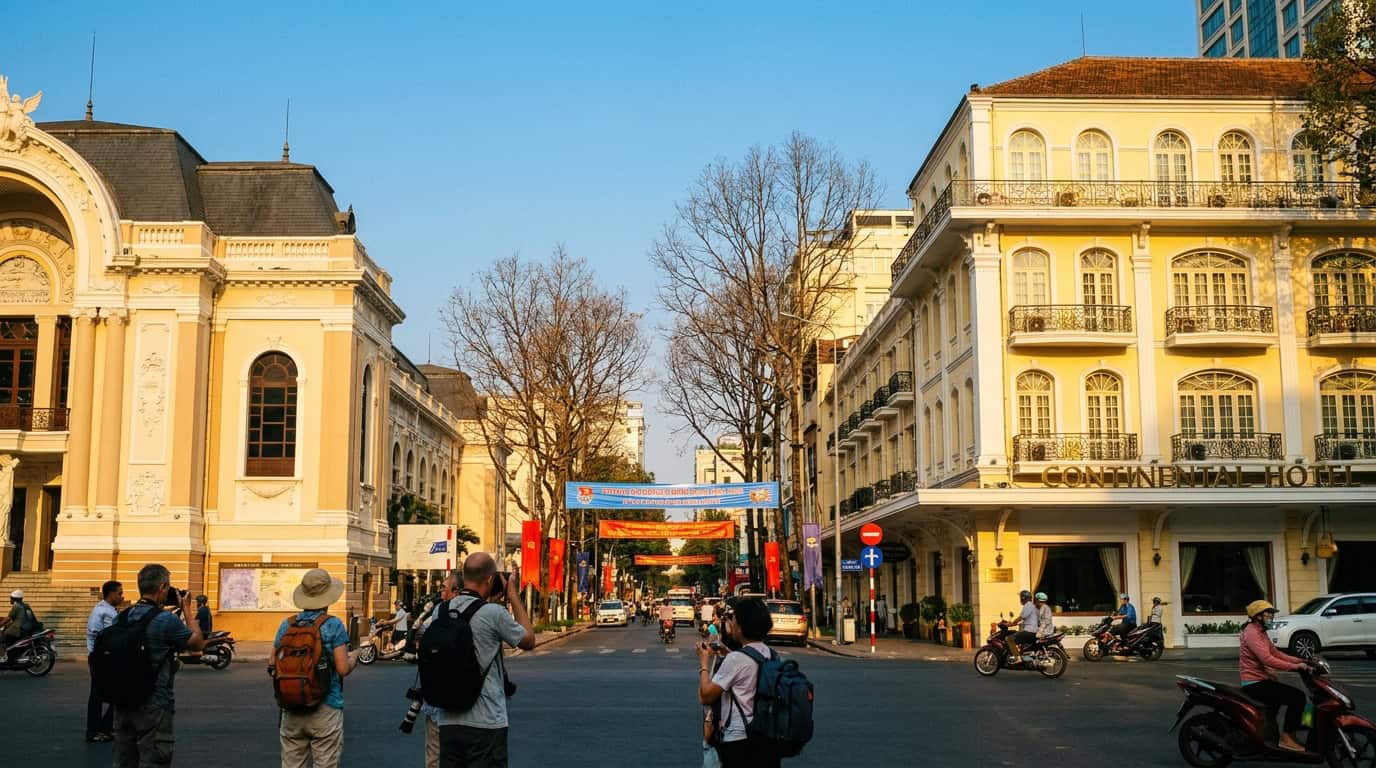
The best time to visit Saigon is November through April, when the city runs on its dry season calendar: low humidity, clear skies, and daily highs that stay predictable. Ho Chi Minh City recorded a target of 8.5 million international visitors for 2025, up 39.3% on 2024, according to vietnam.vn. That surge of traveler interest reflects something real about the city’s appeal. But it also means that choosing the wrong window can mean paying peak prices, sweating through afternoon storms, or arriving during Tet to find half the city shuttered. This guide gives you the full picture, month by month.
Key Takeaways
– The best time to visit Saigon is November to April (dry season), with February offering the lowest rainfall (5 mm) and lowest humidity (70%) of any month.
– Temperatures barely change year-round (31-34°C daily highs). Rainfall and humidity are the real variables that define each season.
– Rainy season hotel rates run 30-50% below peak, and afternoon showers typically last only 1-3 hours (usually 2-5 PM), leaving mornings free.
– Tet 2026 falls on February 17 (public holiday window: February 14-22). The city is atmospheric but some restaurants and shops close for several days.
Quick Answer: The Best Time to Visit Saigon at a Glance
The best time to visit Saigon is November through April. This is the dry season, and it consistently delivers the most comfortable conditions: less rain, lower humidity, and clear mornings. February is statistically the driest single month, averaging just 5 mm of rainfall and only 0.6 wet days. December through January offers comparable dryness with the added benefit of slightly cooler nights. If your dates are fixed in the rainy season (May-November), that’s workable too – but you’ll need a different strategy.
The table below gives the complete picture. Use it to find the right balance of weather, cost, and crowds for your trip.
| Month | Avg High | Avg Low | Rainfall (mm) | Wet Days | Humidity | Crowd Level | Notes |
|---|---|---|---|---|---|---|---|
| Jan | 33°C / 91°F | 23°C / 73°F | 5 mm | 0.9 | 72% | High | Peak dry season |
| Feb | 34°C / 93°F | 23°C / 73°F | 5 mm | 0.6 | 70% | High | Driest month, Tet |
| Mar | 35°C / 95°F | 24°C / 75°F | 10 mm | 1.6 | 71% | Med-High | Hot, shoulder |
| Apr | 34°C / 93°F | 25°C / 77°F | 33 mm | 4.3 | 74% | Medium | Shoulder, Reunification Day |
| May | 33°C / 91°F | 25°C / 77°F | 109 mm | 11.7 | 79% | Low | Rainy season starts |
| Jun | 32°C / 90°F | 25°C / 77°F | 157 mm | 15.9 | 82% | Low | Peak wet |
| Jul | 32°C / 90°F | 25°C / 77°F | 160 mm | 16.7 | 83% | Low | Peak wet |
| Aug | 32°C / 90°F | 25°C / 77°F | 147 mm | 15.7 | 83% | Low | Peak wet |
| Sep | 32°C / 90°F | 25°C / 77°F | 165 mm | 16.6 | 84% | Low | Wettest month |
| Oct | 32°C / 90°F | 25°C / 77°F | 165 mm | 16.5 | 84% | Low | Wettest month |
| Nov | 32°C / 90°F | 24°C / 75°F | 71 mm | 8.4 | 80% | Med | Shoulder, transitioning |
| Dec | 32°C / 90°F | 23°C / 73°F | 20 mm | 2.9 | 75% | High | Dry season resumes |
Source: WeatherSpark – Average Weather in Ho Chi Minh City
Understanding Saigon’s Two Seasons (Not Four)
Saigon has two seasons, not four. The tropical climate of southern Vietnam doesn’t produce the spring-summer-autumn-winter cycle familiar to European or North American travelers. What it produces instead is a dry season (roughly November through April) and a rainy season (roughly May through October), separated by short transition periods in April-May and October-November.
Temperature is almost irrelevant as a seasonal marker. According to WeatherSpark data, daily highs stay within a narrow band of 32-35°C all year. The hottest month is March, averaging 35°C. Even during the “cooler” rainy months of June through October, highs stay at 32°C. That’s a difference of just 3°C across the entire calendar year.
What actually changes is humidity and rainfall. Dry season humidity sits around 70-75%. Rainy season peaks at 83-84% in August through October. That gap is significant in practice. At 70% humidity, 33°C feels uncomfortable but manageable with a light shirt. At 84% humidity, the same temperature becomes genuinely draining, especially for anyone not used to tropical heat.
The distinction matters for packing, planning, and expectations. Anyone arriving in July expecting “hot weather” and finding it rainy every afternoon for two weeks has confused Saigon with a four-season city.
Saigon Weather by Month: A Full 12-Month Breakdown
Saigon weather by month breaks into three clear phases: true dry (December-March), shoulder (April, November), and rainy (May-October). Knowing which phase you’re entering shapes every decision from packing to scheduling outdoor activities.
December to February: The Core Dry Window
December, January, and February are the most consistently comfortable months. Rainfall is negligible: 20 mm, 5 mm, and 5 mm respectively. Wet days barely register – February averages 0.6 wet days for the entire month. Humidity stays at 70-75%, the lowest of any point in the year. Nights cool to around 23°C, which is the closest Saigon gets to genuinely fresh evening air.
The trade-off is crowds and price. International visitor numbers concentrate in this window, hotels fill up, and December-January rates reflect it. The average cost of a 3-night stay hits $173 at peak versus $93 in the off-season low, per booking platform aggregate data. Book accommodation at least 4-6 weeks out if you’re targeting January or the Christmas-New Year window.
March to April: Shoulder Territory
March is technically dry (only 10 mm rainfall) but stands out as the hottest month, with averages reaching 35°C. There’s no rain to cut through the heat, so late March afternoons in District 1 can feel genuinely punishing. Early mornings (6-9 AM) and late evenings become the preferred hours for outdoor movement.
April transitions into the shoulder period. Rainfall picks up to 33 mm and 4.3 wet days, so occasional afternoon showers arrive. The upside is that crowds thin from peak levels and prices begin to ease. April 30 is Reunification Day, a national holiday with citywide festivities and parades. It’s a good time to be in the city if you’re interested in local culture, though hotels and popular restaurants fill up for that specific weekend.
May to October: The Rainy Season
May marks the start of the monsoon cycle. Rainfall climbs from 33 mm in April to 109 mm in May, then to 157-165 mm across June through October. September and October are the wettest months, each averaging 165 mm of rain and approximately 16.5 wet days. Humidity peaks at 83-84% during this window.
That said, the rainy season is not what most travelers picture when they imagine a monsoon. Rain rarely falls continuously for days. The standard pattern is a clear or partly cloudy morning, building clouds through the early afternoon, then a heavy downpour between roughly 2 PM and 5 PM that lasts 1-3 hours. After the rain stops, streets are wet but the temperature has dropped a degree or two and the air feels briefly cleaner.
November: The Transition Month
November sits in an interesting middle position. Rainfall drops sharply from October’s 165 mm to 71 mm, and wet days fall from 16.5 to 8.4. Humidity eases from 84% to 80%. By late November, you’re increasingly in dry season conditions. Early November still sees some rainy days, but it’s genuinely a shoulder period: fewer crowds than December, lower prices than January, and improving weather day by day.
Dry Season (December-April): Peak Comfort, Peak Crowds
The dry season offers the best conditions for sightseeing, outdoor dining, and day trips outside the city. WeatherSpark records only 5 mm of rainfall in both January and February, with February averaging less than one wet day for the entire month. Dry season humidity sits around 70%, noticeably lower than the 83-84% peak of the rainy months. For most travelers, this is the clear preference.
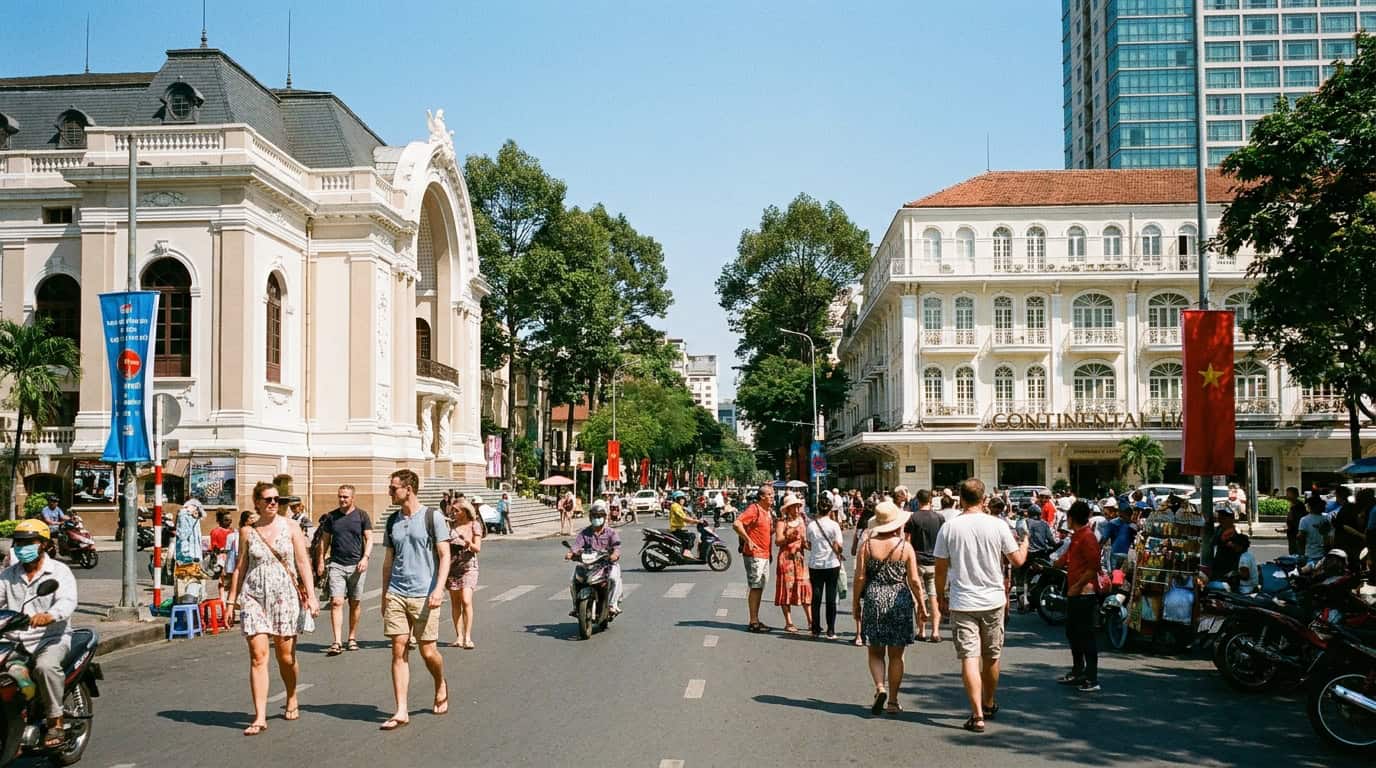
The reality of peak season is that Ho Chi Minh City is not a quiet destination to begin with. The streets of District 1 stay busy year-round. What peak season adds is a higher concentration of international tourists, fuller hotels, and less negotiating room on accommodation. Booking 4-8 weeks in advance for December through February is a reasonable rule of thumb. Last-minute availability exists but often means paying above-average rates or compromising on location.
The practical advantages of dry season go beyond comfort. Day trips to the Mekong Delta, Cu Chi Tunnels, and Vung Tau beach are much more rewarding when you’re not fighting mud and rain. Outdoor food markets and street dining are fully accessible. The nightly food scene around Bui Vien and Ben Thanh Market operates without weather disruption.
Citation capsule: February is the driest month in Saigon, recording 5 mm of rainfall and an average of 0.6 wet days, based on multi-decade historical averages from WeatherSpark. Humidity at 70% makes it the most comfortable month for outdoor activity. Hotel rates during peak dry season (January-February) average approximately $173 for a 3-night stay, compared to $93 during the rainy season low.
Shoulder Months: November and April – The Hidden Sweet Spots
November and April offer the best value in Ho Chi Minh City for travelers willing to accept imperfect weather. Both months sit outside the peak pricing window but deliver substantially better conditions than the rainy season core. November has 71 mm of rainfall (less than half of October’s 165 mm) and crowds that thin considerably compared to December-January. April has warming temperatures and occasional showers but none of the sustained rain that defines June through September.
The financial case is direct. Accommodation rates between peak and off-season vary significantly – a 3-night stay averages $173 during peak season versus $93 during the low season. November and April typically land somewhere in the middle of that range, giving you better value without accepting the wettest conditions.
April carries one specific consideration: the April 30 Reunification Day national holiday. The city celebrates with public events, and streets around District 1 fill with local crowds. For some travelers, this is a feature. For anyone with a tight schedule or plans to visit historical sites that day, it’s worth checking opening hours in advance.
November is arguably the more underrated of the two. The weather transition from rainy to dry happens progressively through the month. Early November still sees some rain; late November increasingly resembles December. If you can target the second half of November, you get near-dry-season conditions at shoulder-season prices with fewer tourists.
Rainy Season (May-November): What It’s Actually Like on the Ground
The rainy season in Saigon is workable for most travelers, provided you adjust your daily schedule around the afternoon rain window. September and October are the wettest months, averaging 165 mm of rainfall each with around 16.5 wet days, according to WeatherSpark historical data. But “wet day” in Saigon’s context rarely means a day of continuous rain. It means a day with at least one measurable rainfall event, usually concentrated in the 2-5 PM window.
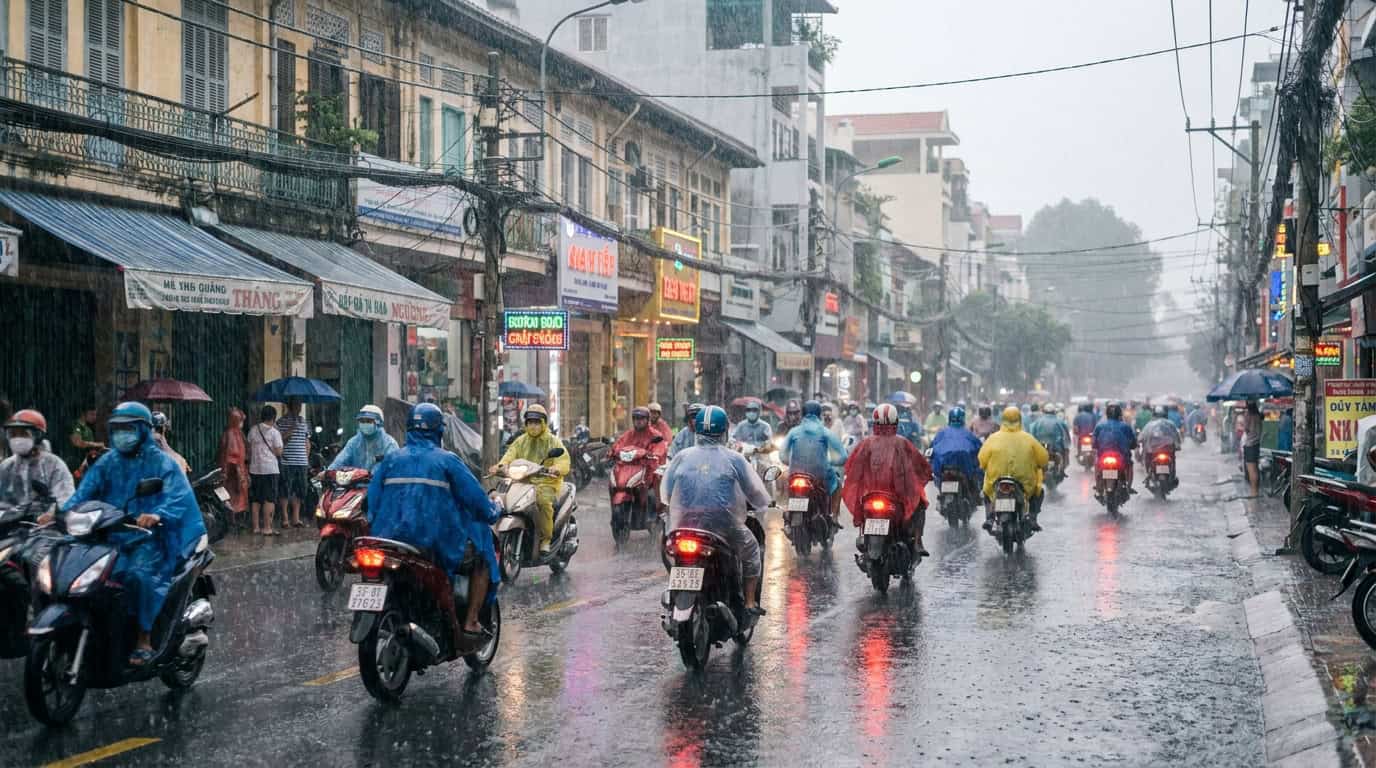
The practical implication: schedule outdoor activities, temple visits, and street market browsing in the morning. By 11 AM-12 PM, you should be thinking about moving toward an indoor lunch. The rain typically arrives between 2 PM and 5 PM and lasts one to three hours. After it passes, the air temperature has dropped slightly and evenings are actually comfortable for walking.
Flooding is a real concern on specific streets during heavy rain events. The streets most prone to standing water during peak downpours include Bui Vien, Le Loi, Nguyen Hue, and Nguyen Huu Canh. These are major tourist thoroughfares. Ankle-to-shin-depth water is not unusual on these streets during a serious storm. Waterproof sandals or shoes you don’t mind getting wet, plus having your phone in a sealed bag during heavy rain, are practical precautions.
The financial upside of rainy season is the 30-50% discount on hotel rates compared to peak. For budget travelers or those with flexible schedules, May, June, and early November in particular offer reasonable weather-to-price tradeoffs. July through October is harder to recommend unless budget is the dominant factor.
Saigon During Tet (Lunar New Year): Magical but Plan Carefully
Tet 2026 falls on February 17, with the official public holiday window running February 14-22. Tet is Vietnam’s most important cultural event, a Lunar New Year celebration that transforms the city in ways that are genuinely worth experiencing – once you understand what “transforming the city” actually means for a tourist.
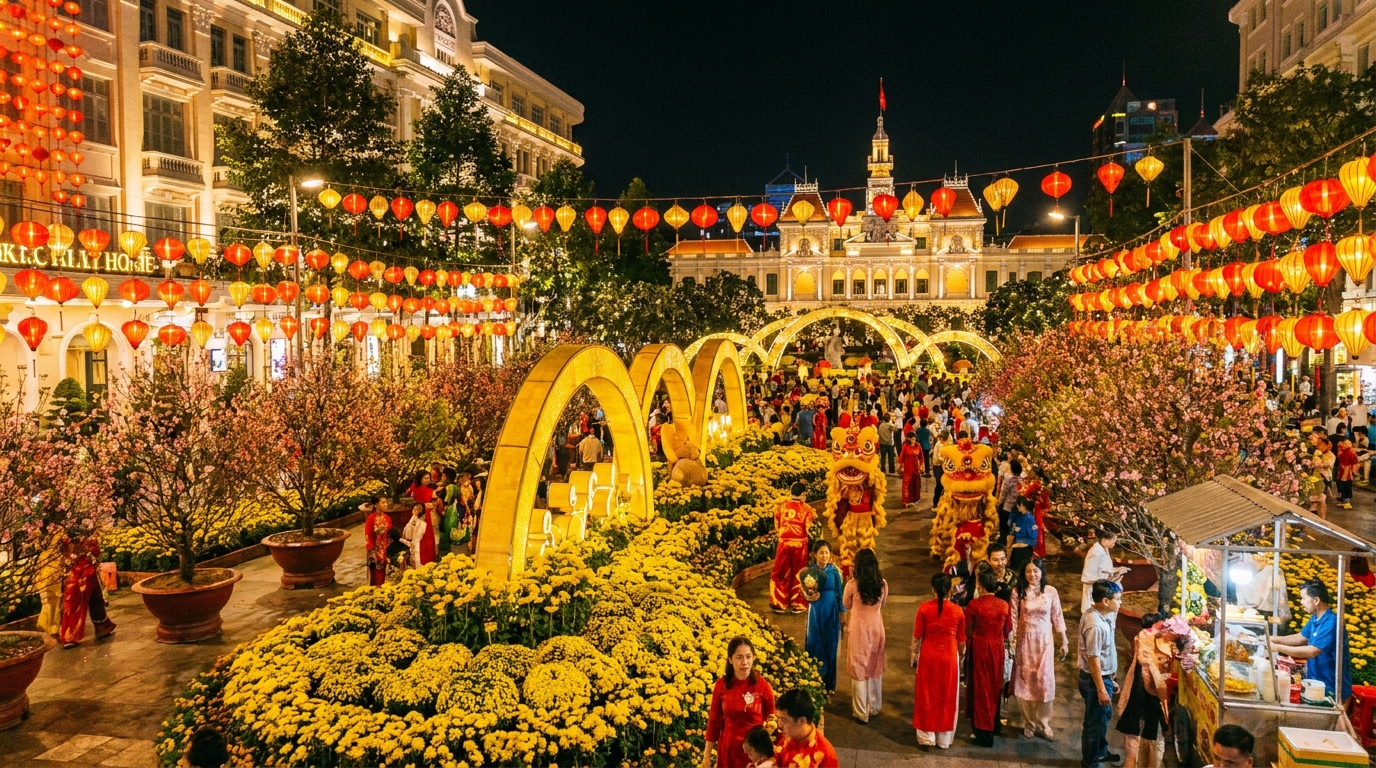
The positive side first. In the days before Tet (roughly February 10-16), the streets of District 1 fill with flower markets, decorative peach and apricot blossom trees, and lanterns. Nguyen Hue Walking Street hosts a flower festival. Locals dress in traditional ao dai clothing. The city has a festive energy that differs entirely from any other time of year. Fireworks light up the sky at midnight on the lunar New Year’s Eve.
The practical complications are significant. From roughly February 17 onward through the holiday window, a substantial share of locally-owned restaurants, street food stalls, and small shops close entirely. Staff return to their home provinces. District 1 hotels stay open because they’re staffed by tourist-economy workers, but the surrounding neighborhood goes quiet. Some major tourist attractions reduce hours or close for 2-3 days.
If you’re visiting during Tet, book your accommodation well in advance – the holiday window is one of the most heavily booked periods of the year. Identify which restaurants and cafes near your hotel remain open during the holiday. Expect to pay peak-season hotel rates. And budget some flexibility into your itinerary, because transport and services run on reduced schedules.
Arriving 3-5 days before Tet to experience the pre-holiday flower markets, then departing by February 17-18, is a reasonable strategy for getting the atmosphere without the logistical friction of the closure period.
Other Festivals and Public Holidays Worth Knowing
Several public holidays and festivals outside of Tet directly affect what’s open, how crowded it is, and whether prices spike during your visit. Vietnam has 11 official public holiday days per year, and Ho Chi Minh City feels several of them distinctly as a tourist destination.
Reunification Day, April 30, commemorates the end of the Vietnam War in 1975. It’s a national holiday with citywide celebrations, parades in District 1, and significant local crowds around historical sites. The Ho Chi Minh City Museum and War Remnants Museum may have extended hours or special programming. Hotels and popular restaurants fill up for that specific long weekend, so book ahead if you’re targeting late April.
International Labor Day falls on May 1, immediately following Reunification Day. The two holidays together create a long weekend that many Vietnamese use for domestic travel, which means some tourist sites and transport routes are busier than usual. Departing the city on May 1-2 can involve crowded buses and trains.
The Mid-Autumn Festival (Tết Trung Thu) falls in September or October on the lunar calendar (in 2026 it falls on October 6). It’s a family-oriented event with lantern parades and mooncakes, mostly celebrated in residential neighborhoods. It doesn’t significantly disrupt tourist activities but adds a pleasant local layer if you happen to be in the city.
Vietnamese National Day falls on September 2. Similar to Reunification Day in character: government buildings are decorated, there are some public events, and it’s a national holiday that means some offices and smaller businesses close.
Best Time to Visit Saigon for Budget Travelers
The cheapest time to visit Ho Chi Minh City is during the rainy season core: June through September. A 3-night hotel stay averages $93 during the low season versus $173 during peak season, based on booking platform aggregate data. That $80 difference per 3-night stay adds up quickly across a 1-2 week trip.
The rainy season price discount applies across accommodation, tours, and some transport. Hotels with lower occupancy rates are more likely to negotiate or offer promotional pricing directly. Day trip operators to Cu Chi Tunnels and the Mekong Delta run their itineraries year-round regardless of weather, and prices are typically lower outside peak season.
The months with the most favorable budget-to-weather ratio within the rainy season are May and November. May is the start of the wet season, so you get rainy season prices without yet experiencing the full volume of July-October rainfall. November is the tail end of the wet season, with rapidly improving conditions as the month progresses. Both months offer a better experience than the core July-October rainy period while still pricing well below December-February peak.
Avoiding the Tet window (approximately February 10-22) is important for budget travelers even though it falls within the dry season. Hotel rates during Tet spike to their highest annual levels, and prices for everything from flights to tours reflect the demand.
Best Time to Visit Saigon by Travel Style
The right time to visit Saigon depends heavily on what you’re planning to do. Weather is one variable; your activities, budget, and tolerance for crowds are equally important.
For First-Time Visitors
December through February is the safe recommendation. You get the most comfortable conditions, the broadest range of outdoor activities without weather disruption, and the city at full operation. The cost is peak pricing and higher tourist volumes. If you’re visiting Saigon once and want to see it at its most accessible, this window is worth the premium.
For Food-Focused Travelers
The dry season (November-March) gives you uninterrupted access to street markets, outdoor food courts, and rooftop dining. Rain doesn’t eliminate street food in the rainy season, but it does disrupt the experience. Some of Saigon’s best eating happens on plastic stools at pavement stalls, and doing that in 83% humidity during a downpour is a significantly different experience than doing it on a clear November evening.
For History and Museum Visits
Shoulder season (November, April) works well for museum-heavy itineraries because outdoor time is less critical. The War Remnants Museum, Independence Palace, and Ben Thanh Market are all climate-controlled or covered. A rainy afternoon inside the War Remnants Museum is actually more immersive than many visitors expect.
For Day Trips Outside the City
The dry season is strongly preferable for the Mekong Delta, Cu Chi Tunnels, and Vung Tau. Delta boat tours become more difficult and some paths muddy in the wet season. Vung Tau beach loses its appeal under grey skies and heavy surf from July to October.
For Repeat Visitors
Repeat visitors to Saigon who already know the city’s structure tend to favor November. The festival calendar is quieter than December-February, prices are below peak, and the transitioning weather creates a different version of the city than they’ve experienced before.
Rainy Season Survival Guide: Packing Tips and Street Tactics
Visiting Saigon in the rainy season is manageable with the right gear and a schedule built around the afternoon rain window. The core adjustment is simple: plan outdoor activities in the morning and early afternoon, and have an indoor backup ready for 2-5 PM.
What to Pack for the Wet Season
A compact packable rain jacket or poncho is more useful than an umbrella in Saigon’s tropical downpours. Wind combined with heavy rain makes umbrellas awkward on motorbike-heavy streets, and rain often comes in from multiple angles. A poncho that covers your bag is ideal – it keeps both you and your gear dry without occupying a hand.
Waterproof or quick-dry footwear matters more than most travelers expect. When Nguyen Huu Canh or Bui Vien floods to ankle depth during a serious storm, leather shoes become a problem quickly. Waterproof sandals or trail-style shoes with drainage work well.
Keep your phone in a waterproof pouch or sealed zip-lock bag when you’re out during rain-prone hours. Phone snatchers also operate during rain, when tourists are distracted and visibility is reduced. A phone in your pocket rather than your hand is the right posture.
Street Tactics During Rain
The most useful tactic is simply reading the sky from mid-morning onward. When clouds build rapidly and darken from around noon, rain is usually 1-2 hours away. This gives you enough time to finish outdoor activities, move to a covered market or cafe, and wait out the storm.
Grab (the ride-hailing app) surges during heavy rain as demand spikes. If you need transport during or immediately after a major downpour, expect 1.5-2x normal pricing and a longer wait for available drivers. Walking an extra 5 minutes away from a major intersection often reduces surge pricing.
Street food vendors on the main tourist strips pack up during rain and return after it passes. Covered food markets like Ben Thanh stay open throughout. Having a list of 2-3 nearby covered food options near wherever you’re staying is a useful habit during rainy season months.
Air Quality and Health Considerations by Season
Saigon’s air quality follows a counterintuitive seasonal pattern: the dry season is actually worse for air pollution, not the rainy season. HCMC’s PM2.5 annual average sits at 26.9 micrograms per cubic meter, more than double the WHO annual guideline of 5 µg/m³. The rainy season’s daily downpours wash particulate matter from the air, giving a temporary clean-air effect after each storm. In the dry season, with no rainfall to clear pollutants and burning agricultural waste from surrounding provinces adding to the load, air quality can deteriorate significantly.
This is relevant for travelers with asthma, respiratory conditions, or young children. The dry season months of January through March coincide with the region’s agricultural burning season. On higher-pollution days, a N95 or KN95 mask worn outdoors, particularly when riding motorbikes or cycling, provides meaningful protection.
The overall health picture for Saigon visitors is not alarming for healthy adults. The PM2.5 figure represents an annual average – many individual days are cleaner, and the outdoor hospitality culture of the city (street food, rooftop bars, outdoor cafes) is built around this climate. But the assumption that rainy season air is dirtier than dry season air is worth correcting. The opposite is true.
For the most current air quality data before and during your trip, IQAir maintains a live HCMC monitoring page. Checking it during high-pollution dry season days (January-March, when PM2.5 can spike) lets you decide whether to limit outdoor exposure on particularly bad mornings.
Frequently Asked Questions
Is Saigon worth visiting during the rainy season?
Saigon is worth visiting during the rainy season for travelers with the right expectations. The rain follows a predictable afternoon pattern (typically 2-5 PM lasting 1-3 hours), leaving mornings fully available for sightseeing. Hotel rates run 30-50% below peak season, and the city’s indoor attractions – the War Remnants Museum, Ben Thanh Market, galleries, and restaurants – operate normally year-round. Adjust your schedule, pack a poncho, and the rainy season is a functional, budget-friendly option.
What is the cheapest time to visit Ho Chi Minh City?
The cheapest time to visit Ho Chi Minh City is during the rainy season core, specifically June through September. A 3-night hotel stay averages around $93 in the low season compared to $173 during peak season. May and November offer a better weather-to-price compromise: you get rainy-season rates without the full volume of July-September rainfall. Avoid the Tet holiday window (mid-February in 2026), when prices spike to their annual high even though it falls in the dry season.
Does it rain every day in Saigon during the wet season?
It does not rain all day every day in Saigon during the wet season. September and October are the wettest months, averaging about 16.5 wet days per month – meaning roughly every other day has measurable rain. Even on wet days, the rain typically falls in the afternoon for 1-3 hours rather than continuing throughout the day. Mornings in the rainy season are often clear or partly cloudy, giving you 4-6 usable hours for outdoor activity before the afternoon downpours arrive.
Should I avoid Saigon during Tet?
Saigon during Tet (February 17, 2026, with public holidays from February 14-22) is not a period to avoid entirely, but it requires careful planning. The pre-holiday days (February 10-16) are genuinely atmospheric, with flower markets, lanterns, and citywide festivity. After the New Year begins, many locally-owned restaurants and shops close for several days, and the city gets quieter than usual. Hotel prices are at their annual peak. Arriving before the holiday, experiencing the flower festival, and departing by February 17-18 gives you the atmosphere without the service disruptions.
What month is hottest in Ho Chi Minh City?
March is the hottest month in Ho Chi Minh City, with average daily highs reaching 35°C / 95°F, based on WeatherSpark multi-decade averages. April follows closely at 34°C. The slight cooling that occurs from May onward is due to increased cloud cover and rainfall from the arriving monsoon season, not any meaningful temperature drop. Practically speaking, all months from January through April require the same precautions: early morning outdoor activity, midday shade, and adequate hydration.
Planning Your Trip: Final Recommendations
The best time to visit Saigon depends on what matters most to you. For comfort and ease, November through February is the clear answer – dry, lower humidity, and fully operational. For budget travelers, May and November offer the best compromise between price and conditions. If you’re flexible on dates, late November is arguably the single most underrated window: prices are below peak, weather is improving daily, and crowds are lower than the December-February rush.
Whatever month you choose, Saigon rewards travelers who adapt to its pace rather than fighting it. The afternoon rains of the wet season are not a reason to stay inside all day. The heat of the dry season is not a reason to avoid the outdoors. The city operates on its own logic. Meeting it on those terms makes for a better trip at any time of year.
Sources
- WeatherSpark – Average Weather in Ho Chi Minh City, Vietnam, Year Round
- Vietnam National Tourism Administration – Weather and Climate in Vietnam
- Vietnam.vn – Ho Chi Minh City targets 8.5 million international visitors in 2025
Before booking anything, check the entry rules in our Vietnam e-visa guide.
Related Guides
- Saigon 3-Day Itinerary: The Perfect First-Timer Plan (2026)
- Best Areas to Stay in Saigon: District Guide for First-Timers
- Best Time to Visit Hanoi: Weather, Seasons & Crowds
- Vietnam North to South Itinerary: 3–4 Week Route (2026)
- How Many Days in Saigon Is Enough? (Honest 2026 Guide)
- Best Places to Visit in Vietnam: Complete 2026 Guide