
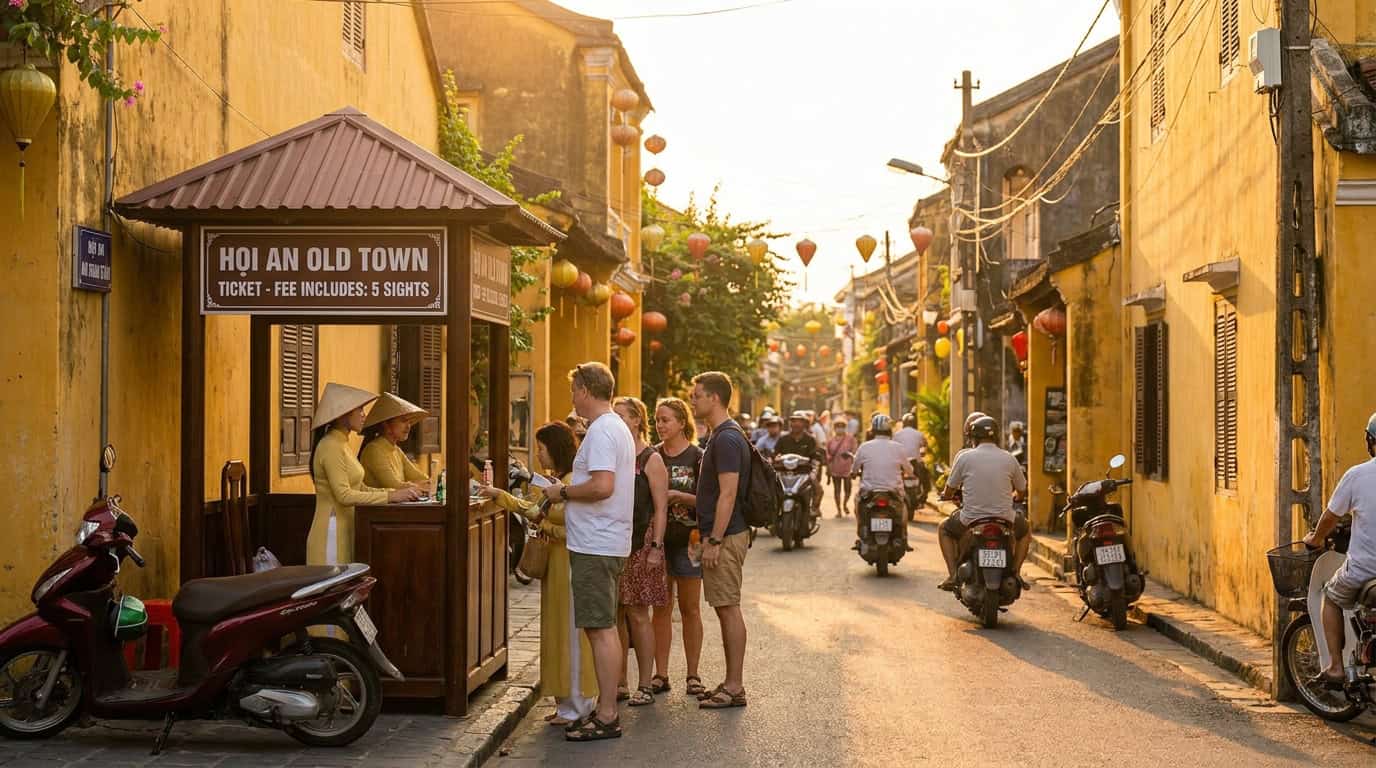
The Hoi An Old Town entrance fee is 120,000 VND (about $5 USD) per foreign visitor in 2026, and it grants you access to 5 of the 22 official heritage sites inside the UNESCO-listed Ancient Town, plus the right to cross the iconic Japanese Covered Bridge. If you’ve landed here wondering whether you actually need a ticket, where the official booths are, or if the fee is a polite scam, this guide answers every question — written for foreign travelers and expats based in Vietnam who want a clear, no-fluff verdict before they show up at the entrance.
We’ve cross-checked current pricing with the Hoi An Centre for Culture & Sports management board (the agency that issues the tickets), compared it against UNESCO’s own listing for the site, and walked the booths personally in early 2026. Below you’ll find the real cost, what’s included, the smartest 5 sites to pick, and exactly when the ticket is — and isn’t — worth your money.
Key Takeaways
- Cost: 120,000 VND (~$5 USD) for foreigners, 80,000 VND for Vietnamese nationals. Free for children under 16.
- What you get: Entry to 5 of 22 heritage attractions (your choice), 1 free cultural performance, and “legal” passage across the Japanese Covered Bridge.
- Validity: Multi-day — the paper ticket is valid for 24 hours minimum, often honored across consecutive days if unused.
- Where to buy: 9 official kiosks ring the Old Town perimeter. Buy from booths only — never from street touts.
- Worth it? Yes, if you plan to enter 2+ heritage homes or attend a show. No, if you only want to stroll and photograph lanterns at night.
- Enforcement: Loose by day, stricter after 5 PM and during festival nights.
Quick Summary Table: Hoi An Old Town Ticket at a Glance
| Detail | Information |
|---|---|
| Price (foreigners) | 120,000 VND (~$5 USD) |
| Price (Vietnamese) | 80,000 VND (~$3.35 USD) |
| Children under 16 | Free |
| Sites included | 5 of 22 (your choice) |
| Cultural show | 1 free performance per ticket |
| Ticket validity | 24 hours (often honored 2–3 days) |
| Official booths | 9 around Old Town perimeter |
| Operating hours | 07:30 – 21:30 daily |
| Best time to visit | Early morning (7–9 AM) or after 5 PM |
| Payment | Cash only at most kiosks (VND preferred) |
How Much Is the Hoi An Old Town Entrance Fee in 2026?
The current Hoi An Old Town entrance fee for foreign visitors is 120,000 VND, which converts to roughly $5 USD, €4.60 EUR, £3.95 GBP, or 7.50 AUD at June 2026 exchange rates. Vietnamese citizens pay a discounted 80,000 VND, and any child under 16 enters the heritage zone free of charge regardless of nationality — though they still need an adult companion holding a valid ticket to enter the listed sites.
This price has been stable since the most recent adjustment by the Hoi An People’s Committee. The revenue funds restoration work on the 800+ wooden heritage shophouses inside the protected zone — a UNESCO World Heritage Site since 1999, as listed on the official UNESCO World Heritage Centre database. Without ongoing conservation funding, much of the Old Town’s 16th-century Japanese-Chinese-Vietnamese trading port architecture would simply collapse from monsoon-season humidity and termite damage.
Group discounts exist for licensed tour operators booking 8+ tickets in advance, but as an independent traveler walking up to a kiosk, you’ll always pay the flat 120,000 VND.
What’s Included in the Hoi An Old Town Entrance Fee

Your 120,000 VND ticket comes as a small paper strip with 5 detachable stubs. Each stub is collected (or punched) when you enter a heritage attraction. The Hoi An Old Town entrance fee specifically covers:
1. Entry to 5 heritage sites of your choice from a menu of 22 official attractions. These fall into four categories:
- Old houses (Tan Ky, Phung Hung, Quan Thang, Duc An — 4 are open)
- Chinese assembly halls (Phuc Kien/Fujian, Trieu Chau, Quang Trieu/Cantonese, Hai Nam, Trung Hoa — 5 are open)
- Museums (Folklore, Trade Ceramics, Sa Huynh Culture, Hoi An Museum)
- Communal houses, temples, and the Japanese Covered Bridge (Quan Cong Temple, Cam Pho Communal House, the Bridge itself)
2. One free traditional cultural performance at the Hoi An Traditional Art Performance House on Nguyen Thai Hoc Street — typically a 30-minute rotation of bai choi folk singing, classical dance, and traditional music. Shows run twice daily (10:15 AM and 3:15 PM).
3. Symbolic right of passage across the Japanese Covered Bridge (Chùa Cầu) — Hoi An’s 400-year-old wooden landmark and the image on Vietnam’s 20,000 VND banknote.
4. Map and pamphlet in English, French, Japanese, Korean, or Chinese, depending on availability.
What’s not included: food, drinks, boat rides on the Thu Bon River (50,000–150,000 VND extra), the night lantern release (10,000–30,000 VND per lantern), cooking classes, or any of the unofficial “museums” that have sprouted up in recent years.
Where to Buy Tickets: The 9 Official Booth Locations

There are nine official Hoi An Old Town ticket booths positioned at the major pedestrian entry points to the protected zone. The most useful for first-timers:
- Tran Phu Street kiosk — opposite the Phuc Kien Assembly Hall, busiest booth
- Nguyen Hue Street kiosk — best for arrivals from An Bang Beach
- Hoang Dieu Street kiosk — near the bus drop-off, quieter
- Bach Dang Street (riverside) kiosk — for visitors arriving by boat or coming from the Night Market
All kiosks share the same green-and-yellow signage, the same flat price, and the same paper ticket design. Accept nothing else. A common scam involves men in lanyards approaching tourists near the bridge offering “discount tickets” — these are fakes that don’t get punched at the heritage sites.
The booths are staffed from 07:30 to 21:30. After hours, the Old Town transitions to an “honor system” where police occasionally check, but most visitors walk freely. Bring cash in VND if possible; some booths now accept QR-code payments via VietQR but cards are still rarely accepted. If you need to withdraw cash before arrival, see our Vietnam currency and ATM guide for fee-free withdrawal tips.
The 22 Heritage Sites: Which 5 Should You Pick?
The single most important decision after paying the Hoi An Old Town entrance fee is choosing which 5 attractions to “spend” your stubs on. After visiting all 22 over the years, here’s our highest-leverage picks for first-time foreign visitors:
Must-visit (pick at least 3):
- Japanese Covered Bridge (Chùa Cầu) — The icon. Recently restored in 2024–2025 with controversial new paintwork, but still essential.
- Phuc Kien (Fujian) Assembly Hall — The most ornate of the Chinese halls, with vivid statues of Thien Hau, goddess of the sea.
- Tan Ky Old House — A 200-year-old Vietnamese-Japanese-Chinese hybrid home still inhabited by the 7th-generation owner family. Excellent free guided tour included.
Strong second tier (pick 1–2):
- Quan Cong Temple — Atmospheric, dedicated to a Chinese general; smaller crowds.
- Museum of Trade Ceramics — Surprisingly fascinating, explains Hoi An’s role as a 16th-century maritime trading hub.
- Phung Hung Old House — Two-story merchant house with a trapdoor system for flood-season goods rescue.
Skip unless you’re an enthusiast:
The Sa Huynh Culture Museum (sparse), Trieu Chau Assembly Hall (less visually striking), and most communal houses unless you read Vietnamese or Chinese characters.
Do You Actually Need a Ticket for Hoi An Old Town?
This is the question every traveler wrestles with — and the honest answer is “it depends on what you’re doing”. The Hoi An Old Town entrance fee is technically required for any foreigner entering the protected pedestrian zone, but enforcement varies wildly by time of day.
Daytime (7 AM – 5 PM): Ticket checkers stand at the main bridge crossings and at the entrance to every paid attraction. To enter any of the 22 heritage sites or cross the Japanese Bridge legally, you need a stub. To simply walk the streets, eat at restaurants, or shop, technically yes — practically, checkers focus on the bridges and attractions.
Evening (5 PM – 10 PM): Enforcement tightens during the lantern hours. Plainclothes inspectors do spot-check tourists on Nguyen Thai Hoc and Tran Phu streets, and refusing to show a ticket can result in being escorted to a booth to purchase one.
Late night (after 10 PM): Essentially no enforcement. Many travelers wander in for night photos without issue.
For a strictly law-abiding answer: yes, you need a ticket. For a pragmatic answer: if you’re doing nothing but eating dinner and taking lantern photos for an hour, you can often walk in without one — but you’re rolling the dice and, frankly, contributing nothing to a UNESCO site that deserves the support. We recommend just buying it.
When the Hoi An Old Town Entrance Fee Is Worth It (and When It Isn’t)
Definitely worth it if you:
- Plan to enter 2 or more heritage homes or assembly halls
- Want to attend the traditional cultural performance
- Care about supporting heritage restoration
- Are staying 2+ days in Hoi An and can spread sites across visits
- Are traveling with kids who get in free (family value rockets up)
Probably not worth it if you:
- Are only visiting for one night specifically for lantern photos
- Have already visited Hoi An before and seen the main sites
- Plan to stay outside the Old Town and only pass through briefly
For most foreign visitors arriving from Saigon, the math is straightforward: at $5, the Hoi An Old Town entrance fee is one of the cheapest “all-access” heritage passes in Southeast Asia. Compare that to Angkor Wat’s $37 single-day pass or Bagan’s $19 archaeological zone fee. It’s a bargain.
How to Avoid Scams and Common Mistakes
A few avoidable pitfalls foreign visitors trip over:
- Don’t buy from anyone not in a booth. Lanyard-wearing freelancers selling “discount tickets” near the bridge are running a forgery scam.
- Keep the ticket whole. Some travelers tear off stubs before entry; only the booth staff at each attraction should punch or detach them.
- Don’t lose it. No refunds, no replacements. Tuck it in a zipped pocket.
- Watch for “free museum” touts. Several private galleries near the Old Town label themselves “museums” and charge separate 50,000–100,000 VND fees on top of your ticket. Stick to the 22 official sites on the back of your map.
- The cyclo problem: Pedicab drivers sometimes claim they’ll “take you in without a ticket.” Don’t. You’ll just be dropped at a back alley and asked for tip extortion.
For broader Vietnam travel safety, our Vietnam scam-avoidance guide for first-time visitors covers the patterns you’ll see in Saigon, Hanoi, and tourist hotspots.
Best Time to Use Your Hoi An Old Town Ticket
Timing your visit transforms the experience. The Old Town receives an estimated 4 million visitors annually according to figures published by Vietnam’s official tourism authority, and crowds peak between 4 PM and 8 PM during the lantern transition.
Optimal slots:
- 7:30 – 9:30 AM — Booths just opened, heritage homes empty, soft light, locals still doing morning prayers at the temples. Best for photography of interiors.
- 2:00 – 4:00 PM — Quietest mid-afternoon window. Most tour buses are at lunch or An Bang Beach.
- 6:30 – 8:00 PM — Lanterns lit, atmospheric, but very crowded. Use this slot for streets and bridge, not for interior visits.
Avoid the full moon nights (14th day of each lunar month) for sightseeing — the Old Town turns off motorized traffic and electric lights, and crowds triple. It’s magical, but the heritage sites become unbearable. Plan your 5-stub visits for any other evening.
Combining Hoi An with Saigon: Smart Travel Logistics
Most foreign visitors hit Hoi An on a Vietnam loop that includes Ho Chi Minh City. The fastest path is a 1-hour 20-minute domestic flight from Saigon’s Tan Son Nhat to Da Nang (DAD) followed by a 45-minute taxi or shuttle south to Hoi An. Budget travelers take the 17-hour Reunification Express train, which is scenic but eats two travel days.
If you’re basing yourself in Saigon and day-tripping (not recommended — you’ll exhaust yourself), at minimum plan an overnight in Hoi An. Better: 2 nights in Hoi An sandwiched between your Saigon stays, which lets you split your 5 ticket stubs across two evenings and actually enjoy the cultural performance.
For travelers planning the full route, our Saigon to Hoi An travel guide compares flights, sleeper buses, trains, and the popular Da Nang stopover. And if you haven’t built your Vietnam itinerary yet, start with the 3-day Saigon itinerary hub and add Hoi An as days 4–6.
Frequently Asked Questions
Do I need a ticket for Hoi An Old Town?
Technically yes — foreign visitors are required to purchase the 120,000 VND ticket to enter the protected heritage zone, cross the Japanese Covered Bridge, or visit any of the 22 official attractions. In practice, enforcement focuses on the bridges and attractions rather than every street, but inspectors do spot-check during evening lantern hours. Buying the ticket is the responsible choice.
Where to buy tickets for Old Town Hoi An?
Buy tickets only at one of the 9 official green-and-yellow kiosks ringing the Old Town perimeter. The busiest are on Tran Phu Street (opposite Phuc Kien Hall) and Nguyen Hue Street. Booths are open 07:30 to 21:30 daily, accept cash in Vietnamese dong, and increasingly accept VietQR mobile payment. Never buy from individuals approaching you on the street.
How much is the ticket for Ancient Town?
The Hoi An Ancient Town ticket costs 120,000 VND (~$5 USD) per foreign adult in 2026, 80,000 VND for Vietnamese citizens, and free for children under 16. The price includes entry to 5 of 22 heritage attractions of your choice plus one traditional cultural performance. Prices are set by the Hoi An People’s Committee and last adjusted in the most recent fee revision.
How much is Hoi An Ancient Town?
Hoi An Ancient Town itself is free to walk through during off-peak hours, but the official Hoi An Old Town entrance fee of 120,000 VND ($5 USD) is required to legally enter the UNESCO-protected zone, cross the Japanese Bridge, and visit heritage attractions. Compared to other Southeast Asian heritage passes — Angkor Wat at $37 or Bagan at $19 — Hoi An offers exceptional value.
Is the Hoi An Old Town entrance fee valid for multiple days?
The ticket is officially valid for 24 hours, but staff at heritage sites generally honor the paper ticket across 2–3 consecutive days as long as stubs remain unpunched. This unofficial flexibility makes it ideal for travelers spending 2+ nights — you can spread your 5 attractions across multiple visits without rushing.
Are children required to have a ticket?
No. All children under 16 enter the Hoi An protected zone and all 22 heritage sites free of charge, regardless of nationality. They must be accompanied by an adult holding a valid ticket. This makes the Hoi An Old Town entrance fee particularly family-friendly compared to other major Asian heritage destinations.
Can I pay with a credit card or US dollars?
Most booths accept Vietnamese dong cash only, though a growing number now accept VietQR mobile bank transfers. Credit cards and foreign currency are not accepted at official kiosks. ATMs are available within 200 meters of the Old Town — see our currency guide for low-fee withdrawal options before you arrive.
Plan Your Hoi An Trip from a Central Saigon Base
Most foreign visitors land in Ho Chi Minh City before flying up to Da Nang for Hoi An. To make the Saigon half of your Vietnam trip effortless, book a central District 1 homestay within walking distance of Ben Thanh Market, the Saigon River, and the airport shuttle pickup points.
A central District 1 base puts you 5 minutes from Bui Vien backpacker street, 10 minutes from the Notre-Dame Cathedral and Post Office, and a 25-minute Grab ride from Tan Son Nhat for your Da Nang connection. See the District 1 hotels options and pair them with the full things to do in Ho Chi Minh City hub to make every day of your Saigon stopover count.
Book your Saigon base before adding the Hoi An leg, as rooms can fill 3–6 weeks ahead during dry season (December–April).