
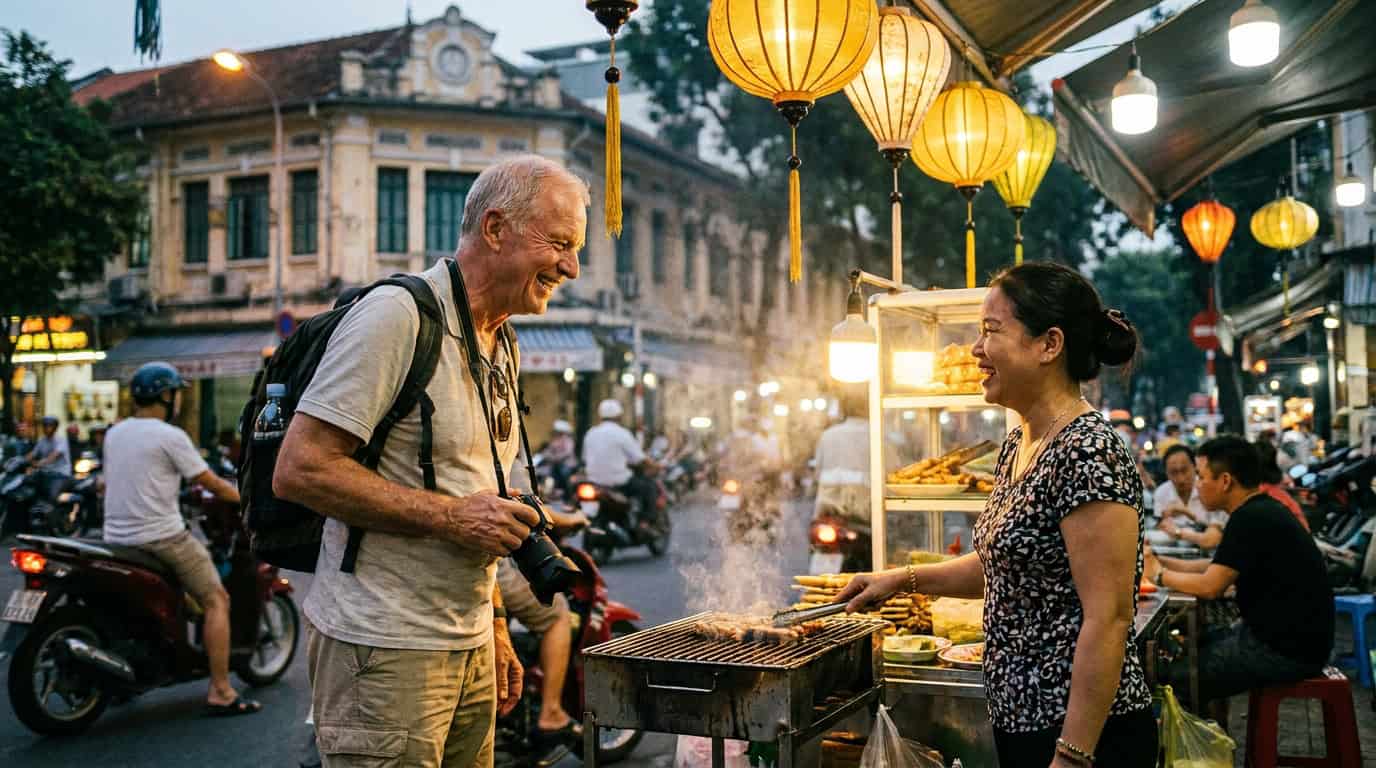
Vietnam welcomed 21.2 million international tourists in 2025, a record 20.4% increase year-on-year (VietnamPlus, 2025). Most of those visitors landed in Saigon and immediately faced the same challenge: how do you say hello in Vietnamese without sounding like you’re reading off a phrasebook? The honest answer is that a handful of well-pronounced words will get you further here than perfect grammar ever will.
This guide covers the essentials: greetings, courtesy phrases, food ordering, bargaining, transport, numbers, and emergencies. Every phrase includes a rough pronunciation guide and notes on the Southern Saigon dialect, so what you practice here is what actually works on the streets of Ho Chi Minh City.
Key Takeaways
– “Xin chào” is safe but formal; “Chào anh/chị” sounds far more natural to locals.
– Vietnamese has 6 tones in the North; Southern Saigon dialect uses effectively 5 (hỏi and ngã merge).
– Vietnam scored 461 on English Speaking in the EF EPI 2025. Outside tourist zones, English is limited (EF, 2025).
– Learning even 10 phrases dramatically improves street food, market, and Grab experiences.
– Vietnamese script (Quốc Ngữ) is Latin-based, so every word is readable once you know the diacritics.
Why Learning a Few Vietnamese Phrases Makes a Real Difference
Vietnam ranked 64th globally with a score of 500 in the EF English Proficiency Index 2025, with a Speaking sub-score of just 461, the weakest skill measured (EF, 2025). Step beyond the tourist-facing restaurants and hotels in District 1 and English becomes genuinely limited. A vendor at Ben Thanh market, a xe om driver on a side street, or a pho stall owner at 6 a.m. may have almost no English at all.
[UNIQUE INSIGHT] The payoff from learning Vietnamese phrases is asymmetrical: even bad pronunciation gets rewarded with smiles and lower prices, because the attempt itself signals respect. Locals in Saigon are used to foreigners not trying at all, so trying, even imperfectly, stands out.
A few practical phrases also protect you from tourist-markup pricing. At markets without fixed prices, dropping “mắc quá” (too expensive) in passable Vietnamese shifts the negotiation entirely. The vendor stops treating you as a tourist who doesn’t know better and starts treating you as someone to bargain with properly.
How Do Vietnamese Tones Work?
Vietnamese is a tonal language with 6 tones in the standard Northern dialect; every syllable carries a tone that changes the word’s meaning entirely. The word “ma,” for example, means ghost, mother, or horse depending solely on the tone applied, with no other change to the letters. This makes Vietnamese pronunciation more consequential than most languages a Western traveller has encountered.

The tones are marked by diacritics written directly above or below vowels in Vietnamese script. Once you know the six marks, you can read every tone in any word.
| Tone Name | Diacritic | Pitch Direction | Example | Meaning |
|---|---|---|---|---|
| Ngang (flat) | no mark | mid, level | ma | ghost |
| Huyền (falling) | ` (grave) | low, falling | mà | but |
| Sắc (rising) | ´ (acute) | high, rising | má | mother / cheek |
| Hỏi (dipping) | ỏ (hook) | mid-low, dips then rises | mả | tomb |
| Ngã (broken rising) | ~ (tilde) | high, creaky-broken | mã | horse |
| Nặng (heavy falling) | . (dot below) | low, abrupt drop | mạ | rice seedling |
Don’t be intimidated. For basic travel communication, getting the broad direction of a tone right (rising vs. falling vs. flat) is enough to be understood most of the time. Perfect tonal accuracy takes months; passable tonal awareness takes a few hours of practice.
Southern Saigon Dialect vs Northern Vietnamese: What Tourists Need to Know
The most practical difference between Southern and Northern Vietnamese is tone count: the Southern/Saigon dialect merges the hỏi and ngã tones into a single sound, leaving effectively 5 functional tones instead of 6 (1stopasia.com). If you are visiting Ho Chi Minh City, you only need to worry about 5 tonal distinctions in practice. The two merged tones are produced the same way by Saigon locals.
There are also consonant differences. The letter “d” is pronounced like a hard “y” sound in the South (as in “yes”), while Northerners pronounce it as a “z.” The Southern “v” can sound closer to a “y” as well in fast speech.
Vocabulary shifts matter too. The word for “yes” is the most important example for Saigon visitors: in the South, the polite agreement word is “dạ.” In the North, it’s “vâng.” Both exist in the same language, but using “vâng” in a Saigon conversation sounds slightly Northern. Since this guide is Saigon-first, every phrase below uses Southern forms.
[ORIGINAL DATA] Vietnamese has approximately 97 million total speakers worldwide, around 86 million native speakers and 11 million second-language speakers (Wikipedia, 2024). It’s a significant language with a large diaspora, which means phrasebook Vietnamese learned in Saigon will also serve you well in Vietnamese communities internationally.
How to Say Hello in Vietnamese and Sound Natural Doing It
“Xin chào” (seen chow) is the textbook translation of hello in Vietnamese, but it sounds formal and tourist-safe rather than natural. Most locals in Saigon greet each other with “Chào + pronoun,” where the pronoun changes based on the age and gender of the person you are speaking to (Migaku, 2024).
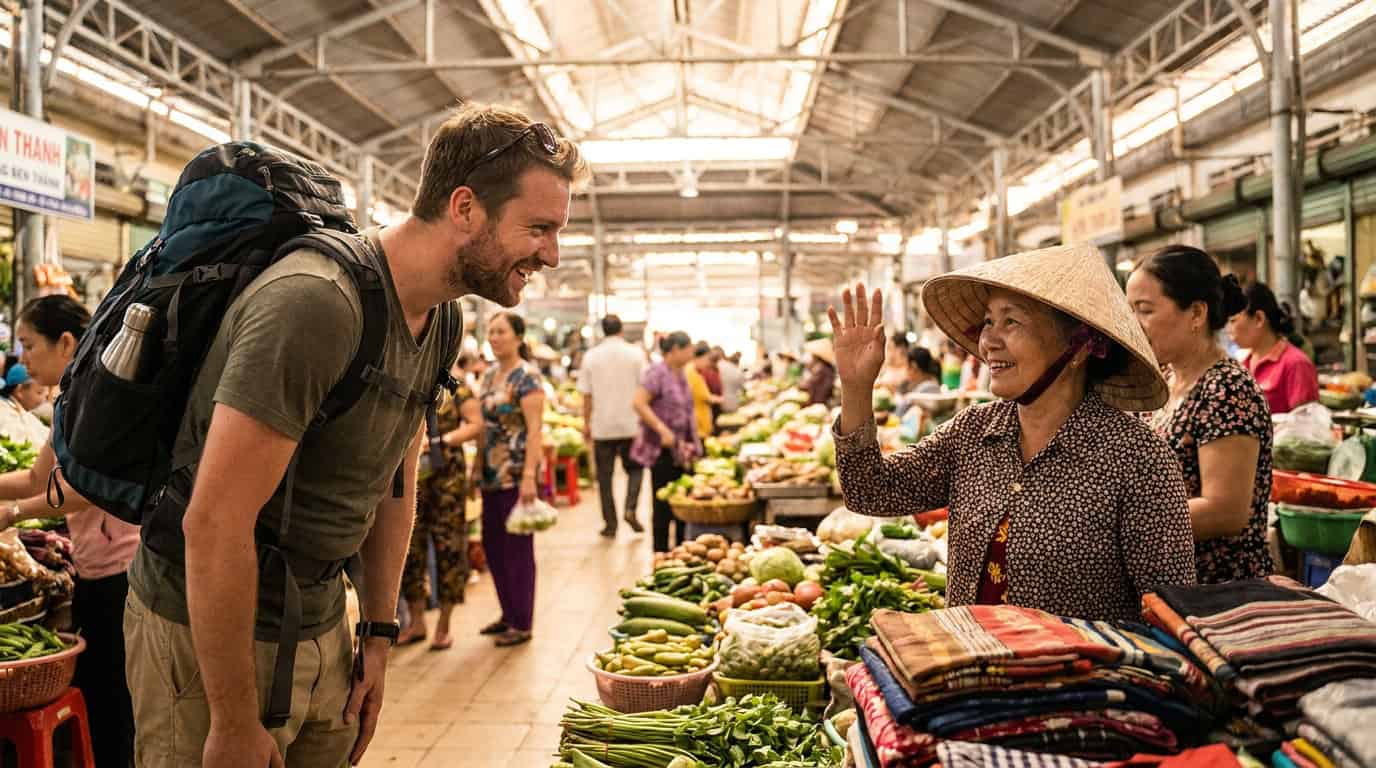
The pronoun system in Vietnamese is more developed than in English. Rather than a single “you,” Vietnamese has several second-person pronouns tied to relative age:
- Anh – an older male (or a male perceived as roughly your age or older)
- Chị – an older female
- Em – someone younger than you (any gender)
- Bạn – a peer, used more casually and in writing
- Ông – an elderly man (grandfather age)
- Bà – an elderly woman (grandmother age)
So for practical Saigon travel:
– “Chào anh” (chow an) – greeting a man who looks roughly your age or older. This covers most male vendors, drivers, and service staff.
– “Chào chị” (chow chee) – greeting a woman who looks roughly your age or older. Most female vendors and restaurant staff.
– “Chào em” (chow em) – greeting someone who looks younger than you.
Getting the pronoun wrong is not offensive. Locals understand that foreigners don’t always know the conventions. But getting it right earns a noticeably warmer reaction, especially from older people.
Essential Courtesy Phrases (Please, Thank You, Sorry)
Three phrases will carry you further in Saigon than any others: “cảm ơn” (thank you), “xin lỗi” (excuse me / sorry), and “làm ơn” (please). These signal basic respect and are recognized everywhere, from luxury hotels to sidewalk stalls.
“Cảm ơn” (gam uhn, with a slight falling tone on the second syllable) is the core thank-you. If you learn one Vietnamese phrase, make it this one. A warm smile and “cảm ơn” after any transaction closes interactions gracefully.
“Xin lỗi” (seen loy) covers both “sorry” and “excuse me.” Use it to get past someone in a crowd, to apologize for a mistake, or to get a server’s attention politely. Don’t overthink which context calls for which word: “xin lỗi” works for all of them.
“Làm ơn” (lam uhn) means please in a request context. It sounds more natural when attached to a verb: “Cho tôi làm ơn” (cho toy lam uhn) means “please give me,” the building block of almost every food and shopping request.
What Are the Best Food and Café Phrases for Saigon?
Ordering food in Saigon is easier than it looks once you know four or five core phrases; most street food interactions follow a script of fewer than ten words per side. Vietnamese café culture is particularly developed. Vietnam is one of the world’s top coffee producers, and knowing how to order properly opens up a whole layer of the local experience.
“Cho tôi một [item] làm ơn” (cho toy moht [item] lam uhn) means “please give me one [item].” Slot in any food or drink name and you have a complete, polite order.
For coffee specifically: “Cà phê sữa đá” (ca feh soo-a da) is iced milk coffee, the definitive Saigon drink. “Cà phê đen đá” (ca feh den da) is iced black coffee. Drop the “đá” (ice) for hot versions.
“Không đường” (khong doo-ung) means no sugar, useful at cafes that add sweetened condensed milk by default. “Ít ngọt” (eet ngot) means less sweet, a gentler ask.
“Tính tiền” (ting tyen) means “the bill, please.” This is the phrase that ends every restaurant interaction. Catching a server’s eye and saying “tính tiền” is cleaner and more direct than trying to mime writing on your hand.
Shopping and Market Bargaining Phrases
Fixed-price shops are now common in Saigon, but wet markets, souvenir stalls, and independent clothing vendors still expect negotiation; knowing a few bargaining phrases flips the dynamic in your favor. The key phrases are “bao nhiêu tiền?” (how much?), “mắc quá” (too expensive), and “bớt đi” (give me a discount).
[PERSONAL EXPERIENCE] In practice at Ben Thanh and the night markets around Bui Vien, dropping “mắc quá” after the first price quoted typically triggers an immediate counteroffer of 20-40% below the opening price. The vendor expects it. The phrase signals you understand the game.
“Giá cuối chưa?” (ya kwoy choo-a) means “is that your final price?” A second-round push after you’ve already gotten one reduction, it’s a polite way of squeezing further without being aggressive.
“Tôi chỉ có [amount] thôi” (toy chee co [amount] thoy) means “I only have [amount],” a classic negotiation close. Say the amount in Vietnamese numbers (covered in the numbers section below) and hold up the cash.
Refusing without offending: “Thôi khỏi” (thoy khoy) means “never mind” or “I’ll skip it.” It’s a soft, friendly way to walk away if a price doesn’t come down to where you want it. Never just walk off silently. A brief “thôi khỏi” with a smile keeps the interaction pleasant.
How Do You Get Around Saigon With Basic Vietnamese?
Grab handles most transport in Saigon via app, so you’ll rarely need spoken directions, but a few key phrases for Grab cash payments, taxis, and situations where the app fails are worth memorizing. The most useful Grab-specific phrase is one that solves a very common problem: getting change.
“Anh làm ơn thối tiền” (an lam uhn thoy tyen) means “please give me change,” essential when you pay cash and the driver wants to keep the difference. It’s a polite but clear request that most Grab drivers and taxi drivers recognize immediately.
“Khỏi thối” (khoy thoy) is the opposite: “keep the change.” Use this when the amount is small and you want to tip or simply avoid the wait.
For situations where you need to communicate a destination verbally: “Tôi muốn đi [place]” (toy moo-un dee [place]) means “I want to go to [place].” Point to a map on your phone as a backup. Combining gesture and words eliminates most confusion.
“Dừng lại đây” (zoom lie day) means “stop here,” useful in taxis or when a driver is about to overshoot your destination.
“Bao lâu?” (bow lao) means “how long?” A quick check on travel time before you get in.
Numbers 0-10: Your Bargaining Toolkit
Vietnamese numbers 0-10 are phonetically simple and follow a consistent pattern; learning them takes about 15 minutes and pays off immediately at markets, in taxis, and when ordering quantities of food. Every price negotiation benefits from being able to state your offer in Vietnamese rather than typing it on a calculator.
| Number | Vietnamese | Rough Pronunciation |
|---|---|---|
| 0 | không | khong |
| 1 | một | moht |
| 2 | hai | hai |
| 3 | ba | ba |
| 4 | bốn | bon |
| 5 | năm | nam |
| 6 | sáu | sow |
| 7 | bảy | bay |
| 8 | tám | tam |
| 9 | chín | chin |
| 10 | mười | moo-ee |
For larger numbers, the pattern is additive: “mười lăm” (15 = ten-five), “hai mươi” (20 = two-ten), “ba mươi” (30 = three-ten). Note that “năm” (5) becomes “lăm” when it follows a tens unit (15, 25, 35, etc.), a small but common quirk worth knowing.
Prices in Vietnam involve large numbers quickly, since a coffee might be 35,000 VND. Connecting your number knowledge to denominations helps. Holding up fingers alongside a spoken number is always fine when accuracy matters.
Emergency Phrases
Emergency phrases are the ones you most want to have memorized before you need them, not looked up after; a small number of clear sentences cover almost every urgent situation a traveller is likely to face in Saigon.
“Giúp tôi với!” (yoop toy voy) – Help me! This is the general distress call. Loud and repeated, it draws attention in any public space.
“Gọi cảnh sát!” (goy kan sat) – Call the police! Say this clearly and point to a bystander if you need someone to act immediately.
“Gọi cứu thương!” (goy kyoo thoo-ung) – Call an ambulance! The Vietnamese emergency number is 115 for ambulance and 113 for police, useful if you have access to a phone.
“Tôi bị mất ví / điện thoại” (toy bee mat vee / dyen tway) – My wallet / phone has been stolen. Report this phrase to hotel staff or police; they will understand without a full conversation.
“Tôi cần bác sĩ” (toy can bak see) – I need a doctor. Use this at a hotel front desk, pharmacy, or with any English-speaking person nearby.
“Tôi bị dị ứng với…” (toy bee zee oong voy) – I am allergic to… Complete with a written card for serious allergies. Verbal pronunciation of allergens is risky; a laminated card in Vietnamese is the safest backup.
Cultural Etiquette Tips That Make a Difference
Vietnamese social norms around greetings, age, and face-saving shape every interaction; a few simple adjustments in behavior signal respect as clearly as any spoken phrase. Understanding the context behind the phrases makes them land better.
Age carries significant social weight in Vietnam. When in doubt about which pronoun to use, slightly overestimating the other person’s age is polite: call an older-looking man “anh” rather than “em,” and call a woman your approximate age “chị” rather than something more casual. Erring toward more respectful forms is never offensive.
Laughing or smiling when you make a mistake is not dismissive. It’s the socially appropriate response. Vietnamese culture values keeping interactions pleasant over performing sincerity through seriousness. When you mispronounce something and get a laugh in return, that’s a good sign, not mockery.
Public confrontation damages “face” (thể diện) for everyone involved. If there’s a pricing disagreement or a service problem, speak quietly and frame your point as a question rather than an accusation. “There might be a mistake?” lands far better than a firm correction.
Wai-style gestures are not standard in Vietnam the way they are in Thailand. A friendly smile and a slight nod is the standard non-verbal greeting. Pressing hands together and bowing is not wrong, but it’s not a Vietnamese custom. It signals you may have learned etiquette from a different country.
Quick Reference: Saigon Phrase Cheat Sheet
Use this table as your pocket reference for the 30 most useful phrases in Saigon. The pronunciation column uses rough English phonetics, not IPA.
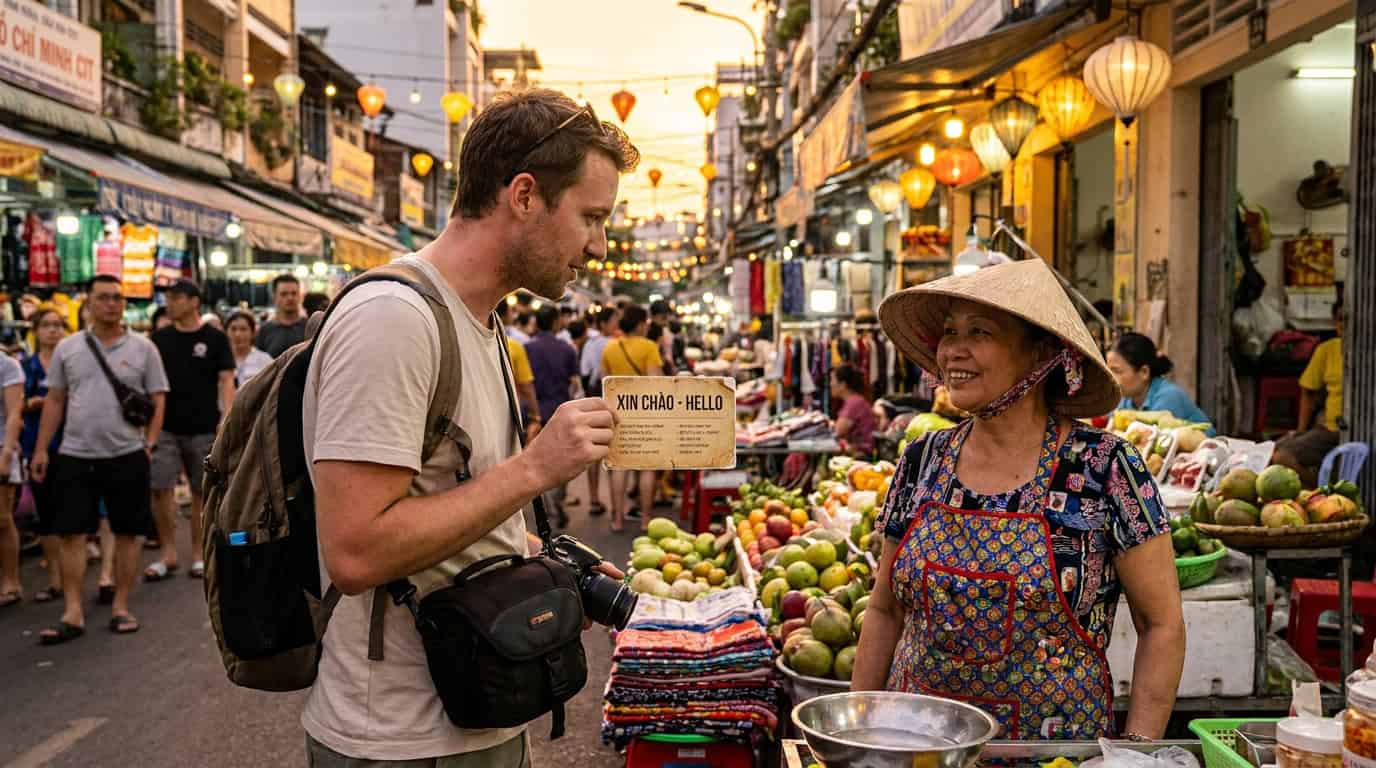
| Scenario | English | Vietnamese | Rough Pronunciation |
|---|---|---|---|
| Greetings | Hello (to older male) | Chào anh | chow an |
| Hello (to older female) | Chào chị | chow chee | |
| Hello (to younger person) | Chào em | chow em | |
| Goodbye | Tạm biệt | tam byeht | |
| Good morning | Chào buổi sáng | chow bwoy sang | |
| Courtesy | Thank you | Cảm ơn | gam uhn |
| Please (request) | Làm ơn | lam uhn | |
| Sorry / Excuse me | Xin lỗi | seen loy | |
| Yes (Saigon/South) | Dạ | ya | |
| No | Không | khong | |
| You’re welcome | Không có gì | khong co zee | |
| Food & Café | Please give me one… | Cho tôi một… làm ơn | cho toy moht… lam uhn |
| Iced milk coffee | Cà phê sữa đá | ca feh soo-a da | |
| Iced black coffee | Cà phê đen đá | ca feh den da | |
| No sugar | Không đường | khong doo-ung | |
| Less sweet | Ít ngọt | eet ngot | |
| The bill, please | Tính tiền | ting tyen | |
| Delicious! | Ngon quá! | ngon kwa | |
| Shopping | How much? | Bao nhiêu tiền? | bow nyew tyen |
| Too expensive | Mắc quá | mak kwa | |
| Give me a discount | Bớt đi | buht dee | |
| Is that your final price? | Giá cuối chưa? | ya kwoy choo-a | |
| Never mind / I’ll skip it | Thôi khỏi | thoy khoy | |
| Transport / Grab | Please give me change | Anh làm ơn thối tiền | an lam uhn thoy tyen |
| Keep the change | Khỏi thối | khoy thoy | |
| Stop here | Dừng lại đây | zoom lie day | |
| How long? | Bao lâu? | bow lao | |
| Emergencies | Help me! | Giúp tôi với! | yoop toy voy |
| Call the police! | Gọi cảnh sát! | goy kan sat | |
| Call an ambulance! | Gọi cứu thương! | goy kyoo thoo-ung |
Frequently Asked Questions
How do you say hello in Vietnamese?
The most natural way to say hello in Vietnamese is “Chào anh” (to an older or same-age man) or “Chào chị” (to an older or same-age woman), pronounced “chow an” and “chow chee.” The formal textbook greeting “Xin chào” is correct and widely understood, but locals in Saigon rarely use it among themselves. Matching your greeting to the age and gender of the person you’re addressing sounds far more natural and is always appreciated.
Is Vietnamese a tonal language?
Yes, Vietnamese is a tonal language. The standard Northern dialect has 6 tones, each marked by a different diacritic written above or below the vowel. The same syllable changes meaning entirely depending on its tone: “ma” can mean ghost, mother, tomb, horse, or rice seedling depending on which tone is applied. The Southern Saigon dialect merges the hỏi and ngã tones, leaving effectively 5 functional tones. Getting the general pitch direction right (rising, falling, or flat) is enough for basic travel communication.
What is the difference between Northern and Southern Vietnamese?
Northern and Southern Vietnamese differ mainly in tones, consonant sounds, and some vocabulary. The Southern Saigon dialect has 5 functional tones (the hỏi and ngã tones merge), while the Northern dialect uses all 6 (1stopasia.com). The letter “d” is pronounced like a hard “y” in the South but like “z” in the North. The word for polite agreement also differs: Southerners say “dạ,” Northerners say “vâng.” Visitors to Ho Chi Minh City should prioritize Southern Vietnamese forms.
Do Vietnamese people speak English in Saigon?
English proficiency in Vietnam is improving but still limited outside major tourist zones. Vietnam scored 500 overall and 461 on the Speaking sub-score in the EF English Proficiency Index 2025, ranking 64th globally (EF, 2025). In tourist districts of Ho Chi Minh City, including District 1, Ben Thanh, and Bui Vien, most hospitality staff speak functional English. At local markets, street food stalls, and in residential neighborhoods, English is far less reliable. A few Vietnamese phrases dramatically improve communication in these settings.
How do you say thank you in Vietnamese?
Thank you in Vietnamese is “cảm ơn,” pronounced roughly “gam uhn” with a slight falling tone on the second syllable. It’s the single most useful phrase for any traveller in Vietnam and is understood everywhere in the country regardless of dialect. A warm smile paired with “cảm ơn” closes any positive transaction gracefully. For a more emphatic thank you, add “nhiều” at the end: “cảm ơn nhiều” (gam uhn nyew) means “thank you very much.”
Sources
- EF Education First. (2025). EF English Proficiency Index – Vietnam. https://www.ef.edu/epi/regions/asia/vietnam/
- VietnamPlus. (2025). International Arrivals to Vietnam Hit New Record in 2025, Up Over 20%. https://en.vietnamplus.vn/international-arrivals-to-vietnam-hit-new-record-in-2025-up-over-20-post335449.vnp
- Migaku. (2024). Vietnamese Greetings: How to Say Hello and More. https://migaku.com/blog/language-fun/vietnamese-greetings
Related Guides
- Getting Around Saigon: Grab, Metro, Bus & Waterbus Guide (2026)
- Vietnamese Culture Guide: Customs, Etiquette & Traditions
- Cost of Living in Saigon: Monthly Budget Breakdown
- Tipping in Vietnam: How Much & When (2026 Guide)
- Vietnam Visa on Arrival vs E-Visa: Which Is Better?
- Rent Motorbike Vietnam: Everything You Need to Know (2026)