
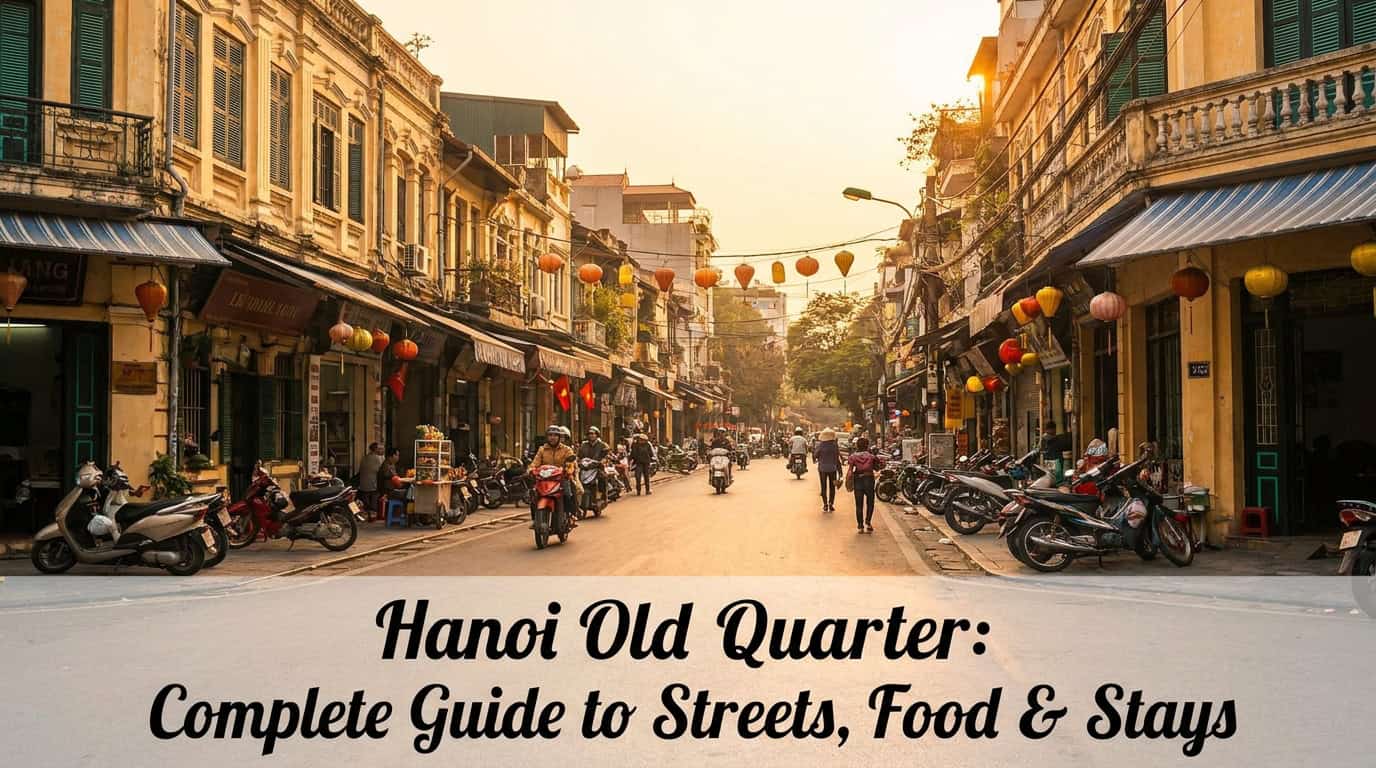
Hanoi Old Quarter is a 100-hectare maze of 36 historic guild streets in the heart of Vietnam’s capital, packed with street food stalls, French-colonial shophouses, and budget homestays priced from 400,000 VND (around $16 USD) per night. If you have only 48 hours in Hanoi, this is where you spend them. This 2026 guide gives you the full street-by-street walking map, the safest cross-streets, the seven dishes you must try, and where to sleep without losing sleep to karaoke noise.
We’ve cross-checked every price, route, and hour against on-the-ground reporting from May 2026, and we’ve added the practical context most listicles skip — scam patterns, monsoon timing, and how to get from the airport in under 800,000 VND ($32 USD).
Key Takeaways
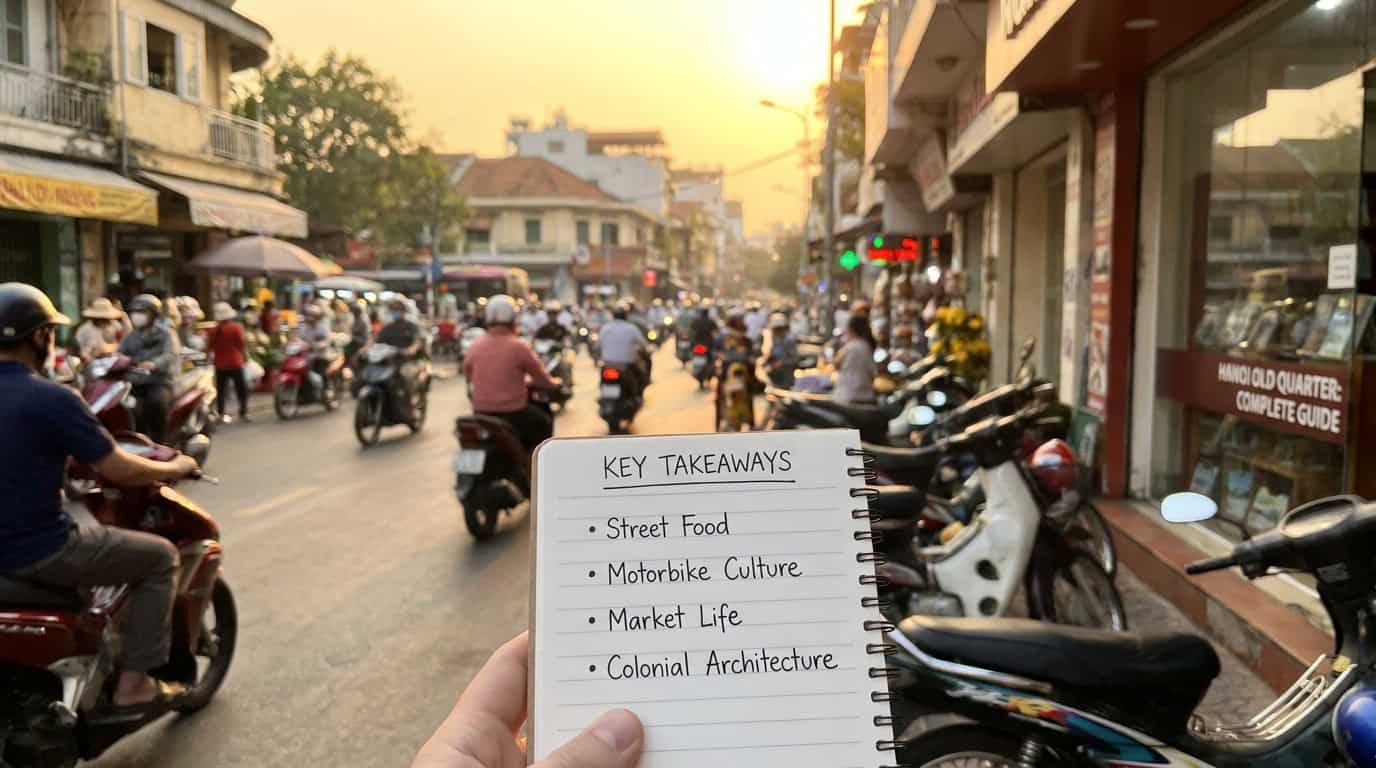
- What it is: A 36-street historic trading district just north of Hoan Kiem Lake, originally laid out in the 13th century under the Ly Dynasty.
- How long to spend: 1.5 to 2 full days for first-time visitors; serious foodies should plan three.
- Daily budget: 600,000–1,500,000 VND ($24–$60 USD) covers a homestay, three meals, coffee, and a walking tour.
- Best time to visit: October to April — cool, dry, and free of the May–August humidity peak.
- Safety status: Very safe for solo travelers; the main risks are traffic, motorbike-snatch theft, and overpriced cyclo rides.
- Where to start: Hoan Kiem Lake’s north shore at the red Huc Bridge, then walk north into Hang Dao Street.
Summary Table: Hanoi Old Quarter at a Glance

| Detail | Information |
|---|---|
| Location | Hoan Kiem District, central Hanoi |
| Area | ~100 hectares (1 km²) |
| Number of streets | 36 traditional guild streets |
| Opening hours | Public streets 24/7; weekend night market 19:00–24:00 Fri–Sun |
| Entry cost | Free (individual sights 30,000–50,000 VND / $1.20–$2 USD) |
| Best time of day | 06:00–09:00 for food, 17:00–22:00 for atmosphere |
| Recommended stay | 2 nights minimum |
| Closest airport | Noi Bai International (NIA), 27 km / 45 min by taxi |
What Is Hanoi Old Quarter Famous For?

Hanoi Old Quarter is famous for being one of Southeast Asia’s last intact medieval trading districts, where each street still carries the name of the craft once sold there. “Hang Bac” means Silver Street, “Hang Gai” means Silk Street, “Hang Ma” means Paper-Offering Street. According to the Vietnam National Authority of Tourism, the district has been a continuous commercial center for more than 1,000 years, since King Ly Thai To moved the capital here in 1010 AD.
Beyond its history, the quarter is famous for three things: street food (Hanoi is the birthplace of pho and bun cha), tube houses (narrow 2–3-meter-wide buildings stretching 30 meters deep, designed to dodge frontage taxes), and bia hoi corners — the cheapest fresh draft beer in the world at roughly 8,000 VND ($0.32 USD) per glass.
Hanoi Old Quarter Map: The 36 Streets Explained

The district is bounded by four landmarks: Hoan Kiem Lake (south), Long Bien Bridge approach (east), Phung Hung Street (west), and Hang Dau Street (north). The grid isn’t really a grid — streets curve and rename mid-block — but the logic is medieval guild-based. Once you understand that “Hang” simply means “merchandise” or “stall,” you can read the map like a 13th-century shopper.
Here are the streets worth memorizing:
- Hang Bac — Silver Street, now jewelry workshops and the open-air theater.
- Hang Gai — Silk Street, the go-to for tailored ao dai (allow 24–48 hours).
- Hang Ma — Paper Street, festooned with red lanterns and Tet decorations year-round.
- Ma May — best-preserved tube-house museum at number 87, entry 10,000 VND ($0.40 USD).
- Ta Hien — the legendary “beer street,” wall-to-wall plastic stools after sunset.
For a fully marked walking map, see our companion piece on Vietnam travel tips for first-timers, which includes downloadable offline maps for Google Maps and Maps.me.
Where to Start Your Hanoi Old Quarter Walk
Start at the Huc Bridge on the north shore of Hoan Kiem Lake — the bright-red arched footbridge leading to Ngoc Son Temple. From here, walk north up Hang Dao Street (the southern entrance to the quarter). Within 400 meters you’ll hit Hang Ngang, Hang Duong, and the bustling Dong Xuan Market, the wholesale heart of the district. This is the canonical south-to-north route used by every reputable walking tour, and it works because it follows a single straight axis you cannot get lost on.
If you arrive early (before 08:00), reverse the route: start at Dong Xuan Market for breakfast and walk south toward the lake, finishing with a morning coffee at Cafe Pho Co overlooking the water.
Best Streets in Hanoi Old Quarter for First-Time Visitors
The best street in Hanoi Old Quarter depends on what you want: food, atmosphere, shopping, or photography. Here’s a ranked shortlist based on our 2026 walkthroughs:
- Ta Hien Street — atmosphere and nightlife. Pull up a plastic stool by 19:00 for bia hoi.
- Hang Buom Street — the best authentic food corridor, with bun cha and banh cuon stalls run by third-generation families.
- Hang Gai Street — silk shopping and tailored clothing; bargain politely, expect 30% off the opening price.
- Ma May Street — heritage architecture and the Ancient House museum.
- Cau Go Street — the lakeside spillover, full of egg-coffee shops with second-floor balcony views.
A solid first day combines Hang Buom for lunch, Ma May for the museum, and Ta Hien for sunset drinks.
Hanoi Old Quarter Street Food: 7 Dishes You Cannot Skip
The single best reason to base yourself inside the quarter is breakfast. By 06:30 the pho pots are simmering, and by 09:00 the locals’ favorite stalls are sold out. Budget around 50,000 VND ($2 USD) per dish.
| Dish | Where to Eat | Price (VND) |
|---|---|---|
| Pho bo (beef noodle soup) | Pho Gia Truyen, 49 Bat Dan | 60,000 ($2.40) |
| Bun cha (grilled pork & noodles) | Bun Cha Huong Lien, 24 Le Van Huu | 85,000 ($3.40) |
| Banh mi (Vietnamese baguette) | Banh Mi 25, 25 Hang Ca | 35,000 ($1.40) |
| Cha ca (turmeric fish) | Cha Ca Thang Long, 21 Duong Thanh | 200,000 ($8) |
| Egg coffee (ca phe trung) | Giang Cafe, 39 Nguyen Huu Huan | 35,000 ($1.40) |
| Banh cuon (steamed rice rolls) | Banh Cuon Ba Hoanh, 66 To Hien Thanh | 45,000 ($1.80) |
| Bia hoi (fresh draft beer) | Bia Hoi Corner (Ta Hien × Luong Ngoc Quyen) | 8,000 ($0.32) |
For a deeper food crawl, pair this list with our cross-country guide to Vietnamese street food essentials — it explains the regional differences between Hanoi pho and the sweeter, herb-loaded southern version.
Is It Safe to Walk Around Hanoi Old Quarter?
Yes — Hanoi Old Quarter is one of the safest urban tourist districts in Southeast Asia. Violent crime against tourists is rare, and Vietnamese police maintain a visible presence around Hoan Kiem Lake 24 hours a day. According to the UK Foreign Travel Advice for Vietnam, petty theft is the main concern, particularly drive-by phone and bag snatching by passengers on motorbikes.
Three practical rules will eliminate 95% of risk:
- Wear your bag cross-body on the inside of the sidewalk, away from the road.
- Never use your phone while walking near the curb — keep it tucked while crossing.
- Settle taxi prices before getting in, or use Grab to lock in the fare digitally.
Traffic is the real hazard. There are no functional traffic lights inside the quarter; pedestrians cross by walking slowly and predictably while motorbikes flow around them. Don’t stop, don’t run, don’t reverse.
When to Visit the Hanoi Old Quarter in 2026
Hanoi has four genuine seasons, which sets it apart from Ho Chi Minh City’s two. Here’s how 2026 looks based on the 10-year climate averages published by Vietnam’s General Statistics Office:
- October–November: 18–25°C, dry, low humidity — peak season, book 4 weeks ahead.
- December–February: 10–18°C, occasional drizzle, perfect pho weather.
- March–April: mild and increasingly humid, shoulder season pricing.
- May–August: 28–36°C with monsoon downpours; the cheapest stays but the hardest walking.
- September: typhoon-tail risk; cheapest week of the year is mid-September.
If you’re combining cities, our breakdown of Saigon versus Hanoi for travelers covers exactly when each city peaks and how to time a two-city trip.
Getting to and Around Hanoi Old Quarter
From Noi Bai International Airport, the cheapest reliable option is Bus 86, which runs to Hanoi Railway Station via the Old Quarter for 45,000 VND ($1.80 USD). A Grab car costs 350,000–450,000 VND ($14–$18 USD); a metered Mai Linh or Vinasun taxi runs 380,000–500,000 VND ($15–$20 USD). Avoid airport “tour” hustlers offering 25 USD flat rates.
Once inside the quarter, walk. The streets are too narrow and chaotic for rental cars, and motorbike rental is not advisable unless you’ve ridden in Vietnamese traffic before. Cyclos (pedicabs) are charming but routinely overcharge; agree on a 200,000 VND ($8 USD) flat rate for a 30-minute loop, not per-hour pricing.
Where to Stay: Best Hanoi Old Quarter Neighborhoods
The quarter has three sleeping zones with very different vibes:
- Hang Bac / Ma May area — central, walkable to everything, mid-range homestays at 600,000–1,200,000 VND ($24–$48 USD).
- Hang Be / Cau Go — closest to the lake, best for first-time visitors who want quick orientation.
- Hang Bac extended (toward Long Bien) — quieter at night, slightly cheaper, 15-minute walk to Ta Hien.
Avoid sleeping directly on Ta Hien Street unless you plan to drink until 02:00 — the noise carries up six floors. For travelers continuing south, see our District 1 Saigon stays guide for the equivalent central-neighborhood breakdown in Ho Chi Minh City, and our master Saigon itinerary hub for combining both cities into a smooth two-week trip.
Hanoi Old Quarter Etiquette and Cultural Notes
Three small habits will earn you instant respect from local shopkeepers:
- Take your shoes off when entering temples, traditional tube houses, and many family-run restaurants with low wooden floors.
- Use both hands when passing money or business cards to anyone older than you.
- Don’t photograph monks, soldiers, or police without asking first — it’s culturally rude and occasionally illegal.
UNESCO has recognized Hanoi’s broader Thang Long Imperial Citadel — a 10-minute walk west of the Old Quarter — as a World Heritage Site since 2010, and it pairs perfectly with a quarter-walking day.
Frequently Asked Questions
What is Hanoi Old Quarter famous for?
Hanoi Old Quarter is famous for its 36 historic guild streets, each named after the craft once traded there (silver, silk, paper, tin). It’s also internationally known for being the birthplace of pho and bun cha, and for its dense network of French-colonial tube houses, bia hoi beer corners, and 1,000-year-old temples surrounding Hoan Kiem Lake at its southern edge.
Is it safe to walk around Old Quarter Hanoi?
Yes, Hanoi Old Quarter is very safe for solo travelers and families, day or night. Violent crime is rare and police patrols are constant around Hoan Kiem Lake. The main risks are traffic (cross the road slowly and predictably) and petty theft (wear bags cross-body away from the road). Avoid using your phone near the curb to deter motorbike-snatch theft.
What is the best street in Hanoi Old Quarter?
The best street depends on your interest. For nightlife and atmosphere, choose Ta Hien Street with its plastic-stool bia hoi corners. For authentic food, walk Hang Buom Street. For silk shopping and tailoring, head to Hang Gai. For heritage architecture, visit Ma May Street and its 1890s Ancient House museum at number 87.
Where to start Old Quarter Hanoi?
Start at the red Huc Bridge on the north shore of Hoan Kiem Lake, then walk straight north up Hang Dao Street. This canonical south-to-north route leads you through the central spine of the quarter in 1 kilometer, ending at Dong Xuan Market. Arrive by 08:00 to beat heat and crowds, or begin at 17:00 for the lantern-lit evening walk.
How many days do you need in Hanoi Old Quarter?
Two full days is the sweet spot. Day one covers the walking spine (Huc Bridge to Dong Xuan Market) plus an evening on Ta Hien. Day two covers the food crawl, the Ancient House museum, and a half-day Thang Long Citadel side trip. Add a third day if you want to slow down for coffee culture and tailored clothing fittings.
How much does a day in Hanoi Old Quarter cost?
A budget-conscious traveler can do Hanoi Old Quarter on 600,000 VND ($24 USD) per day including homestay, three meals, coffee, and a walking tour. Mid-range comfort runs 1,200,000–1,800,000 VND ($48–$72 USD). The single biggest cost is the homestay; food and transport are remarkably cheap by Southeast Asian standards.
Plan Your Vietnam Trip from a Central Homestay
Doc them: Hanoi Shopping Guide: Markets, Malls & What to Buy
📌 Đọc thêm: Hanoi Shopping Guide: Markets, Malls & What to Buy
Hanoi Old Quarter is the easy half of any Vietnam itinerary — flat, walkable, and packed with English-friendly stalls. The harder half is choosing the right base for the south. If you’re combining Hanoi with Ho Chi Minh City, book a central District 1 homestay with Saigon Homestay to keep your southern leg just as walkable as your northern one. Our hand-picked properties sit within 10 minutes of Ben Thanh Market, the Saigon River, and the night street food alleys — and our 24/7 concierge handles airport pickup, motorbike day trips, and tailored Mekong itineraries.
Browse availability for July–November 2026 and lock in early-bird pricing on our Saigon itinerary planning hub — and start your Vietnam trip with two cities, one trusted host.
Not sure what those dong figures are worth? The Vietnam currency and money exchange guide converts them and lists the ATMs with the lowest fees.