
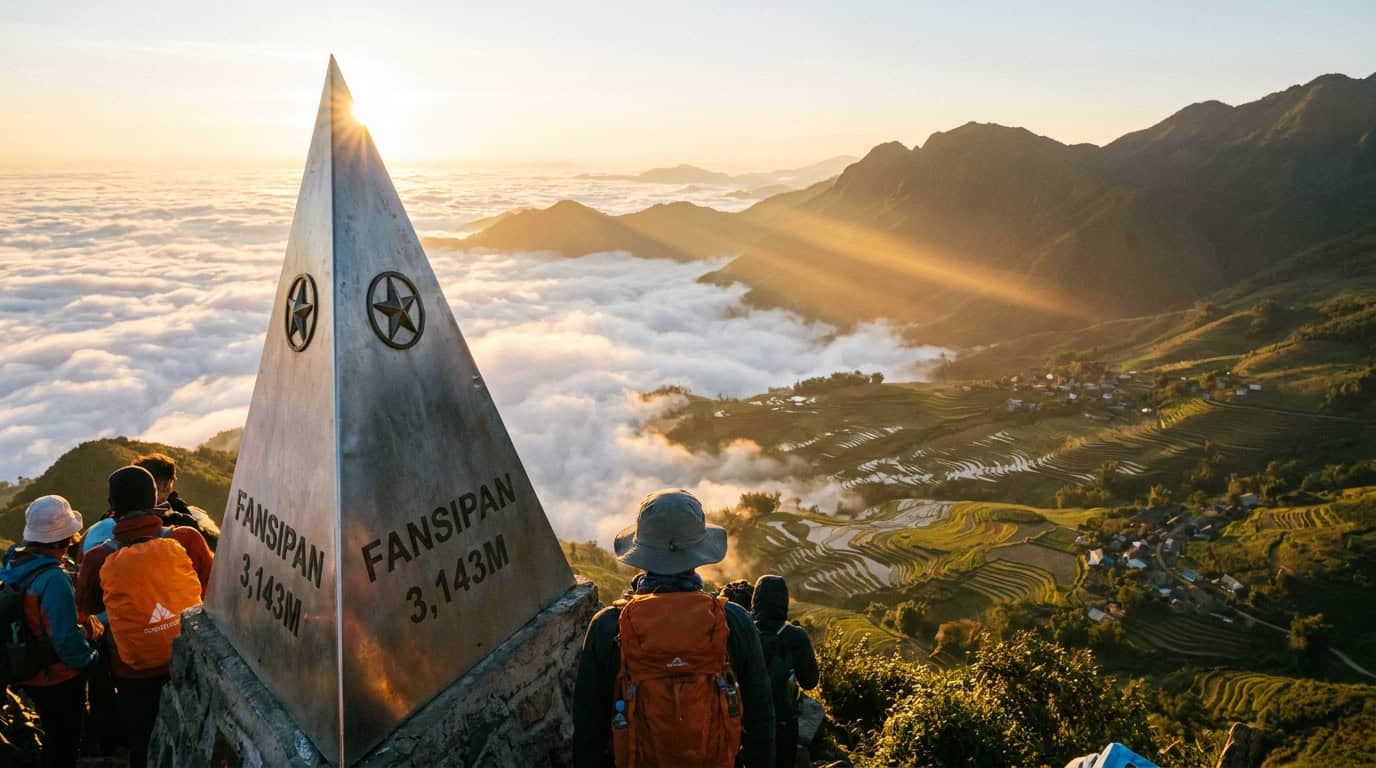
Fansipan mountain is the 3,147-meter summit in Sapa, Lao Cai Province, that holds the title of the highest peak in Vietnam and the entire Indochinese Peninsula — reachable in 15 minutes by the world-record Sun World cable car or in 2–3 days on foot through bamboo forest and alpine meadow. This guide compares both routes, lists 2026 prices in VND and USD, answers the four questions foreign visitors ask most, and shows you how to pair the trip with a base in Ho Chi Minh City.
Key Takeaways
- Height: 3,147.3 m (10,326 ft) — officially the “Roof of Indochina.”
- Easy option: Sun World cable car, 15 minutes, VND 800,000 (~USD 32) round-trip adult.
- Hard option: 2–3 day guided trek via Tram Ton trail; difficulty rated moderate-to-hard.
- Best months: October–April for clear skies; avoid June–August (heaviest rain).
- Getting there: Overnight train or sleeper bus Hanoi → Lao Cai → Sapa town (≈ 6 hrs total).
- From HCMC: Fly Saigon → Hanoi (2 hrs), then continue overland — plan 4–5 days minimum.
Fansipan Mountain at a Glance
| Detail | Information |
|---|---|
| Elevation | 3,147.3 m (10,326 ft) |
| Location | Hoang Lien Son range, Sapa, Lao Cai |
| Cable car operator | Sun World Fansipan Legend |
| Cable car price (2026) | VND 800,000 adult / VND 550,000 child round-trip |
| Cable car ride time | ~15 minutes |
| Hiking duration | 2 days (express) or 3 days (standard) |
| Guided trek cost | VND 4,500,000–7,000,000 (USD 180–280) |
| Best season | October to April |
| Park entry (Hoang Lien NP) | VND 80,000 (~USD 3.20) |
| Nearest town | Sapa (9 km from cable car station) |
Why Fansipan Mountain Tops Every Northern Vietnam Bucket List
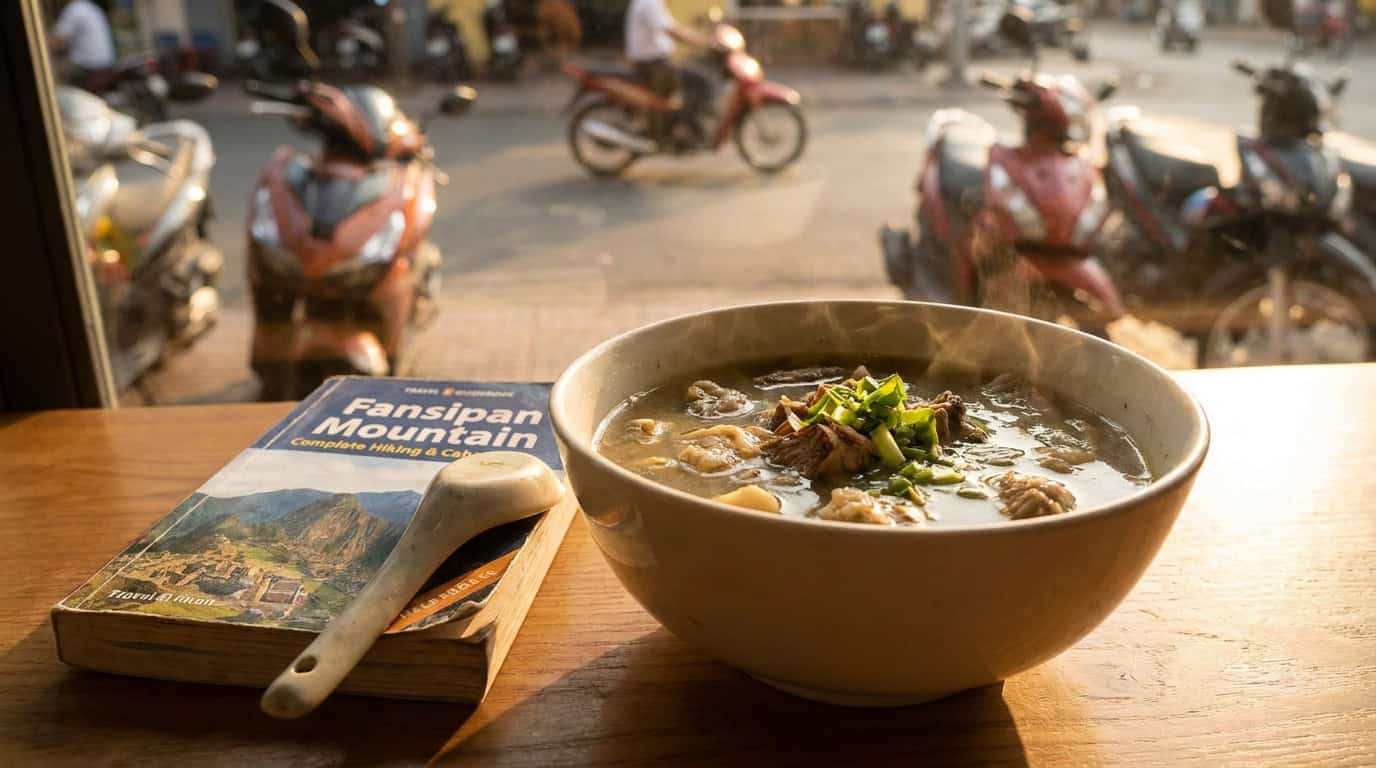
Fansipan mountain isn’t just tall — it’s a complete sensory shift from the tropical lowlands most travelers know. The summit sits inside Hoang Lien National Park, a UNESCO-recognized biodiversity hotspot holding more than 2,000 plant species, 66 mammal species, and the elusive black gibbon. According to Vietnam’s official tourism portal, more than 2.5 million visitors rode the cable car in 2024, making it Vietnam’s single most-trafficked alpine attraction.
What makes the peak unforgettable isn’t the steel pyramid marker at the top — it’s the cloud inversion. On clear winter mornings the summit floats above a white ocean of cloud, with the Hoang Lien ridgeline poking through like islands. Photographers call this the “biển mây” (sea of clouds), and it’s most reliable from late October through early March.
For visitors based further south, treat Fansipan as the climax of a longer Vietnam itinerary. Build your trip from a comfortable base in Saigon — see our Saigon itinerary for the southern half — then fly north.
Is Fansipan the Highest Mountain in Vietnam?
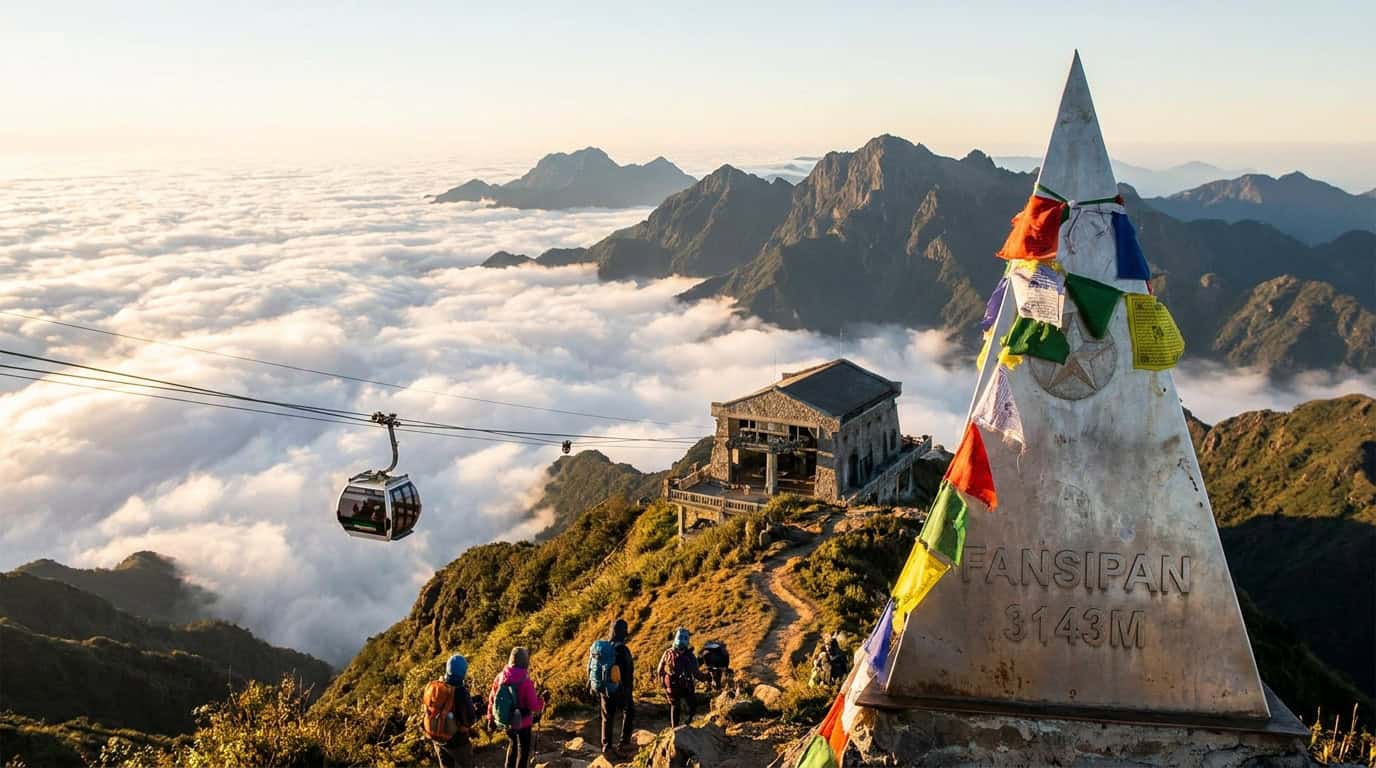
Yes. Fansipan mountain is officially the highest peak in Vietnam at 3,147.3 meters, confirmed by Vietnam’s Department of Surveying and Mapping in a 2019 re-measurement that added 4 meters to the previous figure. It’s also the tallest mountain on the Indochinese Peninsula, beating Laos’ Phou Bia (2,820 m) and Cambodia’s Phnom Aural (1,810 m). The runner-up inside Vietnam is Pu Ta Leng, also in Lai Chau Province, at 3,049 m — a serious peak that hikers tackle once Fansipan no longer feels like a challenge.
Is Fansipan Mountain Worth It?
For most travelers, yes — but the value depends entirely on which route you take and what month you arrive. The cable car delivers a near-guaranteed summit photo regardless of fitness, while the trek delivers solitude and altitude earned the hard way.
Choose the cable car if you:
- Have less than 4 days in northern Vietnam.
- Are traveling with children, elderly relatives, or anyone with knee issues.
- Visit between May and September when trails turn into slippery mud chutes.
- Want the cultural complex at the top (Bich Van Pagoda, Great Bell Tower, 21-m bronze Amitabha Buddha statue).
Choose to hike if you:
- Have prior multi-day trekking experience and can manage 8 hours/day of climbing.
- Visit between October and April.
- Want to camp at 2,200 m and 2,800 m and see the forest belts shift from bamboo to rhododendron to stunted alpine scrub.
- Want a story, not a selfie.
A common 2026 compromise: hike up over 2 days, ride the cable car down to save your knees. Most reputable Sapa operators now offer this hybrid for around VND 5,500,000 (USD 220) per person in a group of four.
Is Mount Fansipan Hard to Climb?
Fansipan mountain is rated moderate-to-hard, not technical. There is no rope work, no glacier crossing, and no exposure to drops where a slip means death. What makes it hard is sustained vertical: you gain roughly 1,200 vertical meters on summit day, often in cold rain, on a trail of wet roots, granite slabs, and bamboo ladders. Trekkers in average fitness — those who can comfortably walk 15 km on flat ground — finish the standard 3-day route. Anyone who cannot manage stairs for 30 continuous minutes should ride the cable car.
The main hazards are slip-and-fall on wet rock, hypothermia (summit temperatures drop to 0–5°C even in March), and altitude headaches above 2,800 m. Hire a licensed H’mong porter-guide through your Sapa homestay — solo hiking inside Hoang Lien National Park has been prohibited since 2017 for safety reasons.
How Long Does It Take to Hike Fansipan Mountain?
The hike to Fansipan mountain takes 2 to 3 days, depending on the route and your pace. The classic itinerary starts at Tram Ton Pass (1,940 m), climbs to Camp 2 at 2,200 m on day one, pushes to Camp 3 at 2,800 m and tags the summit on day two, then descends on day three. Express 2-day groups skip Camp 3 and summit on the morning of day two from Camp 2 — brutal but doable. The fastest recorded ascent by a local porter is under 6 hours one-way, but tourists should budget 16–22 hours of moving time spread across the trip.
Day-by-day breakdown (standard 3-day itinerary)
- Day 1: Tram Ton (1,940 m) → Camp 2 (2,200 m). Distance ≈ 6 km, time 4–5 hrs. Forest of bamboo and tree ferns; one steep section before camp.
- Day 2: Camp 2 → Camp 3 (2,800 m) → Summit (3,147 m) → return to Camp 3. Distance ≈ 7 km, time 7–9 hrs. Sleep at altitude.
- Day 3: Camp 3 → Tram Ton or Sin Chai exit. Distance ≈ 9 km, time 4–6 hrs, descending knees-on.
The Sun World Cable Car: The Easy Way Up
The Fansipan Legend cable car, operated by Sun World, holds two Guinness World Records: longest non-stop three-rope cable car (6,292.5 m) and greatest elevation difference between departure and arrival stations (1,410 m). It opened in February 2016 and carries up to 2,000 passengers per hour in glass-floor gondolas.
2026 cable car pricing
| Ticket | VND | USD (approx) |
|---|---|---|
| Adult round-trip | 800,000 | 32 |
| Child (1.0–1.4 m) | 550,000 | 22 |
| Child under 1.0 m | Free | Free |
| Senior (60+) | 600,000 | 24 |
| Mountain funicular (extra) | 150,000 | 6 |
From the upper cable car station you still need to climb 600 stone steps to reach the actual summit, OR ride a second funicular for an extra fee. Allow 3–4 hours total for the round trip including temple visits.
Buying tickets and avoiding queues
Buy tickets online via the Sun World app the night before — physical ticket counters at the Muong Hoa station routinely have 45-minute queues on weekends and during Lunar New Year. The first cable car runs at 07:30 and the last descent is at 17:30. Aim for the 07:30 departure: cloud cover thickens after 10:00 nearly year-round.
Best Time to Visit Fansipan Mountain
| Season | Months | What to Expect |
|---|---|---|
| Dry & cold (best) | Nov–Feb | Clear summit views, possible snow/frost at top, 0–10°C summit, 8–15°C in Sapa |
| Spring bloom | Mar–Apr | Rhododendron flowers, occasional rain, 10–18°C |
| Rainy & green | May–Aug | Terraced rice in water (May) then growing (Jun–Aug), heavy rain, leeches on trail |
| Golden rice (popular) | Sep–early Oct | Harvest season — booked solid; clear mornings then afternoon rain |
If your only goal is the summit photo, target the second half of January. If you want both Fansipan and the famous golden rice terraces, late September is unbeatable — but book accommodation 6 weeks ahead.
Getting to Fansipan Mountain from Ho Chi Minh City
There is no direct route. The journey runs Saigon → Hanoi → Lao Cai → Sapa → Fansipan, and trying to do it in fewer than 4 days will exhaust you. Here’s the realistic chain:
- Fly Saigon to Hanoi. Vietnam Airlines, VietJet, and Bamboo Airways run 30+ daily flights; 2 hrs in the air, VND 1,200,000–2,800,000 (USD 48–112).
- Hanoi to Sapa. Choose the overnight sleeper train to Lao Cai (8 hrs, VND 600,000–1,400,000) plus a 1-hour minivan to Sapa, OR a direct sleeper bus (6 hrs, VND 400,000). Train is more comfortable; bus is faster.
- Sapa town to the cable car. The Muong Hoa station is in the town center — walk or take a 5-minute taxi (VND 30,000).
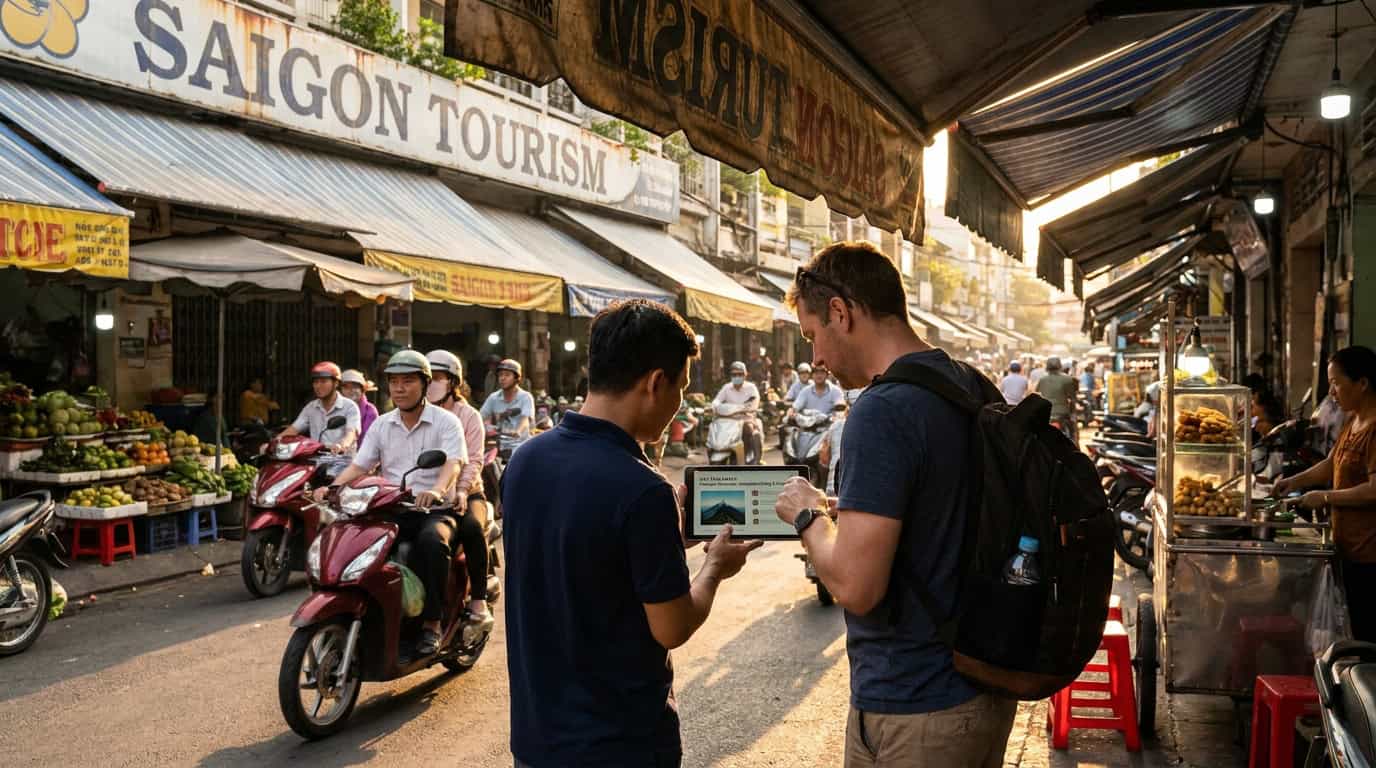
Many Saigon-based expats and tourists use District 1 as their staging point because of direct international flights and proximity to Tan Son Nhat. Browse our hub of things to do in Ho Chi Minh City for ideas before you fly north, and check the Ben Thanh Market guide if you want to stock up on snacks and a fleece for the cold.
What to Pack for Fansipan Mountain
Even cable-car visitors underestimate how cold the summit gets. The temperature differential between Sapa town and the peak is routinely 8–12°C.
For cable car day-trippers:
– Down or fleece jacket (rentable in Sapa for VND 50,000/day)
– Waterproof shell
– Closed-toe shoes with grip — the stone steps are slippery
– Cash for the funicular (cards accepted but the queue is shorter at cash counters)
For hikers, add:
– 30–40L backpack
– Sleeping bag rated to 0°C (most operators include this)
– Headlamp with spare batteries
– Trekking poles — non-negotiable on the descent
– 2L water capacity (water is filtered at camps)
– Snacks high in fat: nuts, chocolate, peanut butter
– Trash bag — pack out everything
Cultural Complex at the Summit
At the upper station, the developer built a Buddhist complex that is genuinely impressive even to non-religious visitors. The 21.5-meter bronze Amitabha Buddha is one of the largest in Vietnam. Bich Van Pagoda, the Great Bell Tower (the bell weighs 1.6 tons), and the Eleven-Storey Pagoda are all worth 30 minutes each. The architecture deliberately mimics ancient Vietnamese temple design — these are new buildings, but built with traditional techniques and reclaimed timber.
Dress modestly inside the pagodas: covered shoulders, knees, and no shoes inside the inner halls.
Where to Stay Before and After
In Sapa town, mid-range guesthouses run VND 400,000–900,000 (USD 16–36) per night. For the southern half of the trip, our District 1 base is walking distance to Ben Thanh, the Opera House, and the night flight terminal — see the best Saigon homestay options and our District 1 neighborhood guide for context.
Frequently Asked Questions
Is Mount Fansipan hard to climb?
Fansipan is moderate-to-hard — physically demanding but not technical. Expect 7–9 hours of climbing on summit day with 1,200 m of vertical gain on wet roots and granite. Anyone who trains by walking 15 km/day for two weeks before the trip will finish. Solo hiking has been illegal since 2017; you must go with a licensed guide.
Is Fansipan the highest mountain in Vietnam?
Yes — Fansipan mountain is the highest peak in Vietnam at 3,147.3 meters, re-measured by Vietnam’s Department of Surveying in 2019. It is also the tallest mountain on the Indochinese Peninsula, which includes Vietnam, Laos, and Cambodia. The second-highest peak in Vietnam, Pu Ta Leng (3,049 m), sits just 30 km north in Lai Chau Province.
Is Fansipan mountain worth it?
For most travelers, yes. The cable car delivers a near-guaranteed summit photo in 15 minutes for VND 800,000 (USD 32), even in poor weather, plus access to an impressive Buddhist complex. The multi-day hike is worth it only for experienced trekkers visiting October–April. Skip Fansipan entirely if your trip falls in June–August during peak rains.
How long does it take to hike Fansipan mountain?
The standard hike takes 2 to 3 days. Express groups summit and descend in 2 days from Tram Ton trailhead, while comfortable 3-day itineraries split the climb across two camps at 2,200 m and 2,800 m. Total moving time is roughly 16–22 hours. The cable car alternative covers the same elevation in 15 minutes.
Can I see snow on Fansipan?
Occasionally. The summit dropped below freezing on 14 days in 2024 according to Sapa’s regional weather station, with light snow recorded on three of those days. Snow is most likely between mid-December and early February. Frost is far more common than snow.
Do I need a permit?
Yes — Hoang Lien National Park charges a VND 80,000 (~USD 3.20) entry fee and requires a guide for the trekking routes. Your tour operator includes both in the package price. Cable car visitors don’t need a separate permit.
Final Tip: Build Fansipan Into a Two-City Trip
The smartest way for foreign visitors to do Fansipan mountain in 2026 is to anchor the trip on both ends in cities — start in Saigon for warm-weather acclimation, food, and the international airport, then fly north for the cool-weather peak and Sapa’s trekking culture. A 7-day version: 3 nights in District 1, fly to Hanoi, 2 nights Sapa with cable car day-trip, return to Saigon for a final night.
Book your Saigon base first. Our central District 1 homestay puts you 5 minutes from Ben Thanh Market, 10 minutes from the Bui Vien backpacker district, and 25 minutes from Tan Son Nhat Airport — the ideal launch pad for your flight north to Fansipan. Check availability and book a District 1 homestay →
Not sure what those dong figures are worth? The Vietnam currency and money exchange guide converts them and lists the ATMs with the lowest fees.