
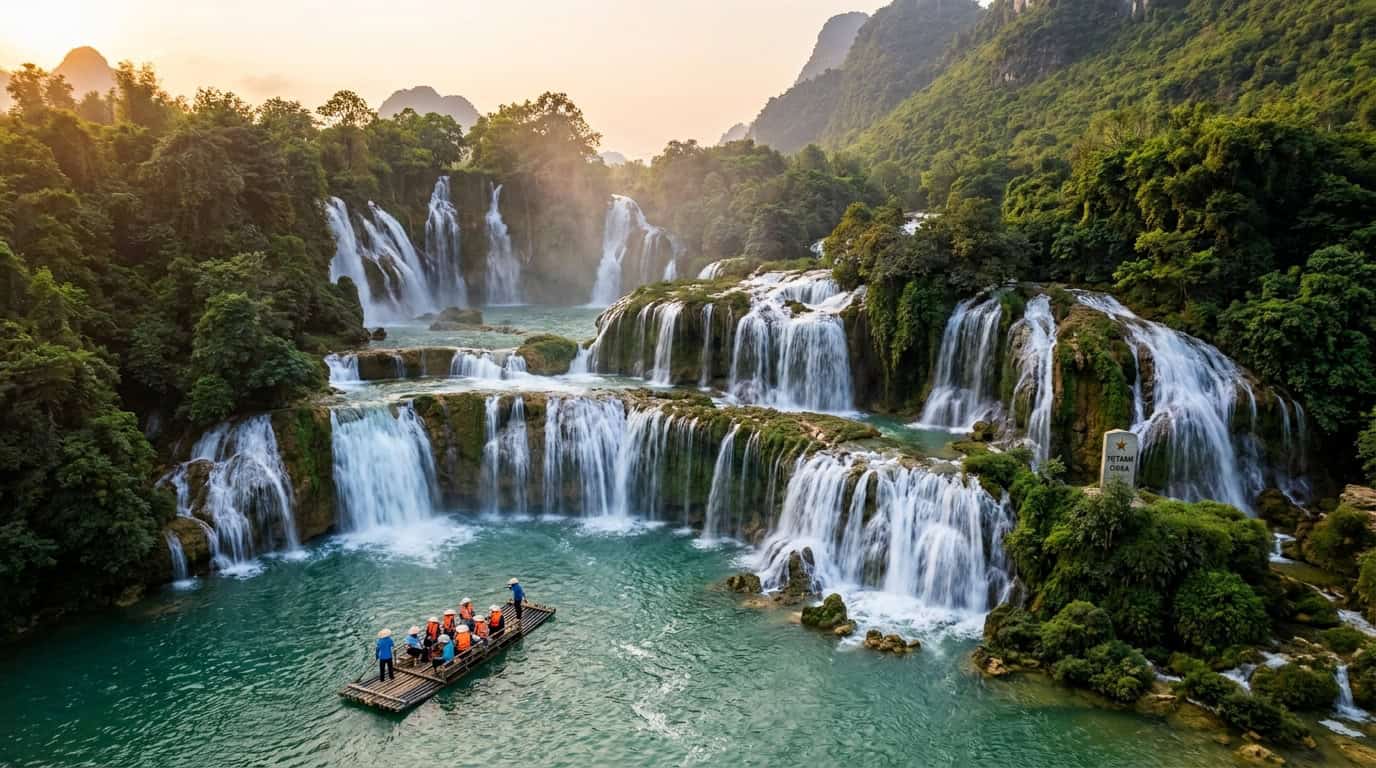
Ban Gioc Waterfall is the largest transnational waterfall in Asia and the fourth-largest border waterfall in the world, plunging 30 metres across a 300-metre-wide limestone shelf that straddles Vietnam’s Cao Bang province and China’s Guangxi region. Located roughly 350 kilometres north of Hanoi, it is the crown jewel of the UNESCO-recognised Non Nuoc Cao Bang Global Geopark and one of the most photogenic natural sights in Southeast Asia. This 2026 guide tells foreign visitors exactly when to go, how to get there, what to pay, and how to chain Ban Gioc with the Ma Phuc Pass, Nguom Ngao Cave and the loop back to Saigon.
Key Takeaways
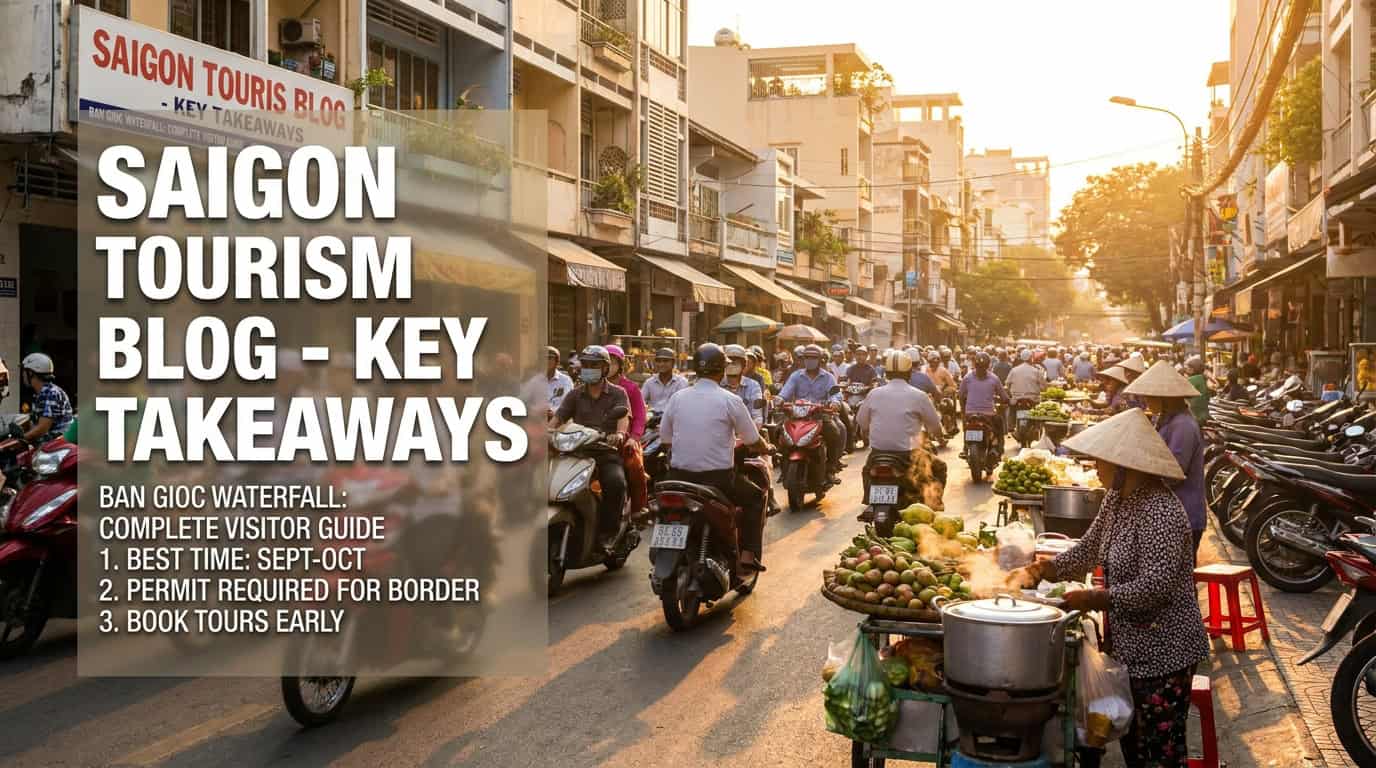
- Location: Dam Thuy commune, Trung Khanh district, Cao Bang province — 89 km from Cao Bang city, 350 km from Hanoi.
- Entrance fee (2026): 70,000 VND (~$2.80 USD) for adults; bamboo raft 50,000 VND (~$2.00 USD) per person.
- Best months: Late September to early October for peak flow with golden rice terraces; May–June for lush greenery.
- Opening hours: 07:30 – 17:00 daily, including weekends and public holidays.
- Minimum trip length: 3 days / 2 nights from Hanoi; 5 days from Ho Chi Minh City (Saigon).
- Border status: Vietnamese side is fully open to foreigners with no special permit; passport required at the checkpoint.
Quick Facts Summary Table
| Detail | Information |
|---|---|
| Vietnamese name | Thác Bản Giốc |
| Height | 30 m (3 tiers) |
| Width | ~300 m |
| Province | Cao Bang (Cao Bằng) |
| Nearest city | Cao Bang City (89 km) |
| Distance from Hanoi | 350 km (~8 hr drive) |
| Adult ticket | 70,000 VND ($2.80 USD) |
| Bamboo raft ride | 50,000 VND ($2.00 USD) |
| Opening hours | 07:30 – 17:00 |
| Best months | Sep–Oct (flow + rice) |
Why Ban Gioc Waterfall Should Be on Your Vietnam Bucket List
Vietnam is famous for Ha Long Bay and the Mekong Delta, but Ban Gioc Waterfall is the country’s most underrated mega-sight. While 7 million tourists crowd Ha Long Bay each year, fewer than 700,000 visitors make the trip to Cao Bang — meaning you can stand within spray distance of a thundering 30-metre cataract without fighting through a single tour bus crowd.
The waterfall sits inside the Non Nuoc Cao Bang UNESCO Global Geopark, designated in 2018 and re-validated in 2022. Limestone karst towers, tea-coloured rivers and Tay and Nung minority villages surround the falls, making the surrounding 3,275 km² as compelling as the waterfall itself. National Geographic ranked Cao Bang among its “Best of the World” destinations in their 2023 cool list, and visitor numbers have risen 38% year-on-year since the Hanoi–Cao Bang expressway opened in late 2024.
You can read more on the official UNESCO Global Geoparks listing for Non Nuoc Cao Bang and the Vietnam National Administration of Tourism’s overview of Cao Bang province.
How to Get to Ban Gioc Waterfall from Hanoi
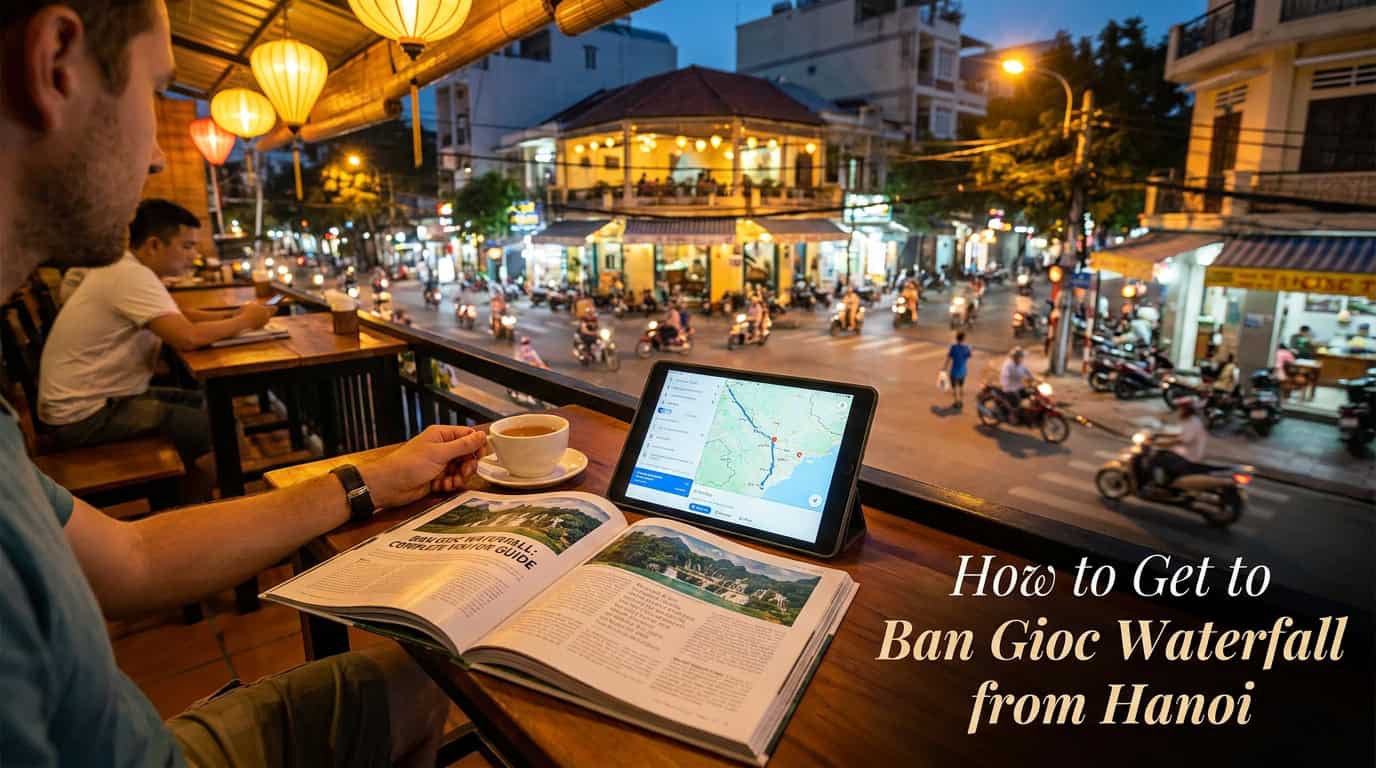
The bad news: there is no train and no airport in Cao Bang. The good news: a new expressway opened in November 2024 has cut the Hanoi-to-Cao Bang drive from 8 hours to roughly 5.5 hours.
Option 1: Sleeper Bus (Cheapest)
Sleeper buses leave Hanoi’s My Dinh Bus Station between 19:00 and 22:00, arriving in Cao Bang City around 04:00–05:00. Tickets cost 250,000–320,000 VND (~$10–$13 USD). Operators include Khanh Hoan, Hung Thanh and Thanh Ly. From Cao Bang City, take a local minivan (80,000 VND / $3.20 USD) or rent a car with driver (1,200,000 VND / $48 USD) for the 89 km final leg to the falls.
Option 2: Limousine Van (Most Comfortable)
9-seat limousine vans run by Limousine Cao Bang depart Hanoi Old Quarter at 06:00, 08:00, 13:00 and 21:00. The fare is 280,000–350,000 VND (~$11–$14 USD) and includes hotel pickup. Travel time is 5.5–6 hours.
Option 3: Private Car or Motorbike Tour
A private car with English-speaking driver costs 4,500,000–6,000,000 VND ($180–$240 USD) for a 3-day round trip including the Ma Phuc Pass and Nguom Ngao Cave. Adventure motorbike loops (4–5 days) from Hanoi run 5,000,000–7,500,000 VND ($200–$300 USD) including bike, fuel, and guide.
Best Time to Visit Ban Gioc Waterfall
The flow and surrounding landscape change dramatically by season, so when you visit matters more here than at almost any other Vietnamese sight.
| Season | Months | What to expect |
|---|---|---|
| Peak flow + rice harvest | Late Sep – early Oct | Maximum water, golden terraces |
| Lush green | May – August | Heavy flow, occasional flooding |
| Cool & dry | Nov – Feb | Reduced flow but crisp skies |
| Reduced flow | Mar – Apr | Lowest water, milder weather |
Most professional landscape photographers target the last week of September through the first two weeks of October — water volume is at its highest from the south-west monsoon, but the skies have begun to clear, and the rice terraces in surrounding Trung Khanh district turn brilliant gold. Hotels book out 6–8 weeks ahead during this window.
What to Do at Ban Gioc Waterfall
You will need 4–6 hours on-site to do the area justice. Don’t make the mistake of treating it as a 30-minute photo stop.
1. Take the Bamboo Raft Ride
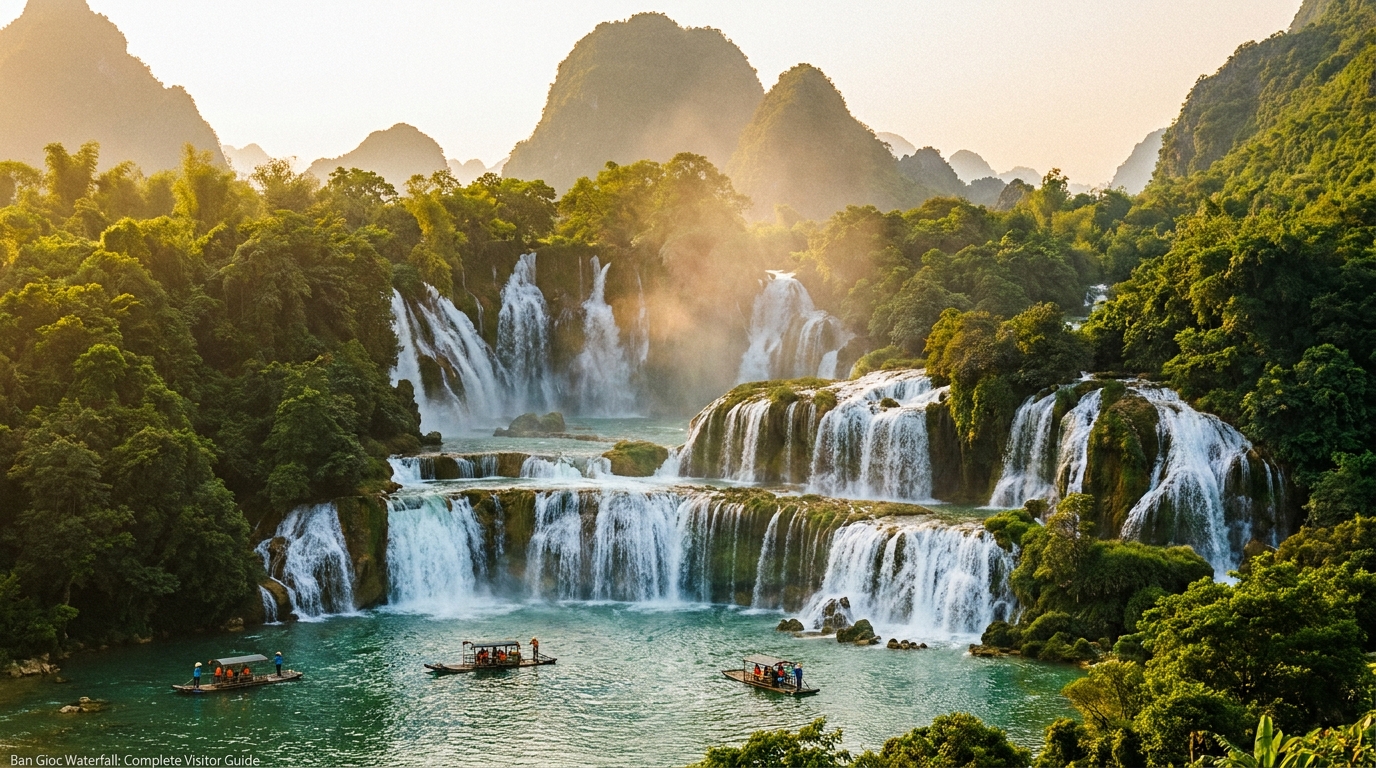
The classic 15-minute raft ride pushes you to within 30 metres of the main cascade — close enough to taste the spray. Rafts run continuously from 08:00 to 16:30 and cost 50,000 VND ($2.00 USD) per person. Vietnamese rafts are coloured red; Chinese rafts (on the other side of the river) are yellow.
2. Hike the Three Viewpoints
A well-signed path leads to three viewpoints. The middle viewpoint is the iconic postcard angle. The upper viewpoint requires a 15-minute climb but rewards you with a top-down view across the entire 300-metre shelf.
3. Cross to Phat Tich Truc Lam Pagoda
This 2014 Buddhist pagoda sits on Phia Nham Mountain directly above the falls. Free entry; the 10-minute climb gives you the best bird’s-eye photo of ban gioc waterfall and the Quay Son river snaking into China.
4. Visit Nguom Ngao Cave (3 km away)
This 2,144-metre-long limestone cave is one of Vietnam’s most underrated caverns. Entrance is 45,000 VND ($1.80 USD); allow 90 minutes. Most independent travellers tack it onto the waterfall visit in a single day.
Ban Gioc Waterfall Entrance Fees and Practical Information
Pricing has been stable since 2023 but expect a modest 10–15% increase by 2027 as the new visitor centre opens.
- Adult ticket: 70,000 VND ($2.80 USD)
- Child (1.0–1.3 m tall): 35,000 VND ($1.40 USD)
- Under 1.0 m: Free
- Electric shuttle (optional): 25,000 VND ($1.00 USD) round trip
- Bamboo raft: 50,000 VND ($2.00 USD) per person, minimum 4 people per raft
- Parking (motorbike): 10,000 VND ($0.40 USD)
- Parking (car): 30,000 VND ($1.20 USD)
Bring cash in small denominations — there are no ATMs at the falls, and card machines only work intermittently. The nearest reliable ATM is in Trung Khanh town, 25 km away.
Where to Stay Near Ban Gioc Waterfall
Foreign visitors have three sensible bases.
Base 1: At the falls (best for sunrise photographers)
Saigon-Ban Gioc Resort is the only 4-star property within walking distance, 800 metres from the entrance. Doubles run 1,800,000–2,800,000 VND ($72–$112 USD). Yen Nhi Homestay and Hoan My Homestay offer simple Tay-style stilt-house rooms from 350,000 VND ($14 USD).
Base 2: Trung Khanh town (best for short stays)
25 km from the falls with multiple mid-range options under 600,000 VND ($24 USD).
Base 3: Cao Bang City (best for multi-stop loops)
89 km from the falls but better restaurants, faster Wi-Fi, and easier onward connections. Recommended for travellers chaining Ban Gioc with Ba Be Lake.
Pairing Ban Gioc with the Cao Bang Loop
Don’t fly all the way to north-east Vietnam just to see one waterfall. The classic 3-day Cao Bang loop pairs Ban Gioc with five other geopark sites: Ma Phuc Pass (Vietnam’s most photographed mountain road), Nguom Ngao Cave, Pac Bo Cave (where Ho Chi Minh hid from French forces in 1941), Thang Hen Lake and Khuoi Ky stone village.
If you’re chaining north Vietnam into a longer Indochina trip, see our North Vietnam vs South Vietnam comparison guide to decide how many days you’ll need in each region, and the Hanoi to Cao Bang travel guide for the loop logistics in full.
What to Bring and What to Wear
Cao Bang has cooler temperatures than the south year-round. In January, daytime highs of 14–18 °C are common; in July, the falls hit 32 °C with 85% humidity.
- Footwear: Closed-toe walking shoes with grip — the limestone paths are slippery from spray.
- Dry bag: Bamboo rafts get wet; protect phones and cameras.
- Cash: 800,000 VND ($32 USD) per person per day is comfortable.
- Passport: Required at the border checkpoint, even if you don’t cross.
- Insect repellent: Mosquitoes are heavy from May to September.
- Light rain jacket: Brief showers are common even in dry season.
Is Ban Gioc Waterfall Safe for Foreign Travellers?
Yes — Cao Bang has one of the lowest crime rates in Vietnam, and the waterfall area is patrolled by Vietnamese border guards. The Quay Son river separating Vietnam from China is well-marked with red-and-white buoys; never swim past them. A handful of tourists have been fined 2,000,000–8,000,000 VND ($80–$320 USD) over the past three years for accidentally drifting into Chinese waters.
The U.S. State Department’s Vietnam travel advisory currently rates Vietnam at Level 1: Exercise Normal Precautions.
Frequently Asked Questions
How much does it cost to visit Ban Gioc Waterfall in 2026?
The entrance ticket is 70,000 VND ($2.80 USD) per adult in 2026, with children between 1.0 m and 1.3 m tall paying half price. Budget around 200,000 VND ($8 USD) per person on-site once you add the bamboo raft (50,000 VND), shuttle (25,000 VND), and a basic Tay-style lunch.
Can foreign tourists visit Ban Gioc Waterfall without a permit?
Yes. The Vietnamese side of ban gioc waterfall is fully open to all nationalities and no special permit, guide, or border zone visa is required. You will need your original passport (not a photocopy) at the checkpoint, and the standard 45-day Vietnam e-visa or visa-exempt entry is sufficient.
Is one day enough for Ban Gioc Waterfall?
One day is the absolute minimum if you only want to see the falls. To fully enjoy ban gioc waterfall plus Nguom Ngao Cave, the Ma Phuc Pass, and a Tay homestay dinner, plan two nights in the area. Day-tripping from Hanoi is technically possible but involves 11+ hours of driving for 90 minutes on-site.
What is the best month to see Ban Gioc Waterfall?
Late September to early October is widely considered the best time, combining peak water volume from the rainy season with the brilliant gold of the Trung Khanh rice harvest. May and June offer the lushest green setting, while November to February has clearer skies but noticeably reduced flow.
Can I cross from Vietnam to China at Ban Gioc?
No, there is no functioning passenger border crossing at Ban Gioc itself. The waterfall sits on the border, but the international gateway for crossing to China by land is the Huu Nghi (Friendship) gate near Lang Son, about 180 km south-east. Bamboo rafts are not permitted to cross the marked boundary line.
Plan Your Vietnam Trip Around Ban Gioc Waterfall
Most foreign visitors fly into Ho Chi Minh City (Saigon) first, then loop up to Hanoi and onward to Cao Bang. A relaxed itinerary looks like this: 3 nights in Saigon, 1 night Hoi An, 1 night Hue, 3 nights Hanoi + Ban Gioc loop, total 8 nights. For the southern legs, see our full Saigon itinerary planner and the things to do in Ho Chi Minh City guide for non-touristy picks. If you’re focused on food, our District 1 street food map covers the best stalls within 600 m of most central homestays.
Stay With Us in District 1, Saigon
Before or after your Cao Bang adventure, base yourself at our centrally located homestay in District 1, just 5 minutes’ walk from Ben Thanh Market and 12 minutes from the Saigon River. Rooms from 650,000 VND ($26 USD) per night include fast Wi-Fi, complimentary Vietnamese coffee, and a free 30-minute trip-planning consultation — perfect for travellers stitching together the Saigon-to-Ban Gioc journey across Vietnam. Check availability and book direct →
Carrying the right cash matters more than most visitors expect — see the Vietnam currency and money exchange guide before you arrive.