

Van Long Nature Reserve is the quietest, most rewarding boat experience in northern Vietnam — and most visitors drive straight past it. While tour buses queue for Trang An and Tam Coc, this 2,962-hectare wetland sits largely undiscovered, offering limestone karst scenery that rivals Ha Long Bay, a critically endangered primate, and a boat ride so calm you can hear the oars drip. This guide gives you everything you need: costs, timing, wildlife, transport, and honest comparisons so you can decide whether it belongs on your itinerary.
It does.
Key Takeaways
– Van Long covers 2,962 ha and was designated a Ramsar Wetland of International Importance in 2012 — the largest inland wetland in the Red River Delta.
– A boat tour costs 150,000 VND (~$6 USD) per boat plus a 20,000 VND (~$0.80 USD) entrance fee per person.
– It protects one of the last wild populations of the critically endangered Delacour’s langur.
– Best visited October to April; arrive before 8:00 AM for wildlife and calm water.
– Combine with Hoa Lu Ancient Capital and Trang An for a full 2-day Ninh Binh itinerary.
| Detail | Info |
|---|---|
| Location | Gia Van Commune, Gia Vien District, Ninh Binh Province |
| Hours | 6:00 AM – 5:00 PM daily |
| Entry Fee | 20,000 VND (~$0.80 USD) per person |
| Boat Fee | 150,000 VND (~$6 USD) per boat (up to 4 people) |
| Best Time | October to April; arrive before 8:00 AM |
| Distance from Hanoi | ~100 km (2–2.5 hours) |
| Distance from Ninh Binh City | 18 km (30–40 minutes) |
What Makes Van Long Nature Reserve Vietnam’s Most Peaceful Wetland?
Van Long Nature Reserve protects a rare mosaic of flooded rice paddies, freshwater marsh, and dramatic karst limestone cliffs across 2,962 hectares — making it the largest inland wetland in the Red River Delta. The Ramsar Convention awarded it Wetland of International Importance status in 2012, recognising an ecosystem that supports over 40 mammal species and 150 bird species within a single valley. That international recognition hasn’t translated into tourist crowds, which is exactly what makes it special.
The landscape feels genuinely different from anything else in Ninh Binh. Flooded paddies merge with reed beds and mirror-still pools at the base of sheer limestone towers. There’s no soundtrack of motor engines — only oars on water and birds overhead.
Here’s what the guidebooks miss: the sheer scale of Van Long works in your favour. With nearly 3,000 hectares and a visitor count that’s a fraction of Trang An’s, you can be the only boat in sight for 15–20 minutes at a stretch. That kind of solitude is almost impossible to find at other karst wetland sites in Vietnam. Trang An processes over 2 million visitors per year (Ninh Binh Department of Tourism, 2024). Van Long sees a small fraction of that traffic.
Ready to build your wider Ninh Binh trip? Our Ninh Binh travel guide covers all the major sites, transport options, and suggested itineraries in one place.

Van Long Nature Reserve Boat Tour: What to Expect on the Water

The boat tour at Van Long Nature Reserve is the main event — and it’s genuinely excellent value. You board a traditional flat-bottomed wooden sampan: no motor, no loudspeaker commentary, just a local rower who navigates a roughly 5 km circuit through flooded paddies, reed-fringed channels, and past cave openings carved into the karst walls. The whole trip takes about two hours.
Costs are straightforward. Entrance is 20,000 VND (~$0.80 USD) per person. The boat fee is 150,000 VND (~$6 USD) per boat, shared between up to four passengers. Tipping your rower 20,000–50,000 VND is customary and genuinely appreciated — these are local residents, often women, who row the full circuit using their feet on the oars while sitting backwards. It’s worth watching.
Arriving at 6:30 AM on a weekday in November, the water was completely still, the mist hadn’t lifted, and the first langurs were already visible on the cliffs before the boat left the dock. There were two other boats on the entire circuit. By 10:00 AM, the car park was filling and that particular quiet had gone. That early start makes a real difference — not just a nice suggestion.
What you’ll see on the circuit: narrow cave passages cut through limestone, wide flooded paddy panoramas, reed beds alive with egrets and herons, and the vertical cliff faces where langurs perch in the early morning. The caves aren’t lit or developed. You pass through them in near-darkness — genuinely more atmospheric than the tourist-optimised caves elsewhere in the region.
For comparison with Ninh Binh’s most famous water experience, our guide to the Trang An boat tour covers that UNESCO-listed route in full.
The Wildlife That Makes Van Long Unforgettable

Van Long’s headline species is the Delacour’s langur (Trachypithecus delacouri) — a critically endangered black-and-white primate found only on limestone karst in northern Vietnam. Fewer than 250 individuals survive in the wild (IUCN Red List, 2023), and Van Long holds one of the last viable populations. Your chances of spotting them from the boat are strong, particularly between 6:30 AM and 9:00 AM when they descend to lower cliff ledges to warm in the early sun.
Beyond the langurs, the reserve supports an impressive range of species across its wetlands, reed beds, and forest fringe.
Key mammals:
– Delacour’s langur — limestone cliff faces, best viewed early morning
– Rhesus macaque — common near the trail entrance
– Asian small-clawed otter — rare, possible at dawn or dusk
– Semi-wild water buffalo — grazing the flooded paddies
Key birds (150+ species recorded):
– Painted Stork — October to March
– Great Cormorant — October to February, often drying wings on mid-channel rocks
– Common Kingfisher — year-round along the water’s edge
– Black-crowned Night Heron — year-round
– Various migratory duck species — winter visitors, October to February
Bring binoculars — 10×42 is the recommended minimum for langur watching from the boat. A compact 8×25 pair will work for birds but you’ll feel under-equipped on the cliff faces.

How to Get to Van Long from Hanoi and Ninh Binh City
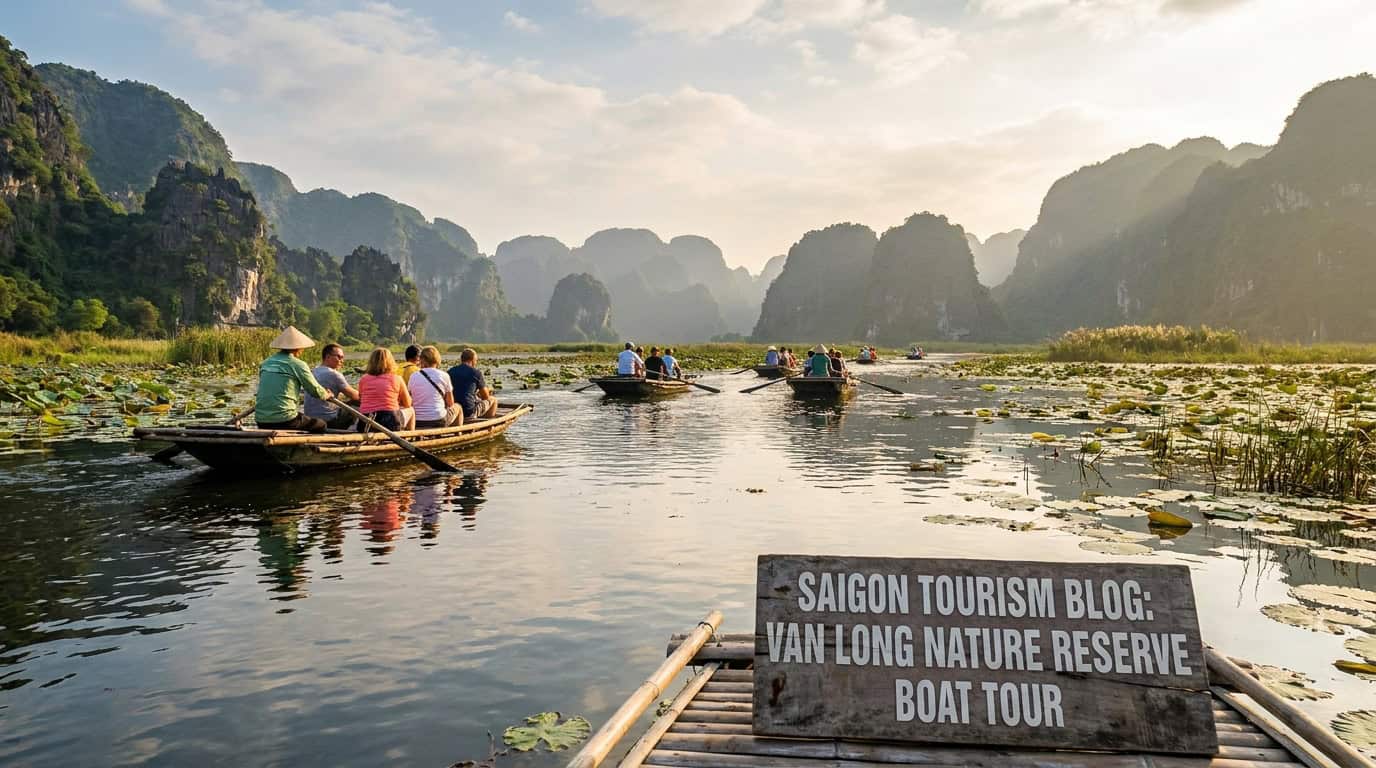
Van Long sits 100 km south of Hanoi and 18 km northwest of Ninh Binh City. The GPS coordinates are 20°18′30″N, 105°51′00″E — save them before you go, as some map apps still show the entrance incorrectly. Cash only at the ticket booth. There’s no ATM or card reader on site.
From Hanoi (~100 km, 2–2.5 hours)
- Hired car with driver: 1,200,000–1,800,000 VND ($48–72 USD) for a full-day round trip, including waiting time at the reserve. Best value for groups of three or four covering multiple Ninh Binh sites.
- Limousine bus to Ninh Binh City: 120,000–150,000 VND ($4.80–6 USD) one way from Giap Bat or My Dinh station. Then Grab taxi or xe om for the final 18 km.
- Self-drive motorbike: 2–2.5 hours via National Highway 1A then QL12B. Flexible and scenic for riders comfortable on Vietnamese roads.
From Ninh Binh City (18 km)
- Grab taxi: 150,000–200,000 VND ($6–8 USD) one way
- Xe om (motorbike taxi): 80,000–120,000 VND ($3.20–4.80 USD) negotiated at the bus station
- Bicycle rental: Around 50,000 VND ($2 USD) per day from guesthouses in the city. The 18 km ride is flat and passes through beautiful countryside — perfectly doable in under an hour.
Best Time to Visit Van Long for the Ultimate Experience
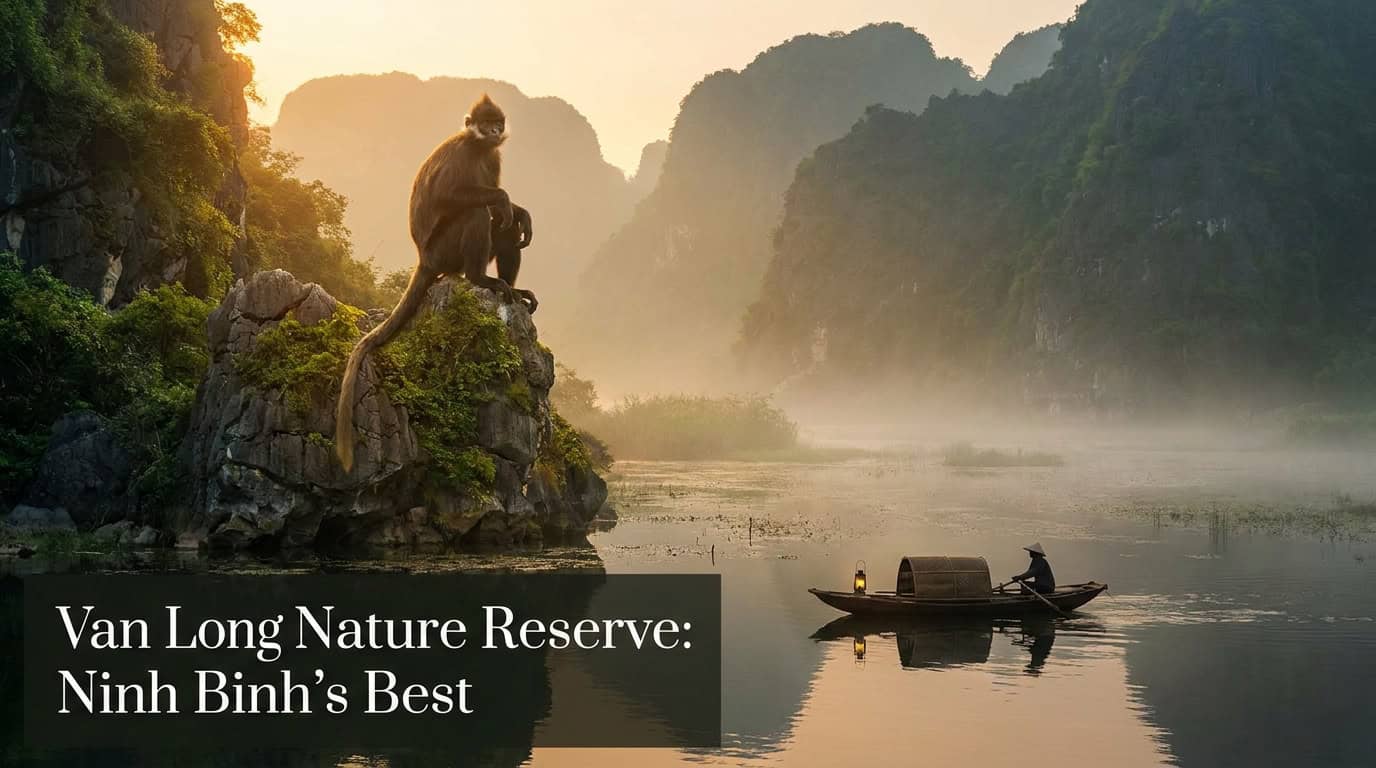
October to April is the best window, covering the dry season and the full annual wildlife cycle. October to November stands out: migratory birds are arriving, the paddy fields glow gold before harvest, water levels suit the boat circuit, and the air is cool without being cold. This is when Van Long looks exactly like the photographs.
Whenever you go, arrive before 8:00 AM. Langurs are most active in early light, the water is at its calmest, and you’ll share the circuit with far fewer boats. If an early start genuinely isn’t possible, late afternoon — after 3:30 PM — is a strong second choice. Day-trippers have mostly left, the light softens beautifully, and the birds get active again.
Season at a glance:
| Season | Months | Verdict | Notes |
|---|---|---|---|
| Peak dry season | Oct–Dec | ★★★★★ | Best wildlife, golden paddy fields, cool air |
| Cool dry season | Jan–Mar | ★★★★☆ | Good birding, clear skies, cold mornings |
| Shoulder season | Apr–May | ★★★☆☆ | Warmer, fewer migratory birds, still pleasant |
| Rainy season | Jun–Sep | ★★☆☆☆ | Flooding risk, reduced wildlife visibility |
A note on the rainy season (June–September): heavy rainfall can cause the surrounding wetland to flood beyond navigable levels, which occasionally forces partial route closures. If you’re visiting July or August specifically, check current conditions with your accommodation before making the trip out.
Van Long vs. Trang An vs. Tam Coc: Which Should You Choose?
All three offer boat tours through karst limestone scenery. The differences matter more than most travel blogs suggest.
| Feature | Van Long | Trang An | Tam Coc |
|---|---|---|---|
| Crowd level | Low | Moderate | High |
| Cave system | Basic, unlit | 9 caves, dramatic | 3 caves, moderate |
| Wildlife | Excellent — langurs, birds | Limited | Limited |
| Boat experience | Motorless, very quiet | Motorless, scenic | Motorless, busy |
| Scenery type | Open wetland panorama | River + enclosed karst | River valley + paddies |
| UNESCO status | Ramsar Wetland | UNESCO World Heritage | Part of UNESCO listing |
| Total cost (1 person) | ~170,000 VND | ~250,000 VND | ~120,000 VND |
Van Long wins on tranquillity, wildlife, and cost. If you want a genuine chance at seeing rare primates in a near-empty wetland, nothing in the region compares.
Trang An wins on scenery drama and cultural depth. The nine cave passages and ancient temples make it the most layered experience. The UNESCO designation isn’t just a badge — the site genuinely earns it.
Tam Coc is the most convenient and the most photographed. It’s also the most crowded and the most commercialised. Still worthwhile, but it won’t be the highlight of your Ninh Binh visit.
The honest recommendation? Don’t pick just one. With an overnight stay in Ninh Binh, you can comfortably cover all three across two days. Our guides to the Trang An boat tour and Hoa Lu Ancient Capital cover those experiences in full.
Nearby Attractions to Combine With Your Visit
Ninh Binh packs an extraordinary amount into a compact geography. All the major sites sit within 40 km of Van Long, making combinations easy whether you’re day-tripping from Hanoi or staying overnight.
Hoa Lu Ancient Capital (35 km)
Vietnam’s capital in the 10th and 11th centuries under the Dinh and Le dynasties. Two well-preserved temples sit at the base of dramatic karst cliffs in a valley that once served as a natural fortress. Allow 1–1.5 hours. It pairs naturally with Trang An, just 5 km away.
Bai Dinh Pagoda (25 km)
Vietnam’s largest Buddhist temple complex, covering 700 hectares on a forested limestone hill. Over 500 Arhat statues line the main processional route — a striking scale even if large religious sites aren’t normally your thing. Allow 2–3 hours.
Trang An Landscape Complex (30 km)
The region’s UNESCO World Heritage listing. The boat circuit passes through cave tunnels connecting lake-like pools beneath towering karst walls, with prehistoric cave settlements along the route. Allow 3–4 hours including the boat.
Cuc Phuong National Park (40 km)
Vietnam’s oldest national park, established in 1962. Primary rainforest, an endangered primate rescue centre with pangolins and slow lorises, and ancient trees over 1,000 years old. Best saved for a dedicated full-day visit rather than tacked onto a Van Long afternoon.
Practical Tips Every Visitor Should Know Before Going
Before you buy your boat ticket, walk the perimeter trail that runs along the reserve boundary. It’s free, takes 20–30 minutes, and gives you elevated views of the wetland from the karst cliff base — exactly where the langurs congregate in the early morning. Most visitors skip this entirely and miss their best langur sighting of the day. Do it before your boat departs, not after.
What to pack:
– Binoculars: 10×42 minimum for langur watching from the boat
– Camera lens: Telephoto 200mm+ for wildlife; wide-angle for karst panoramas
– Sun protection: Wide-brim hat and SPF 50+ sunscreen — zero shade on the boat for most of the circuit
– Insect repellent: Particularly useful in the reed bed sections, October through April
– Light rain jacket: Packable, takes no space, earns its keep on changeable days
– Cash: 20,000 VND entrance + 150,000 VND boat + tip; no ATM or card payment on site
Clothing: No temple dress code applies at Van Long. Light, breathable clothing in neutral colours works best — for comfort in the heat and for not startling wildlife on the perimeter trail.
Facilities: A small café at the entrance serves Vietnamese coffee, cold drinks, and basic snacks. Clean toilets near the ticket booth. A few souvenir stalls sell local honey and hand-woven village crafts near the car park.

Frequently Asked Questions
Is Van Long Nature Reserve worth visiting?
Yes — without reservation. Van Long Nature Reserve delivers one of the best-value nature experiences in Vietnam: the boat tour costs just 150,000 VND (~$6 USD) per boat, the limestone karst scenery rivals Ha Long Bay on land, and your chances of seeing the critically endangered Delacour’s langur in the wild are higher here than almost anywhere else on Earth. The crowds that spoil Tam Coc simply don’t exist here.
What is there to do at Van Long Nature Reserve?
Van Long Nature Reserve centres on its 2-hour motorless rowboat tour through flooded wetlands and karst passages, but there’s more to explore. Walk the free perimeter trail before your boat departs for close-up langur spotting from the cliff base. Birdwatchers can work the dock area for herons, kingfishers, and cormorants. Combine the visit with Hoa Lu Ancient Capital and Trang An for a complete Ninh Binh day trip.
How much does it cost to go on the boat at Van Long Nature Reserve?
The boat tour at Van Long Nature Reserve costs 150,000 VND (~$6 USD) per boat for up to four passengers, plus a 20,000 VND (~$0.80 USD) entrance fee per person. Total outlay for a solo visitor: approximately 170,000 VND (~$6.80 USD). Add a tip of 20,000–50,000 VND for your rower — it’s customary and genuinely appreciated. Cash only; no card payments are accepted at the reserve.
Start Your Vietnam Adventure in the Heart of Saigon
Most international Vietnam itineraries begin in Ho Chi Minh City. Ninh Binh makes an excellent 2-day northern detour once you’re ready — a quick domestic flight to Hanoi, then 2.5 hours south by road or rail, and you’re in karst country.
Many travellers spend 4–5 days exploring Saigon first, then head north. If you’re still putting that first chapter together, browse our Saigon itinerary for the best 3–7 day plans covering District 1, the Mekong Delta, and day trip options. It’s the practical starting point we’d hand any first-time visitor.
District 1 is a short walk from Pham Ngu Lao Street, the main sleeper bus terminals, and Ben Thanh Market, a comfortable, well-connected base whether you’re arriving from the airport or returning from a week in the north.
Sources: Ramsar Convention Wetland Listing (ramsar.org/wetland/van-long); UNESCO Trang An World Heritage Listing (whc.unesco.org/en/list/1438); IUCN Red List, Delacour’s Langur Assessment, 2023; Ninh Binh Department of Tourism, 2024.
Not sure what those dong figures are worth? The Vietnam currency and money exchange guide converts them and lists the ATMs with the lowest fees.