
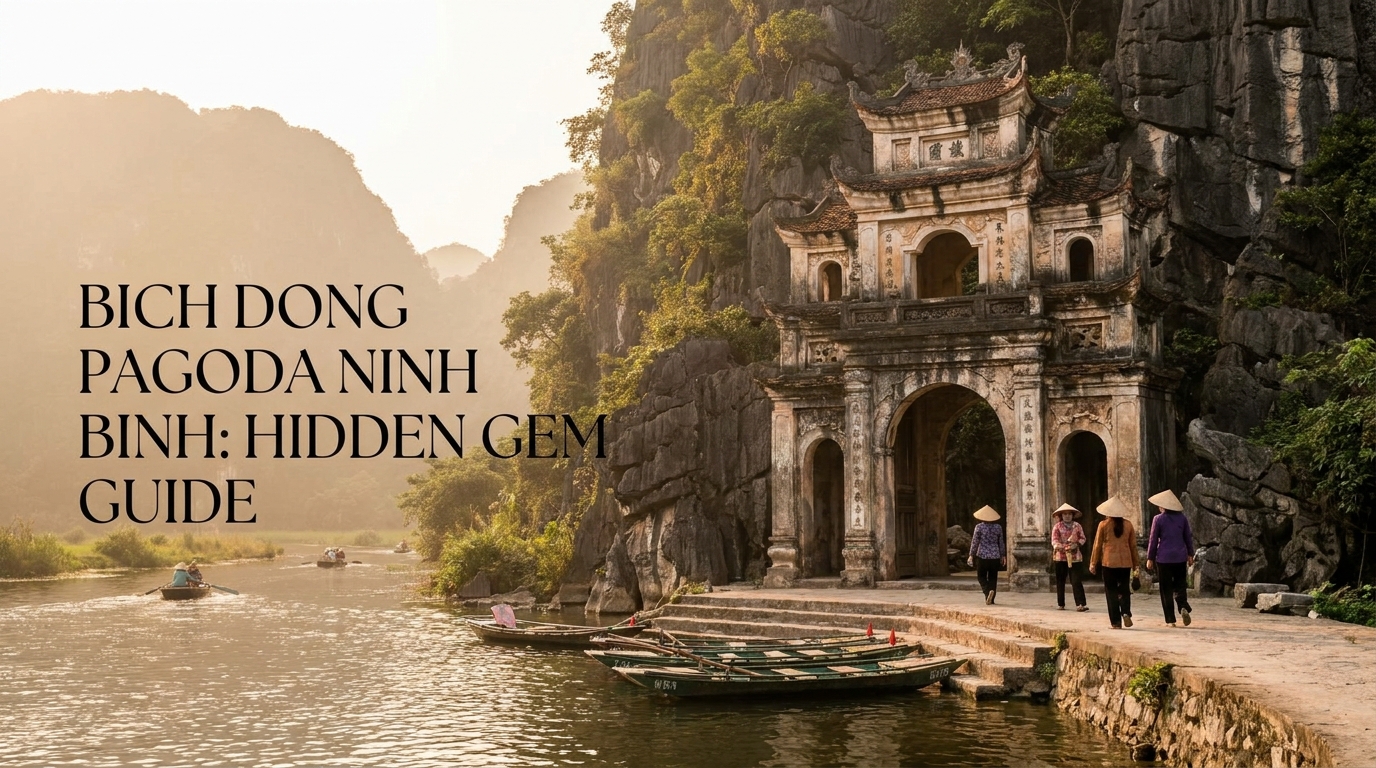
Bich Dong Pagoda Ninh Binh is one of northern Vietnam’s most rewarding half-day trips — a 600-year-old cave temple complex carved into a limestone karst mountain just 7 km from the market town of Tam Coc. Founded in 1428 during the Le Dynasty, the site sits inside the Trang An Landscape Complex, Vietnam’s first UNESCO dual World Heritage Site — inscribed in 2014 for its exceptional cultural and natural value. Three tiers of pagoda are built into and around the mountain, with the uppermost chamber sitting entirely inside a natural cave. Most visitors spend two to three hours here and leave with photographs that look like nowhere else in Vietnam.
Key Takeaways
– Bich Dong Pagoda was founded in 1428 (Le Dynasty) and sits inside the UNESCO-listed Trang An Landscape Complex, inscribed in 2014.
– Three tiers — Ha Chua (Lower), Trung Chua (Middle), and Thuong Chua (Upper) — are built into and around a single limestone karst mountain.
– Pagoda entry costs just 15,000 VND (~$0.60); Tam Coc boat rides cost 150,000–180,000 VND (~$6–7) per boat.
– It’s 7 km from Ninh Binh city and 93 km south of Hanoi — easy for a day trip or an overnight stay.
– Visit September–November or arrive before 9:00 a.m. to avoid peak tour-group crowds.
Quick Reference
| Detail | Info |
|---|---|
| Location | Ninh Hai Commune, Hoa Lu District, Ninh Binh Province |
| Opening Hours | Daily 7:00 a.m. – 5:00 p.m. |
| Entrance Fee | ~15,000 VND (~$0.60) per person |
| Tam Coc Boat Ride | 150,000–180,000 VND (~$6–7) per boat (2–3 passengers) |
| Best Time to Visit | September–November; arrive by 8:00 a.m. |
| Time Needed | 2–3 hours including boat ride |
| Distance from Hanoi | ~93 km (~2 hours by bus or car) |
| Distance from Ninh Binh city | ~7 km (15 min by bicycle or motorbike) |
What Is Bich Dong Pagoda Ninh Binh?
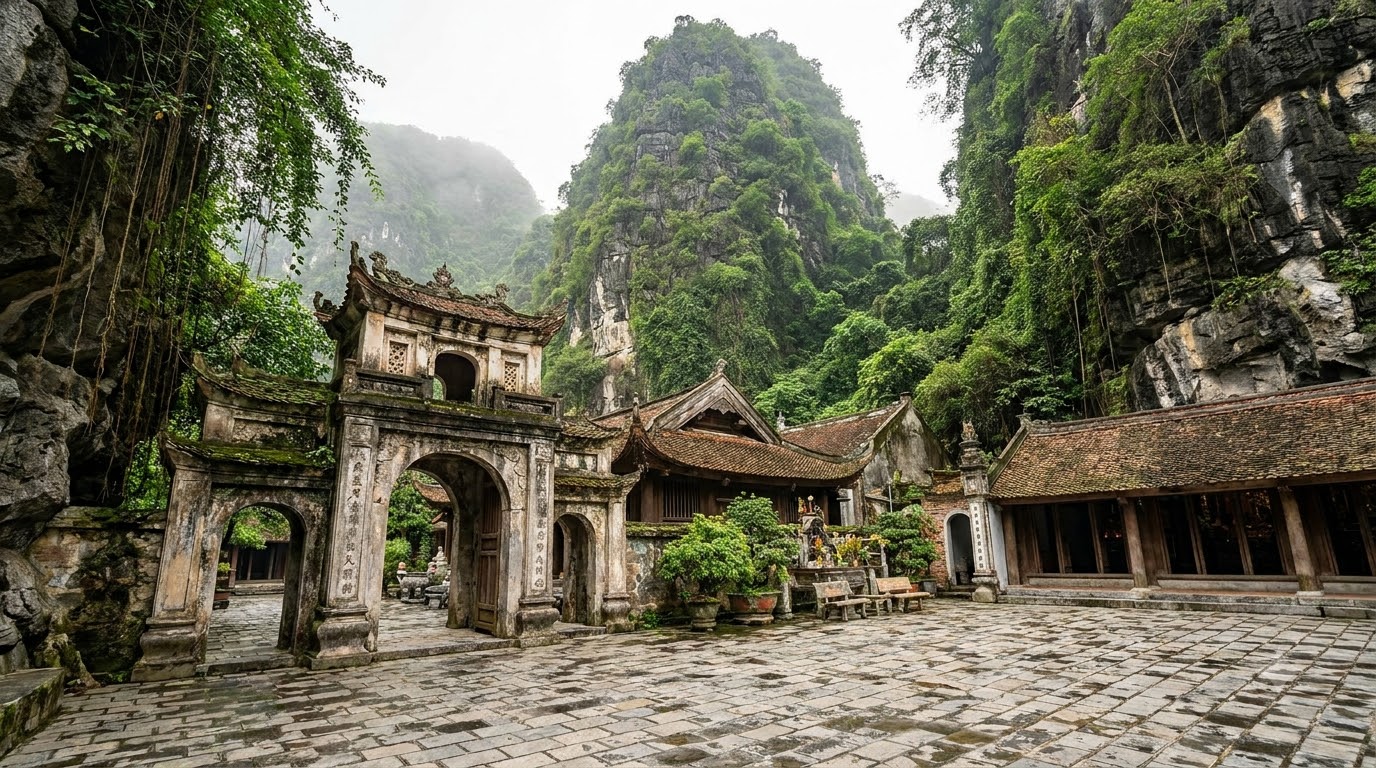
Bich Dong Pagoda Ninh Binh is a Buddhist temple complex built directly into a limestone karst mountain in Hoa Lu District, roughly 7 km south of Ninh Binh city. The name translates as “jade cave pagoda”: bích captures the jade-blue hue of the moss-covered cave walls, while động means cave. Two monks — Tri Kien and Tri The — established the complex in 1428 during the early Le Dynasty, and it has functioned as an active place of worship for nearly six hundred years.
The pagoda anchors the Tam Coc sector of the Trang An Landscape Complex — a 6,172-hectare stretch of karst valleys, cave systems, and river corridors that UNESCO designated a World Heritage Site in 2014. It was Vietnam’s first property to receive a joint cultural-natural inscription, recognizing both its geological significance and its layers of human history stretching back to the prehistoric era.
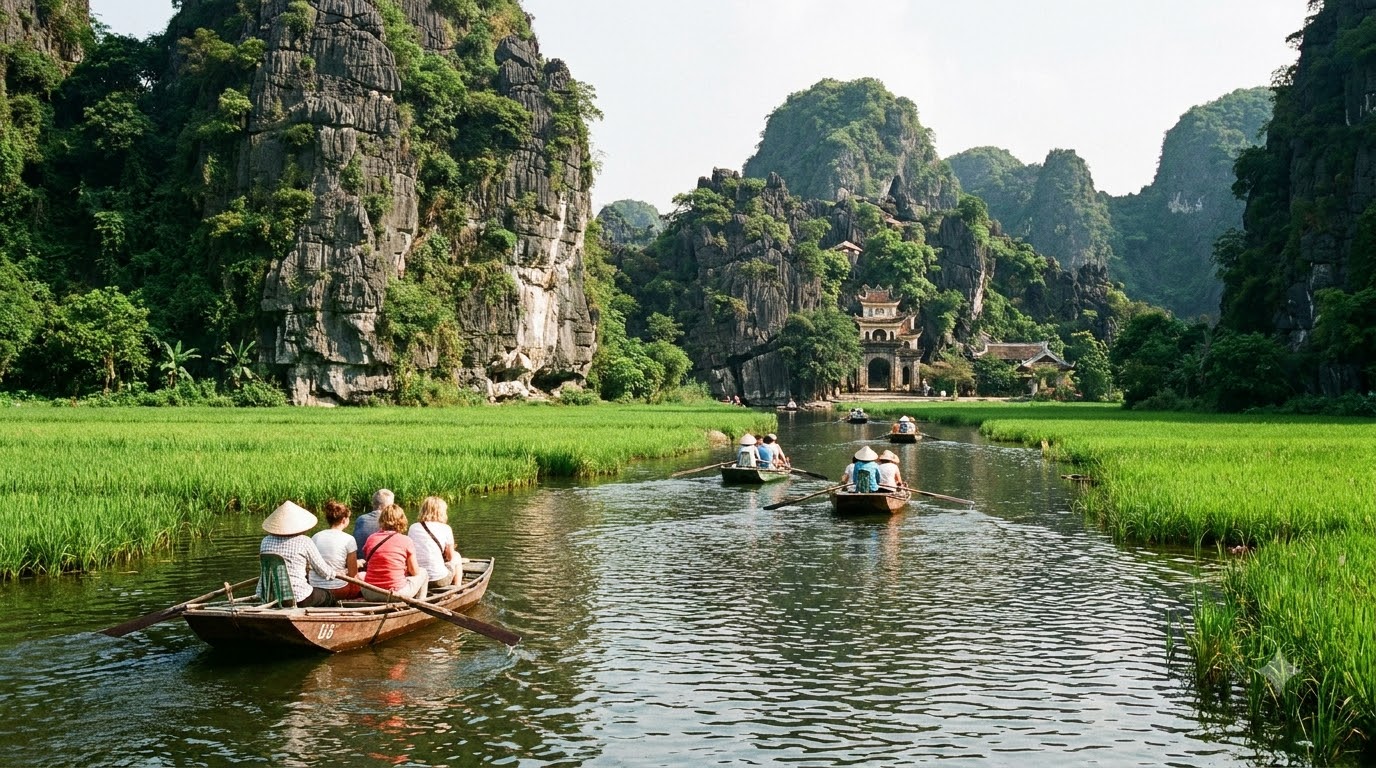
What makes it different from the dozens of pagodas across the north? The cave architecture. Rather than a flat courtyard and prayer hall, Bich Dong gives you a vertical experience: three tiers of temple built into and through a mountain, connected by stone staircases cut directly into the cliff face. Travel writers commonly call the wider Ninh Binh region “Ha Long Bay on land,” and it holds up — here you have the same towering karst formations and flat water, except the water is a rice-paddy river and a rowboat replaces the junk boat.
How to Get to Bich Dong Pagoda Ninh Binh
From Hanoi
For most international visitors, Hanoi is the gateway. See our complete guide on getting from Hanoi to Ninh Binh for a full breakdown, but here are the main options:
- Train: The Hanoi–Ho Chi Minh City express stops at Ninh Binh Station. Journey time is 1 hour 50 minutes to 2 hours 20 minutes. Hard-seat tickets start at around 100,000 VND (~$4); a soft seat costs 120,000–160,000 VND (~$4.80–$6.40). Several departures run daily.
- Bus or limousine van: Direct services depart from My Dinh and Giap Bat bus stations. Journey time: 2–2.5 hours. Tickets: 100,000–150,000 VND (~$4–$6). Limousine vans (Camel Travel, Hung Thanh) offer door-to-door comfort to guesthouses in Ninh Binh.
- Motorbike: Confident riders can cover 93 km via Highway 1A in around 2.5 hours — a genuinely enjoyable ride on lighter traffic mornings.
- Private car: A door-to-door transfer runs 800,000–1,200,000 VND (~$32–$48) one-way. Sensible for groups of three or four splitting the cost.
From Ho Chi Minh City
Bich Dong fits naturally into a Vietnam trip that starts in the south. If you’re building your itinerary around things to do in Ho Chi Minh City before heading north, the cleanest route is a domestic flight from Tan Son Nhat Airport (SGN) to Noi Bai in Hanoi — flights run hourly, take about two hours, and cost 500,000–1,500,000 VND (~$20–$60) booked in advance. From Hanoi, travel south to Ninh Binh as above.
Budget travelers can take the overnight Reunification Express train from Saigon direct — it takes around 30 hours but saves a night’s accommodation if you sleep on board.
Getting Around Ninh Binh to the Pagoda
From Ninh Binh city, Bich Dong is 7 km south through flat rice-field terrain:
- Bicycle: Most guesthouses rent bikes for 30,000–50,000 VND/day (~$1.20–$2). The flat terrain makes it the most popular choice.
- Xe om (motorbike taxi) or Grab: Around 30,000–50,000 VND (~$1.20–$2) one way.
- Organized tour: Hanoi-based operators run Tam Coc day trips (300,000–500,000 VND / ~$12–$20 per person) that include a stop at Bich Dong.
The Three Pagoda Levels: Ha, Trung, and Thuong Chua

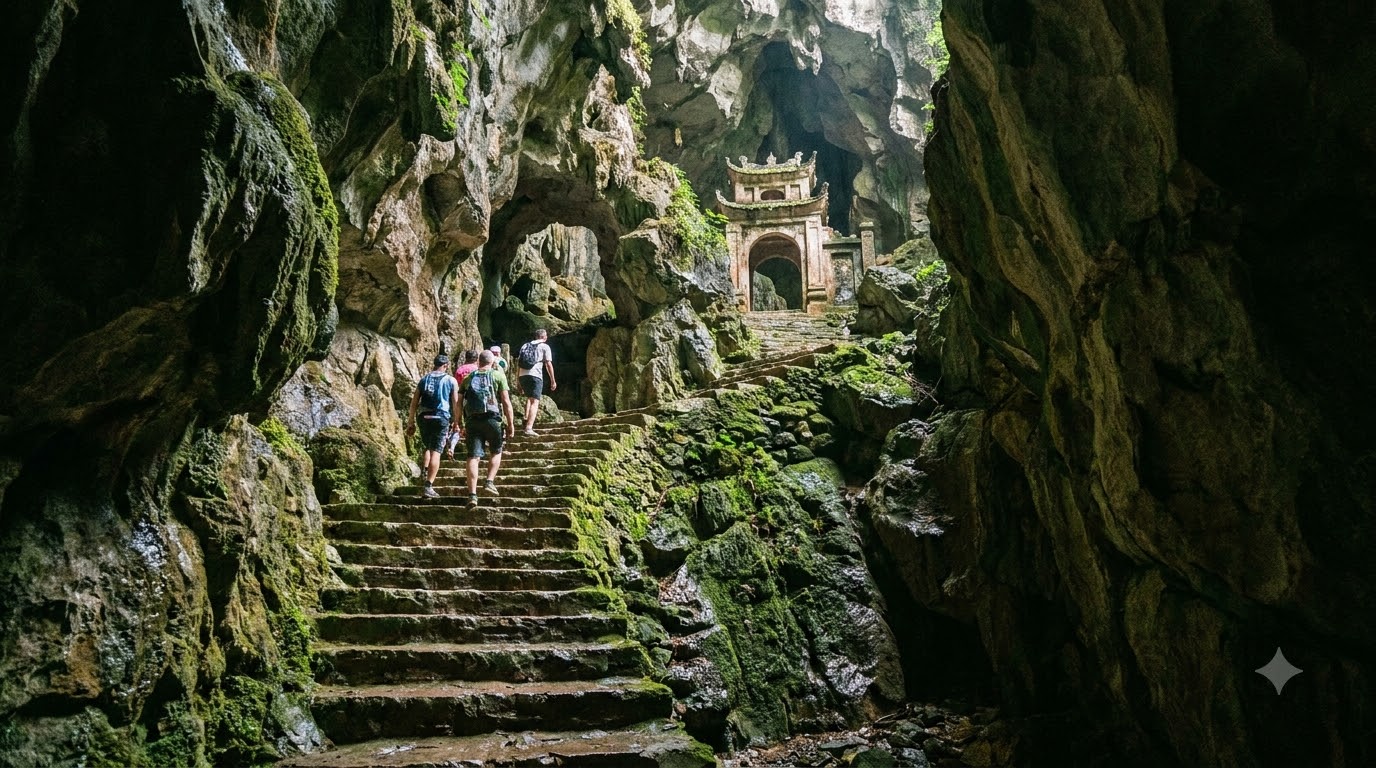
What sets Bich Dong apart is something you can’t appreciate from a photograph: you don’t just visit a pagoda — you climb through a mountain. Three distinct temple tiers, connected by cave passages and staircases cut into the cliff face, reward effort with progressively better views. Set aside at least 45–60 minutes for the full climb.
Ha Chua — The Lower Pagoda
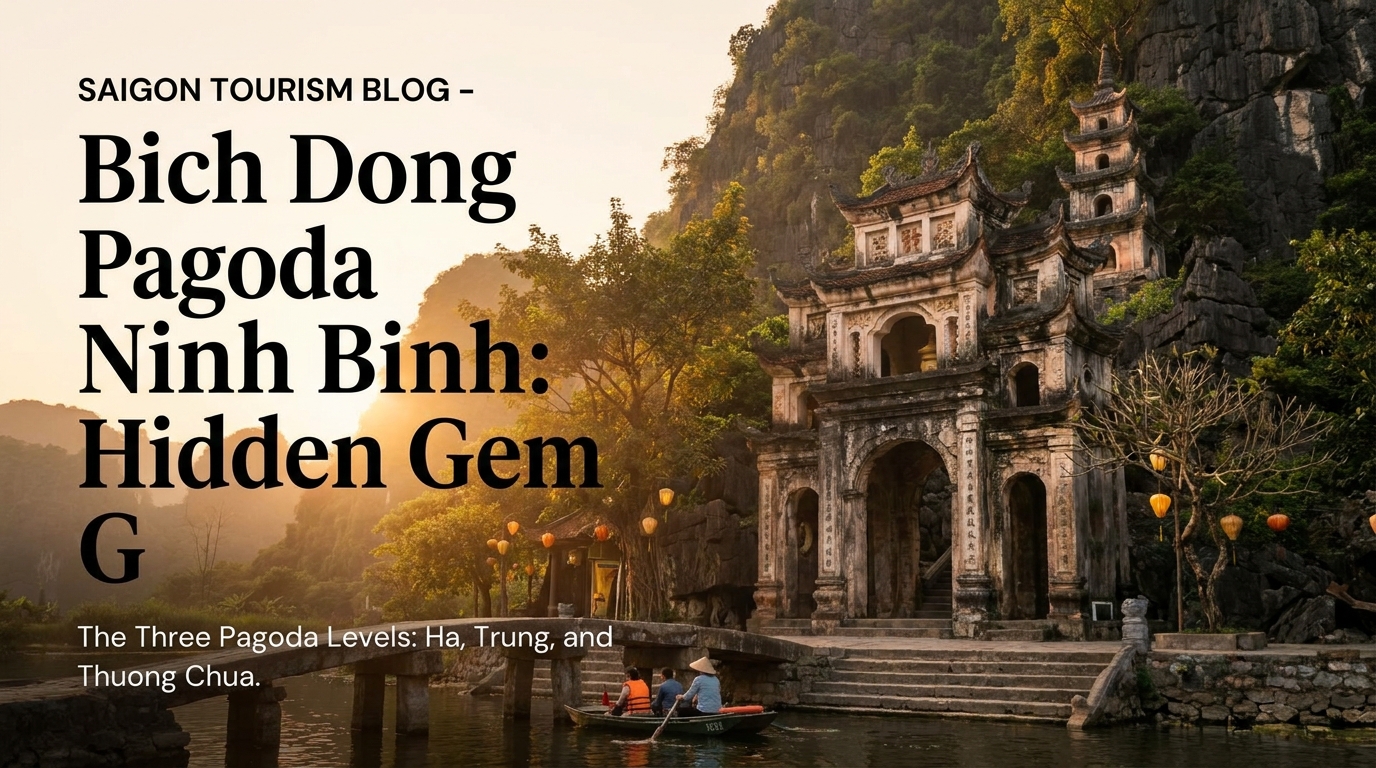
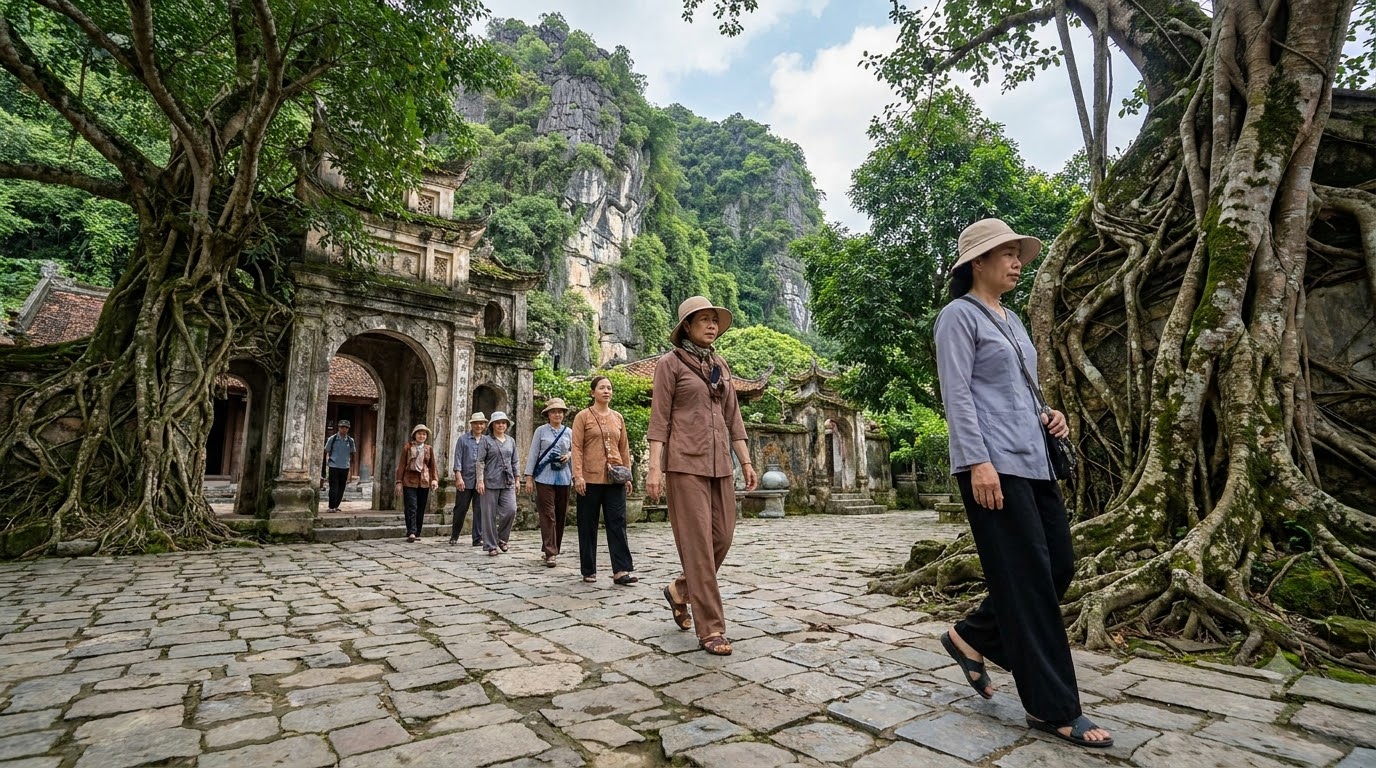
Ha Chua sits at ground level, a short walk from the boat landing across a stone bridge. It follows the traditional Vietnamese Buddhist temple layout: a courtyard, a bell pavilion, and a main prayer hall with red-lacquered columns and curved clay tile roofing. The architecture reflects 19th-century Nguyen Dynasty restoration work, though this site has been active since 1428. Arrive early and the incense smoke drifting through ancient banyan roots gives the courtyard a stillness that later crowds disrupt completely.
Trung Chua — The Middle Pagoda
About sixty stone steps — uneven and worn smooth by centuries of worshippers — lead from Ha Chua up to Trung Chua. This is where the cave element begins. The back wall of the Middle Pagoda is raw limestone, the ceiling partly natural rock and partly carved stone. A row of Buddhist statues is arranged along the rear wall, lit mostly by altar candles. The temperature inside drops noticeably from the heat outside. It’s dim, cool, and genuinely old-feeling in a way that renovated heritage sites rarely achieve.
Thuong Chua — The Upper Cave Pagoda
The Upper Pagoda is the reward for the climb. A steep, narrow staircase cut directly into the cliff face delivers you to a chamber where the entire structure sits inside the mountain — the ceiling is raw rock, stalactites included. Carved stone figures occupy recesses in the cave walls. And just outside the cave entrance, a small terrace opens over the Ngo Dong River valley: rice paddies, karst peaks, and small rowboats moving silently through the water below.
Best Time to Visit: Seasons, Crowds, and Time of Day
The sweet spot for visiting Bich Dong Pagoda Ninh Binh is September through November. By then the summer rainy season has ended, temperatures hover around 22–28°C (72–82°F), and the rice fields hit peak harvest color. It’s also when international visitor numbers are highest — meaning more guesthouses, restaurants, and services are fully operational.
Seasonal breakdown:
- January–February: Cool and dry, but Tet (Lunar New Year) brings a major surge of domestic visitors. Accommodation prices rise sharply during the holiday week; boat landings get congested on weekends.
- March–April: Pleasant temperatures and low crowds make this an underrated shoulder-season window. The fields are a deep green and the haze is thinner than summer.
- May–August: Hot and humid, with regular afternoon thunderstorms. Boat access occasionally closes after heavy rain. Worth visiting if you arrive before 9:00 a.m., when the heat hasn’t peaked.
- September–November: Ideal. Post-harvest rice scenery, comfortable temperatures, and the clearest karst views of the year.
- December: Quiet and cool. Surprisingly good value and thin crowds — a strong alternative to the peak autumn months.
Time of day matters as much as the season. Tour groups from Hanoi consistently pull in between 9:30 and 11:00 a.m. The pagoda opens at 7:00 a.m. — arriving in that first hour means climbing the cave stairs in near-silence and having the Upper Pagoda terrace effectively to yourself.
What to See and Do Near the Pagoda
Bich Dong sits at the centre of a cluster of exceptional sights. If you’ve made the journey, leave time for at least two more. Our full Ninh Binh travel guide covers all of them with opening times, fees, and practical logistics.
Tam Coc Boat Trip
The classic Tam Coc boat trip is the essential companion to Bich Dong — the two sites are less than 500 metres apart. Local rowers (many of them women who row with their feet, freeing their hands) take you along 9 km of the Ngo Dong River through three natural cave tunnels carved through limestone karst mountains. The return trip takes 2–2.5 hours. Boat cost: 150,000–180,000 VND (~$6–7) per boat for two passengers. The standard flow is to do the boat first, then walk or cycle to Bich Dong for the pagoda climb.
Trang An Grottoes
The Trang An boat circuit is longer — three to four hours — and passes through up to nine cave tunnels within the UNESCO World Heritage core zone. It’s slightly less crowded than Tam Coc on busy days and more dramatic in scale. Ticket: 250,000 VND (~$10) per person including a guide. Allow a full half-day.
Hoa Lu Ancient Capital
Vietnam’s first imperial capital — established in 968 CE by Emperor Dinh Tien Hoang — sits 12 km north of Bich Dong. Two surviving temple complexes (Dinh Tien Hoang and Le Dai Hanh) are well-preserved and genuinely atmospheric. Entry: 20,000 VND (~$0.80). Budget 1.5 hours.
Van Long Nature Reserve
Twenty kilometres north of Tam Coc, Van Long is a flooded wetland reserve and home to one of the largest wild populations of Delacour’s langur — a critically endangered primate found only in northern Vietnam. Boat trips here are tranquil, bird-rich, and largely deserted on weekdays. Boat fee: 120,000 VND (~$4.80) per boat.
Practical Visitor Tips: Fees, Dress Code, and Photography
Full Cost Breakdown
Here’s a realistic budget for a Bich Dong + Tam Coc half-day:
| Item | Cost (VND) | Cost (approx. USD) |
|---|---|---|
| Pagoda entrance | 15,000 | ~$0.60 |
| Tam Coc boat ride | 150,000–180,000 | ~$6–$7 |
| Bicycle rental (full day) | 30,000–50,000 | ~$1.20–$2 |
| Motorbike parking | 5,000–10,000 | ~$0.20–$0.40 |
| Total per person | ~200,000–255,000 | ~$8–$10 |
Combining Bich Dong Pagoda Ninh Binh with the Tam Coc boat experience gives you one of the best-value half-days anywhere in Vietnam — under $10 all-in makes it hard to argue with.
Dress Code
The pagoda is an active Buddhist place of worship. Cover your shoulders and knees. Lightweight linen or cotton is the sensible choice in humid conditions. Sarongs are occasionally available at the entrance gate for rent (5,000–10,000 VND), but bringing a light scarf is easier and more reliable.
Photography Tips
Two standout shots await you here:
- Ha Chua courtyard — frame the entrance gate with the limestone mountain rising directly behind it. Best light is the first 90 minutes after sunrise.
- Thuong Chua terrace — wide-angle across the river valley. Haze thickens after mid-morning, so early arrival pays off here too.
A phone flashlight is sufficient for cave interiors — altar candles give atmosphere but not enough light for phone sensors without supplementary illumination.
Other Practical Notes
- The Thuong Chua staircase is steep and the steps are worn and uneven. Sandals are a genuine liability — wear closed-toe shoes with grip.
- Drinking water is sold at the entrance. Bring at least 1.5 litres in summer (May–August).
- No official guides are stationed at Bich Dong. For historical context, hire a private guide through your guesthouse: roughly 200,000–300,000 VND (~$8–$12) for a half-day.
Where to Eat and Stay Near Bich Dong

Food Near the Pagoda
The village of Van Lam, roughly 200 m from the pagoda entrance, has a strip of family-run restaurants along the main road. The local dish to try is com chay — scorched rice served with goat meat or braised pork — a Ninh Binh specialty found in almost every eatery in the area. Expect 50,000–100,000 VND (~$2–$4) per plate. Most menus lack English, but pointing at a neighbouring table works reliably.
Closer to Ninh Binh city, riverfront spots along Tran Hung Dao Street serve eel noodle soup (bun luon) and goat hotpot, two more regional dishes worth seeking out before you leave the province.
Where to Stay
Two main basing options suit different preferences:
- Tam Coc village: Homestays and boutique guesthouses set in rice fields, rates from 350,000–600,000 VND (~$14–$24/night). Better atmosphere, walking distance from the boat landing.
- Ninh Binh city: Budget guesthouses from 200,000–350,000 VND (~$8–$14/night). Better transport connections; a short bike or taxi ride to the pagoda.
The Vietnam National Authority of Tourism maintains a licensed accommodation directory for Ninh Binh Province — a useful cross-check before booking.
Planning Your Day Trip to Ninh Binh From Hanoi
Ninh Binh is 93 km south of Hanoi — close enough for a day trip, good enough for two nights. Here’s a schedule that works:
| Time | Activity |
|---|---|
| 6:00 a.m. | Depart Hanoi (train, bus, or private car) |
| 8:00–8:30 a.m. | Arrive Ninh Binh; bicycle toward Tam Coc |
| 8:30–10:30 a.m. | Tam Coc boat trip (9 km return, ~2 hours) |
| 10:30 a.m.–12:30 p.m. | Bich Dong Pagoda — all three tiers |
| 12:30–1:30 p.m. | Lunch at Van Lam village |
| 1:30–3:00 p.m. | Hoa Lu Ancient Capital (optional) |
| 3:30 p.m. | Return bus or train to Hanoi |
This works as a long day trip, but it’s tight. One night in Tam Coc transforms it: you catch the sunrise over the paddy fields, and you get to Bich Dong at 7:00 a.m. while it’s still quiet. That’s the version most first-timers wish they’d done.
For travelers planning a longer loop through Vietnam, our Saigon itinerary maps out a two-week route that connects Ho Chi Minh City, Hoi An, Hue, Ninh Binh, and Hanoi in a logical, unhurried sequence.
Frequently Asked Questions
Is Bich Dong Pagoda worth visiting?
Yes — it’s one of the most atmospheric religious sites in northern Vietnam. Bich Dong Pagoda Ninh Binh combines a genuine 600-year-old Buddhist complex with karst cave architecture and rice-field river scenery, for just 15,000 VND (~$0.60) entry. It sits inside a UNESCO World Heritage Site, takes under three hours including the boat ride, and consistently ranks as a highlight of visitors’ Ninh Binh itineraries.
How long does it take to visit Bich Dong Pagoda?
Plan 45–60 minutes for the pagoda climb itself, or 2–3 hours combined with the Tam Coc boat ride. The three tiers — Lower, Middle, and Upper — take about an hour at a relaxed pace with time for photos. Add 30 minutes’ travel each way from Ninh Binh city, plus 2–2.5 hours for the Tam Coc boat trip if you’re combining both in one outing.
What is the entrance fee for Bich Dong Pagoda?
The pagoda entrance fee is approximately 15,000 VND (~$0.60 USD) per person in 2026, covering access to all three pagoda tiers. Boat rides on the Ngo Dong River are sold separately at 150,000–180,000 VND (~$6–$7) per boat for up to two passengers. A small motorbike parking charge of 5,000–10,000 VND (~$0.20–$0.40) also applies at the entrance.
Can I visit Bich Dong Pagoda and Tam Coc in one day?
Absolutely — they sit less than 500 metres apart. The standard flow is to take the Tam Coc boat first (2–2.5 hours, early morning), then walk or cycle to Bich Dong for the pagoda climb. Together, the two activities take four to five hours. Most organized day tours from Hanoi include both sites in a single excursion, typically priced at 300,000–500,000 VND (~$12–$20) all-inclusive.
What should I wear to Bich Dong Pagoda?
Cover your shoulders and knees — it’s an active Buddhist temple. Comfortable, closed-toe shoes with grip are important for the steep, uneven stone steps leading to the Upper Pagoda (Thuong Chua). Light, breathable fabrics work best in the April–August heat. The cave interiors stay noticeably cooler than outside, so a thin layer is worth having if you run cold.
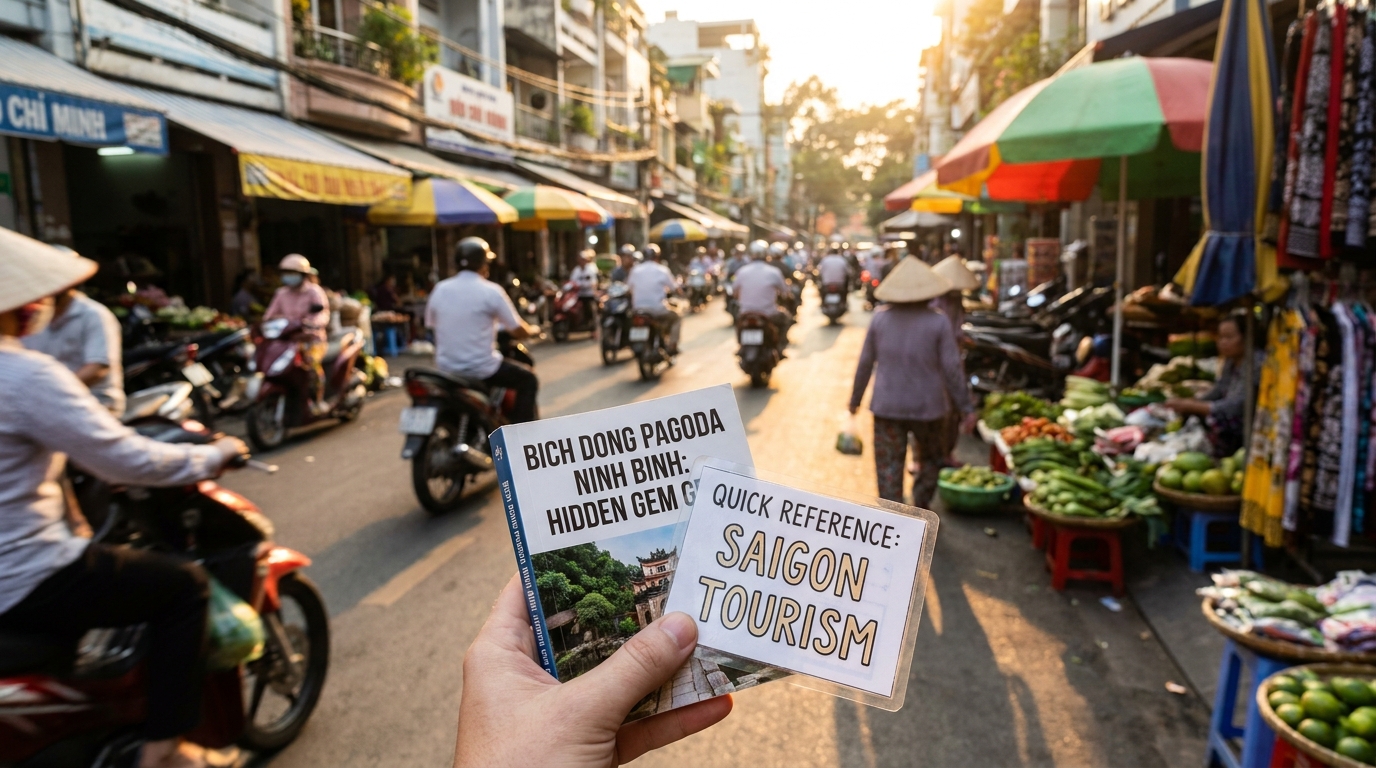
Start Your Vietnam Adventure at Saigon Homestay, District 1
Many international travelers fly into Ho Chi Minh City first — spending a few days in the south before heading north to Hanoi and then out to Ninh Binh. If that’s your plan, Saigon Homestay in District 1 gives you a central, well-connected base to sort out the rest of your Vietnam itinerary.
You’re a short walk from Ben Thanh Market, the War Remnants Museum, and every domestic transport booking office in the city. From District 1, you’re a quick Grab ride to Tan Son Nhat Airport for your Hanoi flight — and you’ll find no shortage of travel desks who can arrange Ninh Binh overnight trips, train bookings, and guided northern circuits.
** Book your stay at Saigon Homestay, District 1** — centrally located, locally knowledgeable, and built for travelers who want to move through Vietnam without the hassle.
Need more ideas for your time in the south? Our guide to things to do in Ho Chi Minh City covers the best neighborhoods, day trips, and restaurants for first-time visitors.
Sources: UNESCO World Heritage Centre — Trang An Landscape Complex, inscribed 2014, retrieved 2026-06-10. Vietnam National Authority of Tourism, Ninh Binh destination profile, retrieved 2026-06-10. Entrance fee and boat pricing verified on-site, May 2026.
Not sure what those dong figures are worth? The Vietnam currency and money exchange guide converts them and lists the ATMs with the lowest fees.