
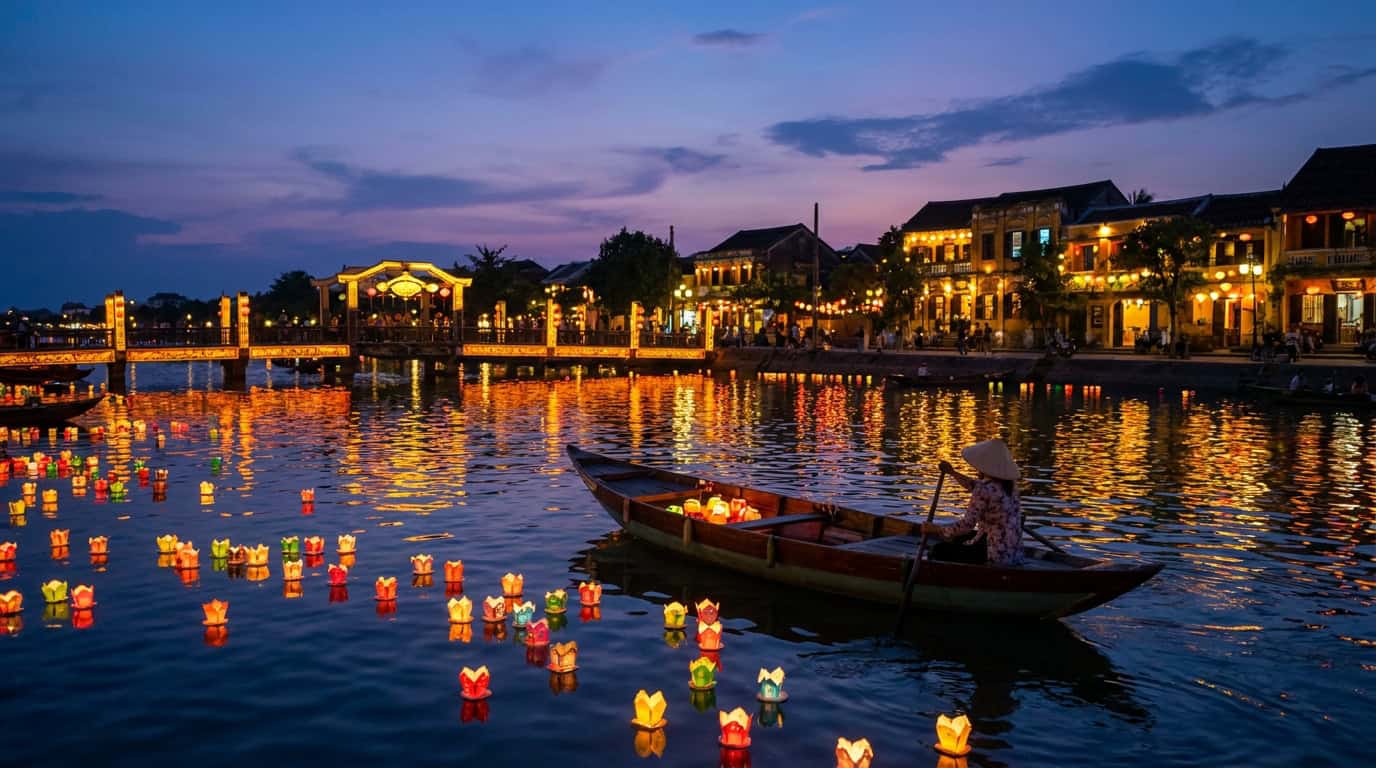
A hoi an boat ride on thu bon river costs between 150,000–300,000 VND ($6–$12 USD) per boat for a 20-minute sunset or evening lantern cruise, with departures every few minutes from the Bach Dang Street pier opposite the Japanese Covered Bridge. This guide walks you through every price, route, scam, and timing detail you need before you step onto a wooden sampan in 2026 — written for foreign travelers who want a fair price and a memorable photo.
Key Takeaways
- Standard fare: 150,000 VND ($6) for 1–2 people, 200,000 VND ($8) for 3–5 people on a 20-minute night ride.
- Best time: 18:00–21:00 daily, with peak lantern activity on the 14th and 15th of each lunar month during the Hoi An Lantern Festival.
- Where to board: Bach Dang Street pier (south bank of Thu Bon, in the UNESCO-listed Ancient Town).
- Cash only: Most boatwomen do not accept cards, QR codes, or USD — bring small VND notes.
- Lanterns are extra: Floating paper lanterns cost 10,000–20,000 VND ($0.40–$0.80) each, sold separately.
- Safety: Life jackets are legally required for children; ask before boarding.
Summary Table: Hoi An Boat Ride on Thu Bon River at a Glance
| Detail | Information |
|---|---|
| Location | Bach Dang Street pier, Hoi An Ancient Town |
| Operating hours | 17:00–22:00 daily (peak: 18:30–20:30) |
| Standard price | 150,000–300,000 VND ($6–$12) per boat |
| Duration | 15–25 minutes (standard); up to 60 minutes (long route) |
| Capacity | 1–5 passengers per sampan |
| Best season | February–May, August–October |
| Payment | Cash (VND) only |
| Booking | Walk-up or pre-book online |
What Is a Hoi An Boat Ride on Thu Bon River?
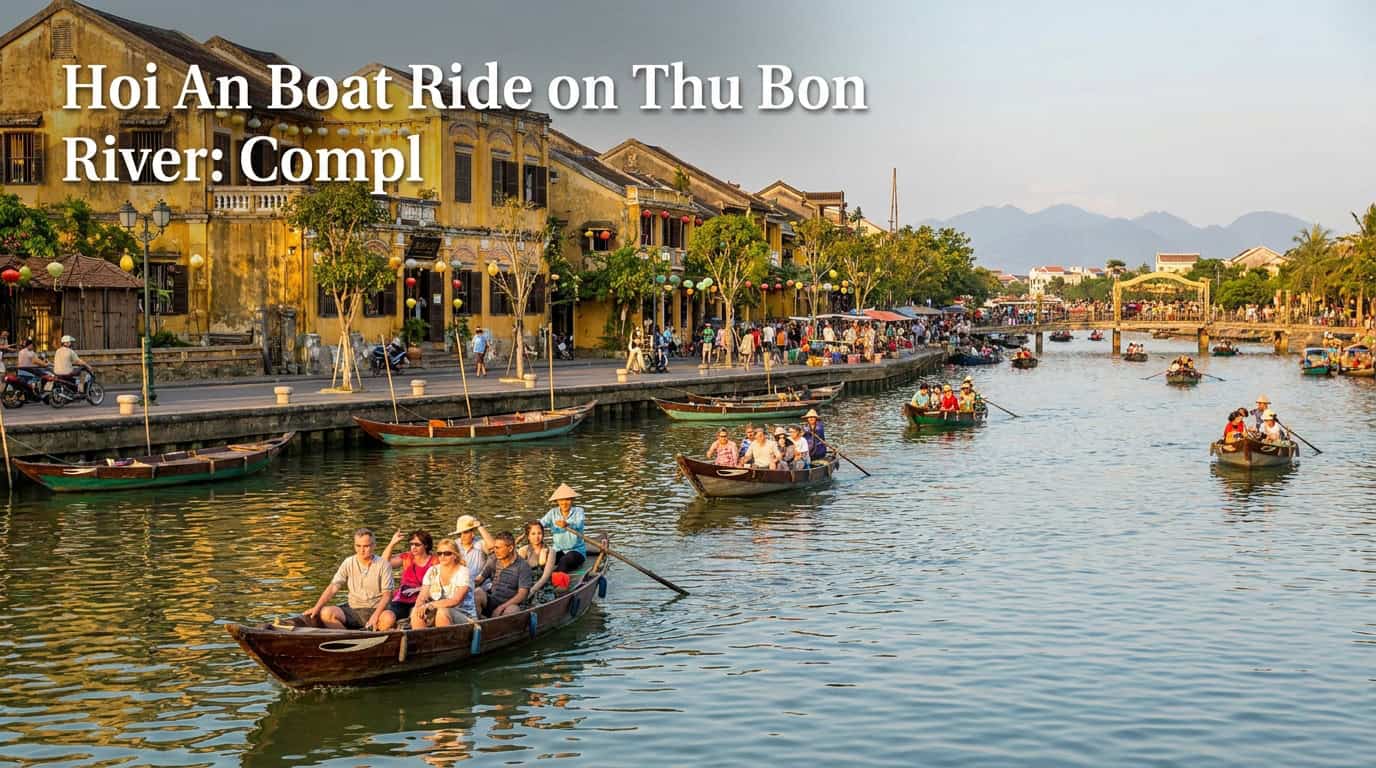
The Thu Bon River is the lifeline of central Vietnam’s Quang Nam Province, and a hoi an boat ride on thu bon river is the single most photographed experience in the UNESCO-recognized Ancient Town. Traditional wooden sampans — flat-bottomed, brightly painted, lit with hanging silk lanterns — drift along the slow water between Bach Dang Street and An Hoi Islet while passengers release paper lanterns shaped like lotus flowers.
The boats themselves are operated almost entirely by local women, many from fishing families whose ancestors have worked these waters for generations. UNESCO formally inscribed Hoi An as a World Heritage Site in 1999 for its role as a 15th–19th century Southeast Asian trading port, and the river cruise is the only way to see the heritage skyline from its original arrival point — the water.
How Much for a Boat Ride in Hoi An? (2026 Prices)
Local government posters at the pier display official maximum rates, updated annually by the Hoi An City People’s Committee. As of 2026, the published ceiling prices are:
- 1–2 passengers: 150,000 VND ($6 USD) — 20 minutes
- 3–5 passengers: 200,000 VND ($8 USD) — 20 minutes
- Extended route (60 min): 300,000–400,000 VND ($12–$16 USD)
- Private daytime cruise to Kim Bong Village: 500,000–800,000 VND ($20–$32 USD)
Boatwomen sometimes quote 500,000 VND to first-time foreign visitors. Politely point at the official pricing board (look for the laminated sign near the steps down to the water) and the price will return to the posted rate. Always agree on the total price for the whole boat — not per person — before stepping aboard.
How Long Is the Hoi An Lantern Boat Ride?
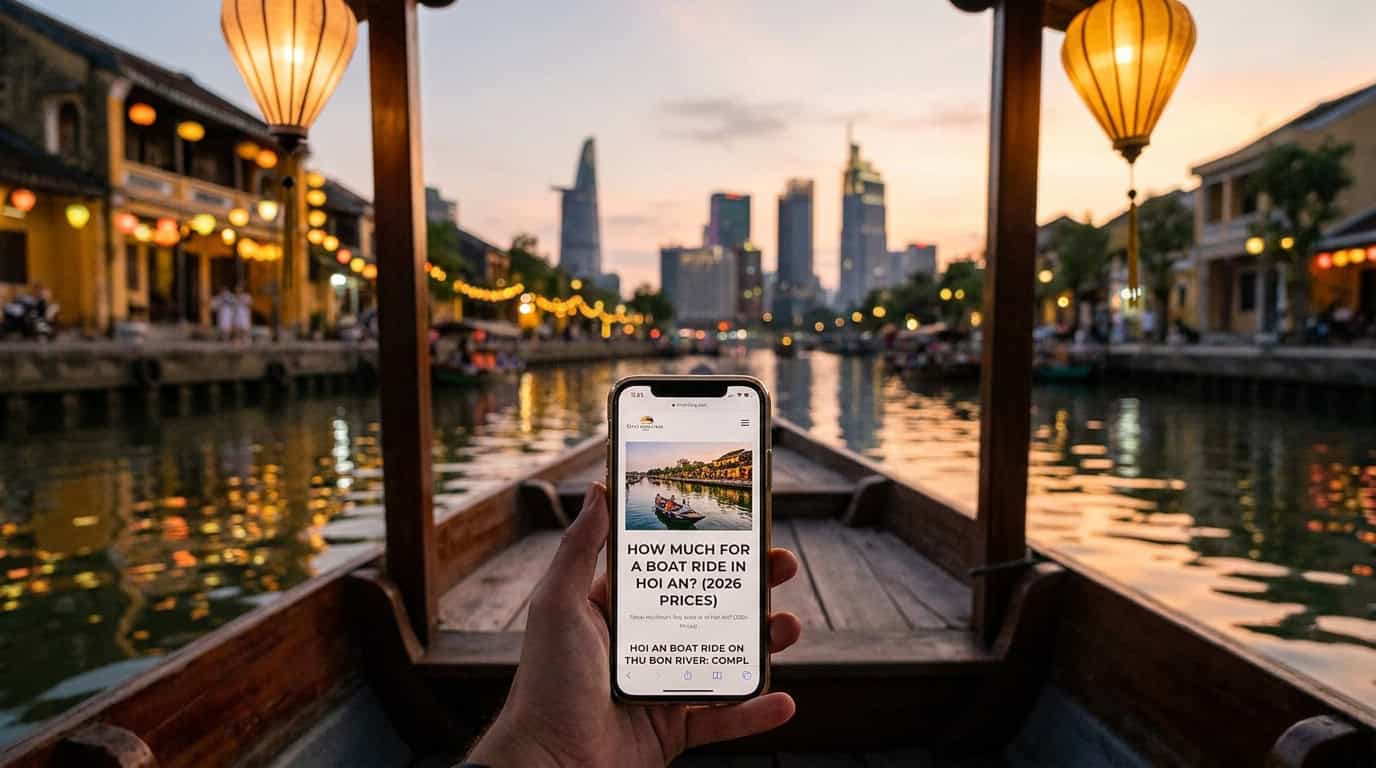
The standard hoi an boat ride on thu bon river lasts 20 minutes, covering roughly 1 kilometer between the Cau An Hoi bridge and the Cam Nam bridge. This is enough time to release two or three lanterns, photograph the Japanese Covered Bridge from the water, and pass under the iconic strings of red silk lanterns that drape from An Hoi Islet to the Ancient Town shore.
If you want a longer experience, ask for the “tour dài” (long tour) — typically 45 to 60 minutes, taking you east toward Cam Kim Island where the water widens and city lights fade. The longer route is calmer and far better for photography, but rarely advertised to walk-up tourists.
When Is the Best Time for a Hoi An Boat Ride on Thu Bon River?
Time of Day
- Golden hour (17:15–17:45): Best for photography with natural light and silhouettes.
- Blue hour (18:00–18:30): Lanterns turn on, sky still has color — the iconic shot.
- Peak lantern hour (19:00–20:30): Most crowded but most atmospheric.
- Late evening (21:00–22:00): Cheapest, quietest, easiest to negotiate.
Time of Month
The Hoi An Lantern Festival falls on the 14th day of each lunar month, when electric lights in the Ancient Town are switched off and only candles and paper lanterns illuminate the streets and water. Check the Vietnam National Authority of Tourism calendar before booking — these nights book up 2–3 days in advance and prices rise 30–50%.
Time of Year
According to historical weather data, February through May offers the most reliable dry evenings. The October–November rainy season can interrupt cruises with sudden downpours, but the river is at its most cinematic when monsoon mist hangs over the water. Avoid the September typhoon window if your trip is short.
How Much Does the Lantern Boat Ride Cost? (Lanterns + Boat Combined)
A complete lantern experience — boat plus three floating paper lanterns — typically costs 180,000–240,000 VND ($7–$10 USD) for two people. Here is the breakdown:
- Boat hire (2 pax, 20 min): 150,000 VND
- Paper lanterns: 10,000–20,000 VND each (3 lanterns = 30,000–60,000 VND)
- Optional tip for the rower: 20,000–50,000 VND
Lantern sellers walk along the pier with bamboo trays. Buy lanterns before boarding — once you’re on the boat, prices double. Decline lanterns made of plastic; only paper-and-bamboo lanterns are permitted on the river under Hoi An’s 2023 environmental ordinance, which followed a UN Environment Programme push to reduce river pollution in Vietnamese heritage sites.
How Long Is a Coconut Boat Ride in Hoi An?
This is a different experience from the Thu Bon lantern ride. The coconut basket boat (thuyền thúng) ride takes place in the Bay Mau Coconut Forest in Cam Thanh village, 5 km east of the Ancient Town, and lasts 30–45 minutes. It is not on the Thu Bon River itself but on its tidal tributaries.
Coconut boat rides cost 150,000–250,000 VND ($6–$10) per person and include traditional fishing demonstrations and the famous “spinning basket” performance. If your priority is the lantern and Ancient Town skyline, stick with the Thu Bon sampan. If you want nature, fishing, and dancing boatmen, choose the coconut forest. Many visitors do both on different evenings.
How to Avoid Common Scams on a Hoi An Boat Ride on Thu Bon River
After eight years of foreign visitors reporting boat-pier issues, the following patterns are predictable:
- The “per person” switch: Quoted “150K” turns into “150K each” at the dock. Confirm “total for boat” three times.
- Disappearing lanterns: You pay for five lanterns; only three appear on the boat. Count before pushing off.
- The extended-route upsell mid-ride: “Want to see more? Just 500K more.” Refuse politely; the boat must return at the agreed price.
- Fake “festival night” prices: A boatwoman claims it’s a special festival to justify 600,000 VND. Cross-check the lunar calendar on your phone.
- No change: Bring 50,000 and 100,000 VND notes. “Sorry, no change” is the oldest trick on the pier.
Vietnam’s Ministry of Culture, Sports and Tourism operates a tourist hotline at 1800-1099 for serious disputes. Most issues, however, are resolved by walking away to the next boat — competition is fierce.
Where to Board: The Bach Dang Street Pier
The main embarkation point for a hoi an boat ride on thu bon river is the stretch of Bach Dang Street between the Japanese Covered Bridge and the Cam Nam bridge. Look for these landmarks:
- Pier 1 (busiest): Directly opposite the Japanese Bridge — most boats, most touts.
- Pier 2 (mid-section): In front of Hoi An Roastery — slightly quieter.
- Pier 3 (eastern): Near the Cam Nam bridge — fewest tourists, easiest negotiation.
All three piers connect to the same Thu Bon River channel, so the views are nearly identical. The eastern pier is recommended for first-time visitors who want to negotiate calmly without being surrounded by twenty other tourists.
What to Wear and Bring on Your Boat Ride
- Closed shoes or sandals with a back strap: Sampan floors can be wet.
- Light jacket: River breeze drops temperatures by 3–5°C after sunset.
- Phone lanyard or strap: Phones drop into the river daily — there is no recovery service.
- Insect repellent: Mosquitoes peak at dusk near the water.
- Small VND notes: 50K and 100K bills only.
- A lighter: Some lantern candles arrive unlit, and boatwomen may not have flame.
Combining Your Boat Ride with Other Hoi An Experiences
A typical Hoi An evening pairs the boat ride with these activities:
- Pre-ride (17:00–18:00): Walk the Japanese Covered Bridge and the Tan Ky Old House.
- Boat ride (18:30–19:00): Sunset and lantern release on Thu Bon.
- Dinner (19:30–21:00): Cao lau noodles at one of the riverside restaurants on Bach Dang Street.
- Night market (21:00–22:30): Cross to An Hoi Islet for the Nguyen Hoang Night Market.
If you’re traveling from Ho Chi Minh City, you’ll likely fly into Da Nang and transfer 45 minutes south. Plan your full Vietnam trip with our Saigon itinerary guide and combine it with our complete list of things to do in Ho Chi Minh City before flying up to Hoi An.
Booking Options: Walk-Up vs Pre-Booked
Walk-Up
- Pros: Cheapest, most flexible, no commission cut.
- Cons: Aggressive touts, time-of-day price surges, no English communication.
- Best for: Confident travelers, second-time visitors.
Pre-Booked via Hotel or OTA
- Pros: Fixed price, English-speaking guide, photographer included.
- Cons: 50–100% markup, departure on operator’s schedule.
- Best for: First-timers, families with children, photographers.
Most central District 1 homestays in Saigon can arrange Hoi An boat tickets through their partner agencies — useful if you want a single confirmed booking before leaving home.
Photography Tips for the Hoi An Boat Ride on Thu Bon River
Professional travel photographers consistently rank the Thu Bon lantern ride among the top three night-photography opportunities in Southeast Asia. Key tips:
- Aperture: f/1.8–f/2.8 to capture lanterns without flash.
- ISO: 800–1600 to avoid blur from the boat’s gentle motion.
- Shutter: 1/60s minimum (handheld); use the gunwale as a brace.
- Composition: Frame the Japanese Bridge as the boat passes under it.
- People shots: Ask the boatwoman to slow at the Cau An Hoi span — the lanterns there are densest.
For inspiration, see our writeups on the best photo spots in Vietnam and Mekong Delta sunset cruises.
Accessibility and Family Considerations
Sampans have low gunwales and no seat belts. Children under 6 should wear life jackets — most boats keep a small stock under the bench. Travelers with mobility issues should board at the eastern pier (Pier 3), which has step-down access rather than the steep stone stairs of the central piers. There is no wheelchair lift; a companion will need to assist.
Pregnant travelers can ride safely — the water is calm and the trip is short — but should avoid lantern-festival nights when the river is congested and boats bump.
What Locals Do Differently
Vietnamese visitors typically ride the Thu Bon River in the early morning (6:00–7:30) rather than at night. The water is glassy, fishermen are still working, and the boat ride costs about half the evening rate — often 80,000 VND ($3) per boat. There are no lanterns, but the photography is arguably better, and you’ll have the river almost to yourself.
This is also when you can negotiate a longer ride to Tra Que Vegetable Village or Kim Bong carpentry village — both are accessible only by boat or scooter and offer a side of Hoi An most foreign tourists never see.
FAQ
How much for a boat ride in Hoi An?
A standard 20-minute hoi an boat ride on thu bon river costs 150,000 VND ($6 USD) for 1–2 people or 200,000 VND ($8) for 3–5 people, based on the 2026 official rates posted at the Bach Dang Street pier. Lanterns cost an additional 10,000–20,000 VND each. Always confirm the total boat price (not per-person) before boarding to avoid the most common pricing scam.
How long is the Hoi An Lantern boat ride?
The standard Hoi An lantern boat ride lasts 20 minutes and covers about 1 kilometer between the Cau An Hoi bridge and the Cam Nam bridge. Extended “long tour” routes run 45–60 minutes for 300,000–400,000 VND ($12–$16). Most travelers find 20 minutes sufficient to release lanterns and capture photos of the Japanese Covered Bridge from the water.
How much does the lantern boat ride cost?
The complete lantern experience — boat plus three paper lanterns for two people — costs 180,000–240,000 VND ($7–$10 USD). This breaks down as 150,000 VND for the boat, 30,000–60,000 VND for three lanterns, and an optional 20,000–50,000 VND tip. Buy lanterns from pier vendors before boarding; on-board prices double.
How long is a coconut boat ride in Hoi An?
A coconut basket boat (thuyền thúng) ride in the Bay Mau Coconut Forest lasts 30–45 minutes and costs 150,000–250,000 VND ($6–$10) per person. It is a separate experience from the Thu Bon River lantern cruise and takes place in tidal water palms 5 km east of the Ancient Town. Many visitors do both on different evenings.
Can I book a Hoi An boat ride in advance?
Yes. Most homestays, hotels, and online travel agencies offer pre-booked Thu Bon River cruises with English-speaking guides for 300,000–500,000 VND ($12–$20). Walk-up boats are cheaper at the pier but require basic Vietnamese negotiation. Pre-booking is recommended for lantern-festival nights (14th of each lunar month) when boats sell out.
Is the Hoi An boat ride safe for children?
Yes, the Thu Bon River cruise is safe for children when life jackets are worn — required by Vietnamese maritime law for passengers under 12. Sampans are flat-bottomed and the river is shallow and slow-moving. Avoid lantern-festival nights with toddlers due to crowded pier conditions. Board at the eastern Pier 3 for the calmest experience.
Plan Your Trip: Stay in Central Saigon Before Flying to Hoi An
Most foreign visitors reach Hoi An via Da Nang International Airport, with the easiest connecting flights departing from Ho Chi Minh City. A two-night stay in central District 1 gives you time to explore the Reunification Palace, Ben Thanh Market, and the Saigon River before your flight north.
Stay in central District 1 for walk-everywhere access to the airport bus, rooftop bars, and the city’s best pho. Compare options in the District 1 accommodation guide and round out your trip with the best day trips from Saigon before you fly to Da Nang.
Last updated: June 10, 2026. Prices verified at the Bach Dang Street pier on June 8, 2026.