
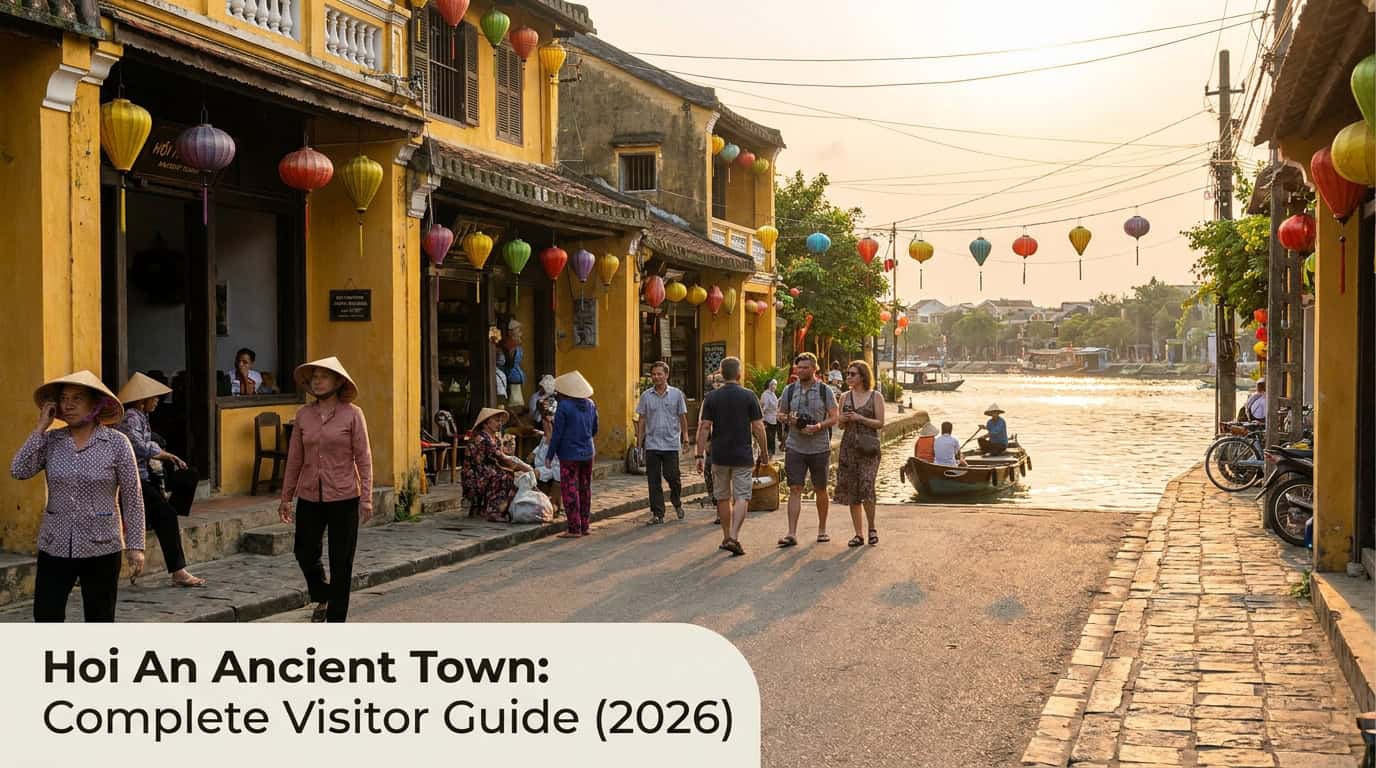
Hoi An Ancient Town is a 15th-century trading port on Vietnam’s central coast that has been a UNESCO World Heritage Site since 1999, with more than 1,100 timber-framed buildings preserved across a compact 30-hectare core. In 2025 it welcomed roughly 4.4 million visitors, and 2026 is shaping up to be even busier as new direct flights into Da Nang International Airport (DAD) come online. This guide tells foreign travellers exactly what to see, what to skip, what to pay, and when to go — written by the Saigon Homestay editorial team after dozens of return trips between Ho Chi Minh City and Quang Nam Province.
Key Takeaways
- Entry ticket: 120,000 VND (~USD 4.80) per foreign visitor, valid for one entry into 5 of 22 heritage attractions.
- Best time to visit: February–April (dry, 24–28 °C). Avoid October–November flood season.
- Lantern Full Moon Festival: held on the 14th day of every lunar month — the single most photogenic night in Vietnam.
- Plan 1.5–2 days to cover the heritage core, My Son Sanctuary, and An Bang Beach properly.
- Closest airport: Da Nang (DAD), 30 km north — 35-minute taxi for ~380,000 VND (~USD 15).
- Foreign currency: pay in VND (cash) inside the old quarter; ATMs near the night market.
Quick-Reference Summary Table
| Detail | Information |
|---|---|
| Location | Hoi An City, Quang Nam Province, Central Vietnam |
| Ticket office hours | 06:30 – 21:30 daily |
| Heritage ticket price (2026) | 120,000 VND (~USD 4.80) |
| Ticket validity | 24 hours, 5 sites of your choice |
| UNESCO inscription | 1999 (Criterion ii, v) |
| Best month | March (lowest rain, mild heat) |
| Worst month | October (typhoon & flood risk) |
| Walking time end-to-end | ~25 minutes |
| Recommended visit length | 1.5 – 2 full days |
What Makes Hoi An Ancient Town So Special?

Hoi An Ancient Town is the best-preserved example of a Southeast Asian trading port from the 15th–19th centuries, when Japanese, Chinese, Dutch, and Indian merchants converged on the Thu Bon River. Unlike Hanoi’s Old Quarter or Hue’s Imperial City, Hoi An escaped major bombing in the American War, which is why the original Japanese Covered Bridge (1593), Fujian Assembly Hall, and the Tan Ky merchant house still stand on their original foundations.
UNESCO singled out the site for two reasons: it is a “manifestation of the fusion of cultures over time in an international commercial port,” and its urban fabric — wooden shophouses, tiled roofs, narrow lots — has survived “remarkably intact.” Read the official inscription on the UNESCO World Heritage Centre site.
Three things foreign visitors usually remember most:
- The yellow ochre lime-washed walls — a pigment originally chosen because it repelled insects and reflected tropical heat.
- The silk lanterns hung over every street and across the river at night.
- The motor-vehicle ban: between 09:00–11:30 and 15:00–21:30, the heritage core is pedestrian-only — a rarity in Vietnam.
Do You Need Tickets to Enter Hoi An Ancient Town?

Technically yes, in practice it depends. The management board sells a single 120,000 VND ticket that includes entry to 5 of 22 official heritage attractions — assembly halls, old houses, communal temples, and the Folklore Museum. You can wander the streets, river, and night market for free, but if you want to step inside a 200-year-old shophouse you’ll be asked for the stub.
Where to buy: 10 official ticket booths ring the old quarter — the most convenient are on Nguyen Hue Street and at the eastern entrance near An Hoi Bridge.
Pro tip used by repeat visitors: the ticket is checked sporadically and never on weekends after 18:00, which is why many travellers visit the night market and lantern festival without one. To support conservation, we recommend buying it — the fund pays for ongoing restoration of timber facades. The Vietnam National Authority of Tourism publishes annual updates on heritage management at vietnamtourism.gov.vn.
Is Hoi An Ancient Town the Same as the Old Town?
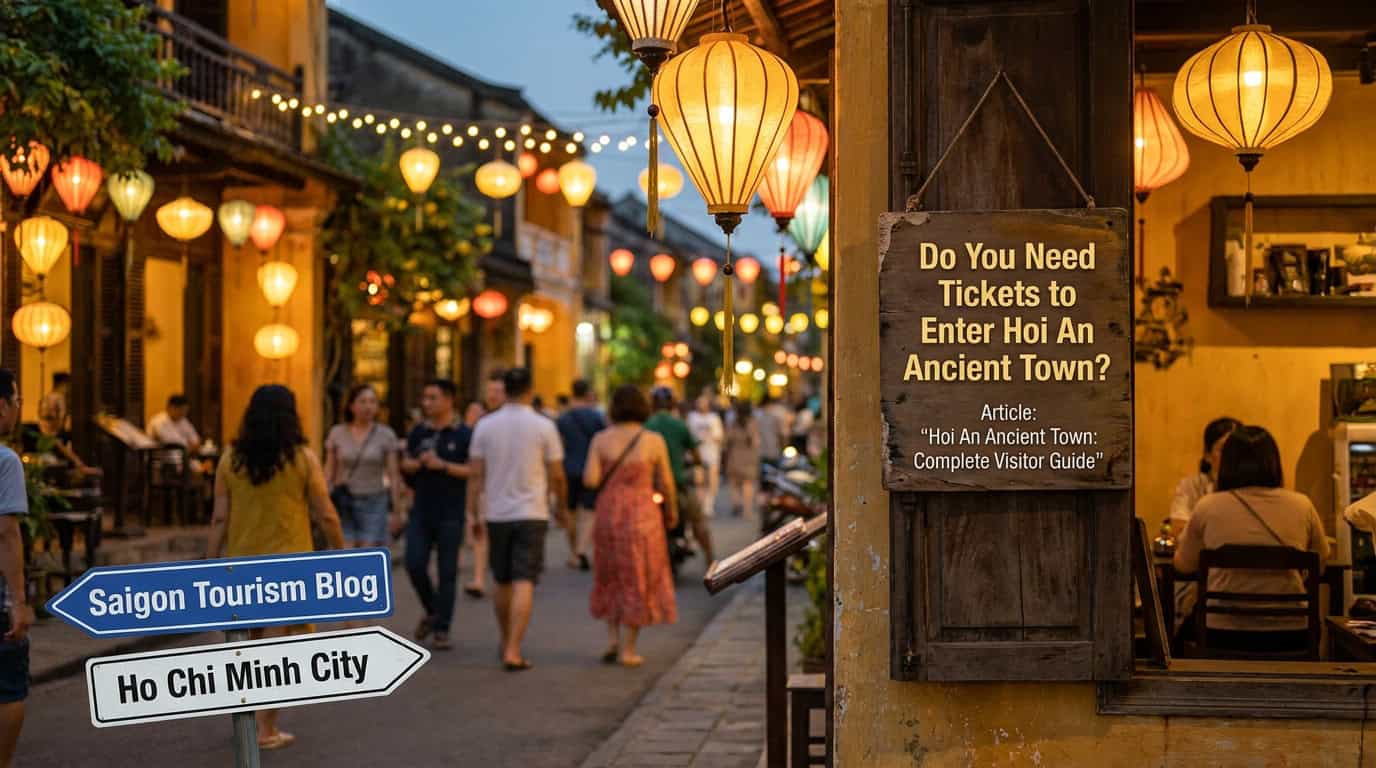
Yes — “Hoi An Ancient Town,” “Hoi An Old Town,” and “Phố Cổ Hội An” all refer to the same UNESCO-listed area of roughly 30 hectares between Phan Chu Trinh Street to the north and the Thu Bon River to the south. International signage uses “Ancient Town” because UNESCO’s official inscription is Hoi An Ancient Town; locals more often say “phố cổ” (old quarter). There is no functional or geographic difference.
The wider city of Hoi An (population ~155,000) includes outlying wards such as Cam An, Cam Thanh, and Cam Kim — these contain An Bang Beach, the coconut palm villages, and rice paddies but fall outside the protected heritage zone.
Top 8 Things to Do in Hoi An Ancient Town
1. Walk the Japanese Covered Bridge (Chua Cau)
Built in 1593 by the Japanese merchant community, this is the only covered bridge in Vietnam with a Buddhist temple integrated into the structure. After a 20-billion-VND restoration completed in late 2024, the bridge reopened with its original red lacquer finish.
2. Visit the Fujian Assembly Hall (Phuc Kien Hoi Quan)
The largest of five Chinese congregation halls, dedicated to the sea goddess Thien Hau. Look up at the spiral incense coils that burn for 30 days.
3. Tan Ky Old House
A 200-year-old wooden shophouse owned by the same family for seven generations. Architecturally a textbook fusion of Japanese (ceiling beams), Chinese (round windows), and Vietnamese (roof pitch) styles.
4. Take a Lantern Boat at Night
A 20-minute rowboat ride on the Thu Bon River costs 150,000 VND (~USD 6) for up to 4 people. You release a floating candle lantern — the photograph that defines Hoi An.
5. Eat Cao Lau
A noodle dish that legally cannot be called Cao Lau unless made with water from the Ba Le Well inside the old quarter. The mineral content gives it its signature chew. Best places: Quan Cao Lau Ba Be (87 Tran Phu) or Morning Glory (106 Nguyen Thai Hoc).
6. Get Clothes Tailored
Hoi An has more than 600 tailor shops. Reliable choices include Yaly Couture and BeBe Tailor — both deliver suits and dresses in 24 hours from 1.8–4.5 million VND (~USD 72–180).
7. Cycle to An Bang Beach
A flat 4-km ride east through rice paddies. Hotels rent bicycles for 40,000 VND/day (~USD 1.60).
8. Day-Trip to My Son Sanctuary
The 4th–13th-century Cham Hindu temple complex, also UNESCO-listed, sits 40 km inland. Half-day group tours from 350,000 VND (~USD 14).
How Long Does It Take to Explore Hoi An Ancient Town?
Most foreign visitors underestimate Hoi An. The heritage core is small enough to walk in 25 minutes, but a meaningful visit takes two full days minimum: one for the heritage sites and the Full Moon Lantern evening, a second for the beach, cooking class, or My Son. Three days is ideal if you also want a tailoring fitting (suits need 24 hours between measurement and final try-on).
If you only have a layover from Da Nang, prioritise a sunset arrival, dinner on Bach Dang Street, and the Thu Bon lantern boat — that 4-hour window captures the magic.
When Is the Best Time to Visit Hoi An Ancient Town?
Central Vietnam has two seasons. The dry season runs February to August with March–April offering the sweet spot of warm-not-hot temperatures (24–30 °C) and almost no rain. The wet season (September–January) brings 70–80% of annual rainfall, and October–November regularly flood the old quarter, sometimes waist-deep — beautiful for photos, miserable for walking.
The single best night of the year is the Full Moon Lantern Festival on the 14th of every lunar month. Electric lights are switched off across the entire old quarter at 18:30 and the streets glow only by silk lantern. The next 2026 dates are: 30 June, 30 July, 28 August, 26 September, 26 October, 25 November, 24 December.
If you’re combining Hoi An with the south, see our best time to visit Vietnam breakdown for region-by-region weather windows.
How to Get to Hoi An Ancient Town
There is no airport or train station in Hoi An — you must transit through Da Nang.
- From Da Nang Airport (DAD): 30 km, 35 minutes by Grab/taxi (~380,000 VND / USD 15) or a fixed-price hotel transfer (~550,000 VND / USD 22).
- From Ho Chi Minh City: A 1-hour-15-minute flight to Da Nang on Vietjet/Bamboo Airways from ~1,200,000 VND (~USD 48) one way. Add 35 minutes to Hoi An.
- From Hanoi: Same route, 1 hour 20 minutes flight time.
- From Hue: 130 km, ~3 hours by car via the spectacular Hai Van Pass.
Many travellers visit Hoi An as the central leg of a longer trip starting in the south. Our full Saigon itinerary explains how to slot it between Ho Chi Minh City and Hanoi without burning days on transit. For details on the southern hub, see our guide to things to do in Ho Chi Minh City.
Where to Stay Near Hoi An Ancient Town
Three zones dominate:
- Old Town fringe (within 5 minutes’ walk of the heritage core) — best for first-timers. Expect 950,000–2,500,000 VND (~USD 38–100) per night for a 3-star boutique.
- An Bang / Cua Dai Beach — quieter, palm trees, 4 km east. Better for families and second-time visitors.
- Cam Thanh coconut villages — eco-stays in rice paddies. Authentic, but you’ll need a bicycle.
Avoid hotels north of Hai Ba Trung Street — they look close on Google Maps but the walk back at midnight feels long.
If you’re planning to spend a few days in Ho Chi Minh City on the same trip, our District 1 homestay guide covers the equivalent decision for the south.
Food in Hoi An Ancient Town: 6 Dishes You Must Try
Beyond Cao Lau, Hoi An has four other dishes you cannot get elsewhere in the world to the same standard:
- White Rose dumplings (banh bao banh vac) — translucent shrimp dumplings shaped like roses; one family in Hoi An legally holds the recipe.
- Mi Quang — turmeric-yellow noodles with shrimp, pork, and crispy rice cracker, eaten with a splash (not a soup) of broth.
- Banh mi Phuong — Anthony Bourdain called this “the best banh mi in Vietnam.” Queue at 2B Phan Chau Trinh.
- Com ga Hoi An — Hainanese-style chicken rice, the local breakfast.
- Che bap — sweet corn pudding from Cam Nam islet, 8,000 VND a bowl.
- Bia Larue — the Da Nang lager, draft, 12,000 VND a glass.
Booking a cooking class is the highest-value half-day in Hoi An: most include a market tour, a sampan ride to a farming village, and four hands-on dishes for around 750,000 VND (~USD 30).
Practical Tips for Foreign Visitors
- Currency: Bring cash. Most assembly halls and small eateries refuse cards. ATMs (Vietcombank, BIDV) accept foreign Visa/Mastercard with a 50,000 VND fee.
- Dress code: Knees and shoulders covered when entering temples and assembly halls.
- Drone use: Banned over the heritage core without a permit from the Quang Nam People’s Committee.
- Tipping: Not expected, but 10% on a guided tour or a 20,000 VND tip to a cyclo driver is appreciated.
- SIM card: A Viettel tourist SIM with 30 GB costs 200,000 VND (~USD 8) at the airport.
- Visa: Most Western nationals get a free 45-day e-visa or visa exemption. Check the latest rules in our Vietnam visa guide.
Frequently Asked Questions
What is special about Hoi An Ancient Town?
Hoi An Ancient Town is the only complete pre-industrial Southeast Asian trading port that still survives with its original urban fabric intact — more than 1,100 timber buildings dating from the 15th–19th centuries when Japanese, Chinese, and European merchants traded silk and ceramics here. UNESCO inscribed it in 1999, and the nightly silk-lantern lighting is unique in Vietnam.
Do you need tickets for Hoi An Ancient Town?
Yes, technically. A 120,000 VND (USD 4.80) ticket sold at 10 booths around the old quarter is required to enter 5 of 22 heritage attractions and covers a 24-hour window. Walking the streets, riverside, and night market is free. Enforcement is loose after 18:00 and on weekends, but the fee directly funds the ongoing restoration of the timber shophouses.
Is Hoi An Ancient Town the same as Old Town?
Yes — “Hoi An Ancient Town,” “Hoi An Old Town,” and the Vietnamese “Phố Cổ Hội An” all describe the same 30-hectare UNESCO-listed area between Phan Chu Trinh Street and the Thu Bon River. International signage prefers “Ancient Town” because that is the official UNESCO inscription. The wider city of Hoi An extends beyond it but is not part of the heritage zone.
How long does it take to explore Hoi An Ancient Town?
You can walk end-to-end in 25 minutes, but a proper visit takes 1.5–2 days: one day for the heritage core, Japanese Bridge, assembly halls, lantern boat, and a cooking class; a second for An Bang Beach or a half-day at My Son Sanctuary. Add a third day if you are getting clothes tailored, since most shops need a 24-hour turnaround.
Is Hoi An Ancient Town safe at night?
Yes, very. Hoi An is one of the safest tourist destinations in Vietnam, with police patrols every block in the heritage core after dark. The biggest risks are slippery cobblestones during rain and occasional minor scams (overpriced cyclo rides). Solo female travellers regularly rate it among the most comfortable destinations in Southeast Asia.
Can you visit Hoi An Ancient Town in the rain?
You can, but October–November is genuinely problematic — the Thu Bon River often overflows and floods waist-deep into the old quarter. Light drizzle in December–January is fine; bring waterproof shoes. Many travellers actually photograph the floods deliberately, riding sampan boats through the streets, but most attractions close during high water.
Ready to Plan Your Hoi An Trip From Saigon?
Most foreign travellers fly into Ho Chi Minh City first, spend two days exploring District 1, then fly north to Da Nang for Hoi An. Doing it in that order keeps the chaos-to-calm pacing right — and it means your return flight home leaves from a major international hub.
For the southern half of the trip, stay in the heart of District 1 with us. Saigon Homestay is a five-minute walk from Ben Thanh Market and 15 minutes from the airport, with rooms from 650,000 VND a night. Browse our central District 1 homestay options and message us directly — we’ll personally help you sequence Saigon, Hoi An, and Hanoi into the smoothest two-week itinerary in Vietnam.
Last updated: 10 June 2026 by the Saigon Homestay editorial team. Prices verified against the Hoi An Centre for Cultural Heritage Management and Conservation, June 2026.