
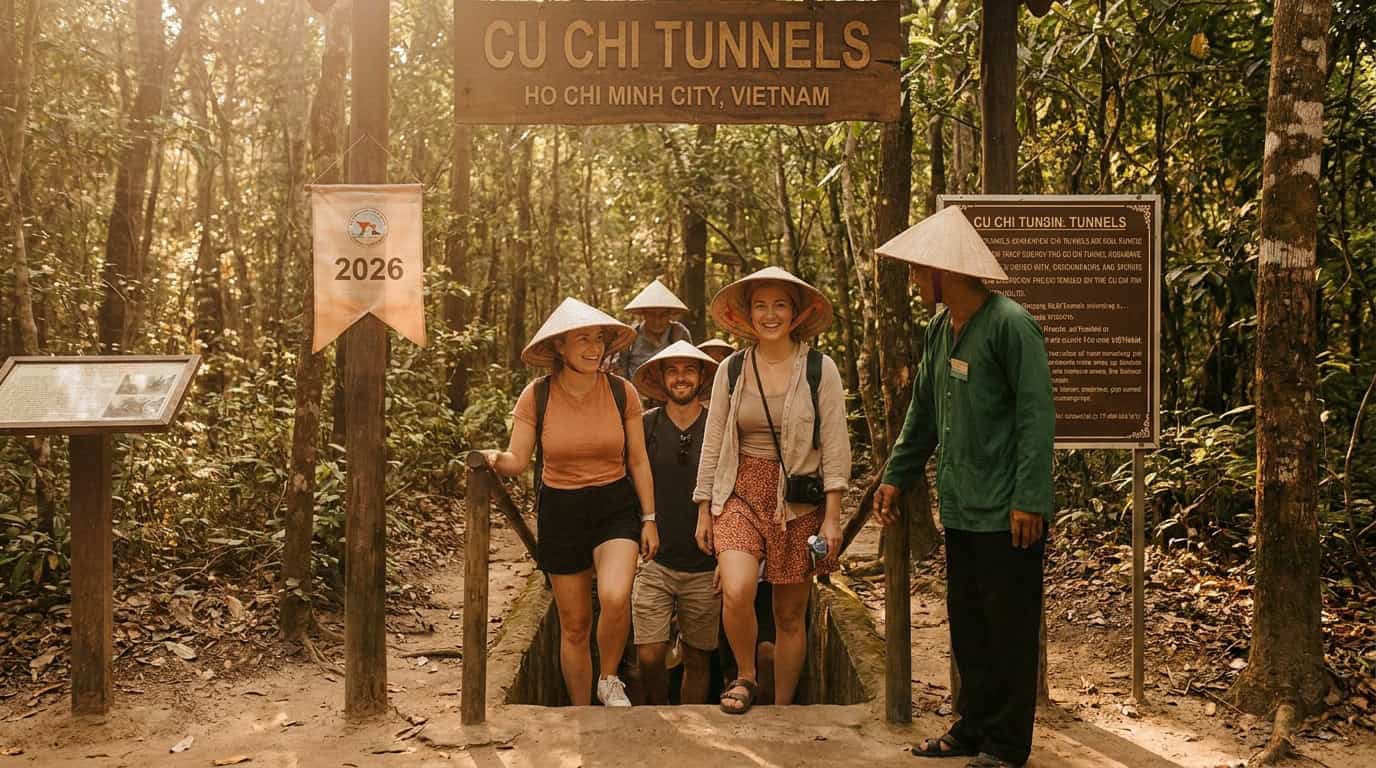
If you have one day in Saigon and want to understand the city’s most defining chapter, the Cu Chi Tunnels are non-negotiable. This 250-kilometer underground network, dug by hand over more than 25 years, is where Vietnam’s most legendary guerrilla campaign was planned, supplied, and survived. In 2026, the site is more accessible than ever — but it’s also busier, more commercial, and more confusing to navigate than most guidebooks admit.
This guide cuts through the noise. We’ll cover exactly how to get to the Cu Chi Tunnels from central Ho Chi Minh City, which of the two tunnel sites to choose, what your ticket actually buys you, and what to expect once you’re crawling 1.2 meters underground. Everything below is based on visits, reader feedback from guests of our District 1 homestays, and the latest 2026 operator pricing.
Quick Summary: Cu Chi Tunnels at a Glance
| Detail | Information |
|---|---|
| Location | Cu Chi District, ~70 km northwest of Ho Chi Minh City |
| Two sites | Ben Dinh (closer, more touristed) & Ben Duoc (further, more authentic) |
| Opening hours | 07:00 – 17:00 daily (last entry 16:30) |
| Ticket price (2026) | 125,000 VND (~US$5) per adult; children under 7 free |
| Best time to visit | December – March (dry season); arrive before 09:00 |
| Time needed on-site | 2 – 3 hours |
| Total trip from Saigon | 5 – 8 hours depending on transport |
| Shooting range (optional) | 40,000 – 60,000 VND per bullet |
What Are the Cu Chi Tunnels Famous For?

The Cu Chi Tunnels are famous for being the longest, most sophisticated guerrilla tunnel network in modern military history. Built by Viet Minh fighters in the late 1940s and dramatically expanded by the Viet Cong during the American War (Vietnam War), the network stretched roughly 250 km at its peak — connecting villages, supply routes, and command centers all the way from the outskirts of Saigon to the Cambodian border.
What makes the site unique today is that you can actually go inside. A short section has been carefully widened from the original 0.8 m × 0.6 m crawl space to accommodate modern visitors, but the rest remains close to original dimensions. Most travelers leave with three takeaways: the engineering ingenuity (kitchens with smoke-dispersal vents, underground hospitals, booby-trap workshops), the sheer physical hardship of tunnel life, and a much more grounded understanding of why the war ended the way it did.
According to UNESCO’s tentative World Heritage listing, the Cu Chi Tunnels are considered one of Vietnam’s most significant 20th-century heritage sites, and Vietnam has been pursuing formal inscription since 2024.
What Happened at the Cu Chi Tunnels?
The Cu Chi area sat at a critical strategic location: close enough to Saigon to threaten the capital, but far enough into rural terrain to be defensible. From 1965 onward, the U.S. 25th Infantry Division established its main base at Dong Du, directly above part of the tunnel system — without knowing it for months.
What happened underground over the next decade became a textbook case in asymmetric warfare:
- Operation Crimp (1966): 8,000 U.S. and Australian troops attempted to clear the tunnels. They failed.
- Operation Cedar Falls (1967): A scorched-earth bulldozing and bombing campaign across the “Iron Triangle.” The tunnels survived.
- “Tunnel Rats”: A specialist unit of small-statured U.S. soldiers volunteered to descend into the tunnels armed with pistols and flashlights. Casualty rates were among the highest of any role in the war.
- The Tet Offensive (1968): The Cu Chi network served as the staging ground for attacks on Saigon, including the assault on the U.S. Embassy.
By 1969, the U.S. resorted to B-52 carpet bombing the area. Much of the surface was reduced to a moonscape — yet portions of the tunnel system remained functional until the end of the war in 1975.
Ben Dinh vs Ben Duoc: Which Tunnel Site Should You Choose?
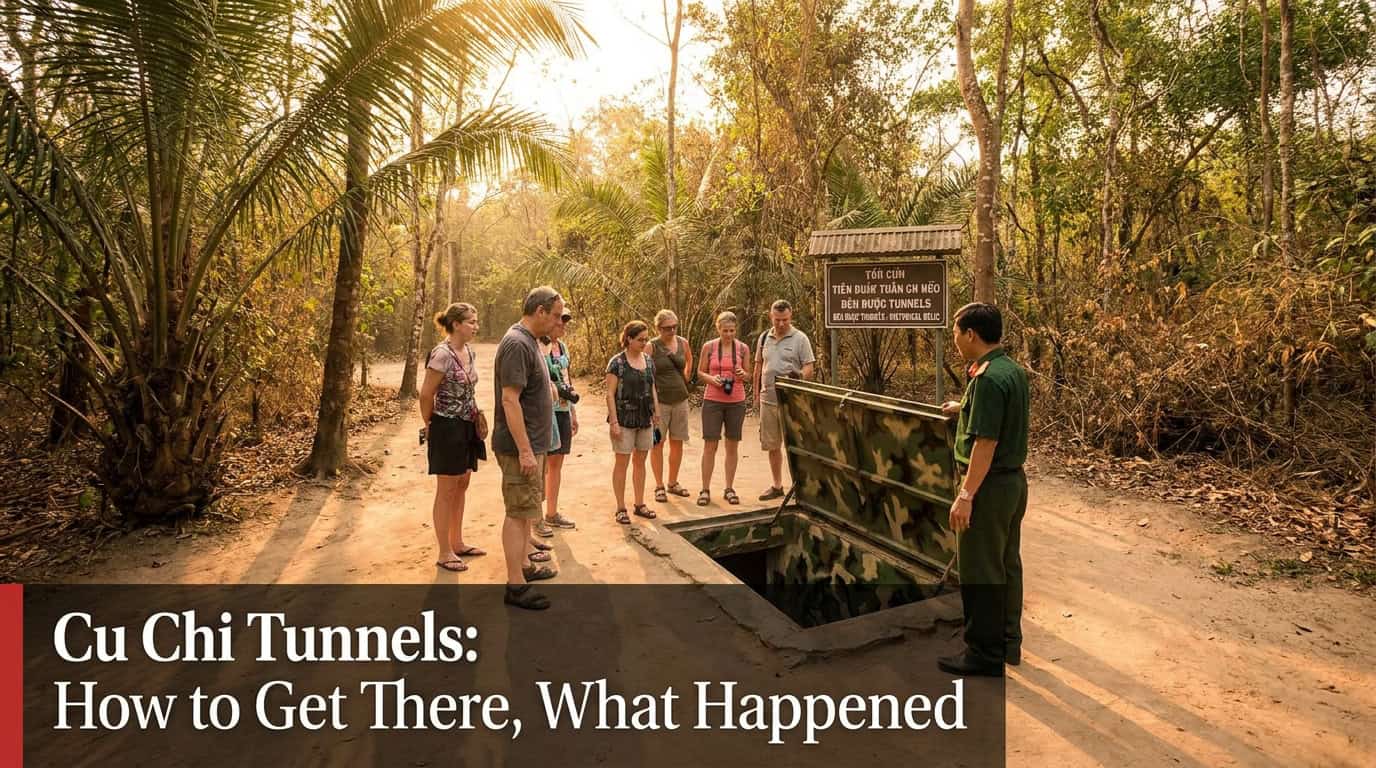
The single most common question we get from guests at our homestays is which site to visit. Both are part of the same historical complex, but the experience is meaningfully different.
Ben Dinh (Bến Đình)
- Distance from Saigon: ~50 km
- Best for: First-time visitors, group tours, time-pressed travelers
- Vibe: More touristed, English-fluent guides, larger crowds
- Tunnel section: Widened more aggressively for Western body sizes
Ben Duoc (Bến Dược)
- Distance from Saigon: ~70 km
- Best for: Repeat visitors, history buffs, photographers, anyone who wants fewer crowds
- Vibe: More authentic, closer to original conditions, larger memorial complex
- Tunnel section: Slightly less modified; lower ceilings, narrower passages
If it’s your first time and you’re booking a group day tour, you’ll likely be sent to Ben Dinh by default. If you’re traveling independently and want the more atmospheric visit, choose Ben Duoc — and combine it with the adjacent Cu Chi Memorial Temple, which honors more than 45,000 Vietnamese soldiers and civilians who died in the district.
How to Get to Cu Chi Tunnels from Ho Chi Minh City

You have four realistic options in 2026. Each has trade-offs in cost, time, and comfort.
Option 1: Speedboat via the Saigon River (Most Scenic)
The Les Rives or Saigon Riverboat speedboat trips depart from piers in District 1, run up the Saigon River for about 75 minutes, and dock directly at Ben Duoc. Including return, lunch, and guide, expect to pay US$75 – US$110 per person. This is the most comfortable and the most photogenic way to make the trip, and it’s what we recommend for travelers who only have one full day.
Option 2: Group Day Tour by Bus (Cheapest)
Hundreds of operators around Pham Ngu Lao and De Tham streets sell half-day group tours to Ben Dinh for US$8 – US$15 per person, including transport, entrance fee, and an English-speaking guide. Pickup is usually around 07:30 with return by 14:00. This is the best-value option, but expect a packed minibus, occasional handicraft-shop detours, and a fast-moving itinerary.
For a more curated experience, look for “small group” or “non-stop” tours in the US$25 – US$45 range — these skip the souvenir-shop stops.
Option 3: Private Car with Driver (Most Flexible)
Hiring a private car for the day from your homestay or via apps like Xanh SM, Grab Car Hourly, or Klook costs 1,200,000 – 1,800,000 VND (US$48 – US$72) for a 7-hour rental, regardless of group size up to 4. This is the option we recommend for families or anyone who wants to combine Cu Chi with the Cao Dai Temple in Tay Ninh.
Option 4: Public Bus (Most Adventurous)
The genuinely budget approach: take Bus 13 from September 23 Park (Sài Gòn Bus Station) to Cu Chi Bus Station (~90 minutes, 20,000 VND). Then transfer to Bus 79 to Ben Duoc (~60 minutes, 15,000 VND). Total cost: under US$2 each way. Total time: 5 – 6 hours roundtrip just for transit. Doable if you speak some Vietnamese and start at 06:00.
If you’re staying in a District 1 homestay near Ben Thanh Market, all four options are within a 10-minute walk or scooter ride.
What to Expect On-Site
Most visitors are surprised at how much there is to see beyond the tunnels themselves. A typical 2 – 3 hour visit follows this rough flow:
- Introductory film (15 min): A black-and-white documentary screened in an open-air auditorium. The narration is dated and propagandistic in tone, but the archival footage is genuinely rare.
- Outdoor exhibits: Reconstructed booby traps (punji pits, swing traps, folding-chair traps), B-52 bomb craters, and a destroyed M48 tank you can climb on.
- The tunnel descent: The signature experience. You’ll crawl through a 100-meter section with exit points at 20 m, 40 m, 60 m, 80 m, and 100 m, so you can bail out if claustrophobia kicks in.
- Underground meeting rooms and field kitchen: Larger chambers reconstructed for visitors, complete with the Hoang Cam stove — a famous design that filtered smoke through multiple chambers to disperse it before it reached the surface.
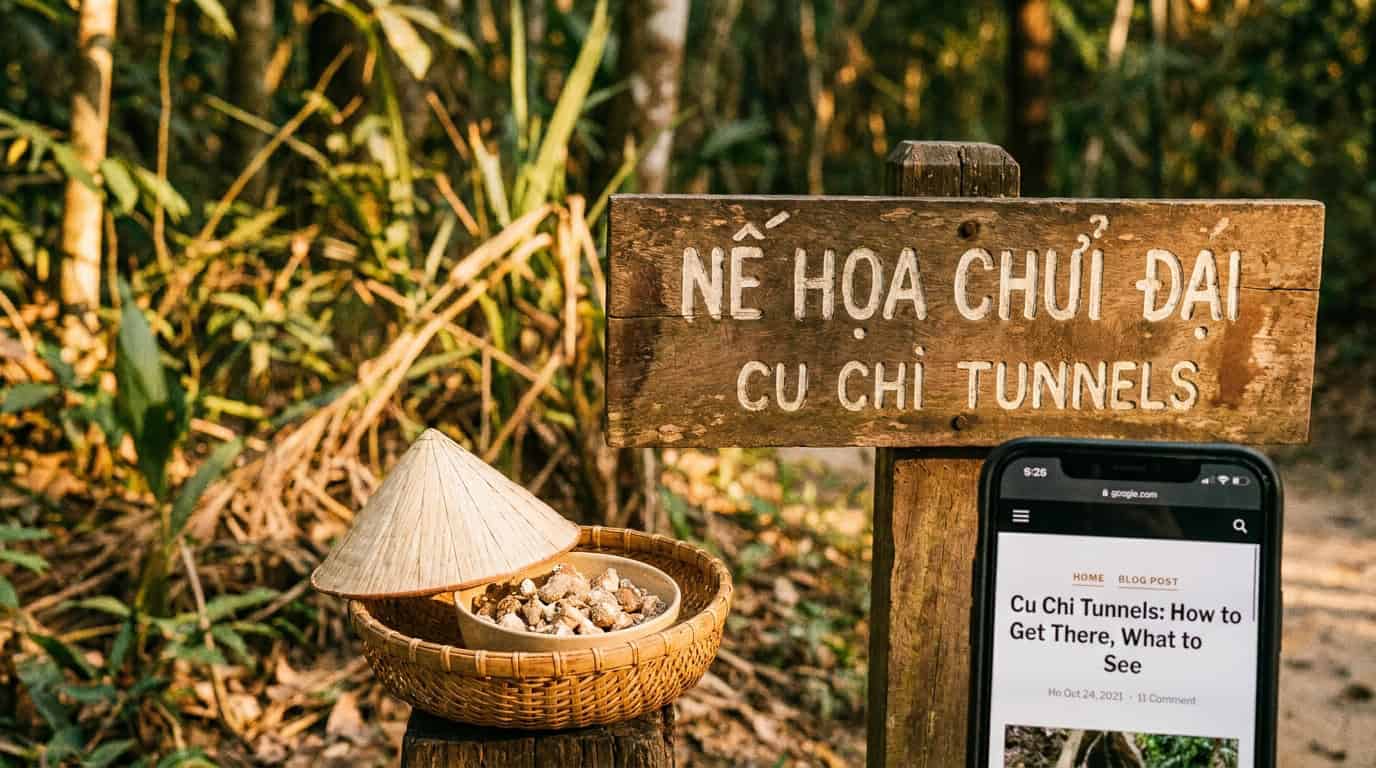
- Tasting station: Free samples of tapioca root with sesame salt and tea — the standard wartime diet for tunnel dwellers.
- Shooting range (optional): AK-47, M16, M60, and M30 carbine rounds available. Prices in 2026 are 40,000 – 60,000 VND per bullet, with a 10-round minimum. Ear protection provided.
How Did the Cu Chi Tunnels Not Collapse?
This is the engineering question every visitor asks, and the answer is geology. The Cu Chi area sits on a thick layer of red laterite clay — a soil that, once dried, is structurally similar to soft sandstone. It cuts cleanly with a hoe but hardens against pressure, supports its own weight at narrow widths, and drains rainwater effectively.
The Viet Cong combined this natural advantage with deliberate design choices:
- Multiple levels (typically 3 – 4) with the deepest chambers 8 – 10 meters down, dispersing the load.
- Trapezoidal cross-sections rather than rectangular, distributing stress to the walls.
- Short straight runs with frequent 90-degree turns to localize any blast damage from grenades or bombs.
- Bamboo and wooden bracing only at junctions, not along the full length.
A 2019 engineering study published in the Journal of Asian Earth Sciences found that the laterite clay in the region maintains structural integrity at compressive loads up to 2.5 MPa — roughly equivalent to the weight of a small building.
Is It Worth Visiting Cu Chi Tunnels?
Yes — with caveats. The Cu Chi Tunnels are worth visiting if you have at least one full day in Saigon, an interest in 20th-century history, and reasonable physical mobility. The site provides context for almost every other piece of Vietnam War history you’ll encounter elsewhere in the country, including the War Remnants Museum in District 3 and the Independence Palace.
It’s not worth visiting if:
- You have severe claustrophobia (you’ll skip the main draw and feel shortchanged)
- You have only a half-day in Saigon (the round trip eats the day)
- You’re traveling with children under 6 (the tunnels are unsuitable and most exhibits are violent)
- You expect a neutral, multi-perspective museum experience (the narration is firmly from the Vietnamese side, which is historically appropriate but worth knowing)
For everyone else, it consistently ranks in the top 3 most-recommended day trips by our homestay guests, alongside the Mekong Delta and Cao Dai Temple.
According to TripAdvisor’s 2026 Travelers’ Choice data, the site holds a 4.5/5 rating from over 27,000 reviews — placing it in the top 1% of attractions in Vietnam.
What to Wear and Bring
The Cu Chi Tunnels are an outdoor site, and conditions underground are humid and dusty. Pack accordingly:
- Closed-toe shoes (sneakers ideal; the tunnel floors are uneven dirt)
- Long pants you don’t mind dirtying — shorts will leave your knees grazed
- Lightweight, breathable shirt in a darkish color
- A small flashlight or phone with charged torch (the tunnels are dimly lit)
- Insect repellent (the surrounding forest has mosquitoes year-round)
- At least 1.5 L of water per person
- Hand sanitizer or wipes for after the crawl
- A small towel if you’re heat-sensitive — you will sweat
Avoid sandals, dresses, white clothing, and large backpacks (they don’t fit through the tunnels).
Best Time of Year to Visit
Southern Vietnam has two seasons: dry (December – April) and wet (May – November). For Cu Chi specifically:
- December – February: Cool, dry, low humidity. Peak season; arrive by 08:30 to beat coach tours.
- March – April: Hotter (up to 36°C) but still dry. Bring extra water.
- May – September: Wet season. Brief afternoon downpours; the outdoor exhibits get muddy. Mornings are usually fine and crowds are thinner.
- October – November: Tail end of monsoon. Variable but often pleasant.
Best time of day, year-round: arrive at opening (07:00) or after 14:30 once the morning bus tours have left.
Combining Cu Chi with Other Day Trips
If you’re willing to make a longer day of it, two combinations are worth considering:
- Cu Chi + Cao Dai Temple (Tay Ninh): 12-hour day. Cao Dai noon ceremony at 12:00 is the highlight; Cu Chi in the afternoon. Best by private car.
- Cu Chi morning + Saigon city tour afternoon: Take the speedboat there at 07:30, return by 13:30, and spend the afternoon at the War Remnants Museum and Independence Palace. This is what we recommend for travelers with only 48 hours in Saigon — see our 2-day Saigon itinerary for the full route.
Common Mistakes to Avoid
After hundreds of post-trip conversations with guests, the same handful of mistakes come up:
- Booking the cheapest tour without checking the route. Some US$8 tours include 90-minute lacquerware factory stops. Verify the itinerary before paying.
- Going to Ben Dinh and Ben Duoc on the same day. Pick one. Doing both is exhausting and repetitive.
- Skipping the introductory film. It’s slow, but it provides context the guides often gloss over.
- Paying for the shooting range without knowing the minimum. It’s 10 rounds, not 1.
- Forgetting cash. Card payments are accepted at the ticket office but not at on-site food stalls, the shooting range, or for tips.
Frequently Asked Questions
Is it worth visiting Cu Chi Tunnels?
Yes, for most travelers with at least one full day in Saigon and an interest in 20th-century history. The Cu Chi Tunnels offer a tangible, physical understanding of the Vietnam War that no museum can replicate. The site is less worthwhile for those with severe claustrophobia, very young children, or only a few hours to spare in the city.
What are the Cu Chi Tunnels famous for?
The Cu Chi Tunnels are famous as the world’s largest preserved guerrilla tunnel network — roughly 250 km of hand-dug passages used by the Viet Cong during the Vietnam War. They’re known for sophisticated engineering (multi-level chambers, smoke-dispersing kitchens, hidden trap doors) and for being where major operations including the 1968 Tet Offensive on Saigon were planned.
What happened at the Cu Chi Tunnels?
The tunnels served as a guerrilla base, supply route, and command center from the 1940s through 1975. U.S. and allied forces launched multiple major operations to clear them — including Operation Crimp (1966) and Operation Cedar Falls (1967) — and ultimately resorted to B-52 carpet bombing in 1969. Despite this, sections of the network remained operational until the end of the war.
How did the Cu Chi tunnels not collapse?
The tunnels were dug into red laterite clay, a soil that hardens like soft sandstone when dry and supports its own weight at narrow widths. The Viet Cong reinforced this natural strength with trapezoidal cross-sections, multi-level designs (3 – 4 levels), short runs with sharp turns to localize blast damage, and selective bamboo bracing at junctions. The combination is why much of the network survived years of bombing.
Can I visit Cu Chi Tunnels without a tour?
Yes. You can take a Grab Car or private taxi directly to either Ben Dinh or Ben Duoc, buy your 125,000 VND ticket at the gate, and explore at your own pace. English-language site guides are available for hire at the entrance for 150,000 – 250,000 VND per group.
Final Tips Before You Go
A few last things worth knowing in 2026:
- The site is cashless-friendly but cash-essential. Bring at least 500,000 VND in small notes.
- Don’t drink anything offered by strangers on the bus tour. This is rare but it has happened — and always involves “free” coffee at unscheduled stops.
- Tip your guide 50,000 – 100,000 VND if they were genuinely informative; most are underpaid by tour operators.
- Phone signal is patchy. Download Google Maps and your tour info offline before leaving District 1.
- Respect the memorial. The Cu Chi Memorial Temple at Ben Duoc is an active place of remembrance, not a photo backdrop. Hats off, voices down.
Stay in the Heart of Saigon — Walk to Your Tour Pickup
The easiest way to make the Cu Chi day trip painless is to stay where the tours start. Our centrally located District 1 homestays are a 5 – 10 minute walk from the De Tham backpacker street pickup zone, the Saigon River speedboat pier, and Ben Thanh Market — meaning you can sleep until 07:00, walk to your tour, and be back in time for a riverside sunset.
Browse our handpicked Saigon homestays → saigonhomestay.com — from US$22/night, with free airport pickup over 3 nights and local Cu Chi tour booking at guest rates.
Staying in Saigon?
We host furnished apartments in District 1 — studios up to two-bedroom
lofts, for stays from three nights to six months.
See the apartments or
check availability and book direct with us.
For fares and which option makes sense at which time of day, see getting around Saigon.