
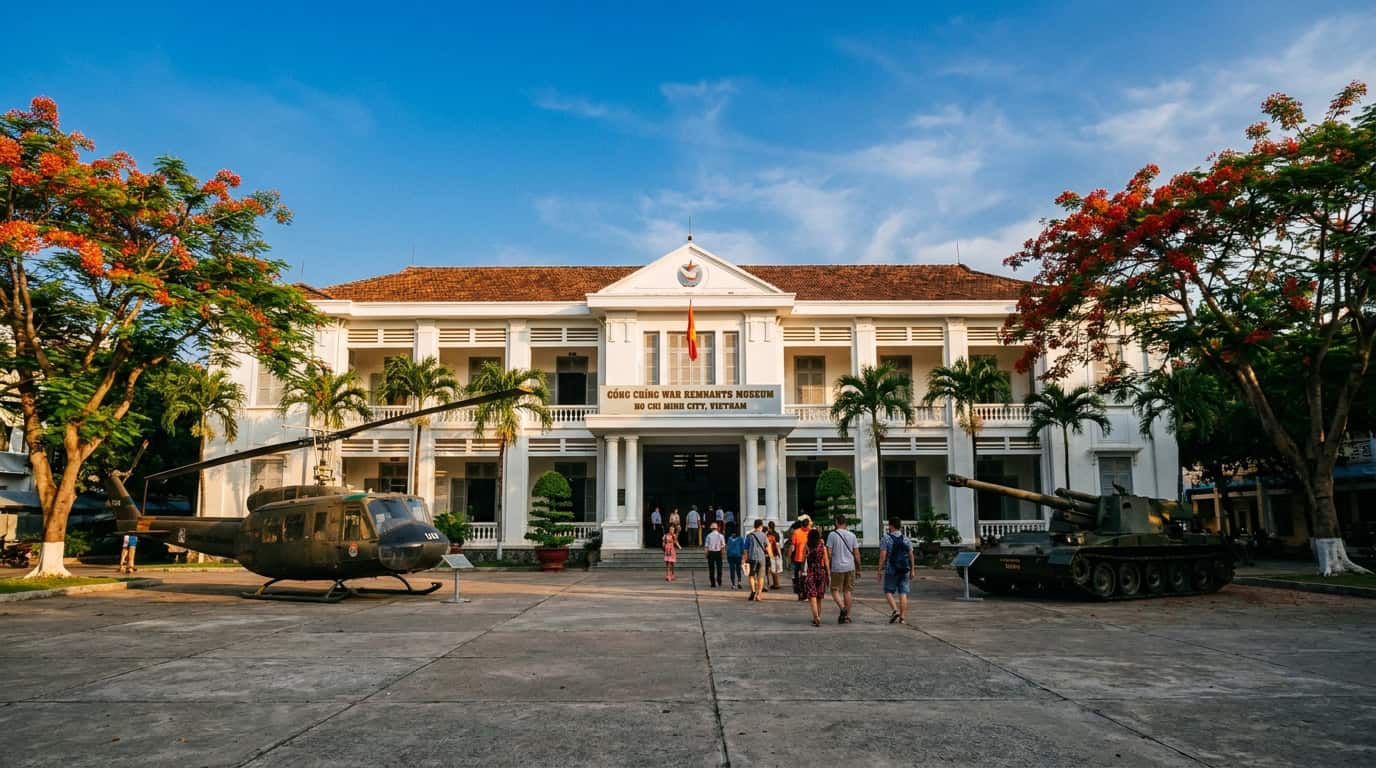
The War Remnants Museum Saigon is one of the most-visited museums in Southeast Asia, drawing over 500,000 visitors every year from across the globe — and more than half a century after the fall of Saigon, its galleries remain as urgent as ever. This is not an easy afternoon out. It is, however, one of the most important things you can do on a trip to Ho Chi Minh City.
Whether you’re a history buff, a student, a veteran, or simply a curious traveller, this museum will leave a mark on you. This guide covers everything you need to know before you go: what’s inside, how long to spend there, what to emotionally brace for, and practical logistics for 2026.
Key Takeaways
– Open daily 7:30 AM–5:00 PM; arrive before 9:00 AM to beat tour groups
– Entrance fee: 60,000 VND (~$2.40 USD) — one of the best-value historical sites in Asia
– Allow 2.5 to 3.5 hours for a thorough visit; rushing is disrespectful to the subject matter
– The Agent Orange and Prison exhibits are extremely confronting — prepare accordingly
– Located in District 3, it’s an easy Grab ride or a 20-minute walk from the District 1 backpacker area
– Photography is permitted throughout most of the museum
What Is the War Remnants Museum?
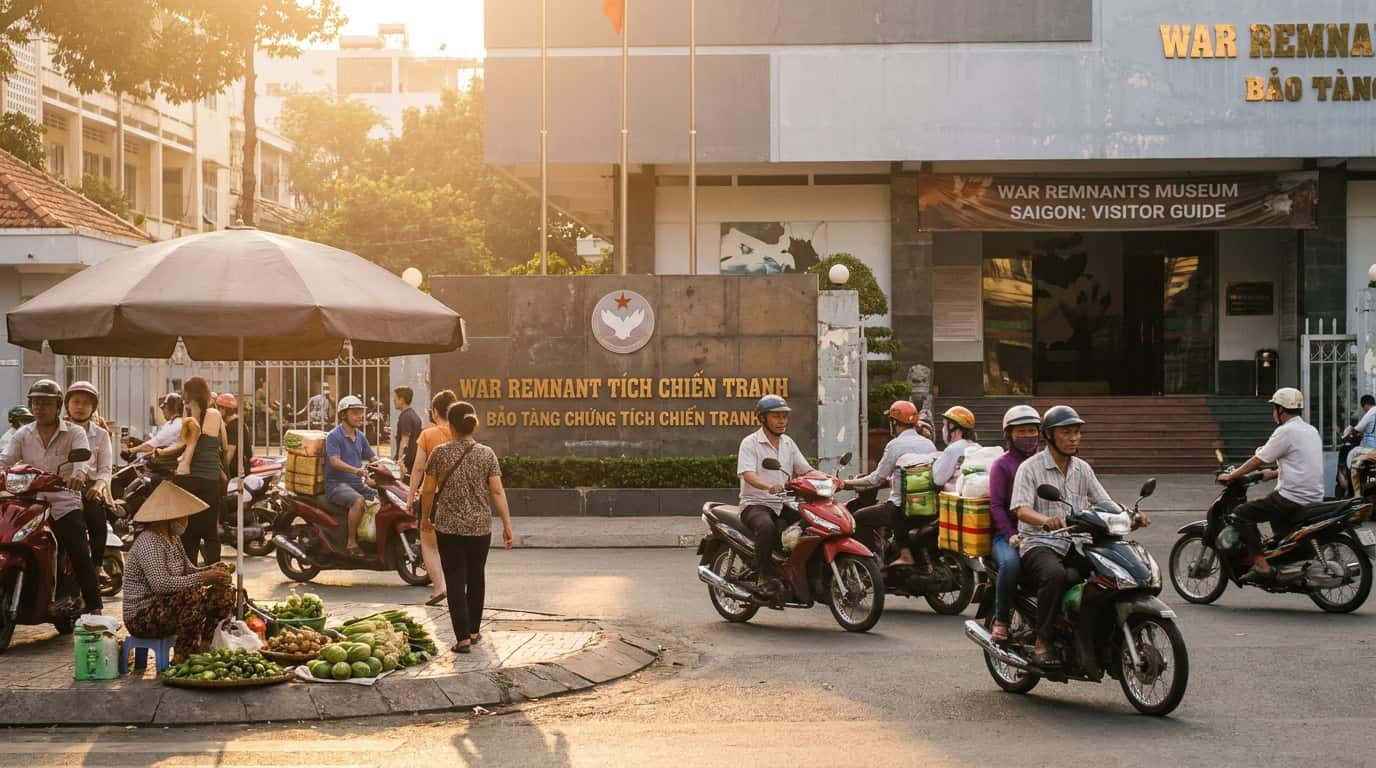
The War Remnants Museum (Vietnamese: Bảo tàng Chứng tích Chiến tranh) is Saigon’s definitive monument to the Vietnam War — or as it is known here, the American War (Chiến tranh Chống Mỹ Cứu nước). The distinction in naming is worth noting the moment you walk through the gates: you are seeing this conflict entirely from a Vietnamese perspective, and that framing shapes every exhibit inside.
The museum opened in September 1975, just months after the reunification of Vietnam, in a building that once housed the US Information Service. It was originally called the Exhibition House for US and Puppet Crimes — a deliberately political name that has since been softened, though the content remains blunt and unflinching.
Today it sits at 28 Võ Văn Tần Street, District 3, on the edge of what most visitors consider walkable from central District 1. It occupies a two-storey main building surrounded by a courtyard filled with decommissioned military hardware. The collection spans thousands of photographs, documents, weapons, and artefacts documenting not just the American War but also the earlier French colonial conflict.
For context: Vietnam lost an estimated 2–3 million civilians during the American War. Over 58,000 US military personnel died. The museum makes no attempt at false balance — it is a memorial first, a historical archive second. Understanding that going in will help you engage more honestly with what you see.
Practical Information at a Glance
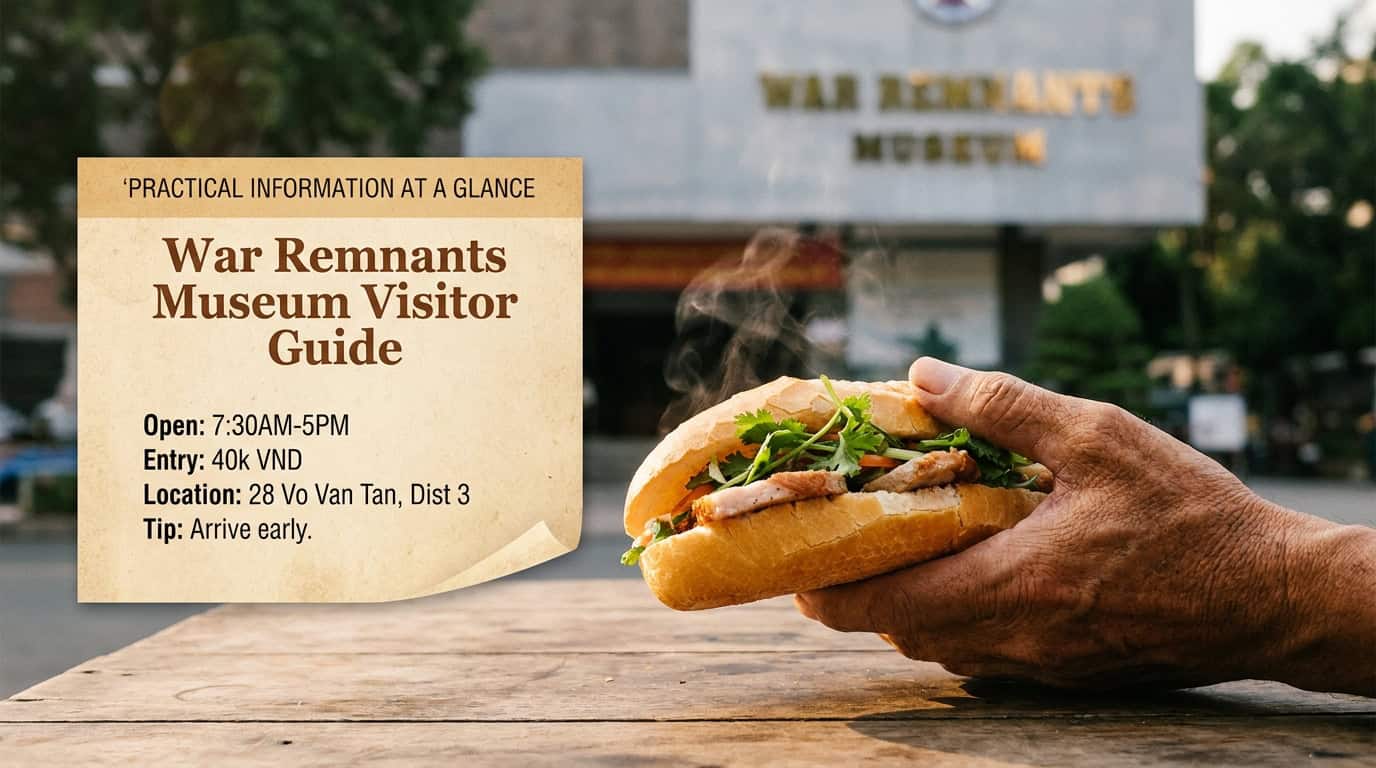
| Detail | Information |
|---|---|
| Address | 28 Võ Văn Tần, Phường 6, Quận 3, TP. Hồ Chí Minh |
| Opening Hours | 7:30 AM – 5:00 PM daily (last entry 4:30 PM) |
| Closed | Never — open 365 days a year |
| Entrance Fee (Adults) | 60,000 VND (~$2.40 USD) |
| Entrance Fee (Children under 6) | Free |
| Audio Guide | Available at the ticket counter (~30,000 VND / ~$1.20) |
| Photography | Permitted throughout (no flash on some exhibits) |
| Wheelchair Access | Partial — ground floor and courtyard accessible |
| Official Website | baotangchungtichchientranh.vn |
A couple of things worth calling out: the museum is open every single day of the year, including Tết, which is unusual for Vietnamese institutions. The entrance fee is genuinely one of the lowest for a museum of this calibre anywhere in Asia — 60,000 VND is roughly the cost of a cup of coffee on Bùi Viện Street.
The Outdoor Courtyard: Military Hardware Up Close
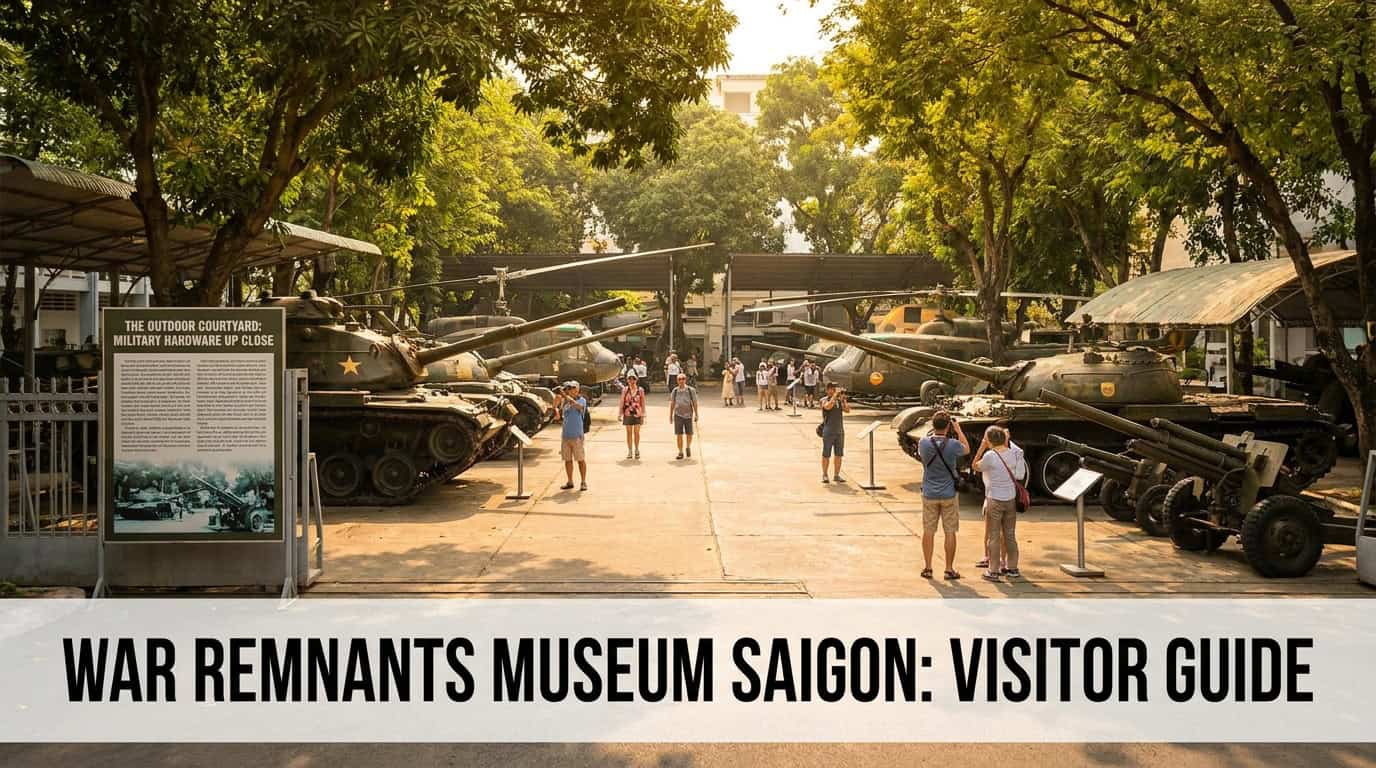
Before you even reach the ticket desk, the courtyard hits you with an arresting collection of full-size military equipment left over from the war. This is where most visitors spend their first 15–20 minutes, and it sets the tone for everything inside.
What you’ll find in the courtyard:
- F-5A Freedom Fighter jet — a US-supplied aircraft also used by South Vietnamese Air Force
- A-37 Dragonfly light attack aircraft
- UH-1 Iroquois “Huey” helicopter — the iconic workhorse of the Vietnam War, immortalised in countless films
- M48 Patton tank — a mainstay of US armoured operations
- BM-21 rocket launcher and various artillery pieces
- A Chinook helicopter fuselage
- A guillotine used during French colonial rule — a jarring and important reminder that the museum’s scope extends beyond the American War
There’s no rope barrier around most of these vehicles. You can (and should) walk around them, look inside the cockpits, and get a physical sense of the scale of the machinery that defined this war. It’s sobering in a way that photographs alone cannot be.
Floor-by-Floor: What’s Inside the Museum
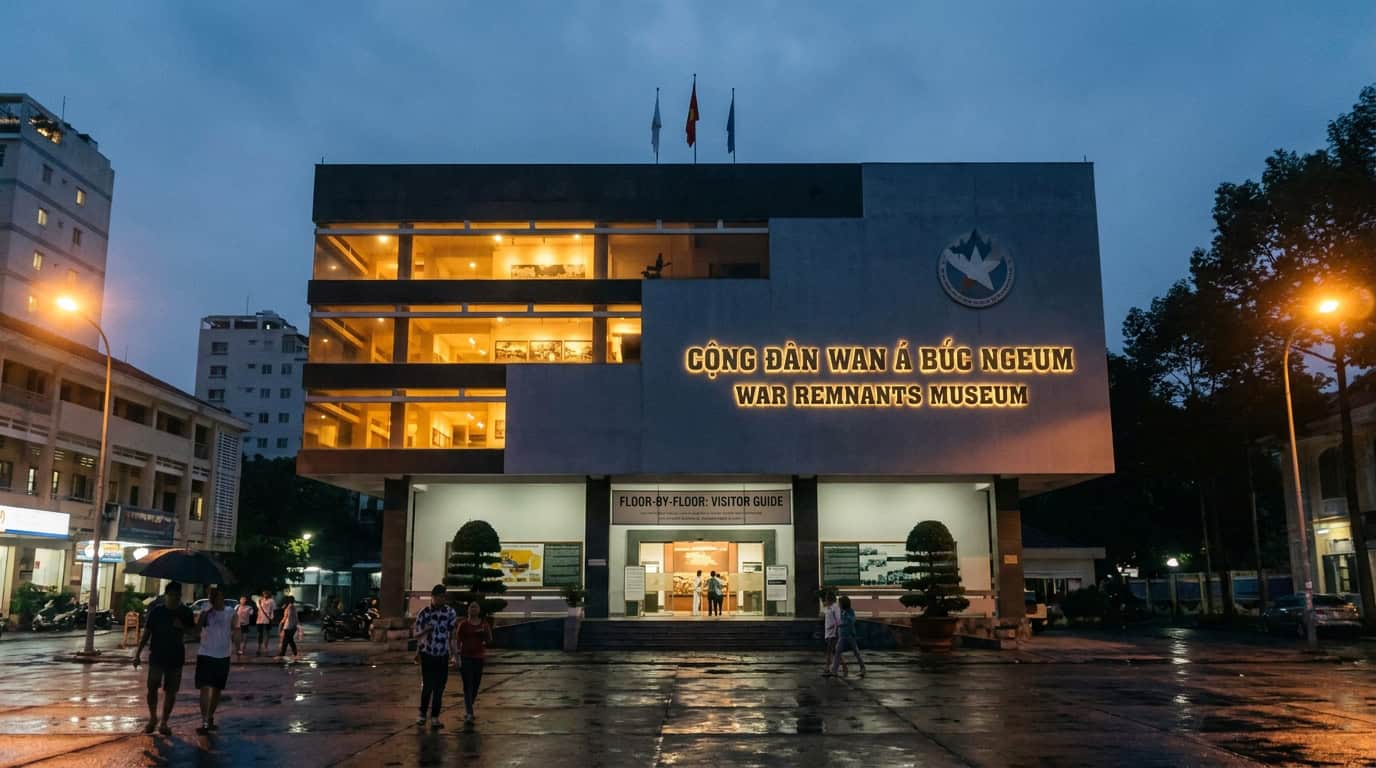
The main building has three floors, each containing multiple themed exhibition rooms. Below is a breakdown of what to expect on each level.
Ground Floor
The ground floor houses several permanent exhibitions:
Room 1 — Requiem: This is arguably the most devastating room in the building. It displays the work of over 130 photojournalists — from both sides of the conflict — who were killed while covering the war in Indochina. Curated by American photographer Tim Page, the collection includes iconic images by Kyoichi Sawada, Larry Burrows, and others who did not survive to see them published. The prints are large, beautifully mounted, and utterly harrowing. Plan to spend at least 20–30 minutes here alone.
Room 2 — Historical Truths: A chronological overview of the conflict from the French colonial era through to 1975, presented through maps, documents, and photographs. This is useful context if your knowledge of the war’s full arc is thin.
Room 3 — The World Supports Vietnam: Documents the global anti-war movement — protests in the US, Europe, Australia, and Japan. Seeing familiar Western faces (Jane Fonda, Martin Luther King Jr., Bertrand Russell) featured in a Vietnamese museum is a quietly powerful experience.
First Floor
Room 4 — Invasion War Crimes: Graphic photographic documentation of massacres, including the My Lai Massacre of 1968, in which US Army soldiers killed between 347 and 504 unarmed South Vietnamese civilians. The photographs here are real, not reconstructions. This is the room where many visitors have to step outside for air.
Room 5 — Agent Orange/Dioxin: This is the exhibit that stays with most visitors longest. Between 1962 and 1971, the US military sprayed approximately 76 million litres of herbicides — including Agent Orange, contaminated with the carcinogen dioxin — across an estimated 24% of southern Vietnam as part of Operation Ranch Hand. The goal was to strip forest cover and deny food supplies to Viet Cong forces.
The human cost continues to this day. The exhibit displays medical photographs and preserved foetal specimens documenting multi-generational birth defects attributed to dioxin contamination. It also includes photographs of living survivors. This is genuinely difficult material. Many visitors, adults included, cry here. That is an appropriate response.
Room 6 — Prison Systems: A replica of the infamous “tiger cage” cells used at Côn Sơn Island prison, where political prisoners were held in stone pits measuring roughly 2 × 3 metres with iron bar ceilings. Mannequins depict prisoners in the conditions reported by survivors. The exhibit includes documentation of torture methods. Disturbing but historically essential.
Second Floor
Room 7 — Vietnam at War (general overview) and rotating temporary exhibitions, which in recent years have included photography and art by international contributors reflecting on the war’s legacy.
Pricing Compared to Other Saigon Attractions
For context, here’s how the War Remnants Museum entry fee stacks up against other popular paid attractions in Ho Chi Minh City in 2026:
| Attraction | Entry Fee (VND) | Entry Fee (USD approx.) |
|---|---|---|
| War Remnants Museum | 60,000 | ~$2.40 |
| Reunification Palace | 40,000 | ~$1.60 |
| Ho Chi Minh City Museum | 30,000 | ~$1.20 |
| Jade Emperor Pagoda | Free (donation) | — |
| Bitexco Financial Tower Skydeck | 250,000 | ~$10.00 |
| Cu Chi Tunnels (self-guided) | 90,000 | ~$3.60 |
| Saigon Zoo & Botanical Garden | 60,000 | ~$2.40 |
The museum represents exceptional value. Combined with the Reunification Palace (a 10-minute walk away), you can spend a full, deeply informative day of historical sightseeing for under 100,000 VND (~$4 USD) per person.
How to Make the Most of Your Visit: Practical Tips
Go early — seriously
Tour buses start arriving from 9:00 AM onwards. Groups of 30–40 people with matching caps move through the rooms quickly and loudly, which affects the atmosphere considerably in a place that warrants quiet reflection. Arriving at opening (7:30 AM) gives you 60–90 minutes of near-solitude, particularly in the Requiem room and the Agent Orange exhibit.
Allocate the right amount of time
Most visitors underestimate how long they’ll spend. A rushed walk-through takes about 90 minutes, but you’ll miss a great deal. Budget 2.5 to 3.5 hours for a thorough visit. If you have a particular interest in photojournalism or the chemical warfare legacy, add another 30 minutes.
Prepare emotionally — and practically
The War Remnants Museum is not a conventional museum experience. The content is graphic, factual, and presented without softening. Adults and older teenagers generally process it well; families with young children should be aware that some exhibits contain preserved human remains and confronting photographs of injury and death. Children under 10 may find it distressing.
Practical note: bring tissues, wear comfortable shoes (lots of standing), and drink water before you go — there’s a small café on-site but the queue can be long mid-morning.
Photography etiquette
Photography is encouraged throughout most of the museum. The exception is a small number of exhibits where signage requests no flash photography due to preservation concerns. On a practical level: take the photos, but also put the phone down and actually read the captions. The written documentation is as powerful as the images.
Audio guide or not?
The audio guide (available in English, French, Japanese, Korean, and Chinese for approximately 30,000 VND / ~$1.20) adds useful context to selected exhibits. It is not exhaustive, and the English narration is straightforward rather than nuanced. Most native English speakers find the printed captions sufficient; the audio guide is more valuable if you’re visiting with someone whose first language isn’t English.
What to wear
Vietnam is a subtropical country and the museum’s main building has air conditioning, but the courtyard is fully exposed. In May–October (wet season), afternoon thunderstorms are common — arriving early avoids both the heat and the rain. Light, breathable clothing and closed-toe shoes (you’ll be on your feet a lot) are ideal. There is no dress code requirement, unlike at religious sites.
Getting to the War Remnants Museum Saigon from District 1
The museum is technically in District 3, but the boundary between Districts 1 and 3 in this part of the city is blurry in practice. From the main backpacker and tourist hotels on Phạm Ngũ Lão, Bùi Viện, or Đề Thám streets, you have three realistic options:
By Grab (recommended): Grab is Vietnam’s dominant ride-hailing app and far more reliable than flagging a xe ôm (motorbike taxi) as a tourist. A GrabBike from the Phạm Ngũ Lão area to the museum costs approximately 20,000–35,000 VND (~$0.80–$1.40) and takes 7–12 minutes depending on traffic. A GrabCar runs 45,000–65,000 VND (~$1.80–$2.60). Download the app before you arrive in Vietnam — it requires a local or international number to register.
On foot: The walk from Bến Thành Market to the museum is approximately 1.3 km and takes 15–20 minutes. The route along Lê Quý Đôn Street is pleasant and passes the Reunification Palace, making it an easy combo. However, Saigon’s footpaths vary in condition, and the midday heat in summer makes any walk over 10 minutes uncomfortable.
By public bus: Line 03 and Line 36 stop near the museum. Fare is 6,000 VND (~$0.24). Useful if you’re already comfortable navigating Saigon’s bus network, but not recommended as your first outing in the city.
Combine Your Visit: What’s Nearby
The War Remnants Museum sits within easy walking or riding distance of several other major sights, making it natural to plan a half-day or full-day historical itinerary.
Reunification Palace (0.7 km): The former Presidential Palace of South Vietnam, captured on 30 April 1975, when a North Vietnamese tank famously crashed through the gates. The building has been preserved almost exactly as it was on that day, with original furnishings, war rooms, and a bunker complex underneath. Entry is 40,000 VND (~$1.60). Allow 1.5–2 hours.
Notre-Dame Cathedral Basilica of Saigon (1.0 km): The red-brick French colonial cathedral on Paris Commune Square. Under ongoing restoration as of 2026, but the exterior and square remain worth seeing.
Central Post Office (1.1 km): One of Saigon’s most beautiful colonial buildings, designed by Gustave Eiffel’s firm and still operating as a working post office. Free to enter.
Ben Thanh Market (1.3 km): If you want to decompress with food and shopping after the museum, the covered market is a 15-minute walk and offers everything from Vietnamese street food to souvenirs.
Frequently Asked Questions
Is the War Remnants Museum suitable for children?
For children under 10, the museum contains content that is likely to be distressing — graphic photographs, medical exhibits, and displays of torture instruments. Older children (12+) can benefit enormously from the visit with parental guidance and context-setting beforehand. Use your judgement based on your child’s maturity and your family’s approach to difficult historical content.
Is the museum one-sided?
Yes, deliberately so. The museum presents the war from a North Vietnamese and Viet Cong-aligned perspective, and makes no pretence of doing otherwise. That doesn’t make it historically inaccurate — the factual record on chemical warfare, civilian casualties, and prison conditions is well-documented by international sources including the International Red Cross. But visitors should be aware they are receiving a specific narrative, not a balanced one. Pair it with a reading of Neil Sheehan’s A Bright Shining Lie or Tim O’Brien’s The Things They Carried for broader context.
Can I visit as part of a tour group?
Yes, most half-day and full-day Saigon city tours include the museum. However, self-guided visits allow you to spend as long as you need in each room — tour groups often move faster than the content deserves.
Is there a café or restaurant on-site?
There is a small refreshment kiosk in the courtyard. For a proper meal, the streets immediately surrounding the museum (particularly on Võ Văn Tần and Nam Kỳ Khởi Nghĩa) have numerous Vietnamese lunch restaurants and cafés catering to the lunch crowd.
Where to Stay in Saigon
The War Remnants Museum is a short Grab ride or brisk walk from the heart of District 1 — which makes it an easy anchor for a day of historical sightseeing without the logistics of crossing the city. Saigon Homestay offers serviced apartments in District 1, putting you within 15 minutes of the museum, the Reunification Palace, and Ben Thanh Market. Having a proper kitchen and living space makes a difference after an emotionally heavy museum day — somewhere to sit, decompress, and process what you’ve seen.
A note on sources: The entrance fee, hours, and exhibit details reflect the museum’s documented state through early 2026. Vietnam occasionally adjusts museum admission fees without advance notice online — the figure of 60,000 VND / ~$2.40 USD is the current standard adult rate, but confirming at the ticket window is always sensible. The official museum website lists current pricing in Vietnamese.
Staying in Saigon?
We host furnished apartments in District 1 — studios up to two-bedroom
lofts, for stays from three nights to six months.
See the apartments or
check availability and book direct with us.
Getting between these places is easiest by Grab or metro. Our getting around Saigon guide compares every option with fares.
Related Guides
- 30 Best Things To Do in Ho Chi Minh City (2026)
- Best Spas & Massage in Saigon: Complete Guide
- Saigon Nightlife Guide: Bars, Clubs & What to Expect
- Saigon Rooftop Bars: Best Views in the City (2026)
- Best Day Trips from Saigon: Complete Guide (2026)
- Saigon Zoo & Botanical Garden: Is It Worth Visiting?