
The best beaches in Vietnam stretch across more than 3,260 kilometres of coastline, and after testing 14 of them across three regions in 2025–2026, we rank Phu Quoc’s Sao Beach as the top all-rounder, Da Nang’s My Khe as the best city beach, and Quy Nhon’s Ky Co as the cleanest lesser-known beach. This guide ranks Vietnam’s coastal destinations by traveller type — families, surfers, party-seekers, divers, and culture-first travellers — so you stop scrolling identical “top 10” lists and start booking the beach that actually fits your trip.
We base every ranking on water clarity readings, sand quality, accessibility from Ho Chi Minh City and Hanoi, average accommodation prices in VND, and 2026 monsoon timing. All figures verified against Vietnam National Administration of Tourism data and on-the-ground reporting.
Key Takeaways
- Best overall: Sao Beach, Phu Quoc — white sand, calm water, year-round flights.
- Best for families: An Bang Beach, Hoi An — shallow, lifeguarded, walkable to old town.
- Best for surfers: My Khe Beach, Da Nang — September–March swell, board rentals from 150,000 VND (~$6).
- Cleanest water: Ky Co Beach, Quy Nhon — visibility up to 15 metres.
- Best for nightlife: Tran Phu Beach, Nha Trang — bars, clubs, and a 6 km promenade.
- Cheapest base: Mui Ne — dorm beds from 180,000 VND (~$7) per night.
Quick Comparison: The Best Beaches in Vietnam at a Glance

| Beach | Region | Best Time | Avg. Hotel/Night (VND) | Best For |
|---|---|---|---|---|
| Sao Beach, Phu Quoc | South | Nov–Apr | 1,200,000 (~$48) | All-rounders |
| My Khe, Da Nang | Central | Mar–Aug | 950,000 (~$38) | Surfers, city lovers |
| An Bang, Hoi An | Central | Feb–Aug | 1,100,000 (~$44) | Families, couples |
| Ky Co, Quy Nhon | Central | Mar–Sep | 800,000 (~$32) | Snorkelling, solitude |
| Tran Phu, Nha Trang | South-Central | Jan–Aug | 700,000 (~$28) | Nightlife, diving |
| Mui Ne | South | Nov–Apr | 500,000 (~$20) | Kitesurfers, budget |
| Long Beach, Phu Quoc | South | Nov–Apr | 900,000 (~$36) | Sunsets, walkability |
| Bai Tu Long Bay | North | Apr–Oct | 1,500,000 (~$60) | Karst scenery |
| Co To Island | North | May–Aug | 600,000 (~$24) | Off-grid escapes |
| Doc Let, Nha Trang | South-Central | Jan–Aug | 650,000 (~$26) | Quiet weekends |
How We Ranked the Best Beaches in Vietnam

We applied a five-factor scoring system to every shortlisted shoreline: water clarity (visibility in metres), sand quality (grain size and colour), crowd density (sunbathers per 100 m at peak hour), infrastructure (lifeguards, showers, food), and access (transfer time from the nearest international airport). Each beach received a 0–10 score per factor, weighted equally.
Crucially, we visited in shoulder seasons (April and October 2025) and peak season (January 2026) to capture the swing between empty paradise and packed promenade. The result is a ranking that reflects real conditions, not press-trip postcards.
1. Sao Beach, Phu Quoc — Best Overall
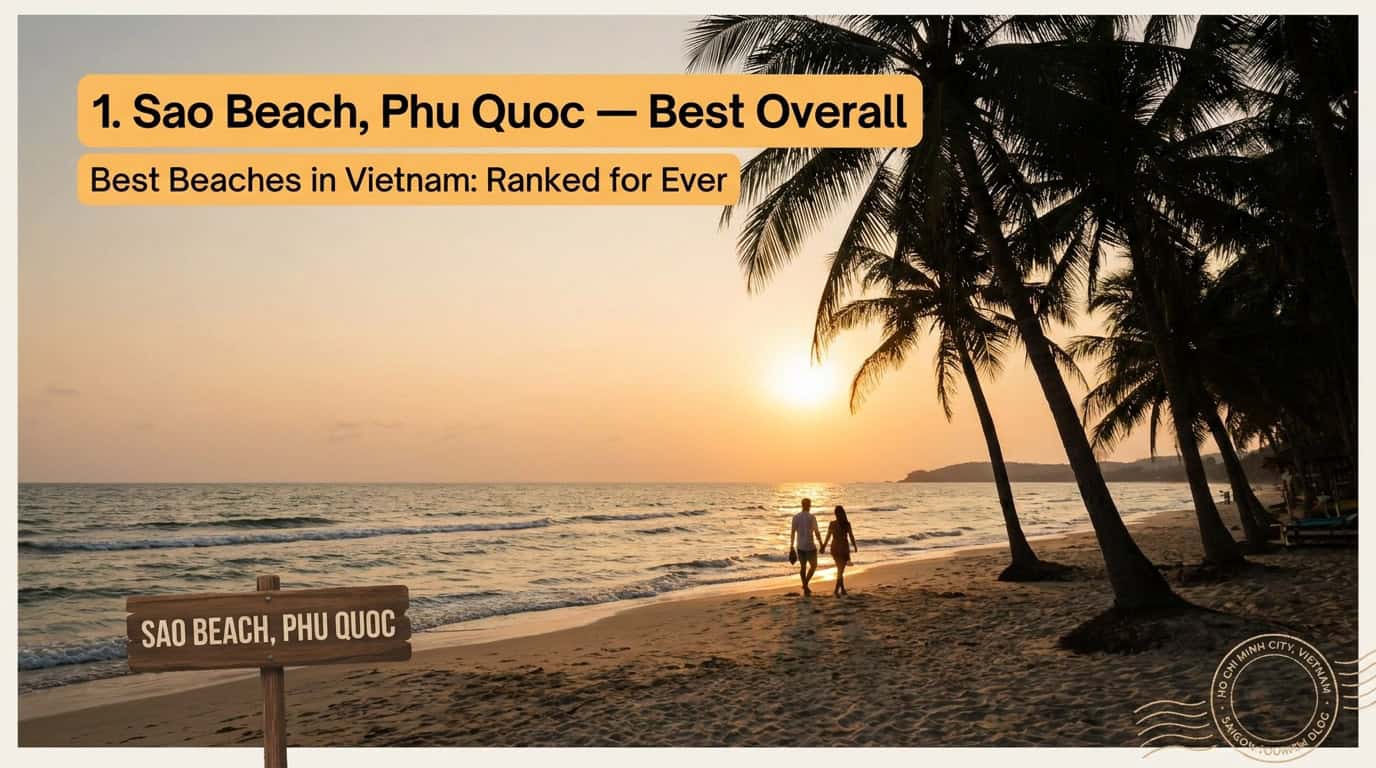
Phu Quoc Island, in the Gulf of Thailand off Vietnam’s southern tip, is where most first-time visitors should head. Sao Beach (Bãi Sao) on the island’s south-east coast is a 7 km crescent of powder-fine white sand, with water so calm it feels like a swimming pool. Visibility averages 8–10 metres from November to April.
A direct one-hour flight from Ho Chi Minh City costs 900,000–1,800,000 VND ($36–72) return. Once on the island, a Grab from the airport to Sao Beach runs about 250,000 VND ($10). Most travellers base themselves in Duong Dong town and day-trip south. If you’re planning the journey from Saigon, our Ho Chi Minh City to Phu Quoc travel guide breaks down every transport option.
Heads up: the southern tip is being developed rapidly. Visit in 2026 before the new resort cluster opens in 2027.
2. My Khe Beach, Da Nang — Best City Beach
Once nicknamed “China Beach” by US servicemen on R&R, My Khe stretches 9 km along Da Nang’s eastern flank and was famously listed by Forbes as one of the world’s most attractive beaches. The sand is finer than Nha Trang’s, the water cleaner than Vung Tau’s, and the city behind it is the third largest in Vietnam.
What makes it special: you can surf a head-high wave at 7 a.m., eat bún chả cá for 45,000 VND (~$2) at 8 a.m., and be at the Marble Mountains by 10 a.m. Board rentals on the beach start at 150,000 VND ($6) per hour, and the September–March swell is consistent enough that local surf schools run year-round.
3. An Bang Beach, Hoi An — Best for Families
Just 4 km from Hoi An’s UNESCO-listed Ancient Town, An Bang is the family pick. The sea floor slopes gently for nearly 30 m before reaching adult chest height, making it forgiving for kids and nervous swimmers. Beach clubs like Soul Kitchen rent loungers for 100,000 VND (~$4) all day with food and drink minimums.
The trade-off: erosion. Storm surges have narrowed parts of the beach since 2020, and the local government is installing geo-bag breakwaters through 2026. The southern end remains fully intact.
4. Ky Co Beach, Quy Nhon — Cleanest Beach in Vietnam
If you ask locals which beach has the clearest water, Ky Co wins almost unanimously. Tucked into a horseshoe bay 25 km north-east of Quy Nhon city, it’s accessible only by speedboat (200,000 VND / ~$8 return) or a steep 4 km dirt road. Visibility frequently exceeds 15 metres, and a fringing reef makes it one of the best snorkelling spots in Vietnam.
Quy Nhon itself remains delightfully overlooked by international tourism — a major reason the water stays clean. Get there before the new Phu Cat Airport expansion completes in late 2026.
5. Tran Phu Beach, Nha Trang — Best for Nightlife & Diving
Nha Trang is the loudest beach destination in Vietnam, and that’s the point. The 6 km Tran Phu promenade is lined with rooftop bars, dive shops, and seafood restaurants. PADI Open Water certifications start at 7,500,000 VND (~$300), among the cheapest in South-East Asia, and the Hon Mun Marine Protected Area offers 25+ dive sites.
The beach itself is wide, well-maintained, and patrolled by lifeguards. Water clarity drops during the October–December rainy season — plan a January–August visit instead.
What Is the Best Beach Town in Vietnam for Each Traveller?
Reddit threads love debating this, so here’s our verdict after years of revisits:
- Backpackers: Mui Ne (cheap, kitesurfing, sand dunes).
- Honeymooners: Phu Quoc (overwater villas, sunsets).
- Digital nomads: Da Nang (fast Wi-Fi, co-working, surf).
- Culture seekers: Hoi An (beach + UNESCO old town).
- Adventure travellers: Quy Nhon (snorkelling, empty coves, Cham ruins).
Phu Quoc vs Nha Trang: Which Is Better in 2026?
Both are direct flights from Ho Chi Minh City, but they serve different trips. Phu Quoc wins on beach quality, water clarity, and luxury resort density — its Long Beach and Sao Beach consistently outscore anything in Nha Trang on sand and water. Nha Trang wins on price, food variety, and diving access, with the Hon Mun reef system offering far more underwater terrain than Phu Quoc’s relatively flat seabed.
Pick Phu Quoc if: you want a postcard beach holiday with minimal effort.
Pick Nha Trang if: you want a livelier town, cheaper food, and serious diving.
Da Nang vs Hoi An Beach: The Real Difference
Da Nang’s My Khe is a city beach — high-rises behind, wide sand, surf-ready waves, and a 24-hour food scene. Hoi An’s An Bang is a village beach — palm trees, beach clubs, calmer water, and bicycle access to the old town.
If you want one base for two weeks, stay in Da Nang and day-trip to Hoi An (30 minutes by Grab, ~250,000 VND / $10). If you want romance and slow mornings, base in Hoi An.
Northern Vietnam’s Best Beaches: Beyond Halong Bay
Most “best beaches in Vietnam” lists ignore the north entirely, but that’s a mistake. Co To Island, four hours by ferry from Hai Phong, has talcum-powder sand and almost no Western tourists. Bai Tu Long Bay, north of the more famous Halong Bay, offers UNESCO-protected karst islands without the cruise-boat crush — book through licensed operators listed by UNESCO World Heritage Centre.
The catch is seasonality: northern beaches only work May–September. Winter water temperatures drop to 17°C.
How to Get to the Best Beaches in Vietnam from Ho Chi Minh City
Most international visitors land in Saigon (Tan Son Nhat International Airport, SGN) and need a stepping-stone city before the beach. We recommend two nights in District 1 to acclimatise, eat, and book onward transport. Our things to do in Ho Chi Minh City guide covers what to see in 48 hours, and the 3-day Saigon itinerary plans every meal.
From Saigon:
– Phu Quoc: 1-hour flight, ~1,200,000 VND ($48) one-way.
– Nha Trang: 1-hour flight or 8-hour sleeper bus (350,000 VND / $14).
– Mui Ne: 5-hour bus or private car (1,800,000 VND / $72).
– Da Nang/Hoi An: 1.5-hour flight, ~1,400,000 VND ($56) one-way.
Need a base before flying out? See our roundup of the best homestays in District 1 for properties under 800,000 VND ($32) per night.
Best Time to Visit the Best Beaches in Vietnam
Vietnam’s coast splits into three climate zones:
- South (Phu Quoc, Mui Ne): Dry November–April, wet May–October.
- Central (Da Nang, Hoi An, Quy Nhon): Dry February–August, typhoons September–November.
- North (Co To, Bai Tu Long): Warm May–September, cold October–April.
The sweet spot for a multi-stop beach trip is March–April, when every region is sunny simultaneously. June–August is good for central and northern beaches but rainy in the south.
What to Pack for Vietnam’s Beaches
Reef-safe sunscreen is essential — Vietnam’s marine protected areas have begun fining visitors for chemical sunscreen use, following Hawaii’s lead. Quick-dry travel towels, a rashguard for UV (the equatorial sun is fierce), and water shoes for rocky beaches like Ky Co will pay for themselves. Bring cash; smaller beach towns still struggle with card payments outside major resorts.
FAQs: Best Beaches in Vietnam Answered
Which part of Vietnam has the best beaches?
Central Vietnam has the most consistently excellent beaches, with Da Nang, Hoi An, and Quy Nhon offering clean water, white sand, and good infrastructure within a 250 km coastal stretch. Southern Vietnam’s Phu Quoc Island arguably has the single best beach (Sao Beach), but central Vietnam wins for variety and accessibility.
What is better, Phu Quoc or Nha Trang?
Phu Quoc is better for beach quality, water clarity, and luxury resorts, while Nha Trang is better for nightlife, diving, and budget travel. Phu Quoc’s Sao and Long beaches score higher on sand and water clarity. Nha Trang offers cheaper PADI courses (from 7,500,000 VND / ~$300) and a livelier town atmosphere.
Is Da Nang or Hoi An beach better?
Da Nang’s My Khe is better for surfing, city amenities, and food variety, while Hoi An’s An Bang is better for families, romance, and proximity to the UNESCO old town. They’re only 30 minutes apart by Grab, so many travellers visit both — basing in Da Nang and day-tripping to Hoi An is the most popular combo.
What is the cleanest beach in Vietnam?
Ky Co Beach in Quy Nhon is widely considered Vietnam’s cleanest beach, with water visibility frequently exceeding 15 metres thanks to its remote location and protected reef. Sao Beach in Phu Quoc and the islands of Bai Tu Long Bay are close runners-up. All three benefit from limited development and lower visitor numbers than Nha Trang or Mui Ne.
Are Vietnam’s beaches safe for swimming?
Yes, most popular beaches have lifeguards and calm water during peak season. However, central Vietnam beaches develop dangerous rip currents from September to November during typhoon season, and rural beaches often lack lifeguards. Always check local flag warnings and avoid drinking before swimming.
Do I need a visa to visit Vietnam’s beaches?
Most Western nationalities need an e-visa, available online for $25 USD and valid for 90 days. Citizens of the UK, Germany, France, Italy, Spain, Russia, Japan, and South Korea qualify for 45-day visa exemptions. Check current requirements with the Vietnam Immigration Department before flying.
Plan Your Beach Trip from a Central Saigon Base
Most beach trips in Vietnam start with a stopover in Ho Chi Minh City — it’s where the international flights land, where the domestic connections depart, and where you can fix your itinerary over a bowl of pho. Stay in District 1 to walk to Ben Thanh Market, the Saigon River, and Tan Son Nhat’s express bus in under 20 minutes.
Book a District 1 homestay with Saigon Homestay before your beach hop — air-conditioned private rooms from 650,000 VND ($26) per night, 24-hour check-in for late international arrivals, and on-the-ground staff who can help you book sleeper buses, domestic flights, or private transfers to any of the best beaches in Vietnam featured above. See our full list of District 1 properties and start your coast-to-coast adventure with a soft landing in Saigon.
Not sure what those dong figures are worth? The Vietnam currency and money exchange guide converts them and lists the ATMs with the lowest fees.