
The Fansipan cable car is a 6,292.5-metre Guinness World Record-holding ride that lifts you from Sapa town to the 3,143-metre “Roof of Indochina” in just 15 minutes — saving the 2-day trek that used to be the only way up. If you’re planning a Northern Vietnam itinerary in 2026, this is the single most efficient way to summit Vietnam’s highest mountain, and ticket prices have just been adjusted for the new season. Below you’ll find current costs, opening hours, what’s actually waiting at the top, and the small details (weather windows, dress code, hidden fees) that most travel blogs leave out.
Key Takeaways
- Price (2026): Adult round-trip cable car ticket costs 800,000 VND (~$32 USD); children 0.9–1.3m pay 550,000 VND (~$22); under 0.9m ride free.
- Record: Holds two Guinness World Records — longest non-stop three-rope cable car (6,292.5m) and greatest elevation gain by a cable car (1,410m).
- Time needed: Budget 4–5 hours total at Sun World Fansipan Legend, including the 15-minute ride each way.
- Best months: October to April for clear views; avoid July–August (heavy cloud and rain at the summit).
- Worth it? For 95% of travellers, yes — the trek takes 2 days minimum, and the cable car runs even when the trail is closed.
- Pro tip: Combine the cable car with the funicular train from Sapa town to skip a steep 15-minute uphill walk to the boarding station.
Fansipan Cable Car at a Glance
| Detail | Information |
|---|---|
| Location | Sun World Fansipan Legend, Sapa, Lao Cai Province |
| Distance from Sapa town | 3 km (10 min by taxi) |
| Operating hours | 7:30 AM – 5:30 PM daily |
| Round-trip price (adult) | 800,000 VND (~$32 USD) |
| Ride duration | ~15 minutes one way |
| Elevation gain | 1,410 metres |
| Maximum capacity | 35 passengers per gondola |
| Best time to visit | October–April (dry season) |
| Phone reservation | +84 214 3818 888 |
What Is the Fansipan Cable Car?

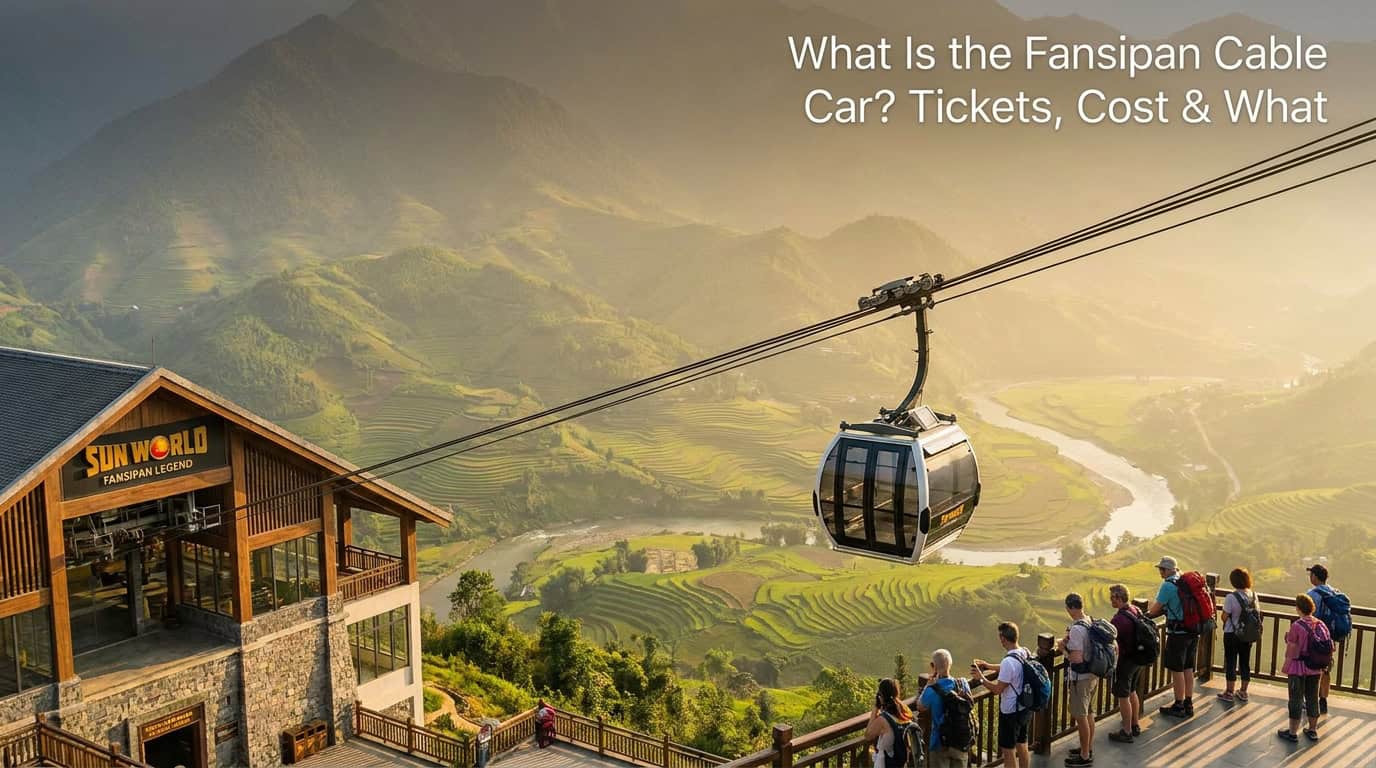
Opened on 2 February 2016, the Fansipan cable car is operated by Sun World Fansipan Legend, a division of Sun Group, and runs from Muong Hoa Valley station in Sapa to a terminus station 600 metres below the summit of Mount Fansipan. The system was engineered by Doppelmayr Garaventa, the Austrian-Swiss cable car specialists behind dozens of European alpine lifts, and uses the 3S (three-rope) configuration for stability in high winds.
When it launched, Guinness World Records certified it as the longest non-stop three-cable car system in the world at 6,292.5 metres and recognised the largest elevation difference for that type of system at 1,410 metres. Both records still stand in 2026.
Before the cable car, summiting Fansipan required a guided 2-day, 1-night trek through the Hoang Lien National Park — a rite of passage for Southeast Asian trekkers but realistically off-limits for families, older travellers, and anyone short on time. The cable car democratised the summit overnight.
How Much Does the Fansipan Cable Car Cost in 2026?
As of June 2026, the official prices at Sun World Fansipan Legend are:
- Adult round-trip: 800,000 VND (~$32 USD)
- Child round-trip (height 0.9m–1.3m): 550,000 VND (~$22 USD)
- Child under 0.9m: Free
- Senior citizen (60+, ID required): 550,000 VND (~$22 USD)
- Combo ticket (cable car + Muong Hoa funicular train): 950,000 VND (~$38 USD)
The funicular train combo is the smart pick. The Muong Hoa funicular saves a 15-minute uphill slog from the cable car arrival station up to the summit pagoda complex, and a separate uphill ticket alone costs 150,000 VND — so the combo essentially gives you free transit between stations.
What’s not included: food at the summit restaurants (mains 120,000–280,000 VND), the small “stairs to summit pole” walk (free), and any photos taken by Sun World photographers (around 100,000 VND per print). There are no hidden park entrance fees on top of the ticket — Hoang Lien National Park fees are bundled in.
Where to Buy Fansipan Cable Car Tickets

You have three options, and they’re not equal in 2026:
- At the station ticket counter — Walk-up tickets are available daily, but on weekends and Vietnamese public holidays (especially Tet, 30 April, 2 September) queues can run 45+ minutes. Bring a passport for ID-linked discounts.
- Online via Sun World’s official site — sunworld.vn/en/fansipan sells e-tickets with a QR code. You scan in at the turnstile. Same price as walk-up, but you skip the queue.
- Hotel concierge or local tour operator — Most Sapa hotels resell tickets at the same official price plus a small 30,000–50,000 VND service fee. Worth it only if you also need transport from your hotel.
Avoid third-party resellers offering “discounted” tickets on Facebook — these are almost always counterfeit QR codes that fail at the gate. Stick to the official channels.
How Long Does the Fansipan Cable Car Ride Take?
The actual cable car ride is approximately 15 minutes each way at a smooth 8 m/s cruising speed. But to answer the real question — how much time you should budget at Sun World Fansipan Legend in total — plan for 4 to 5 hours door-to-door from Sapa town.
A realistic breakdown:
- 10 minutes: Taxi from Sapa town to Muong Hoa station
- 20 minutes: Ticketing, walking to the boarding platform
- 15 minutes: Cable car ascent
- 5 minutes: Funicular train up to the pagoda complex (or 15-minute walk)
- 90–120 minutes: Exploring the summit — Bich Van Zen Monastery, the giant Amitabha Buddha statue, the 11-storey Kim Son Bao Thang Pagoda, and the summit marker
- 15 minutes: Cable car descent
- 10 minutes: Return taxi to town
Photography enthusiasts and pilgrims often stay longer — the pagoda complex is genuinely spectacular and worth lingering at, especially if you visit during sunrise or sunset shoulder hours.
Is the Fansipan Cable Car Worth It?
For the vast majority of foreign visitors to Vietnam, yes. Here’s the honest cost-benefit breakdown:
Worth it if you:
– Have limited time in Sapa (1–2 nights)
– Are travelling with kids, parents, or anyone not in trekking shape
– Want clear summit views without weather risk (the cable car runs in conditions that ground hikers)
– Care about the Buddhist pagoda complex and architecture, not just the summit
– Are visiting in winter (December–February), when the trekking route is brutal
Maybe skip it if you:
– Are a dedicated trekker who values the journey itself
– Visit during peak monsoon (July–August), when the summit is cloud-locked 80% of the time
– Are on an extreme budget — 800,000 VND is real money in Vietnam
The 4 percent of travellers who regret it almost universally fall into the second group. Check the live summit weather webcam on Sun World’s site before you commit on a cloudy morning.
When Is the Best Time to Ride the Fansipan Cable Car?
Sapa’s microclimate is fickle, and the summit weather often differs dramatically from town. Based on data from the Vietnam National Administration of Tourism, the optimal months are:
- October–November: Crisp air, terraced rice paddies turning gold, low cloud probability. Peak photography season.
- December–February: Cold (occasional snow above 2,800m) but the clearest skies of the year. Bring a real jacket.
- March–May: Wildflower bloom and azaleas at the summit. Increasing humidity.
- June–September: Monsoon. Daily rain showers and persistent cloud at the summit. Cable car runs but views are often whited-out.
Time of day matters too. Arrive at the 7:30 AM opening for the clearest views — by 11 AM, clouds typically build up. Late afternoon (3:30–4:30 PM) sometimes clears again if you’re patient.
For broader trip planning, see our guide on the best time to visit Vietnam which breaks down regional weather patterns month by month.
What to Wear and Bring
The summit is 3,143 metres up — temperatures are 10–15°C cooler than Sapa town, and Sapa town is already cooler than Hanoi. Even in summer, the top can hit 12°C with wind chill.
Essentials:
– Warm layer (fleece or light puffer) year-round
– Waterproof shell if visiting May–October
– Sturdy walking shoes — the pagoda complex has plenty of stone steps
– Bottled water (vending machines exist but are expensive)
– Passport or photo ID (required for senior/child discounts)
– Camera with a wide-angle lens
– Cash (some smaller summit kiosks don’t take cards)
Don’t bring drones — they’re banned in the Sun World complex and confiscation is enforced.
What to Do at the Summit
Once you arrive, the Fansipan cable car deposits you at a station 600 metres below the actual peak. From there, the experience splits into the Buddhist spiritual complex and the summit marker itself.
The pagoda complex is the main draw for many domestic visitors. It includes:
- Bich Van Zen Monastery — A working monastery with daily ceremonies
- Kim Son Bao Thang Pagoda — 11 storeys, built in classical Vietnamese architectural style
- The Great Amitabha Buddha statue — 21.5 metres tall, the largest of its kind in Vietnam
- Avalokiteshvara statue with the bell tower
- La Han Path — 18 statues of Buddhist arhats lining the staircase
The summit marker is a small stainless steel pyramid stamped “Fansipan 3,143m” — the obligatory photo opportunity. Expect a 5–10 minute queue on weekends.
If you’re tracing Vietnam’s mountain culture more broadly, this pairs well with our deeper guide to things to do in Sapa, which covers nearby Ham Rong Mountain and Cat Cat Village.
How to Get to the Fansipan Cable Car Station
The Sun World Fansipan Legend station sits 3 km southwest of central Sapa town. Getting there from Sapa is easy; getting to Sapa itself is the longer logistical question.
From Sapa town to the cable car (3 km):
– Taxi/Grab: 70,000–100,000 VND, 10 minutes. The most popular option.
– Sun World shuttle bus: Free for cable car ticket holders, departs from the Sun Plaza building in central Sapa every 30 minutes from 7:00 AM.
– Walking: Possible but uphill — allow 45 minutes.
From Hanoi to Sapa (320 km):
– Sleeper bus: 6 hours, 250,000–400,000 VND
– Vietnam Railways night train + transfer: Train to Lao Cai (8 hours), then 35 km road transfer to Sapa
– Private car: 5–6 hours via the new expressway, 2,000,000–3,000,000 VND
Most travellers spending time in Ho Chi Minh City before heading north will fly Saigon–Hanoi (2h) then take ground transport. If you’re still planning that southern leg, our Saigon itinerary covers exactly what to do with 3 days in the south before catching your domestic flight.
Fansipan Cable Car vs Trekking: Which Should You Choose?
This is the great Sapa debate. The honest comparison:
Cable car:
– 15 minutes vs 2 days
– 800,000 VND vs 2,500,000–4,000,000 VND for a guided trek
– Suitable for all ages and fitness levels
– Weather-resilient
– No physical achievement, but you still touch the summit
Trekking:
– 2 days, 1 night minimum via the Tram Ton route
– Requires a licensed guide (mandatory by Hoang Lien National Park rules)
– Genuine physical challenge — gain 1,600m+ on foot
– Cultural interaction with Hmong and Dao villages
– Bragging rights
A growing number of travellers do both: cable car on day one for the view, optional trek on day two if weather and fitness allow. Sun World even sells one-way trek-down tickets for those who hike up but don’t want to descend on tired knees.
Fansipan Cable Car: Common Mistakes to Avoid
After eight years of operation, the same handful of missteps trip up new visitors:
- Going on a cloudy morning without checking the webcam. You’ll pay 800,000 VND to ride into white nothing. Use the Sun World live cam before you taxi over.
- Skipping the funicular combo. That 15-minute uphill walk between the cable car station and the pagoda is steeper than it looks. The 150,000 VND combo upgrade is worth it.
- Wearing flip-flops or sandals. The pagoda steps are wet, slippery stone. Closed-toe shoes only.
- Booking on Tet holiday without reservation. Lunar New Year week is the busiest pilgrimage period — gondolas fill, queues hit 90 minutes.
- Missing the 5:30 PM last descent. Cable car closes promptly. Sun World does not run late gondolas for stranded visitors.
FAQs
Is Fansipan the longest cable car in the world?
The Fansipan cable car holds the Guinness World Record for the longest non-stop three-rope cable car system at 6,292.5 metres. It’s not the longest cable car of any type in the world — that title belongs to the Norsjö aerial tramway in Sweden at 13.2 km — but Fansipan remains the longest three-rope (3S) system globally as of 2026.
How much is a cable car to Fansipan?
An adult round-trip Fansipan cable car ticket costs 800,000 VND (~$32 USD) in 2026. Children 0.9–1.3m pay 550,000 VND (~$22), and children under 0.9m ride free. A combo ticket including the Muong Hoa funicular train is 950,000 VND (~$38). Prices are set by Sun World and adjusted seasonally.
Is the cable car in Sa Pa worth it?
Yes for most travellers — the Fansipan cable car covers in 15 minutes what previously required a 2-day guided trek, and runs reliably in weather that grounds hikers. It’s worth it if you have limited time, are travelling with family, or want guaranteed summit access. Skip it during peak monsoon (July–August) when the summit is cloud-locked.
How much time for Fansipan cable car?
Budget 4–5 hours total at Sun World Fansipan Legend, including a 15-minute ascent, 90–120 minutes at the summit pagoda complex, 15-minute descent, and transit time. The cable car itself takes 15 minutes each way at 8 m/s. Photography enthusiasts and pilgrims often stay 5–6 hours.
Does the Fansipan cable car run year-round?
Yes — operations run daily from 7:30 AM to 5:30 PM, 365 days a year, weather permitting. The 3S engineering allows the system to operate in winds up to 55 km/h. Closures are rare and usually announced on Sun World’s official website. Lightning storms occasionally cause 30–60 minute pauses.
Can I take the cable car up and trek down?
Yes. Sun World sells one-way cable car tickets for 600,000 VND (~$24 USD) for trekkers who want to summit by gondola but descend on foot via the Tram Ton trail. You must arrange a licensed Hoang Lien National Park guide separately, as the trail descent is regulated.
Plan the Rest of Your Vietnam Trip
The Fansipan cable car is usually the dramatic finish of a Northern Vietnam loop — but if you’re flying in or out of Ho Chi Minh City, you’ll want a calm base for the southern leg of your trip. Our District 1 homestay sits a 5-minute walk from Ben Thanh Market and 10 minutes from the Saigon River, making it an easy launchpad for the top things to do in Ho Chi Minh City before or after Sapa.
Book direct for the best 2026 rates, free airport pickup, and our hand-drawn neighbourhood map — designed so you’ll spend less time on logistics and more time on the parts of Vietnam that actually take your breath away, like the view from the top of the Fansipan cable car.
Carrying the right cash matters more than most visitors expect — see the Vietnam currency and money exchange guide before you arrive.