
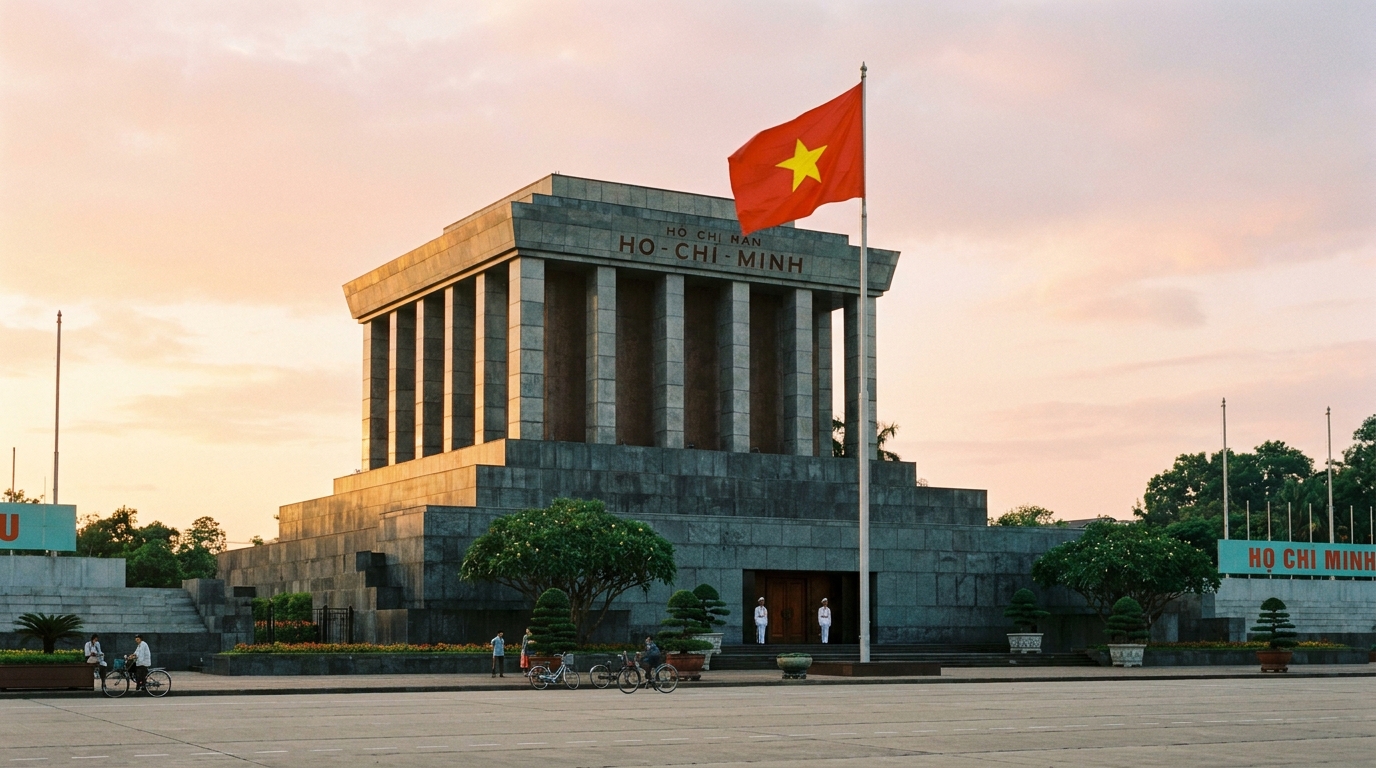
The Ho Chi Minh Mausoleum Hanoi is the granite monument in Ba Dinh Square where the embalmed body of Vietnam’s founding president has been preserved since 1975, and in 2026 it remains one of the country’s most-visited free attractions, drawing more than 15 million visitors since opening. If you have one morning in Hanoi and want to understand modern Vietnam, this is where you start. This guide covers exactly when to arrive, what you cannot bring inside, the strict dress code that turns away thousands of tourists each year, and the five additional sites in the complex that most travelers miss.
Key Takeaways
- Entry is 100% free for the mausoleum itself, but the adjacent Presidential Palace gardens and museum charge a 40,000 VND (~$1.60 USD) ticket.
- Opening hours are short: 7:30 AM–10:30 AM Tuesday–Thursday and 7:30 AM–11:00 AM weekends. Closed Mondays, Fridays, and the entire September 4–November 4 maintenance period.
- Strict dress code: No shorts above the knee, no tank tops, no hats, no sunglasses, no phones or cameras inside the viewing chamber.
- Arrive by 7:00 AM to avoid the 60–90 minute queue that builds by 9:00 AM, especially on weekends and Vietnamese public holidays.
- Plan 3 hours for the full complex: mausoleum, Presidential Palace grounds, Stilt House, One Pillar Pagoda, and Ho Chi Minh Museum.
- Photography is forbidden inside the mausoleum and the inner courtyard guarded by sentries — bag check is mandatory.
Quick Facts: Ho Chi Minh Mausoleum Hanoi at a Glance
| Detail | Information |
|---|---|
| Location | 2 Hung Vuong, Dien Bien, Ba Dinh District, Hanoi |
| Opening Hours | 7:30–10:30 (Tue–Thu), 7:30–11:00 (Sat–Sun) |
| Closed | Mondays, Fridays, Sep 4 – Nov 4 (annual maintenance) |
| Entry Fee | Free (mausoleum); 40,000 VND (~$1.60) for Presidential Palace area |
| Dress Code | Knees and shoulders covered, no hats inside |
| Photography | Allowed in Ba Dinh Square; forbidden inside |
| Best Time | 7:00–7:30 AM, weekdays, October–April |
| Average Visit | 15–20 minutes inside; 2–3 hours for full complex |
| Nearest Metro | Cat Linh Station (Line 2A), 1.2 km walk |
Is the Ho Chi Minh Mausoleum Hanoi Worth Visiting?
Yes, the Ho Chi Minh Mausoleum Hanoi is worth visiting for any traveler interested in 20th-century history, Vietnamese culture, or Soviet-era architecture, and the fact that it is free removes any cost-benefit debate. The visit itself is short — typically 15 to 20 minutes inside — but the surrounding complex of the Presidential Palace, the Stilt House where Ho Chi Minh actually lived, and the One Pillar Pagoda turns a brief stop into a half-day cultural deep-dive.
According to the Vietnam National Administration of Tourism, Ba Dinh Square and the mausoleum complex consistently rank among Hanoi’s top three most-visited heritage sites. Reviews on TripAdvisor average 4.0 stars across more than 9,800 entries, with foreign visitors particularly praising the changing-of-the-guard ceremony at 6:00 AM and 9:00 PM daily — a moment that rivals similar ceremonies at the Tomb of the Unknown Soldier in Washington for solemnity.
That said, this is not a flashy attraction. If you expect light shows or interactive exhibits, you will be disappointed. The experience is reverent, brisk, and tightly controlled by uniformed soldiers who move queues forward without conversation. For travelers who appreciate the gravity of seeing a preserved historical figure — comparable to visiting Lenin’s mausoleum in Moscow or Mao’s in Beijing — this ranks as a once-in-a-lifetime sight.
Tickets and Opening Hours: What You Need to Know
Is the Ho Chi Minh Mausoleum free?
Yes, entry to the mausoleum chamber itself is completely free for both Vietnamese and foreign visitors. There is no ticket booth, no online reservation system, and no skip-the-line option. You simply queue, pass through security, and walk through. The only payment you might make is 40,000 VND (~$1.60 USD) if you want to enter the Presidential Palace grounds, the Stilt House area, and the adjacent Ho Chi Minh Museum, which is well worth the small fee.
Why does the Ho Chi Minh Mausoleum close so early?
The mausoleum closes by 10:30 or 11:00 AM each open day because the preserved body requires strict temperature and humidity controls that limit visitor exposure to roughly three hours daily. Between November and December every year, the complex closes for approximately two months while Vietnamese and Russian scientists from Moscow’s Center for Biomedical Technologies perform conservation work on the body — a tradition since 1976. Mondays and Fridays are closed for routine maintenance.
2026 Opening Schedule
- Tuesday – Thursday: 7:30 AM – 10:30 AM
- Saturday – Sunday: 7:30 AM – 11:00 AM
- Monday & Friday: Closed all day
- September 4 – November 4, 2026: Closed for annual conservation
- National holidays (May 19 – Ho Chi Minh’s birthday, September 2 – National Day): May extend hours; expect 3+ hour queues
Dress Code and Rules: Don’t Get Turned Away
The single most common reason foreign tourists are refused entry is improper dress. Guards in the white uniform of the Mausoleum Guard Honor Regiment stand at the entrance and will firmly send you back if you do not comply. Here is exactly what is enforced:
Required:
– Knees fully covered (no shorts, no skirts above the knee)
– Shoulders covered (no tank tops, no spaghetti straps, no sleeveless dresses)
– Quiet, respectful behavior — no laughing, no loud talking
Forbidden inside:
– Hats and sunglasses (remove before entering)
– Cameras, phones, video devices (checked at the entrance)
– Bags and backpacks (free bag deposit available 200 meters before the queue)
– Smoking, eating, drinking, chewing gum
– Hands in pockets (yes, this is enforced)
– Crossed arms or standing still inside the chamber — you must keep walking
If you arrive in shorts, you can rent a sarong-style wrap from vendors near the entrance for around 30,000 VND (~$1.20 USD), but the supply is limited on busy mornings. Better to dress correctly at your homestay before you leave.
What to See Inside the Ho Chi Minh Mausoleum Hanoi Complex
The mausoleum is the centerpiece, but the surrounding 14-hectare complex includes five additional sites that most travelers underestimate. Plan to spend a full morning to see everything properly.
1. The Mausoleum Itself
The building is a 21.6-meter-tall granite structure modeled after Lenin’s Mausoleum in Moscow but incorporating Vietnamese architectural elements — the sloping roof references traditional communal houses (đình), and the materials were sourced from 200 locations across Vietnam, including marble from Marble Mountain in Da Nang. Construction took two years (1973–1975) and involved Soviet engineers working alongside Vietnamese architect Nguyen Ngoc Chan.
Inside, the embalmed body lies in a glass sarcophagus under soft red lighting. You walk single-file around the bier — total time inside is approximately 90 seconds. Four honor guards in dress whites stand motionless at each corner.
2. Ba Dinh Square
The 32,000-square-meter square in front of the mausoleum is where Ho Chi Minh read Vietnam’s Declaration of Independence on September 2, 1945. The 168 squares of grass between the pavement represent traditional Vietnamese rice paddies. This is where you can photograph the building freely and where the daily flag-raising ceremony takes place at 6:00 AM sharp.
3. The Presidential Palace
The ochre-yellow French colonial building (built 1900–1906 by Auguste-Henri Vildieu as the residence of the Governor-General of French Indochina) is closed to interior visits but visible from the gardens. Ho Chi Minh famously refused to live in it, calling it too grand for a people’s leader.
4. The Stilt House (Nhà sàn Bác Hồ)
This modest wooden house on stilts, where Ho Chi Minh actually lived from 1958 to 1969, is the most moving site in the complex for many visitors. The simple ground-floor meeting area and upstairs bedroom contain his original books, typewriter, and bamboo bed. The carp pond he fed each evening still has descendants of his original fish.
5. The One Pillar Pagoda (Chùa Một Cột)
Built in 1049 during the Ly Dynasty and rebuilt in 1955 after French sappers destroyed it in 1954, this tiny wooden temple rising from a single stone pillar in a lotus pond is one of the oldest Buddhist sites in Vietnam. It takes 10 minutes to see but is symbolically central to Vietnamese identity.
6. The Ho Chi Minh Museum
A modernist concrete building opened in 1990 housing 117,000 documents and artifacts tracing Ho Chi Minh’s life from his birth in Nghe An province through his decades abroad in France, the UK, the US, and the Soviet Union. The museum charges a separate 40,000 VND ticket but is included if you bought the combined Presidential Palace ticket.
How to Get to the Ho Chi Minh Mausoleum Hanoi from the Old Quarter
The complex sits 2.5 km west of Hoan Kiem Lake in the Old Quarter, an easy 10-minute taxi ride or 35-minute walk.
By Grab/taxi: 50,000–70,000 VND (~$2–$2.80 USD) from Hoan Kiem Lake. Tell the driver “Lăng Bác” (Uncle’s Tomb) — the Vietnamese name everyone uses.
By metro: Take Hanoi Metro Line 2A to Cat Linh Station, then walk 1.2 km north. Fare 8,000–15,000 VND.
By bus: Routes 09, 18, 33, 45, and 50 stop at Ba Dinh Square. Fare 7,000 VND.
By cyclo: A traditional but slow option from the Old Quarter, 150,000–200,000 VND (~$6–$8 USD) one-way. Negotiate before you sit.
On foot: A pleasant 35-minute walk through the French Quarter passing the Opera House and St. Joseph’s Cathedral.
If you’re staying further south, see our guide to getting around Vietnam efficiently for cross-country transport options.
Best Time to Visit: Avoiding the Crowds
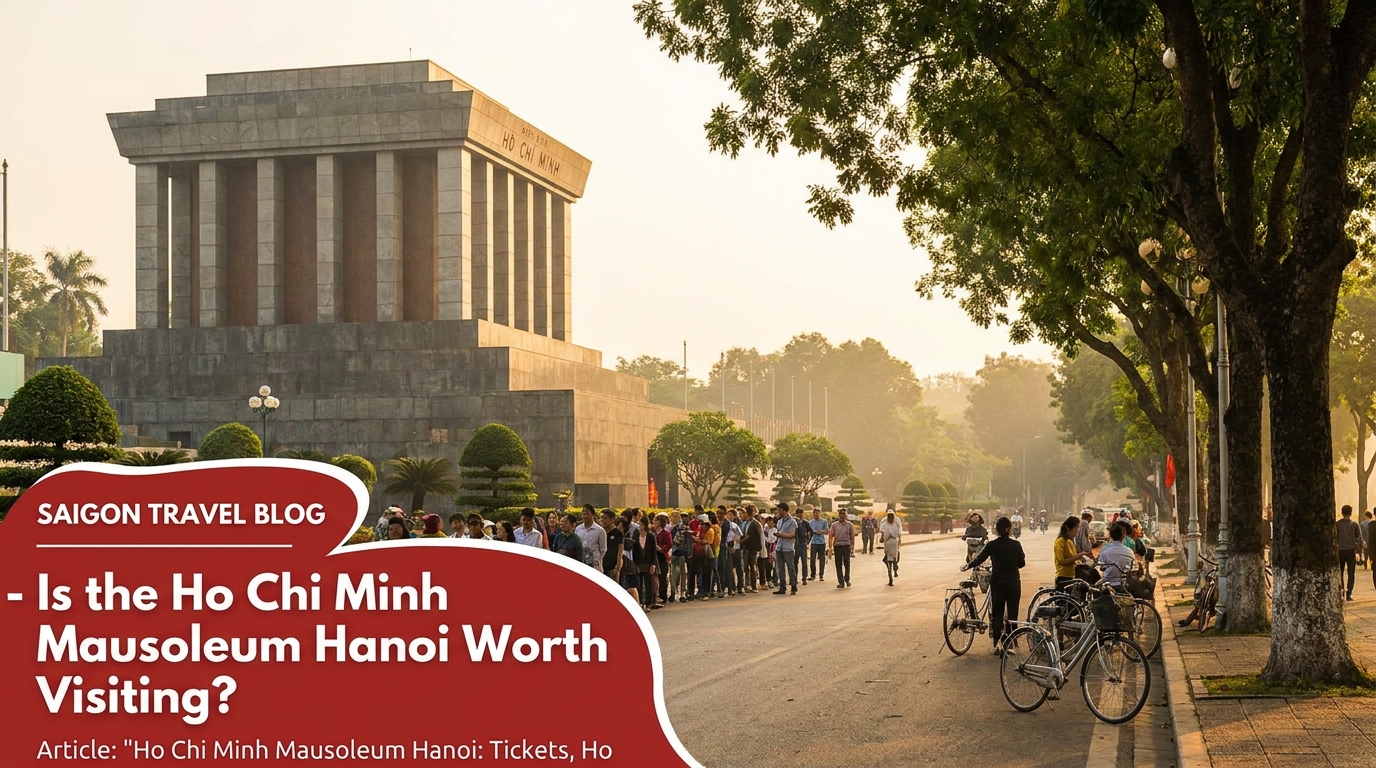
Foreign visitors should arrive between 6:50 and 7:10 AM — about 20 minutes before opening — to be among the first 100 in the queue. By 8:30 AM the line typically stretches 400 meters along Hung Vuong Street, and by 9:30 AM you may not get through before closing.
Best months: October to April, when Hanoi’s weather is cool and dry. Avoid July and August (hot, humid, and packed with domestic tourists during summer school holidays).
Worst days: Sundays and Vietnamese public holidays (Tet Lunar New Year, April 30 Reunification Day, May 1 Labor Day, May 19 Ho Chi Minh’s Birthday, September 2 National Day). Expect 90+ minute queues on these dates.
Best day: Tuesday at 7:00 AM — the first open day after the Monday closure but before weekend crowds.
If you are planning a multi-city trip, our 7-day Vietnam itinerary shows how to slot Hanoi’s mausoleum visit between Halong Bay and a flight south to Ho Chi Minh City.
What Makes the Ho Chi Minh Mausoleum Hanoi Special?
What sets the Ho Chi Minh Mausoleum Hanoi apart from other communist-era memorials is the contrast between the monumental Soviet-style exterior and the very Vietnamese reverence inside. Unlike Mao’s mausoleum in Beijing or Lenin’s in Moscow — both of which feel like state spectacles — the atmosphere here is closer to a religious pilgrimage. Most visitors are elderly Vietnamese citizens from rural provinces, many making the trip once in their lifetime. Many cry quietly.
The body itself is one of only four publicly displayed embalmed leaders in the world (alongside Lenin, Mao Zedong, and Kim Il-sung/Kim Jong-il). According to the BBC, Russian and Vietnamese scientists continue to use the same embalming techniques developed for Lenin in 1924, and the cost of maintaining the body has never been publicly disclosed.
What also makes it special is the contradiction: Ho Chi Minh’s actual will, published in 1969, requested cremation and that his ashes be scattered across three regions of Vietnam — north, center, and south. The Politburo overruled him in 1975 to create a permanent symbol of national unity. Standing in the chamber today, you are seeing a decision made against the wishes of the man preserved within it.
Combining Your Visit with Other Hanoi Attractions
The mausoleum complex sits in Ba Dinh District, walking distance from several other top Hanoi sights. After your morning visit (you will likely finish by 10:00 AM), consider:
- Temple of Literature (1.5 km southeast) — Vietnam’s first national university, founded 1070. Entry 70,000 VND.
- Hoa Lo Prison Museum (2.8 km southeast) — the “Hanoi Hilton” where John McCain was held. Entry 50,000 VND.
- West Lake (Ho Tay) (1.8 km north) — Tran Quoc Pagoda on the lake is Hanoi’s oldest, founded in the 6th century.
- Old Quarter (2.5 km east) — for lunch at a bún chả stall (Obama famously ate at Bún Chả Hương Liên).
For the second half of your Vietnam trip, see our recommended things to do in Ho Chi Minh City and where to find the best pho in Saigon.
Where to Stay in Hanoi Before Visiting
The Old Quarter is the obvious base — most boutique hotels and homestays cluster within a 2 km radius of Hoan Kiem Lake. From there, a 5,000-step morning walk gets you to the mausoleum by opening time. If you’re flying into Hanoi and then heading south, see our guide on how to choose between Hanoi and Saigon as your trip base.
For travelers spending most of their Vietnam trip in the south, our District 1 homestay guide covers the best central neighborhoods in Ho Chi Minh City for first-time visitors.
Frequently Asked Questions
Is it worth going to the Ho Chi Minh Mausoleum?
Yes, the Ho Chi Minh Mausoleum is worth visiting if you have a morning in Hanoi. Entry is free, the surrounding complex includes five additional sites including the Presidential Palace gardens and One Pillar Pagoda, and seeing one of only four publicly displayed embalmed world leaders is a once-in-a-lifetime experience. Budget 2–3 hours total.
Is the Ho Chi Minh Mausoleum free?
Yes, entry to the mausoleum itself is completely free for all visitors, Vietnamese and foreign. The only ticket required is 40,000 VND (~$1.60 USD) for the adjacent Presidential Palace grounds, the Stilt House, and the Ho Chi Minh Museum. There is no online booking — simply queue at the entrance during opening hours.
Why does the Ho Chi Minh Mausoleum close so early?
The mausoleum closes by 10:30–11:00 AM daily because preserving the embalmed body requires strict environmental controls that limit public exposure to about three hours per day. It also closes Mondays and Fridays for maintenance and for two months annually (typically September 4 to November 4) when Russian and Vietnamese scientists perform conservation work on the body.
What is special about the Ho Chi Minh Mausoleum?
The mausoleum is special because it houses one of only four publicly displayed embalmed communist leaders in the world (alongside Lenin, Mao, and Kim Il-sung) and was built in 1975 despite Ho Chi Minh’s own written request to be cremated. The granite was sourced from 200 locations across Vietnam, and the building stands on the exact spot where he declared Vietnam’s independence in 1945.
Can I take photos at the Ho Chi Minh Mausoleum?
You can photograph the exterior freely from Ba Dinh Square and the surrounding gardens. Photography is strictly forbidden inside the mausoleum chamber and inside the Stilt House. Phones and cameras must be deposited at the bag check before joining the entry queue. Guards will confiscate devices used inside.
How long does the visit take?
Plan 15–20 minutes for the mausoleum itself once you reach the entrance (the actual walk-through takes 90 seconds), plus 30–90 minutes of queuing depending on arrival time. To see the full complex including the Presidential Palace, Stilt House, One Pillar Pagoda, and museum, budget 2.5–3 hours total.
Plan Your Vietnam Trip from a Central Base
After Hanoi, most travelers fly south to Ho Chi Minh City for the second half of their Vietnam trip. Stay in a centrally located District 1 homestay within walking distance of Ben Thanh Market, the Notre-Dame Cathedral, and the War Remnants Museum — the southern counterpart to the historical sites you just visited in Hanoi. Browse our handpicked Saigon homestays for verified, foreign-friendly options under $40/night, all within 10 minutes of the city’s top sights.
For fares and which option makes sense at which time of day, see getting around Saigon.