
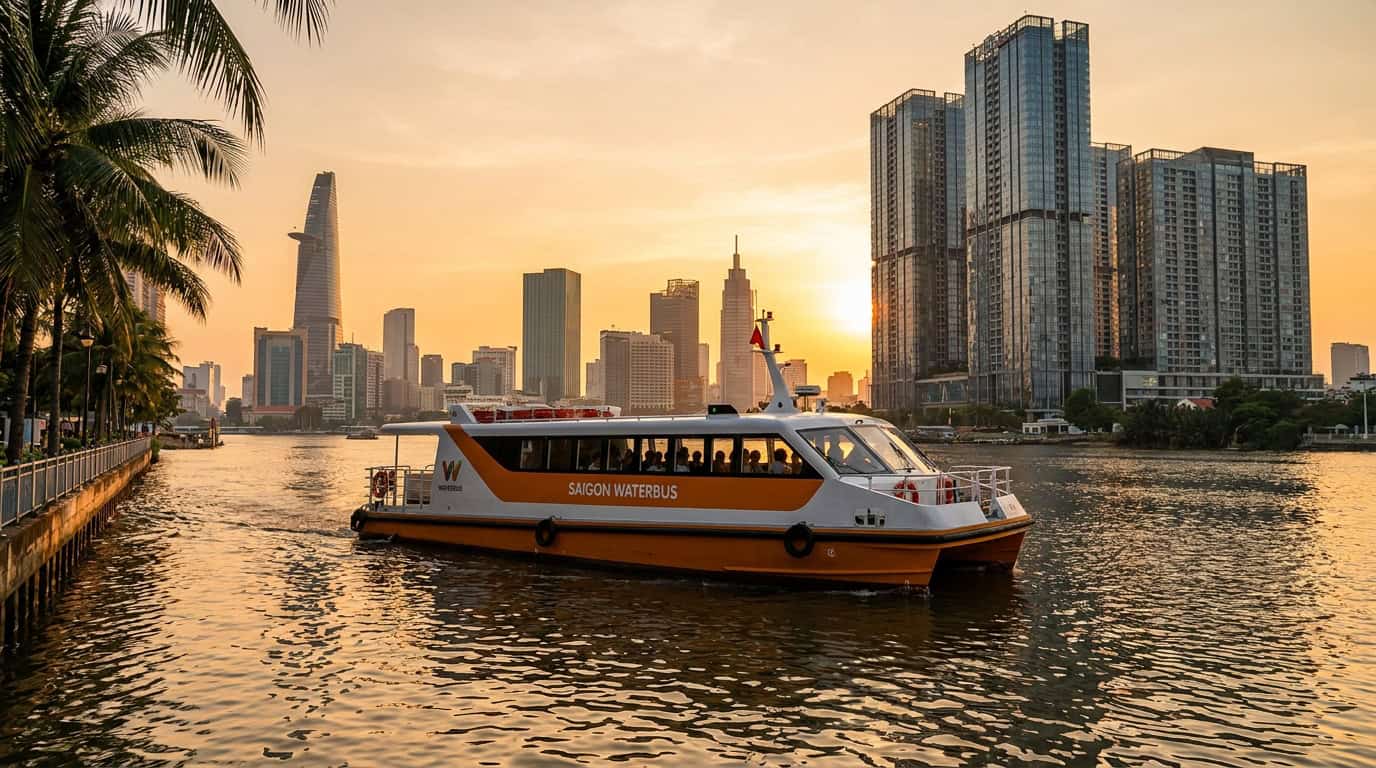
For just 15,000 VND — roughly sixty US cents — you can skip the gridlocked streets of Ho Chi Minh City entirely and glide along the Saigon River on one of Southeast Asia’s best-value urban ferry services. The Saigon Waterbus has quietly been running since November 2017, clocking more than three million passenger journeys by the end of 2021 (VnExpress, 2021), and it remains one of the most underused shortcuts in a city of 10 million people. Pair the ride with a visit to the Q7 Saigon Riverside Complex — Hung Thinh Corp’s sweeping 8.15-hectare riverside development in District 7 — and you have a full afternoon that most visitors never find in the guidebooks.
This guide covers every stop, price, schedule, and practical detail you need.
Key Takeaways
– The Saigon Waterbus (Route 1) runs 10.8 km from Bach Dang Pier in District 1 to Linh Dong in Thu Duc, with departures every 20–30 minutes from 5:30 AM to 7:30 PM daily.
– A single ticket costs 15,000 VND (~$0.60 USD) — up to 16× cheaper than a taxi for the same corridor.
– Q7 Saigon Riverside Complex is a 13-tower, 4,000+ unit mixed-use development on the Saigon River in District 7, best reached by Grab from Bach Dang Pier (~80,000–120,000 VND / $3.20–$4.80).
– Ho Chi Minh City welcomed approximately 5.5–6 million international visitors in 2024 (HCMC Tourism Department, 2024), and the waterbus is increasingly a bucket-list experience — not just a commuter route.
– HCMC’s government plans to expand the waterbus network to eight routes by 2030 (Vietnam Investment Review, 2024).
What Is the Saigon Waterbus?
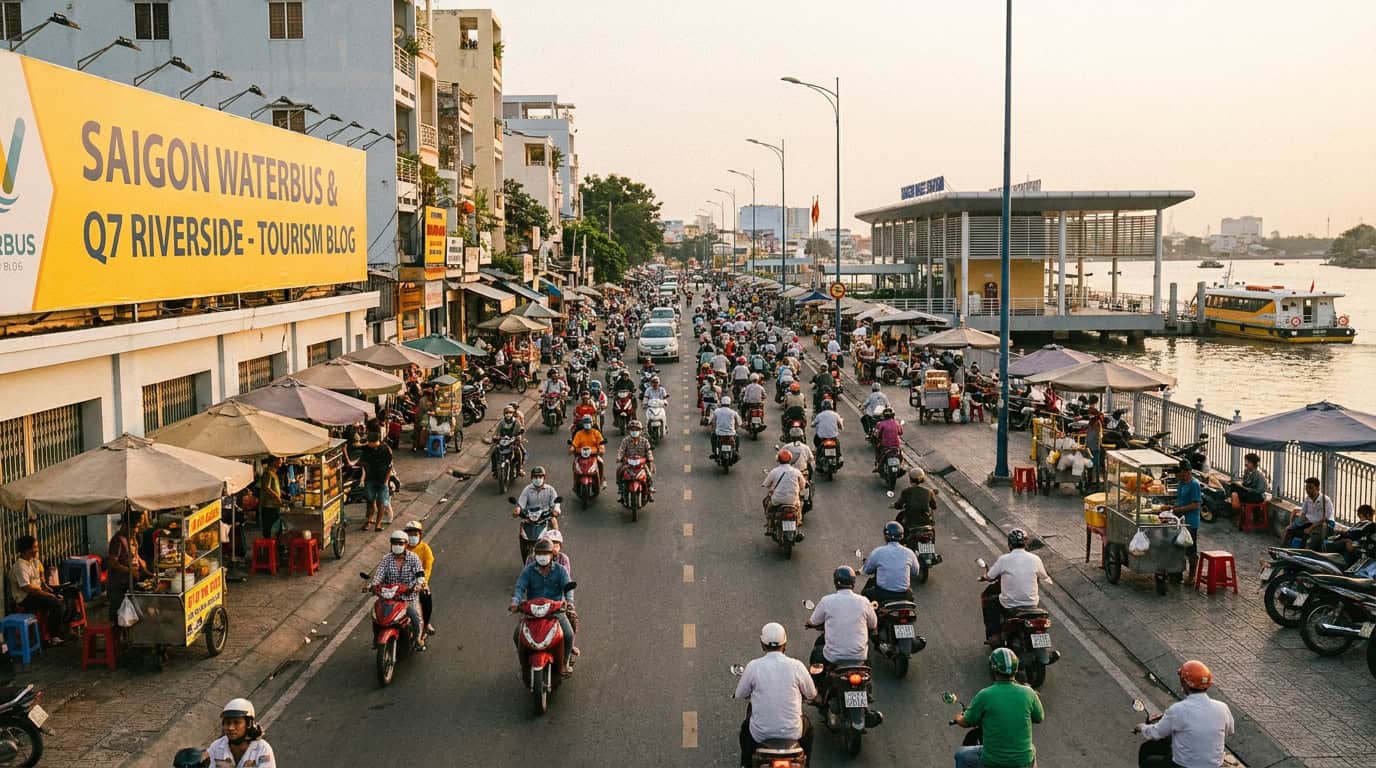
Vietnam’s first modern urban river-bus service launched on 25 November 2017, operated by Thuong Nhan Transportation Co. under a concession from the HCMC Department of Transport. The goal was straightforward: relieve pressure on the city’s chronically congested road network by putting commuters and tourists on the water.
It worked. Within four years, the service had carried more than three million passengers (VnExpress, 2021), and the government has committed to scaling the network from one operational route to eight routes covering key riverside corridors by 2030 (Vietnam Investment Review, 2024).
The Fleet
Each vessel holds approximately 80 passengers and is fitted with air-conditioning, life jackets, and panoramic windows on both sides. The boats run on a fixed schedule and dock at purpose-built floating pontoon piers — not the chaotic informal jetties you’ll see elsewhere on the river.
Current Routes
As of May 2026, Route 1 is the primary operational route for tourists and daily commuters. Additional routes in the southern District 7 / Phu My Hung corridor have been in planning and phased rollout since 2023. Confirm current route availability at the official Saigon Waterbus site before you travel.
Route 1 Stop-by-Stop: Bach Dang to Linh Dong
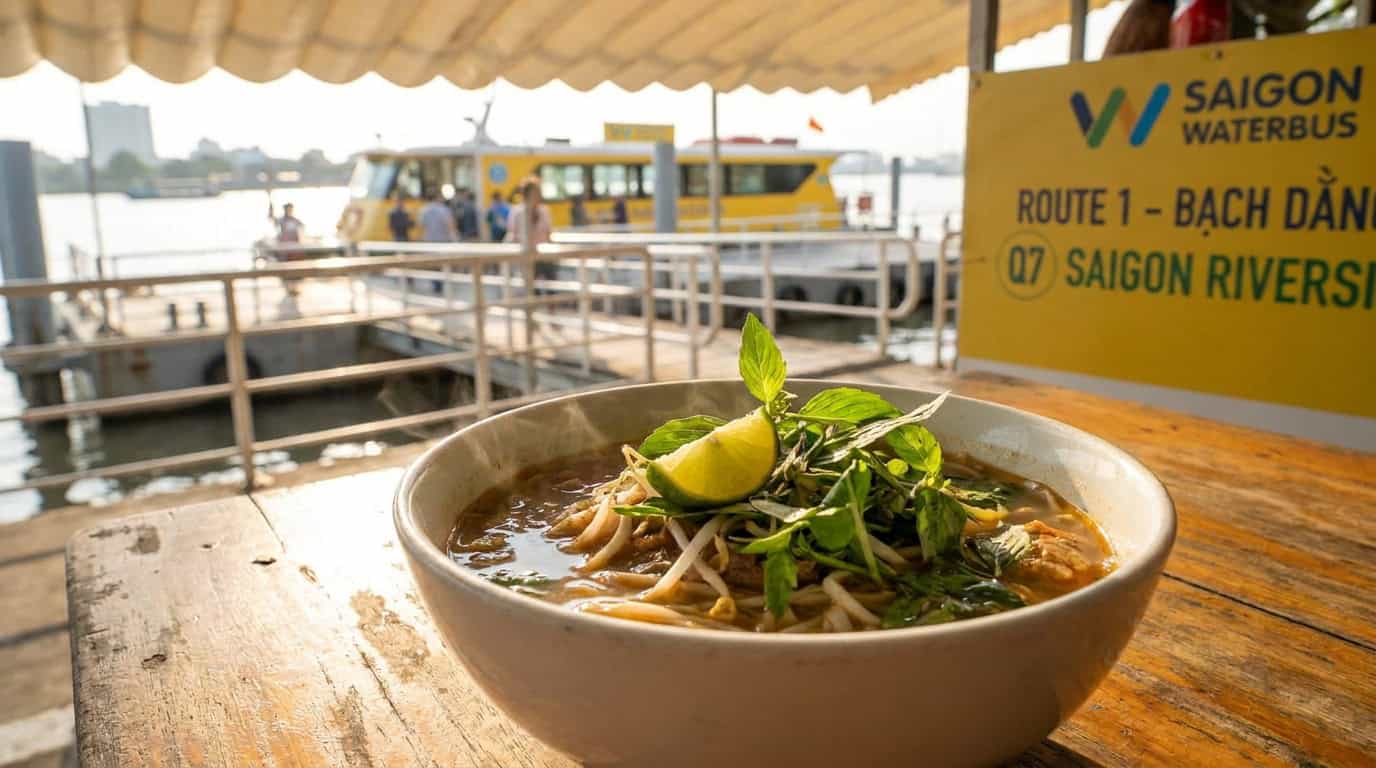
Route 1 covers 10.8 kilometres along the Saigon River and Binh Trieu Canal, connecting the heart of District 1 with the rapidly developing Thu Duc area to the north. Total journey time end-to-end is approximately 60–70 minutes.
The Eight Stops
| Stop # | Pier Name | District | Key Nearby Landmark |
|---|---|---|---|
| 1 | Bach Dang (Pier 1) | District 1 | Bitexco Tower, Nguyen Hue Walking Street |
| 2 | Binh An | District 2 / Thu Duc | An Phu residential area |
| 3 | Thanh Da | Binh Thanh | Thanh Da Peninsula, cafés and parks |
| 4 | Hiep Binh Chanh | Thu Duc | Local residential zone |
| 5 | Hiep Binh Phuoc | Thu Duc | VinUni University campus area |
| 6 | Linh Dong | Thu Duc | Northern terminus, Linh Dong Ward |
Practical note: You don’t have to ride end-to-end. Many visitors board at Bach Dang, disembark at Thanh Da for a riverside café stop, then re-board on the next boat. Your ticket is valid for that journey only, so budget an extra 15,000 VND (~$0.60) for each re-boarding.
Timetable and Frequency
The waterbus runs daily, including public holidays. Boats depart approximately every 20–30 minutes in both directions.
| Day Type | First Departure | Last Departure | Frequency |
|---|---|---|---|
| Weekdays | 5:30 AM | 7:30 PM | Every 20–30 min |
| Weekends | 5:30 AM | 7:30 PM | Every 20–30 min |
| Public Holidays | 5:30 AM | 7:30 PM | Every 20–30 min |
Always verify the current timetable at buytsongsaigon.com.vn — schedules are occasionally adjusted during major holidays or vessel maintenance periods.
Ticket Prices and How to Buy
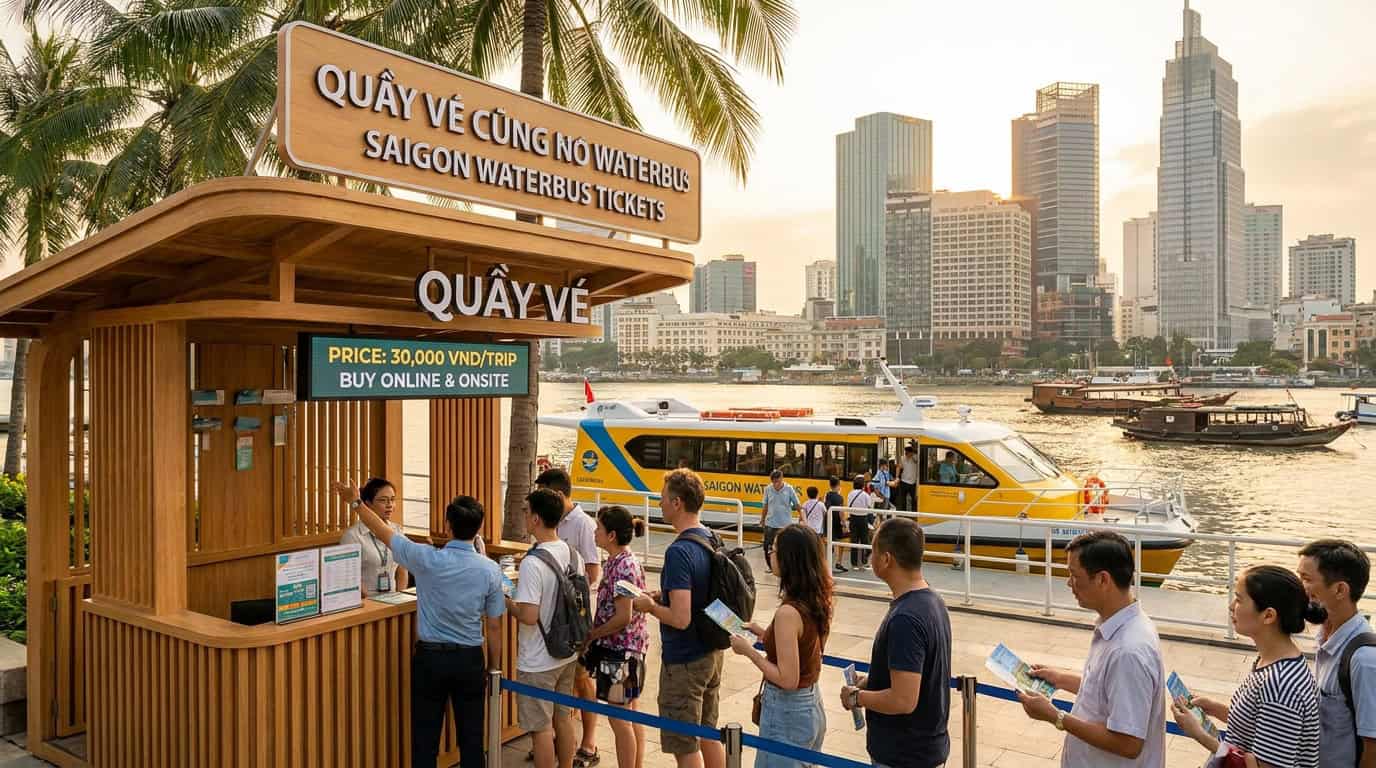
The Saigon Waterbus is extraordinarily affordable. In 2026, the standard fare structure is:
| Ticket Type | Price (VND) | Price (USD) | Notes |
|---|---|---|---|
| Single journey (any stop to any stop) | 15,000 VND | ~$0.60 | Pay on board or at the pier kiosk |
| Monthly commuter pass | 200,000 VND | ~$8.00 | For regular commuters; valid for unlimited Route 1 trips |
| Children under 6 | Free | Free | Must be accompanied by a paying adult |
Source: Saigon Waterbus Official Operator, 2025. Confirm current fares on-site before travel, as fares are periodically reviewed.
How to Pay
Cash is king here. Have 15,000 VND (a single red polymer note) ready when you board. The pier kiosks at Bach Dang also accept payment, and staff are accustomed to tourists — pointing at a destination stop on the route map is enough.
What Is Q7 Saigon Riverside Complex?
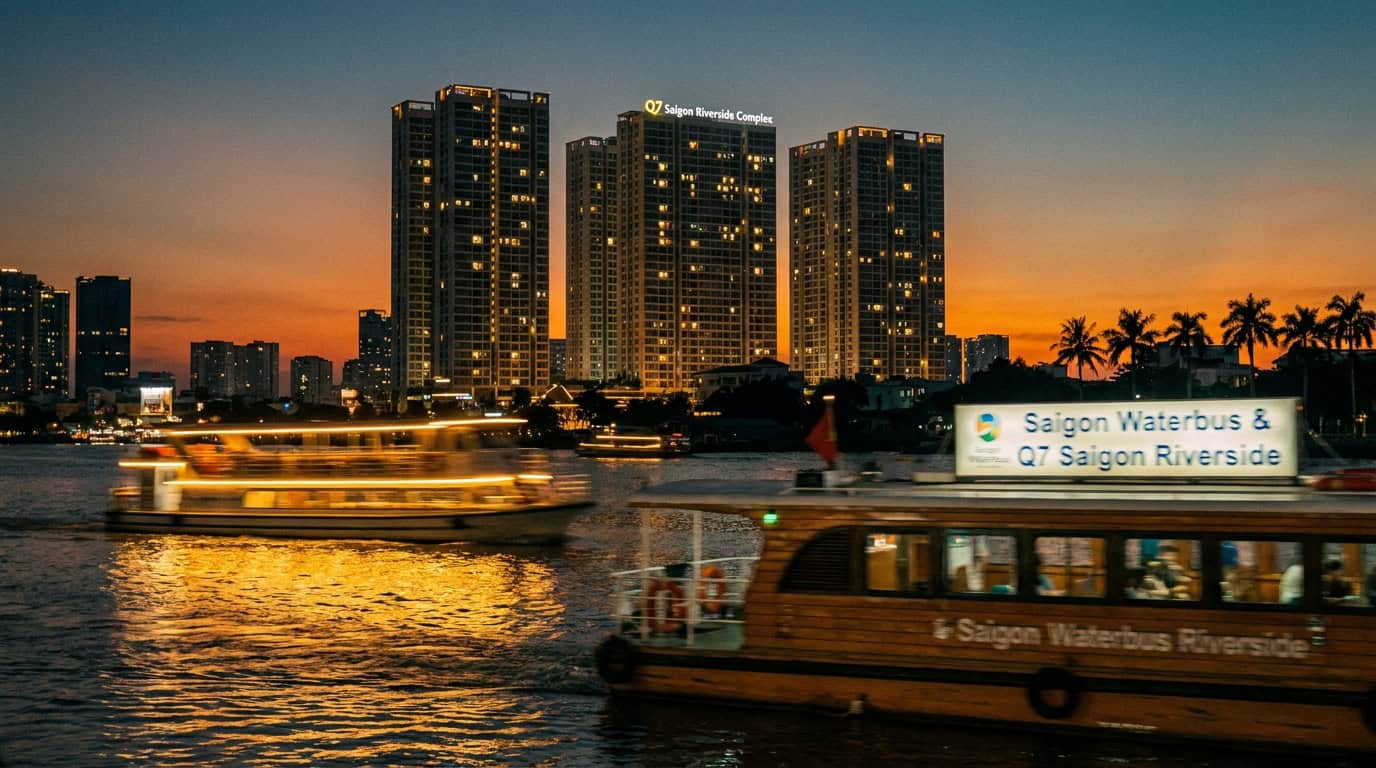
The Q7 Saigon Riverside Complex is a large-scale mixed-use riverside development in District 7, built by Hung Thinh Corp — one of Vietnam’s largest private property developers. The complex sits on Dao Tri Street, Phu Thuan Ward, with direct frontage onto the Kinh Te Canal and Saigon River system.
By the Numbers
- Site area: 8.15 hectares
- Residential towers: 13 towers across phased development
- Total units: 4,000+ apartments
- Development period: Phased delivery from 2020 through 2025–2026
This isn’t just another condo tower. The Riverside Complex is designed as a self-contained urban neighbourhood — it has landscaped riverside promenades, multiple swimming pools, a fully equipped gym, children’s play zones, BBQ terraces, and a ground-floor retail and F&B podium. Several of the towers have now been handed over and occupied, giving the complex a genuine community feel rather than the ghost-town atmosphere of many unfinished mega-projects in Vietnam.
Who Visits — and Why?
For tourists, the draw is the riverside promenade and the F&B strip. The ground-floor retail area has a growing number of cafés, casual restaurants, and a small supermarket. It’s a pleasant spot to sit with a Vietnamese iced coffee (cà phê sữa đá, roughly 35,000–55,000 VND / $1.40–$2.20), watch river traffic, and get a slice of everyday Saigon life away from the backpacker circuit.
For expats and long-stay visitors, Q7 Saigon Riverside is worth knowing as a reference point for the District 7 lifestyle — quieter than District 1, more modern than Binh Thanh, and well-connected by Grab to Phu My Hung’s schools, international restaurants, and supermarkets.
H3: The River View Factor
The complex’s location on the Kinh Te Canal gives it commanding views across the water toward Nha Be District — a stretch of mangrove-edged riverbank that feels surprisingly rural given how close you are to downtown. At sunset, the light on the water here is genuinely spectacular, and on weekends locals gather along the promenade for that exact reason.
How to Get to Q7 Saigon Riverside Complex
Here’s the honest answer: there is no direct waterbus stop at Q7 Saigon Riverside Complex as of mid-2026. Route 1 runs northward from District 1 toward Thu Duc — not south toward District 7. The planned southern routes connecting the Phu My Hung / District 7 corridor are still in rollout phase.
The smartest approach for a combined waterbus + Q7 day trip is:
- Board the waterbus at Bach Dang Pier (District 1) and ride to any stop you like — Thanh Da is a popular midpoint stop with riverside cafés.
- Return to Bach Dang and then grab a Grab (the ride-hailing app, not a walk-in taxi) from Bach Dang Pier south to Q7 Saigon Riverside Complex.
Distance and Cost from Bach Dang to Q7
| Transport Mode | Journey | Est. Cost (VND) | Est. Cost (USD) | Est. Time |
|---|---|---|---|---|
| Grab Car (GrabCar) | Bach Dang → Q7 Saigon Riverside | 80,000–120,000 VND | $3.20–$4.80 | 20–35 min |
| Grab Bike (GrabBike) | Bach Dang → Q7 Saigon Riverside | 40,000–65,000 VND | $1.60–$2.60 | 20–30 min |
| Metered taxi (Vinasun / Mai Linh) | Bach Dang → Q7 Saigon Riverside | 90,000–150,000 VND | $3.60–$6.00 | 20–35 min |
| City bus | Bach Dang → District 7 area | 6,000–8,000 VND | $0.24–$0.32 | 45–70 min |
Cost estimates based on Grab Vietnam fare calculator, 2024–2025. Traffic conditions significantly affect journey time; allow extra time during peak hours (7–9 AM, 5–7 PM).
Pro tip: Open Grab before you leave the pier and pre-check the fare estimate to Q7 Saigon Riverside Complex (search “Q7 Saigon Riverside” in the app destination bar — it’s a recognised POI). This avoids fare surprises and means your driver has the correct address.
Waterbus vs. Other Transport: Real Cost Comparison
One of the most useful things you can know before you commit to anything in Saigon is the true cost gap between transport options. The Saigon Waterbus is not always the fastest option — but it is almost always the cheapest for the corridor it covers, and it’s the only option that comes with a river view.
According to the Grab Vietnam fare estimator (2025), a Grab Car from District 1 to Thu Duc costs approximately 120,000–180,000 VND ($4.80–$7.20), depending on traffic. The waterbus covers the same corridor for 15,000 VND ($0.60).
That’s a saving of roughly 87–91% on transport cost for a journey that takes only 10–15 minutes longer when traffic is bad — and can actually be faster than road transport during the morning and evening rush hours, when Saigon’s roads slow to a crawl.
Full Cost Breakdown: District 1 to Thu Duc (Linh Dong)
| Transport Mode | Cost (VND) | Cost (USD) | Time | Scenic? |
|---|---|---|---|---|
| Saigon Waterbus Route 1 | 15,000 | $0.60 | 60–70 min | Yes — river views the whole way |
| Grab Bike | 60,000–90,000 | $2.40–$3.60 | 40–55 min | No |
| Grab Car | 120,000–180,000 | $4.80–$7.20 | 40–60 min | No |
| Metered taxi | 150,000–250,000 | $6.00–$10.00 | 40–60 min | No |
| City bus | 6,000–8,000 | $0.24–$0.32 | 60–90 min | Limited |
Sources: Grab Vietnam, 2025; Saigon Waterbus, 2025; HCMC city bus fare schedule.
The waterbus wins on price by a wide margin. The trade-off is that it only goes where the river goes — which, for now, means the District 1 to Thu Duc corridor on Route 1.
What to Do Near Bach Dang Pier (District 1)
Bach Dang Pier is at 2 Ton Duc Thang Street, Ben Nghe Ward, District 1 — a prime location in the heart of tourist Saigon. You don’t need to rush straight to the waterbus; the area around the pier rewards a slow walk.
Within 10 Minutes on Foot
- Nguyen Hue Walking Street (600 m): Saigon’s showpiece pedestrian boulevard with fountains, the iconic City Hall facade, and dozens of cafés. Free to walk; expect street performers on weekend evenings.
- Bitexco Financial Tower (500 m): The city’s most recognisable skyscraper. The SkyDeck observation deck on the 49th floor costs 200,000 VND (~$8.00) and gives you an unobstructed 360° view of the river and city grid.
- Ho Chi Minh City Museum of Fine Arts (1.0 km): Excellent collection of Vietnamese art in a beautiful French-colonial building. Entry is 30,000 VND (~$1.20).
- Ben Thanh Market (1.2 km): The obligatory tourist market. Go for the street food surrounding it rather than the overpriced souvenirs inside.
H3: Best Time to Arrive at Bach Dang Pier
The pier is pleasant in the early morning before 8 AM — cooler, quieter, and the light on the river is beautiful. Midday departures (11 AM–2 PM) are the hottest and busiest with tourists. If you want a relaxed experience, aim for a 6:30–8:30 AM departure or an afternoon departure around 4 PM, when the light turns golden and the heat softens.
Practical Tips for Riding the Saigon Waterbus in 2026
A handful of things that aren’t obvious until you’re standing on the dock:
H3: What to Bring
- Small bills: Carry exact change (15,000 VND) or at most a 50,000 VND note. Kiosk staff may not have change for 200,000 VND or above at quiet times.
- Sunscreen: The upper open-air area of some vessels and the gangway approach are fully exposed to the sun. Saigon’s UV index regularly hits 11+ (extreme) from March through October.
- A light layer: The air-conditioning inside the main cabin runs cold. If you’re sensitive to temperature swings, a thin shirt or scarf is worth having.
- Grab app pre-loaded: For onward connections from any pier stop or the return journey from Q7 Saigon Riverside.
H3: Safety and Accessibility
The piers are floating pontoons that move with the tide — they’re stable but there is a slight flex underfoot. The gangway ramp has a moderate incline. Travellers using wheelchairs or with significant mobility limitations should note that the piers are not fully accessible; contact the operator in advance at buytsongsaigon.com.vn to confirm current accessibility provisions.
Life jackets are available onboard. Vessel staff conduct a basic safety briefing before departure.
H3: Photography Rules
There are no restrictions on photography from the vessel or piers. The best shots are from the open rear deck (if available on your vessel) looking back toward the receding skyline. Early morning light shoots the Bitexco Tower dramatically from the water around 6:30–7:30 AM.
The Bigger Picture: Saigon’s Waterway Future
The Saigon River stretches approximately 256 kilometres from Tay Ninh Province to its confluence with the Dong Nai River — one of the longest urban waterway corridors in Southeast Asia (Wikipedia / geographic sources). The HCMC government’s ambition is to use that asset seriously.
The Department of Transport’s master plan calls for eight waterbus routes covering key riverside and canal corridors by 2030 (Vietnam Investment Review, 2024). Crucially for visitors to Q7 Saigon Riverside and Phu My Hung, at least one of those planned routes targets the southern Saigon River corridor through District 7. When that route opens, it will create a direct waterbus connection between Bach Dang Pier and the District 7 riverside — a journey that currently requires a Grab.
For now, the waterbus is an excellent District 1 to Thu Duc experience with a detour to Q7 by road. In two or three years, it may be a single unbroken river journey. Keep an eye on VnExpress and Saigoneer for route expansion announcements.
Frequently Asked Questions
Is the Saigon Waterbus air-conditioned?
Yes. The main passenger cabin is fully air-conditioned. Some vessels also have a small open-air section at the rear, which is popular with photographers and passengers who want fresh air. The interior temperature can feel cold on a hot day — a light layer is recommended.
Can I bring a bicycle or motorbike on the waterbus?
Bicycles are generally permitted on the waterbus, subject to space availability. Motorbikes (including e-bikes) are not permitted on passenger vessels. If you’re cycling, confirm with the operator before arriving at the pier, as policies can vary by vessel and season. Contact details are at buytsongsaigon.com.vn.
Is Q7 Saigon Riverside Complex open to the public?
The riverside promenade and ground-floor retail areas of Q7 Saigon Riverside Complex are open to the public during daylight hours. Security staff manage access to the residential towers and amenities (pools, gym), which are reserved for residents. Visitors can walk the promenade, use the F&B outlets, and enjoy the river views without restriction.
How do I get from Tan Son Nhat Airport to Bach Dang Pier?
From Tan Son Nhat International Airport, the quickest options are Grab Car (approximately 100,000–150,000 VND / $4–$6, 25–45 minutes depending on traffic) or the city’s airport bus routes. There is no direct metro connection as of mid-2026. Once at any hotel in District 1, Bach Dang Pier is a short walk or a very cheap Grab ride away.
What is the best stop to get off for a riverside café experience?
Thanh Da Pier (Stop 3) in Binh Thanh District is the most popular midpoint stop for this. The Thanh Da Peninsula has a cluster of riverside cafés and restaurants — many with terrace seating over the water — at prices significantly lower than District 1. Ride to Thanh Da, spend an hour or two at a café, then catch a later boat back. Total cost: 30,000 VND ($1.20) for the two-way waterbus journey plus café spend.
Where to Stay in Saigon
If the Saigon Waterbus is on your itinerary, you want to be in District 1 — and specifically within walking distance of Bach Dang Pier. Saigon Homestay offers fully serviced apartments in District 1, close to Nguyen Hue Walking Street and the Ton Duc Thang riverside strip, putting the waterbus pier, Bitexco Tower, and the city’s best restaurants all within easy reach on foot. It’s the kind of base that makes a 6:30 AM waterbus departure feel effortless rather than logistically painful.
Here is the complete file, starting with the frontmatter:
title: “Saigon Waterbus & Q7 Saigon Riverside Complex: The Complete 2026 Guide”
slug: “saigon-waterbus-q7-riverside-complex-guide”
meta_description: “Ride the Saigon Waterbus to Q7 Saigon Riverside Complex for just 15,000 VND ($0.60). Full 2026 guide: routes, stops, prices, tips & what to see.”
focus_keyword: “q7 saigon riverside complex”
featured_image_prompt: “Photorealistic 16:9 travel-magazine image of a sleek white-and-orange Saigon Waterbus vessel gliding along the Saigon River at golden hour, with the glittering glass towers of Q7 Saigon Riverside Complex visible on the right bank and the Bitexco Financial Tower piercing the hazy District 1 skyline on the left, warm amber light reflecting off the water, a few passengers visible through panoramic windows, lush tropical palms framing the river banks, cinematic depth of field, vivid saturated colours, shot from a low riverside angle”
featured_image_alt: “Saigon Waterbus cruising past Q7 Saigon Riverside Complex on the Saigon River at sunset”
date: “2026-05-22”
For just 15,000 VND — roughly sixty US cents — you can skip the gridlocked streets of Ho Chi Minh City entirely and glide along the Saigon River on one of Southeast Asia’s best-value urban ferry services. The Saigon Waterbus has been running since November 2017, clocking more than three million passenger journeys by the end of 2021 (VnExpress, 2021), and it remains one of the most underused shortcuts in a city of 10 million people. Pair the ride with a visit to the Q7 Saigon Riverside Complex — Hung Thinh Corp’s sweeping 8.15-hectare riverside development in District 7 — and you have a full afternoon that most visitors never find in the guidebooks.
This guide covers every stop, price, schedule, and practical detail you need.
Key Takeaways
– The Saigon Waterbus (Route 1) runs 10.8 km from Bach Dang Pier in District 1 to Linh Dong in Thu Duc, with departures every 20–30 minutes from 5:30 AM to 7:30 PM daily.
– A single ticket costs 15,000 VND (~$0.60 USD) — up to 16× cheaper than a taxi on the same corridor.
– Q7 Saigon Riverside Complex is a 13-tower, 4,000+ unit mixed-use development on the Saigon River in District 7, best reached by Grab from Bach Dang Pier (~80,000–120,000 VND / $3.20–$4.80).
– Ho Chi Minh City welcomed approximately 5.5–6 million international visitors in 2024 (HCMC Tourism Department, 2024), and the waterbus is increasingly a bucket-list experience — not just a commuter route.
– HCMC’s government plans to expand the waterbus network to eight routes by 2030 (Vietnam Investment Review, 2024).
What Is the Saigon Waterbus?
Vietnam’s first modern urban river-bus service launched on 25 November 2017, operated by Thuong Nhan Transportation Co. under a concession from the HCMC Department of Transport. The goal was simple: relieve pressure on the city’s chronically congested road network by putting commuters and tourists on the water.
It worked. Within four years, the service carried more than three million passengers (VnExpress, 2021), and the government has committed to scaling the network from one operational route to eight routes covering key riverside corridors by 2030 (Vietnam Investment Review, 2024).
The Fleet
Each vessel holds approximately 80 passengers and is fitted with air-conditioning, life jackets, and panoramic windows on both sides. The boats run on a fixed schedule and dock at purpose-built floating pontoon piers — not the chaotic informal jetties you’ll see elsewhere on the river.
Current Routes
As of May 2026, Route 1 is the primary operational route for tourists and daily commuters. Additional routes in the southern District 7 / Phu My Hung corridor have been in planning and phased rollout since 2023. Confirm current route availability at the official Saigon Waterbus site before you travel.
Route 1 Stop-by-Stop: Bach Dang to Linh Dong
Route 1 covers 10.8 kilometres along the Saigon River and Binh Trieu Canal, connecting the heart of District 1 with the rapidly developing Thu Duc area to the north. Total journey time end-to-end is approximately 60–70 minutes.
The Six Confirmed Stops
| Stop # | Pier Name | District | Key Nearby Landmark |
|---|---|---|---|
| 1 | Bach Dang (Pier 1) | District 1 | Bitexco Tower, Nguyen Hue Walking Street |
| 2 | Binh An | District 2 / Thu Duc | An Phu residential area |
| 3 | Thanh Da | Binh Thanh | Thanh Da Peninsula cafés and parks |
| 4 | Hiep Binh Chanh | Thu Duc | Local residential zone |
| 5 | Hiep Binh Phuoc | Thu Duc | VinUni University campus area |
| 6 | Linh Dong | Thu Duc | Northern terminus, Linh Dong Ward |
Practical note: You don’t have to ride end-to-end. Many visitors board at Bach Dang, disembark at Thanh Da for a riverside café stop, then re-board the next boat. Your ticket covers that single journey only, so budget an extra 15,000 VND (~$0.60) for each re-boarding.
Timetable and Frequency
The waterbus runs daily, including public holidays. Boats depart approximately every 20–30 minutes in both directions.
| Day Type | First Departure | Last Departure | Frequency |
|---|---|---|---|
| Weekdays | 5:30 AM | 7:30 PM | Every 20–30 min |
| Weekends | 5:30 AM | 7:30 PM | Every 20–30 min |
| Public Holidays | 5:30 AM | 7:30 PM | Every 20–30 min |
Always verify the current timetable at buytsongsaigon.com.vn — schedules are occasionally adjusted during major holidays or vessel maintenance windows.
Ticket Prices and How to Buy
The Saigon Waterbus is extraordinarily affordable. In 2026, the standard fare structure looks like this:
| Ticket Type | Price (VND) | Price (USD) | Notes |
|---|---|---|---|
| Single journey (any stop to any stop) | 15,000 VND | ~$0.60 | Pay on board or at the pier kiosk |
| Monthly commuter pass | 200,000 VND | ~$8.00 | Unlimited Route 1 trips for the month |
| Children under 6 | Free | Free | Must be accompanied by a paying adult |
Source: Saigon Waterbus Official Operator, 2025. Confirm current fares on-site before travel.
How to Pay
Cash is the simplest method. Have 15,000 VND ready when you board — a single red polymer note does the job. The pier kiosks at Bach Dang also accept payment and staff are comfortable with tourists. Pointing at a destination stop on the route map is enough to communicate where you’re going.
What Is Q7 Saigon Riverside Complex?
The Q7 Saigon Riverside Complex is a large-scale mixed-use riverside development in District 7, built by Hung Thinh Corp — one of Vietnam’s largest private property developers. The complex sits on Dao Tri Street, Phu Thuan Ward, with direct frontage onto the Kinh Te Canal and the broader Saigon River system.
By the Numbers
- Site area: 8.15 hectares
- Residential towers: 13 towers across phased development
- Total units: 4,000+ apartments
- Development period: Phased delivery from 2020 through 2025–2026
This isn’t just another condo tower. Q7 Saigon Riverside is designed as a self-contained urban neighbourhood — landscaped riverside promenades, multiple swimming pools, a fully equipped gym, children’s play zones, BBQ terraces, and a ground-floor retail and F&B podium. Several towers have been handed over and occupied, giving the complex a genuine community atmosphere rather than the ghost-town feel of many unfinished mega-projects across Vietnam.
Who Visits — and Why?
For tourists, the draw is the riverside promenade and F&B strip. The ground-floor retail area has a growing number of cafés, casual restaurants, and a small supermarket. It’s a solid spot to sit with a Vietnamese iced coffee (cà phê sữa đá, roughly 35,000–55,000 VND / $1.40–$2.20), watch river traffic pass, and get a slice of everyday Saigon life well away from the backpacker circuit.
For expats and long-stay visitors, Q7 Saigon Riverside is a useful reference point for the District 7 lifestyle — quieter than District 1, more modern than Binh Thanh, and well-connected by Grab to Phu My Hung’s international schools, restaurants, and supermarkets.
The River View Factor
The complex’s position on the Kinh Te Canal gives it commanding views across the water toward Nha Be District — a stretch of mangrove-edged riverbank that feels surprisingly rural given how close you are to the city centre. At sunset, the light here is genuinely spectacular, and on weekends locals gather along the promenade for exactly that reason.
How to Get to Q7 Saigon Riverside Complex
Here’s the honest reality: there is no direct waterbus stop at Q7 Saigon Riverside Complex as of mid-2026. Route 1 runs northward from District 1 toward Thu Duc — not south toward District 7. The planned southern routes connecting the Phu My Hung / District 7 corridor are still in phased rollout.
The smartest approach for a combined waterbus + Q7 day trip:
- Board the waterbus at Bach Dang Pier and ride to Thanh Da or Linh Dong — enjoy the river cruise.
- Return to Bach Dang, then open Grab and book a ride south to Q7 Saigon Riverside Complex.
Distance and Cost from Bach Dang Pier to Q7
| Transport Mode | Cost (VND) | Cost (USD) | Est. Time |
|---|---|---|---|
| Grab Car (GrabCar) | 80,000–120,000 | $3.20–$4.80 | 20–35 min |
| Grab Bike (GrabBike) | 40,000–65,000 | $1.60–$2.60 | 20–30 min |
| Metered taxi (Vinasun / Mai Linh) | 90,000–150,000 | $3.60–$6.00 | 20–35 min |
| City bus (District 7 route) | 6,000–8,000 | $0.24–$0.32 | 45–70 min |
Source: Grab Vietnam fare estimator, 2025. Traffic conditions significantly affect journey time; allow extra time during peak hours (7–9 AM, 5–7 PM).
Pro tip: Search “Q7 Saigon Riverside” in the Grab app — it’s a recognised point of interest, so your driver will have the correct address without you needing to navigate Vietnamese street names.
Waterbus vs. Other Transport: The Real Cost Comparison
The Saigon Waterbus isn’t always the fastest option — but it’s almost always the cheapest for the corridor it covers, and it’s the only option with a river view. According to the Grab Vietnam fare estimator (2025), a GrabCar from District 1 to Thu Duc costs approximately 120,000–180,000 VND ($4.80–$7.20). The waterbus covers the same corridor for 15,000 VND ($0.60) — a saving of up to 91%.
Full Cost Breakdown: District 1 to Thu Duc Corridor
| Transport Mode | Cost (VND) | Cost (USD) | Journey Time | Scenic? |
|---|---|---|---|---|
| Saigon Waterbus Route 1 | 15,000 | $0.60 | 60–70 min | Yes — river views throughout |
| Grab Bike | 60,000–90,000 | $2.40–$3.60 | 40–55 min | No |
| Grab Car | 120,000–180,000 | $4.80–$7.20 | 40–60 min | No |
| Metered taxi | 150,000–250,000 | $6.00–$10.00 | 40–60 min | No |
| City bus | 6,000–8,000 | $0.24–$0.32 | 60–90 min | Limited |
Sources: Grab Vietnam, 2025; Saigon Waterbus, 2025; HCMC city bus fare schedule.
The waterbus also has one advantage no table captures: you can stand on the open rear deck and photograph the Saigon skyline while moving through it. Every road option keeps you inside a vehicle. For photographers, that alone justifies the ticket.
What to Do Near Bach Dang Pier (District 1)
Bach Dang Pier sits at 2 Ton Duc Thang Street, Ben Nghe Ward, District 1 — prime central Saigon. Don’t rush straight to the waterbus; the surrounding area rewards a slow walk before or after your river journey.
Within 10 Minutes on Foot
- Nguyen Hue Walking Street (600 m): Saigon’s showpiece pedestrian boulevard, with the City Hall facade as backdrop. Free to walk; street performers appear on weekend evenings.
- Bitexco Financial Tower SkyDeck (500 m): 49th-floor observation deck with 360° city and river views. Entry 200,000 VND (~$8.00).
- Ho Chi Minh City Museum of Fine Arts (1.0 km): Excellent Vietnamese art collection in a beautiful French-colonial building. Entry 30,000 VND (~$1.20).
- Ben Thanh Market (1.2 km): Go for the street food stalls surrounding the market rather than the overpriced souvenirs inside.
Best Time to Arrive at Bach Dang Pier
The pier is most pleasant before 8 AM — cooler, quieter, and the morning light on the river is genuinely beautiful. Midday sailings (11 AM–2 PM) are the hottest and busiest with tourists. For the best experience, aim for a 6:30–8:30 AM departure or an afternoon departure around 4 PM, when the heat softens and the light turns golden.
Practical Tips for Riding the Saigon Waterbus in 2026
A few things that aren’t obvious until you’re standing on the dock:
What to Bring
- Small bills: Carry exact change (15,000 VND) or at most a 50,000 VND note. Kiosk staff may not have change for 200,000 VND notes at quiet times.
- Sunscreen: The open-air gangway approach and rear deck are fully exposed to the sun. Saigon’s UV index regularly hits 11+ (extreme) from March through October.
- A light layer: The air-conditioned main cabin runs cold. A thin shirt or scarf is worth having if you feel the chill.
- Grab app pre-loaded: For onward connections from any pier stop and for reaching Q7 Saigon Riverside after your waterbus ride.
Safety and Accessibility
The piers are floating pontoons that move slightly with river traffic — stable, but with a flex underfoot that can feel surprising the first time. The gangway ramp has a moderate incline. Travellers using wheelchairs or with significant mobility needs should contact the operator in advance at buytsongsaigon.com.vn to confirm current accessibility provisions. Life jackets are on board; vessel staff conduct a brief safety briefing before departure.
Saigon’s Waterway Future: What’s Coming
The Saigon River stretches approximately 256 kilometres from Tay Ninh Province to its confluence with the Dong Nai River — one of the longest urban waterway corridors in Southeast Asia (Wikipedia). The HCMC government’s ambition is to use that asset properly.
The Department of Transport’s master plan targets eight waterbus routes covering key riverside and canal corridors by 2030 (Vietnam Investment Review, 2024). At least one planned route targets the southern Saigon River corridor through District 7 — which would create a direct waterbus link between Bach Dang Pier and the Q7 Saigon Riverside area. When that route opens, what currently requires a Grab detour becomes a single unbroken river journey.
For updates, follow VnExpress English and Saigoneer — both cover HCMC transport developments reliably.
Frequently Asked Questions
Is the Saigon Waterbus air-conditioned?
Yes. The main passenger cabin on all Route 1 vessels is fully air-conditioned. Some vessels also have a small open-air section at the rear, which is popular for photography and fresh air. The interior can feel cold on a hot day — a light layer is worth bringing if you’re sensitive to temperature changes.
Can I bring a bicycle on the Saigon Waterbus?
Bicycles are generally permitted subject to space availability. Motorbikes and e-bikes are not permitted on passenger vessels. Confirm with the operator before arriving at the pier, especially during busy periods, as policies can vary. Contact details are at buytsongsaigon.com.vn.
Is Q7 Saigon Riverside Complex open to the public?
The riverside promenade and ground-floor retail and F&B areas are open to the public during daylight hours. Residential amenities (pools, gym) are reserved for residents and their guests. Visitors can walk the promenade, use the cafés and restaurants, and enjoy the river views without restriction.
How do I get from Tan Son Nhat Airport to Bach Dang Pier?
From Tan Son Nhat Airport, the quickest options are GrabCar (approximately 100,000–150,000 VND / $4–$6, 25–45 minutes depending on traffic) or the airport bus routes. There is no direct metro connection between the airport and the pier as of mid-2026. Once you’re based in District 1, Bach Dang Pier is a short walk or a very cheap Grab ride away.
What is the best midpoint stop for a riverside café break?
Thanh Da Pier (Stop 3) in Binh Thanh District is the most popular choice. The Thanh Da Peninsula has a cluster of riverside cafés with terrace seating over the water at prices well below District 1 levels. Ride to Thanh Da, spend an hour or two, then catch a later boat back. Total waterbus cost: 30,000 VND ($1.20) return, plus whatever you order at the café.
Where to Stay in Saigon
If the Saigon Waterbus is on your itinerary, staying in District 1 puts you within walking distance of Bach Dang Pier — no Grab required for your morning departure. Saigon Homestay offers fully serviced apartments in District 1, close to Nguyen Hue Walking Street and the Ton Duc Thang riverside strip, putting the waterbus pier, Bitexco Tower, and the city’s best restaurants all within easy reach on foot. It’s the kind of base that makes a 6:30 AM waterbus departure feel effortless rather than logistically painful.
Staying in Saigon?
We host furnished apartments in District 1 — studios up to two-bedroom lofts, for stays from three nights to six months. See the apartments or check availability and book direct with us.
Getting between these places is easiest by Grab or metro. Our getting around Saigon guide compares every option with fares.