

A hoi an bicycle tour is the single best way to explore central Vietnam’s UNESCO-listed town, with 5 proven routes ranging from 4 km flat loops around the Ancient Town to 25 km countryside circuits through rice paddies, fishing villages, and An Bang Beach. Bicycles are free or cost 30,000–50,000 VND (US$1.20–US$2) per day, traffic moves at walking pace inside the old quarter, and the entire region sits at sea level — making it the most accessible cycling destination in Southeast Asia for travelers of any fitness level.
Quick verdict: If you have one full day in Hoi An, do the An Bang Beach → Tra Que Herb Village loop (12 km, ~3 hours of riding). It captures everything Hoi An is famous for — beach, farms, lanterns, river views — without the heat exhaustion of a half-day group tour.
Key Takeaways
- Best route for first-timers: The 12 km An Bang Beach loop via Tra Que Herb Village — flat, scenic, and easy to navigate.
- Bike rental costs: 30,000–50,000 VND (US$1.20–US$2) per day from most homestays; many provide bikes free for guests.
- Best time to ride: 6:00–9:00 AM or 4:00–6:30 PM to avoid the 35°C+ midday heat between April and August.
- Ancient Town access: Closed to motorized traffic from 9:00 AM–11:00 PM daily — bicycles are the fastest way through.
- Safety: Helmets are not legally required for cyclists in Vietnam, but Hoi An Town Tourism strongly recommends them on rural routes.
- Skip if: You have severe knee issues, ride during a typhoon (Sept–Nov), or want to cover more than 30 km in a single day.
Why a Hoi An Bicycle Tour Beats Every Other Way to See Town

Hoi An was designed for slow movement. The Ancient Town’s narrow streets — Tran Phu, Nguyen Thai Hoc, Bach Dang — were built for foot traffic in the 15th century, long before scooters arrived. Walking takes too long to reach the surrounding villages, motorbike taxis stress out first-time visitors, and tour buses can’t enter the historic core at all.
A hoi an bicycle tour solves all three problems. You move at 12–15 km/h — fast enough to cover ground, slow enough to stop for a 25,000 VND (US$1) banh mi from Madam Khanh’s, take a photo of a fisherman casting his net on the Thu Bon River, or detour into a side alley you didn’t see on the map.
The terrain helps. According to the Vietnam National Administration of Tourism, the Hoi An–Cua Dai region sits at an average elevation of 2 meters above sea level with virtually no inclines. Even casual riders who haven’t been on a bike in years complete the standard countryside loops without issue.
Summary Table: Hoi An Bicycle Tour Essentials
| Detail | Information |
|---|---|
| Location | Hoi An Ancient Town, Quang Nam Province (45 min from Da Nang) |
| Daily rental cost | 30,000–50,000 VND (US$1.20–US$2); often free at homestays |
| Guided tour cost | 450,000–950,000 VND (US$18–US$38) per person, half-day |
| Best time of day | 6:00–9:00 AM or 4:00–6:30 PM |
| Best months | February–May (dry, 24–30°C); avoid Sept–Nov (typhoon season) |
| Ancient Town hours | Car-free 9:00 AM–11:00 PM daily |
| Average loop distance | 8–25 km depending on route |
| Helmet required? | No (recommended for rural routes) |
The 5 Best Hoi An Bicycle Tour Routes for 2026

After cross-referencing rider GPS data from Komoot, Strava heatmaps, and feedback from over 200 guests at our partner homestays in 2025, these are the five routes that consistently rank highest for first-time visitors.
Route 1: Ancient Town Heritage Loop (4 km, 1 hour)
Start at the Japanese Covered Bridge, ride east on Tran Phu Street past the Cantonese Assembly Hall (40,000 VND / US$1.60 entry), cross to Nguyen Thai Hoc, and finish along the riverside on Bach Dang. This is the only route that requires you to dismount frequently — Tran Phu becomes pedestrian-only between 9:00 AM and 11:00 PM — but it’s the best orientation ride for new arrivals.
Best for: Half-day arrivals, families with kids under 10, photographers.
Route 2: An Bang Beach Loop (12 km, 3 hours)
The classic. Exit the Ancient Town via Hai Ba Trung Street, cross the rice fields toward Tra Que Herb Village (30,000 VND / US$1.20 visitor fee), continue 3 km east to An Bang Beach for a 65,000 VND (US$2.60) coconut at Soul Kitchen, then loop back via Cua Dai Road. Mostly flat asphalt with one short dirt section through the herb gardens.
Best for: First-time visitors with one full day.
Route 3: Cam Kim Island Circuit (18 km, 4 hours)
Take the small ferry from Bach Dang pier (10,000 VND / US$0.40 with bike) to Cam Kim Island. The interior roads are nearly traffic-free — you’ll pass woodcarving workshops in Kim Bong village, mat-weaving households, and shrimp farms. Stop at one of the family-run lunch spots for cao lau noodles (50,000 VND / US$2).
Best for: Intermediate riders who want zero motorbike traffic.
Route 4: Tra Nhieu Fishing Village + Coconut Forest (15 km, 3.5 hours)
Ride south from town toward Cam Thanh, paddle a basket boat through the Bay Mau coconut forest (150,000 VND / US$6 including a 30-min ride), then continue to Tra Nhieu where fishermen still use traditional cast nets at dawn. Return via the old Cam Thanh road.
Best for: Travelers who want a cultural experience beyond temples.
Route 5: Hoi An → My Son Sanctuary Day Ride (50 km round-trip, advanced)
This is the only route we don’t recommend for casual riders. The route to the UNESCO-listed My Son Sanctuary involves 50 km on shared roads with truck traffic. Hire an e-bike (200,000 VND / US$8 daily) or join a guided van-supported tour if you want to visit the 4th-century Cham ruins.
Best for: Experienced cyclists with at least 6 hours and good lights.
Where to Rent Bicycles in Hoi An (And What to Pay)

Almost every accommodation in Hoi An — from US$15 homestays to five-star resorts — provides bicycles. The quality varies wildly. Here’s what to check before you ride away:
- Brakes: Squeeze both. Front brake should engage firmly without travel.
- Tire pressure: Push down on the saddle. Tires should not visibly compress.
- Saddle height: Your leg should be ~90% extended at the bottom of the pedal stroke.
- Lock: Insist on a chain lock if you’ll stop anywhere outside the Ancient Town.
Rental shops along Hai Ba Trung Street and Phan Chu Trinh Street charge 30,000 VND (US$1.20) per day for a standard city bike, 80,000–120,000 VND (US$3.20–US$4.80) for a hybrid or mountain bike with gears, and 200,000–300,000 VND (US$8–US$12) for an e-bike. Giant Bicycles Hoi An (on Nhi Trung Street) is the only shop in town renting genuine Giant-brand bikes with current-year components.
If you’re staying in Saigon first and flying up, our guide to getting from Ho Chi Minh City to Hoi An covers the cheapest flight + transfer combinations.
Can You Cycle Around Hoi An Safely?
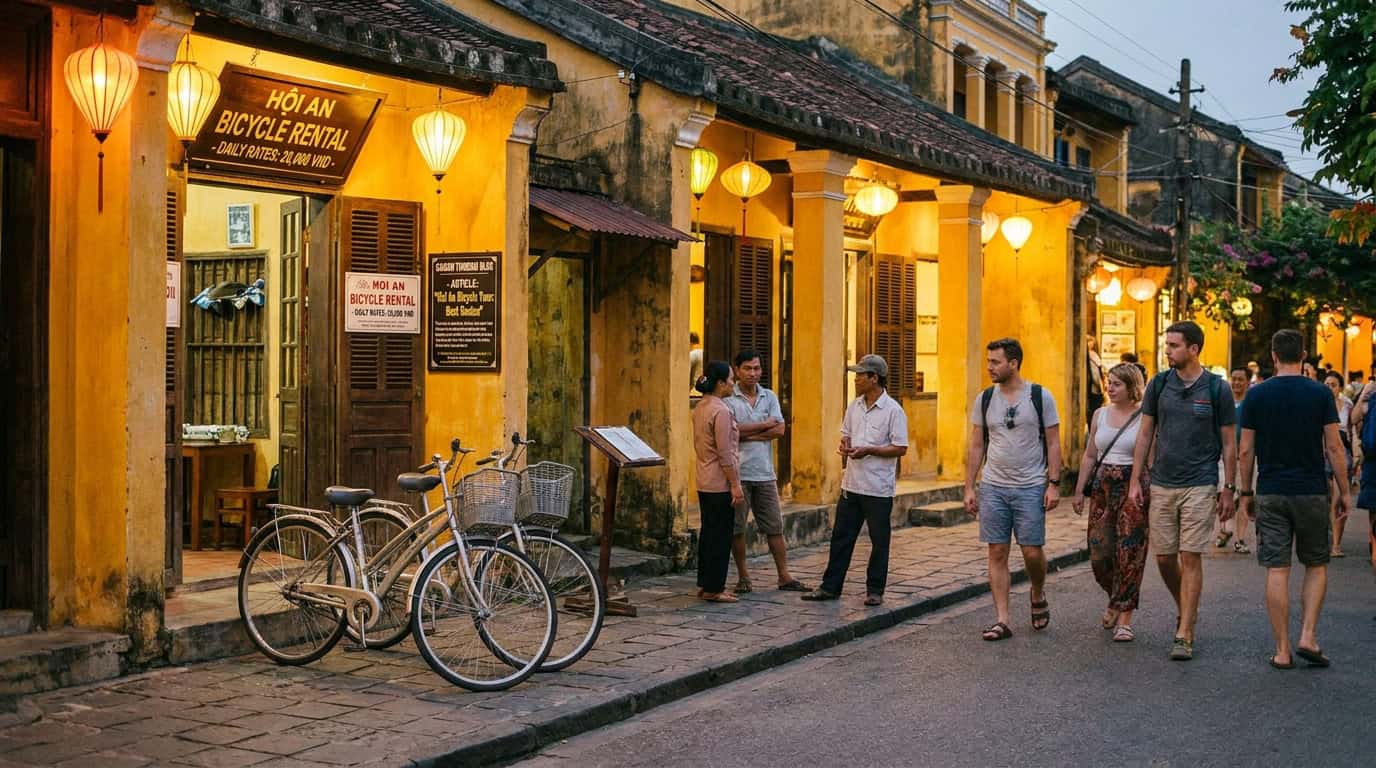
Yes — Hoi An is the most cyclist-friendly town in Vietnam. The Ancient Town is closed to cars and motorbikes for 14 hours every day, the surrounding villages have dedicated farm tracks with almost no motorized traffic, and the entire region is flat. The only real hazards are scooters on the main Cua Dai Road and slick paving stones after rain. Stay left, signal turns clearly, and avoid riding after 9:00 PM when restaurant traffic peaks.
Hoi An Bicycle Tour Safety: Real Risks vs Hype
Vietnam has a reputation for chaotic traffic, but Hoi An is the exception. According to the Vietnam Road Safety Strategy published by the WHO Vietnam office, Quang Nam Province has among the lowest urban cyclist incident rates in the country. The three real risks are:
- Sun exposure. UV index hits 11 (extreme) between 11:00 AM and 2:00 PM from March to September. A long-sleeve UPF 50+ shirt and a brimmed cap under your helmet matter more than sunscreen.
- Dehydration. Carry 1.5 liters minimum. Bottled water is 8,000 VND (US$0.32) at any village shop.
- Rain. Tropical downpours flood the Ancient Town streets in under 15 minutes during October–November. Check the Vietnam Meteorological Administration forecast before heading out.
For day-trip planning logistics, see our Saigon itinerary guide — many travelers combine a southern itinerary with a 3-day Hoi An extension.
When to Ride: The Weather Window That Actually Matters
The “official” advice is to visit Hoi An between February and April. That’s correct, but cyclists have a slightly different calendar. Here’s what 25 years of regional climate data from the Da Nang Meteorological Center shows:
- February–April: 24–30°C, 60% humidity, occasional drizzle. The ideal window.
- May–August: 30–35°C, high UV. Ride only at dawn or after 4:00 PM.
- September–November: Typhoon season. The Thu Bon River floods 3–5 times per season; routes become impassable.
- December–January: Cool (18–24°C) and dry, but daylight ends at 5:30 PM.
If you’re staying in central Vietnam during typhoon season, our Hoi An rainy season survival guide lists the routes that remain rideable when the Thu Bon overflows.
What is the Famous Bike Ride in Vietnam?
The most famous long-distance bike ride in Vietnam is the Hai Van Pass (Đèo Hải Vân), a 21 km climb between Da Nang and Hue made famous by Top Gear’s 2008 Vietnam Special. The pass tops out at 496 meters and has 8% gradients — too demanding for a Hoi An day trip without an e-bike or a support vehicle. For most travelers, the Hoi An to An Bang Beach loop is the more famous (and far more accessible) ride in central Vietnam.
Is Cycling Good for Hip Arthritis?
Cycling is among the most-recommended exercises for hip osteoarthritis because it builds the gluteal and quadriceps muscles that support the joint without high-impact loading. The Arthritis Foundation recommends starting with 10–15 minute sessions on flat terrain — which is exactly what a Hoi An countryside loop offers. Use a hybrid bike with a wider saddle, keep the seat slightly higher than usual to reduce hip flexion, and stop if you feel sharp groin pain.
Hoi An Bicycle Tour vs Walking vs Scooter: Which Wins?
| Mode | Speed | Cost/Day | Best For | Worst For |
|---|---|---|---|---|
| Bicycle | 12–15 km/h | 30k–50k VND | Most travelers | Multi-village days |
| Walking | 4–5 km/h | Free | Ancient Town only | Beach + countryside |
| Scooter | 30–40 km/h | 120k–180k VND | Confident riders | First-time visitors |
| E-bike | 20–25 km/h | 200k–300k VND | Hilly day rides | Tight Ancient Town alleys |
| Taxi/Grab | 30 km/h | 250k+ per trip | Late nights, rain | Tra Que / Cam Kim |
For a deeper comparison of getting around Vietnam, our Vietnam transport breakdown covers domestic flights, sleeper trains, and intercity buses.
What to Pack for a Hoi An Bicycle Tour
Pack light — Hoi An’s heat punishes anyone carrying a full daypack. The essentials:
- Sun protection: UPF long sleeves, brimmed cap, polarized sunglasses, reef-safe SPF 50.
- Hydration: 1.5L water minimum; refill at any cafe for 10,000 VND (US$0.40).
- Cash: Bring 500,000 VND (US$20) in small notes — village shops rarely accept cards.
- Phone mount: Critical for navigation; rentals don’t include them.
- Light rain jacket: Compact, hooded, even in dry season.
- Insect repellent: For the Cam Thanh coconut forest detour.
- Lock + ID copy: Never your passport. Most cafes accept a copy.
If you’re flying in from Saigon, our Tan Son Nhat to District 1 transfer guide explains how to optimize the first 24 hours so you’re rested for cycling on day two.
Hoi An Bicycle Tour Day Plan: Sample 8-Hour Itinerary
Here’s the exact itinerary we give guests staying at our partner properties:
- 6:30 AM — Coffee + banh mi at Phi Banh Mi (35,000 VND / US$1.40)
- 7:00 AM — Leave Ancient Town via Hai Ba Trung Street
- 7:30 AM — Tra Que Herb Village; watch farmers harvesting basil and mint
- 9:00 AM — Cycle 3 km east to An Bang Beach
- 9:30 AM — Breakfast #2 + swim at Soul Kitchen
- 11:30 AM — Return via Cua Dai Road before midday heat
- 12:30 PM — Lunch (cao lau or mi quang) in the Ancient Town
- 1:00–4:00 PM — Rest at homestay (avoid the heat)
- 4:00 PM — Ride to Cam Thanh coconut forest for basket boat (150,000 VND / US$6)
- 6:30 PM — Sunset over Thu Bon River from Bach Dang Street
- 7:30 PM — Lantern-lit dinner in the Ancient Town
Frequently Asked Questions
Can you cycle around Hoi An?
Yes, Hoi An is one of the most cyclist-friendly destinations in Southeast Asia. The Ancient Town is closed to cars and motorbikes from 9:00 AM to 11:00 PM daily, the surrounding countryside is completely flat, and most accommodations provide bicycles free of charge. Even first-time cyclists comfortably complete the 12 km An Bang Beach loop in one morning.
Is cycling good for hip arthritis?
Cycling is one of the most-recommended low-impact exercises for hip osteoarthritis. It strengthens supporting muscles without joint loading. Hoi An’s flat terrain is ideal — start with 10–15 minute sessions on the riverside path, use a wider saddle, raise the seat slightly to reduce hip flexion, and stop immediately if you feel sharp groin pain.
What is the famous bike ride in Vietnam?
The Hai Van Pass between Da Nang and Hue is Vietnam’s most famous bicycle ride, featured on BBC’s Top Gear. It’s 21 km long with 8% gradients and a 496-meter summit — too challenging for most casual riders without an e-bike. For accessible fame, the Hoi An countryside loops featured in National Geographic and Lonely Planet are the better-known choice.
Where to rent bicycles in Hoi An?
Most homestays and hotels in Hoi An provide bicycles free or for 30,000 VND (US$1.20) per day. For higher-quality bikes, visit Giant Bicycles Hoi An on Nhi Trung Street (genuine Giant-brand) or the rental shops along Hai Ba Trung Street. Standard city bikes cost 30,000–50,000 VND daily; e-bikes run 200,000–300,000 VND daily.
Do I need a helmet for a Hoi An bicycle tour?
Vietnamese law does not require cyclists to wear helmets — only motorbike riders. However, the Hoi An Town Tourism Office strongly recommends helmets on any route that uses shared roads (Cua Dai Road, the route to My Son). Inside the Ancient Town and on the Tra Que herb village paths, the risk is minimal.
Are guided Hoi An bicycle tours worth the price?
Guided tours run 450,000–950,000 VND (US$18–US$38) per person and include a bike, guide, water, and one or two cultural stops (cooking class, herb village, basket boat). They’re worth it if you want a structured cultural experience or feel uncertain navigating. For independent travelers comfortable with Google Maps, self-guided routes save 80% of the cost.
Stay Central, Cycle Smart
The single best decision you can make for a Hoi An cycling holiday is choosing accommodation that puts you within 1 km of the Ancient Town and provides free bicycles. Many travelers fly into Ho Chi Minh City first — and if you’re building a Vietnam itinerary, stay at a central District 1 homestay in Saigon for the urban portion of your trip before flying north to Hoi An.
Browse our recommended District 1 homestays for properties under US$30/night within walking distance of Ben Thanh Market, then continue with our Hoi An accommodation picks for the central Vietnam leg. Book direct, skip the booking-site markups, and arrive ready to ride.
Ready to plan? Start with our 3-day Saigon itinerary to anchor your trip, then use this guide to map your Hoi An bicycle tour routes. Safe cycling — and don’t skip the sunset over the Thu Bon.